




Abstract
Objective:
In this postmodern society, people tend to abandon conventional medicine for alternative medical systems, such as acupuncture. What are the reasons for this defiance regarding modern rationality and individualist success? Who turns to acupuncture?
Methods:
This study (n=89) examined whether world views opposed to the predominance of rationality (i.e., mistrust of science, spirituality, paranormal beliefs) and individualist success or consumerism (i.e., power, achievement, and materialism), typically associated with the postmodern era, might explain this attraction toward acupuncture. Participants were recruited through Internet forums interested in complementary and alternative medicine and completed the questionnaire voluntarily.
Results:
Attraction to acupuncture related negatively with materialism and achievement as well as positively with spirituality, paranormal beliefs, and mistrust in science. Spirituality, paranormal beliefs, and low achievement were the main predictors of attraction to acupuncture and explained 44% of the variance. The mistrust in science mediated the relationship between spiritual and paranormal beliefs and the attraction toward acupuncture. Low achievement explained the link between low materialism and positive attitudes toward acupuncture.
Conclusion:
The general mistrust of our rational and individualist modern society is indeed an important predictor of attraction toward acupuncture, in addition to demographic variables.
I
Methods
Defining CAM
In general, CAM is defined as a group of very diverse medical and health care systems, treatments, therapies, and products beyond the scope of conventional medicine. More precisely, the National Center for Complementary and Alternative Medicine in the United States defines CAM as “healthcare practices that are not an integral part of conventional medicine.” 10 This definition of CAM allows a great diversity of practices, from prayer therapy to complex medical systems (such as Traditional Chinese Medicine), to be classified under the same umbrella. Nevertheless, most of these alternative medical systems or therapies share some characteristics, beyond their exclusion of conventional medicine: the use of complex interventions, individualized diagnosis and treatment, and the treatment of the “whole” person. 2
CAM involves a different understanding of the biological processes as well as a different way to process information in general. 3,9 Past studies have indeed shown that American adults who held a holistic view of health were more likely to turn to CAM, 6 that CAM users refer to their intuition when explaining why they turned to CAM, 11 and that CAM beliefs were related to intuitive thinking. 12 To avoid any possible confusion and diversity caused by the term complementary and alternative medicine, the current study focused on a prototypical alternative therapy included in the Traditional Chinese Medicine system: acupuncture. Acupuncture presents the specific and distinctive aspects of CAM and exemplifies the holistic approach of patients and treatments.
Who becomes interested in CAM?
The rise of CAM was first explained as a consequence of the aging population and the growing emphasis on chronic illness, such as chronic pain. Conventional medicine might indeed be perceived as less efficient in confronting that kind of lifestyle-related morbidity compared with CAM. 13 Previous research consistently found that CAM users were more likely to be older 9 and female, 5 have poorer health status, 6 and have experienced less satisfaction with conventional medicine. 14 Nevertheless, according to Pettersen and Olsen, these kinds of demographic variables explain very little of the variance in CAM attitudes compared to world views and beliefs. 15
According to several authors, dissatisfaction with conventional medicine or demographic variables are not the main reasons one turns to alternative medicine. 6,9,15 People use CAM mostly because these health systems are more congruent with their values and beliefs. Some researchers have argued that this rise in the demand for CAM might be explained by the so-called postmodern thesis. 13 The postmodern thesis posits that a social change has occurred in which faith and trust in science has declined. 16 People in this postmodern era have turned to less materialist concerns, green movements, or new spiritual movements and look for alternative medical systems in accordance with their new value system and world views. 17 There is a struggle for re-enchantment in the postmodern era, with doubts about the ability of science to find the absolute truth. Other research indirectly supports this postmodern thesis by showing how world views characterizing the postmodern era relate to CAM attraction.
In this line, the use of, and attraction toward, several studies found CAM relates strongly to negative attitudes toward medical science and paranormal beliefs. 3,7,9,18,19 Furthermore, Astin found that CAM use was associated with valuing sustainability, human rights, peace and altruism but not materialism. 6 Nevertheless, Saher and Lindeman found only a weak association between self-transcendence values (i.e., universalism and benevolence) and attitudes toward CAM, which disappeared after adjustment for other variables, such as paranormal beliefs. 3 Finally, researchers have also tested the potential effect of personality traits on CAM attraction, with the results being scarce and mixed. In one study, Honda and Jacobson found a positive association between openness to experience and the use of CAM therapies. 8 Nevertheless, Furnham found no relationship between the “Big Five” personality traits and attitudes toward CAM. 7
Study objectives and hypotheses
This study tested the potential impact of world views typically associated with the postmodern era (i.e., mistrust of rationality and individualist success) on the attraction to acupuncture. 13 In accordance with the literature and our hypothesis, this study tested the role of paranormal beliefs in the attraction to acupuncture. 3 Furthermore, to avoid being restricted to paranormal beliefs, this study additionally included spirituality as a potential predictor of attitudes toward acupuncture because (1) the turn to spirituality rather than traditional religions is a characteristic of the postmodern era and (2) spirituality is linked to paranormal beliefs and has often even been conceived as a dimension of the latter but is more normative. 20 Finally, mistrust of science was measured as a potential predictor of attraction to acupuncture. Contrary to what has already been tested in the literature, 7,18 the attitude toward science in general (not only medical science) was measured. The attitudes toward medical science might be too specific and easily negatively correlated with attitudes toward acupuncture.
In addition to the mistrust toward rationality, another study hypothesis was that people might turn to acupuncture because they place less value on the individualist ideal of success and consumerism. Following Astin, 6 universalism, low achievement, and low materialism were hypothesized to predict attraction toward acupuncture. Even if Saher and Lindeman found only weak associations between self-transcendent values and attitudes toward CAM in their study, they looked at self-transcendent (universalism and benevolence) values in general and did not investigate the specific effect of universalism. 3 Furthermore, this study measured the extent to which participants valued achievement because this value is less emphasized in the postmodern era and correlates negatively with spirituality. Finally, to control for the potential impact of personality and demographic variables, this study also measured openness to experience (because it was the only personality trait found to relate to CAM beliefs 8 ), age, and sex.
Participants
A total of 89 participants (62% women) were recruited through Internet forums interested in CAM and took part in the study voluntarily. Participants in these forums are interested in CAM without necessarily being regular practitioners or users. The study was posted on forums and advertised as research investigating the rise of CAM, such as acupuncture. Those who agreed to participate took the survey online. Participants self-identified as French (n=43), Belgian (n=36), North African (n=7), or European (n=3). Mean age was 33.15 years. Around 76% of the participants had never tried acupuncture, 13% had tried it only once, and 11% used acupuncture several times a year. Nevertheless, almost 65% of the respondents reported knowing at least one acquaintance who has been treated by acupuncture. These participants were representative of the targeted population for this study because they were likely to be open to acupuncture (and CAM in general) but were not experts or practitioners.
Measures
Attraction to acupuncture
Attitudes toward acupuncture were measured with 18 items (on a Likert scale ranging from 1=totally disagree to 5=totally agree). The scale was created to assess the openness to, and beliefs about, acupuncture (e.g., “If I had the opportunity, I would be willing to try acupuncture” and “Acupuncture can treat some disorders”). This scale was inspired from Vincent and Furnham's scale investigating attitudes toward alternative medicine in general. 4 Satisfactory reliability (α=0.82) and a six-factor structure explaining 64% of variance was found. The frequency with which participants use acupuncture was additionally measured using a single item rated on a five-point Likert scale (ranging from 1=I never use acupuncture to 5=I use acupuncture as a treatment five times a year or more).
Spirituality
Spirituality was measured by using the Spiritual Transcendence Scale. 21 Participants had to rate their degree of agreement with 15 items on a Likert scale (ranging from 1=strongly disagree to 5=strongly agree) (α=0.83).
Paranormal beliefs
The revised 18-item Paranormal Beliefs Scale was used to measure paranormal beliefs (Tobacyk JJ. A revised paranormal belief scale. Unpublished manuscript. Louisiana Tech University, Ruston, LA, 1988) Respondents were invited to rate their agreement with the items on a five-point Likert scale (ranging from 1=strongly disagree to 5=strongly agree) (α=0.91).
Mistrust of science
The extent to which participants display a negative and distrustful vision of science was measured with five items (e.g., “Science removes his humanity to the world” and “The progress of mankind can only be achieved by science”) created for this study (Likert scale ranging from 1=totally disagree to 5=totally agree). A two-factor structure explaining 59% of the variance was found representing the nonreversed and reversed items. Reliability was moderate possibly because of the limited number of items used to capture such a complex concept (α=0.56).
Materialism
The Values-Oriented Materialism Scale was used to measure materialism. 22 Thirteen items (α=0.85) rated on a Likert scale (ranging from 1=totally disagree to 5=totally agree) designed to assess the success (appreciate individuals' success through material possessions) and centrality (material possessions are at center of life) dimensions of materialism were used. The two factors representing each dimensions explained 50% of the variance and strongly correlated (r=0.60; p<0.01).
Universalism and achievement
The values of universalism and achievement were measured by using the relevant items from the Portrait Values Questionnaire. 23 For each portrait describing a person's values, participants had to rate how similar they were to the person (Likert scale ranging from 1=not at all like me to 6=totally like me). Universalism was measured with six items, and achievement was measured with four items (α=0.80 and 0.86, respectively).
Openness to experience
Openness to experience was measured by using the 12-item scale from the NEO-Five Factor Inventory. 24 Reliability for this scale was satisfactory (α=0.60).
Results
Statistical analyses were performed using SPSS 20.0 (SPSS, Chicago, IL). Correlations of acupuncture measures with all other variables are reported in Table 1. In general, the measures of acupuncture were positively associated with spirituality and paranormal beliefs. Furthermore, negative correlations were found between the measures of acupuncture and trust in science, materialism (except for the practice of acupuncture), and achievement. Finally, no significant correlations were found between openness to experience, universalism, and the attraction for acupuncture (attitudes toward, and practice of, acupuncture).
p<.01.
p<.05.
p<.10.
To better understand which variables were the main predictors of attraction for acupuncture, hierarchical multiple regressions were conducted. In the first step, age and sex were included as predictors; in the second step, spirituality, paranormal beliefs, trust in science, materialism, and achievement were introduced into the model. As an outcome variable, the measures of attitudes toward, and practice of, acupuncture together were computed, providing a unique integrated score of attraction for acupuncture (r=0.44; p<0.001). The 19 items (18 items from the attitudes toward acupuncture scale and 1 item assessing practice of acupuncture) were then averaged and demonstrated good reliability (α=0.83). Results of the regression analysis are reported in Table 2. The demographic characteristics (age and sex) were significant predictors of attraction for acupuncture and explained 25% of the variance. The attraction for acupuncture increased as a function of age and sex (older people and women were more likely to be attracted to acupuncture). When the other predictors were included in the model, the percentage of explained variance increased to 44%. Spirituality, paranormal beliefs, and achievement were additional significant predictors of the attraction to acupuncture. The more people were spiritual and believed in the paranormal, and the less they valued achievement, the more susceptible they were to the attraction of acupuncture.
Because significant correlations were found between trust in science and (1) spirituality (r = −0.32; p=0.002) and (2) paranormal beliefs (r = −0.32; p=0.002), two simple mediation analysis were conducted with spirituality and paranormal beliefs as predictors, trust in science as a mediator, and the general attraction to acupuncture as an outcome. 25 Bootstrap analysis revealed that the indirect effect of (1) spirituality and (2) paranormal beliefs through trust in science on the attraction to acupuncture was significant: (spirituality: indirect effect, 0.09, standard error of the mean [SEM], 0.05, 95% confidence interval [CI], 0.02–0.25; paranormal beliefs: independent effect, 0.09, SEM, 0.05, 95% CI, 0.01–0.23). Standardized regression coefficients for these models are reported in Figure 1.
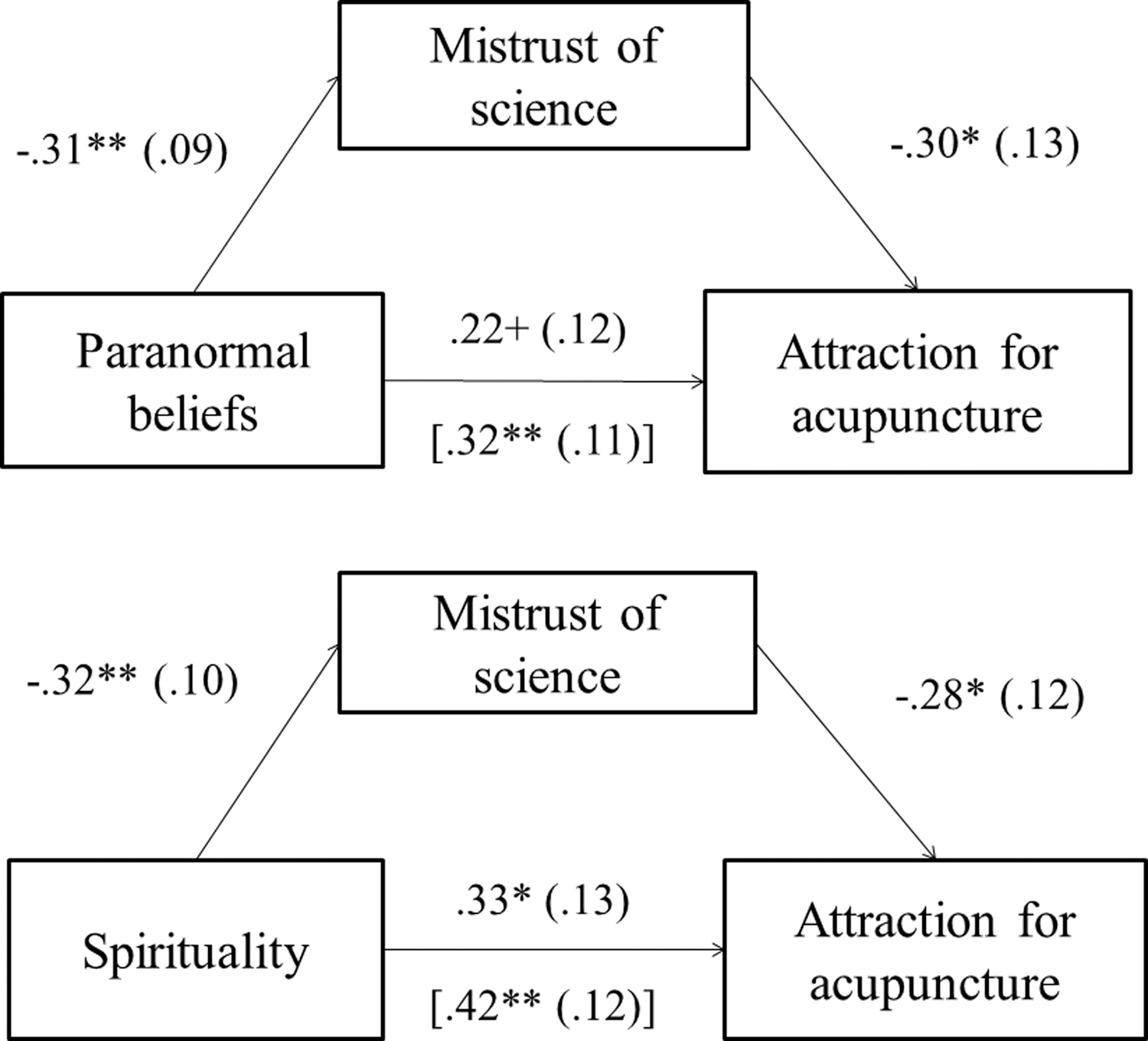
Indirect effect of paranormal beliefs (top) and spirituality (bottom) on attraction for acupuncture through trust in science. Numbers in paths represent unstandardized regression coefficients. Standard errors of the mean are in parentheses. The total effects are in brackets. +p<0.10; *p<0.05; **p<0.01.
Finally, because a significant correlation was found between materialism and achievement (r=0.33; p=0.002), a third simple mediation analysis was conducted with materialism as predictor, achievement as mediator, and positive attitudes toward acupuncture as outcome. In accordance with previous studies, materialism is known to be associated with and evoke achievement goals and motivation. 26 –28 Individuals who value materialism are indeed known to pursue self-enhancement and achievement, or more specifically materialistic achievement. 29 As expected, materialism has been found to have an indirect effect on positive attitudes toward acupuncture through achievement (independent effect, −0.10; SEM, 0.05; 95% CI, −0.24 to 0.02). Standardized regression coefficients are reported in Figure 2.
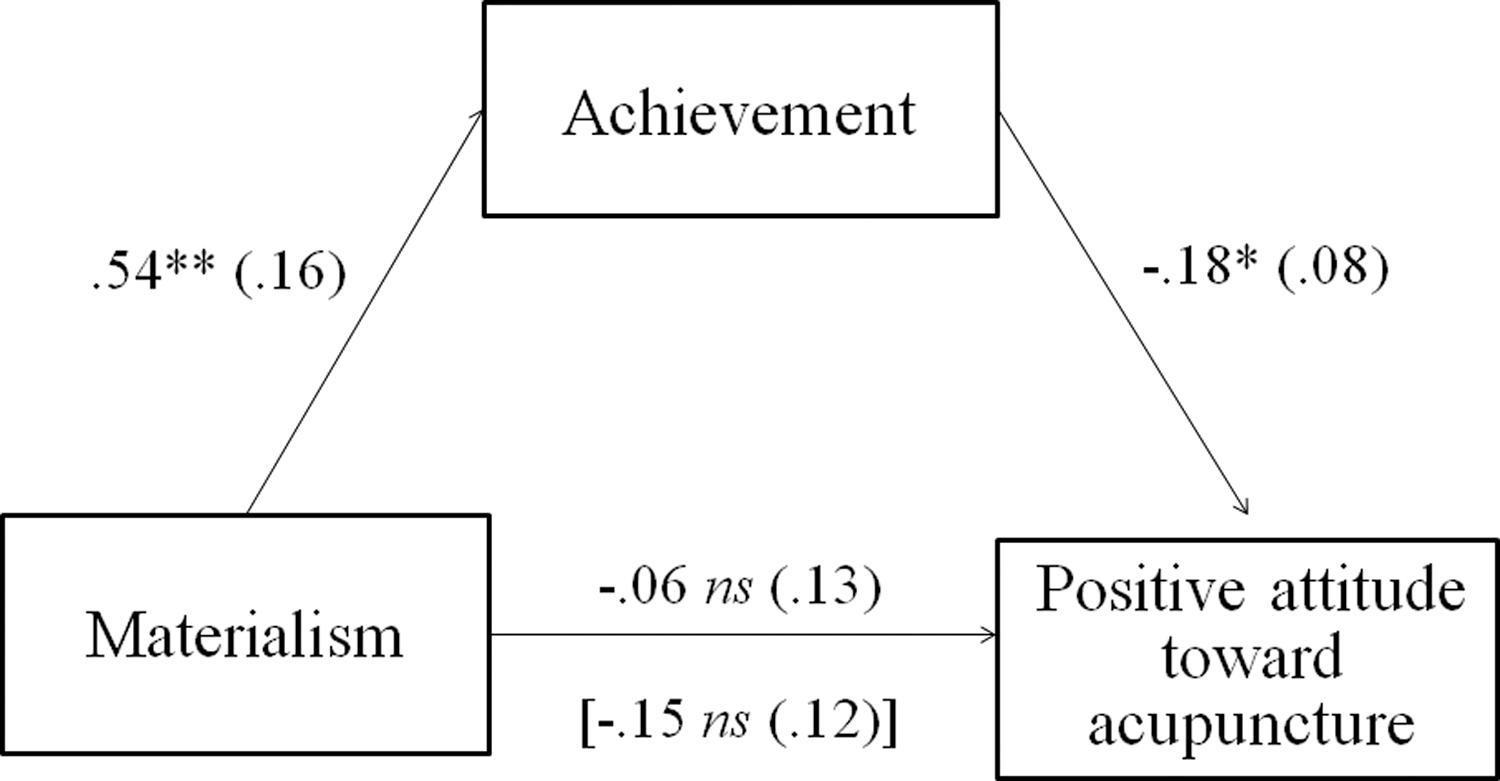
Indirect effects of materialism on attitudes toward acupuncture through achievement. Numbers in paths represent unstandardized regression coefficients. Standard errors of the mean are in parentheses. The total effect is in brackets. **p<0.01; *p<0.05. ns, not significant.
Discussion
This study, in accordance with previous findings, highlighted that demographic variables were not sufficient in explaining the attraction to acupuncture. In line with the hypothesis, the mistrust of rationality and mistrust of individualist success or consumerism were important predictors of attraction to acupuncture. People who are spiritual, are not materialist, and endorse paranormal beliefs are indeed more likely to be attracted to acupuncture. Furthermore, when looking at the mechanisms, mistrust of science partially explained the relationship between the attraction to acupuncture and spiritual/paranormal beliefs. People who endorse spiritual and paranormal beliefs are indeed less inclined to trust science, which in turn increases the attraction to acupuncture. In addition, an indirect relationship linking materialism and attraction to acupuncture through achievement was found. Individuals who are not materialistic tend indeed to value achievement less and, subsequently, are more inclined to hold positive attitudes toward acupuncture. Nevertheless, personality was not a significant predictor of attraction to acupuncture. Taken together, these findings seem to support the postmodern thesis 13 that world views (including beliefs or values) associated with the postmodern era might explain the rise of, and attraction to, acupuncture and maybe, more generally, to CAM.
Despite the efforts made to design a well-thought-out and coherent survey, this study is of course subject to some limitations. First, the sample was not large and consisted of with few regular practitioners of acupuncture. This prevented use of more sophisticated data analysis, such as structural equation modeling, which could be of interest to test the various simple mediation models in a single more complex model. Second, this study focused on acupuncture and did not consider other types of CAM. The use of a single and specific type of CAM might be seen as a strength but also as a weakness. On the one hand, focusing on a specific type of CAM avoids possible confusion caused by the term complementary and alternative medicine. On the other hand, by choosing a single type of CAM, the generalizability of the findings to other types of CAM is questionable. One should then be particularly cautious in not over-interpreting the present results as applying necessarily to CAM in general. Nevertheless, as previously stated, the particular alternative therapy included in this study (acupuncture) perfectly exemplifies the specific and distinctive aspects of CAM. Similar patterns of results might thus be expected in investigations of other specific types of CAM.
This paper provides a new and comprehensive insight into the rise of, and attraction to, acupuncture over the last decades. The recent attraction to acupuncture was not only explained by demographic variables, such as age or sex, but also by a mistrust of a modern, rational, and individualist society (mistrust of science, increase of paranormal beliefs and spirituality, low concern for achievement and materialism). This study attempted for this time to highlight the mechanisms explaining the attraction for acupuncture. The mediation models provide interesting information, but mistrust in science only partially mediated the relationship between paranormal/spiritual beliefs and the attraction toward acupuncture. These results leave room for other investigations to attempt to improve understanding of the impact of postmodern world views on attraction to acupuncture.
In conclusion, this study supports the conviction that, in the postmodern era, therapists and practitioners of conventional medicine should be aware of the reasons why people turn to CAM, such as acupuncture. A better understanding of this phenomenon could indeed provide health practitioners with tools to better respond to this new demand and better meet the concerns of their patients.
Footnotes
Author Disclosure Statement
No funding was received for this study. No competing financial interests exist.