




Abstract
Health as a positive attribute is poorly understood because understanding requires concepts from physics, of which physicians and other life scientists have a very poor grasp. This paper reviews the physics that bears on biology, in particular complex quaternions and scalar fields, relates these to the morphogenetic fields proposed by biologists, and defines health as an attribute of living action within these fields. The distinction of quality, as juxtaposed with quantity, proves essential. Its basic properties are set out, but a science and mathematics of quality are awaited. The implications of this model are discussed, particularly as proper health enhancement could set a natural limit to demand for, and therefore the cost of, medical services.
Introduction
I
Physicists and doctors think in entirely different ways. The latter work on a human scale and accept variability, human nature, imprecision, and limits to the scope of their investigations. Physicists, on the other hand, are most comfortable with the impersonal and abstract, either very large or very small.
They very seldom attempt to communicate. Twenty years ago a conference at the Robens Institute, University of Surrey, United Kingdom, encouraged physicists and physicians to share ideas. It was an abject failure. The author's own later attempts through the Scientific and Medical Network 1 got little further. Physicists and life science academics seem equally unwilling to step beyond subject-specific boundaries.
The younger radicals within both physics and biology have additional constraints. They are at odds with their academic seniors.* So they have resorted to networking among themselves and sharing their ideas through public seminars, popular books, 2 –4 and the Internet. 5 –9
This paper brings physics to bear on biology, derives a definition of health, and indicates how this could radically reduce the cost of medical services.
Waves, Fields, Genes, and Form
Prominent in radical physics thinking is a conviction that all particles and motion can be accounted for in terms of vibration within an elastic medium, space. According to several sources, 5,6 if the existing variables denoting a plain wave in space-time are transformed into a mathematical expression known as a complex quaternion, and the known wave equations of physics are expressed in these terms, all existing particles, forces, and motions resolve into actions of waves within space-time. Particles become spherical scalar waves.
Physicians do not connect well with waves or fields. Our thinking is centered on particles and their chemical interactions. We have in biochemistry an impressive, comprehensive account of the physiologic processes within cells and organisms. But we have no account of form, or its causes. 8
Life scientists in general are confident that DNA will eventually account for everything about organisms, including form. But the genome of a multicellular organism cannot be the architect responsible for its form or functions as a whole. Genes are the same in all participant cells of any organism derived from a single mother cell: a fertilized egg. They can only mediate the properties the myriad cells of that organism have in common. Some epigenetic factor must therefore direct the ways in which daughter cells vary in form and function, participating fluently in intermediate forms, such as the organism's tissues and organs.
Fields of formative causation (morphogenetic or formative fields) meet our epigenetic needs ideally. They are postulated on biological grounds most noticeably by Sheldrake, 9 who presents much experimental evidence for them. The most obvious candidate for this field phenomenon is the scalar field identified within quantum mechanics. The holographic properties of scalar fields, and their huge capacity for information detail per unit volume, make them ideal formative field media, until proven otherwise. They already have many applications in IT storage devices. 10,11
Natural selection, as proposed by Charles Darwin in his landmark work, 12 seems flawless. However, its refinement into neo-Darwinian selection of genetic mutations is profoundly mistaken. The most obvious means for natural selection—capable of intelligence, speed, elegance, and economy—is by evolution of formative fields. According to Sheldrake and others, new behavior, once learned by imitation within a local community of reasonable size, then translates globally throughout that species. This must be, he argues, by evolution of the formative field that defines the entire species. Such evolutionary learning can take place within months—not eons. By extension, forms can also evolve by this mechanism, though much more slowly since they are several orders of magnitude more stable than functions.
Genetic mutation is random, wasteful, and extremely slow. It is seldom directly relevant to enhanced function in the evolved organism, since no functions and very few characteristics are determined by just one gene.
Whatever mechanisms of evolution exist would themselves have been subject repeatedly, and in many different situations, to natural selection. Whenever genetic mutations and formative field evolution set to work on a situation, formative fields would win hands down. Strokes of useful genetic mutation would always have been rare, at best ancillary to progress through formative field adaptations, and most often a destructive nuisance. Once one has considered this proposition squarely, it is hard to see why we ever thought otherwise.
Field Overlay
Physicists, then, have given us a wave theory to account for universal phenomena in a space-time field but decline to superimpose values or qualitative judgments on it. Biologists, meanwhile, have proposed another field phenomenon informing organisms of their forms and functions. Might these two field phenomena relate?
Analogy with music strongly suggests they must. A musical instrument is capable of producing sound waves.† Let us suppose that all tones audible to the human ear can be produced on this instrument, as well as many varied combinations of them.
Physicists account for sound occurring as random perturbations of the instrument, producing white noise. What we actually hear, however, is harmonious music, mediated from a score or musical idea by a musician.
The natural world, too, is manifestly full of harmonies. To account for forms and relations in the universe—in particular life forms—we need something more than random perturbations. We need a harmonizing influence, able to superimpose meaningful qualities on vibrations. Fields of formative causation are suitable media for it.
Uncertainty
One of the most perplexing properties of wave-quanta is the uncertainty of their behavior. Heisenberg derived a series of mathematical expressions relating complementary properties of a quantum, its position and momentum, and showed that it is impossible to know both precisely. A consequence of this is that we can only know the result of a group of quantum events as a statistical distribution of the entire group. Not only can we not predict the path of a particular quantum through a lens, for example, but the quantum itself does not know, while it is traveling, where it will arrive! Schrödinger expressed this in his famous thought experiment about the fate of an invisible cat.
Interpreting this paradox in large, complex living creatures cannot be simply a matter of random events, interpreted by statistical methods. The events required to assemble and maintain the particular form and functions of any large creature cannot have occurred randomly. The existence of the creature is statistically impossible. Yet it does exist, and in the human case possesses will and purpose, acts with intent, and acts as if confident of success. History is full of successful human endeavors that defied all imaginable odds against their accomplishment.
Quality and Health
Neither physicists nor physicians can portray life with quantities only. To understand the orderliness of the living world, we must take account of quality.
Any life event has quantitative attributes—what happened, when, and where—with which all scientists are comfortable. Its qualities—such as who acted, why, and how—have since the Enlightenment been less respectable. They are not, on the face of it, quantifiable. Scientists try to reduce qualities to formulaic relations between quantities, and if this fails they are apt to discount these qualities altogether.
This is to mistake completely the significance of quality, as a phenomenon juxtaposed with quantity. Quality is not reducible to quantity, on any terms. Quality is where events find their character and meaning. It explains them. Quality already is, before related quantities arise. Quality is to causes as quantity is to effects. We can usefully examine quantities in terms of their qualitative causes, but not the other way around.
Health as Such
Hitherto, Western culture has thought of health as a state or condition. The World Health Organization defines it as “a state of complete physical, mental and social well-being and not merely the absence of disease or infirmity.” 13 It has, in consequence, become thought of as a rarely attainable ideal, something doctors and health authorities do not encounter in practice and need not address in their day-to-day work or policy-making.
A state implies quantity, so a notion of physical health is at least dimensionally consistent. However, the substance of an organism is not in a fixed state but in constant flux, material being exchanged continually with the surrounding landscape. So already we should be thinking more in terms of the process that maintains that exchange—its stability and sustainability, for example—not the state as seen at any given moment.
Once we move to mental and social well-being, however, we are unambiguously in qualitative territory— process, not state; affect, not effect. It is dishonest to ignore the social interplay and mental processes on which well-being depends, and their qualitative difference from anything physical.
Health cannot, then, be addressed meaningfully as a quantity. Substance—or rather the waves that fool us into thinking it exists—behaves randomly. But that random behavior can be harnessed by a living quality, acting through a formative field, and so made creative and meaningful. Health, therefore, can emerge only as a function of quality. So we must attempt to visualize events within quality and establish some of their properties—an unfamiliar task, but not unprecedented. 14
Hypothesis: The Bio-Mathematics of Quality
The following axioms are proposed as the basis of a science and mathematics of quality.
1. Quality is the medium of living, or being.
2. The unit of quality is the whole. In biology it equates to the immunologically unique organism.
3. Wholes do not sum but relate with other wholes. Any two wholes create by their relation a third, without being destroyed themselves, making three altogether. This tri-unity is a fundamental in biology, an aspect of quality.
4. A whole already comprises many smaller wholes, relating in a similar way. In quality, then, the triune relationship is an escalator connecting the very small in progressive stages to realize the very large.
5. Wholes are mutually attractive insofar as they complement each other, and together complete a union-whole.
This can best be grasped by first considering the passage of time within a developing tissue of related wholes, such as an embryo or fetus. The process is manifest during gestation as the subdivision of mother cells into daughters, necessary in large organisms to realize specialized functions, such as respiration, circulation, excretion, and nervous control. This process is familiar as embryogenesis: cell multiplication, plate formation and folding, and cell differentiation from a single featureless egg into a formed fetus and eventually a mature adult. This is ontogeny, the differentiation of the individual organism (Fig. 1).

Ontogeny.
Once embryogenesis and maturation are complete, an apparently steady state begins in which time is no longer so sensitive a marker of events. Nevertheless, to maintain the mature organism, cells are still dividing, homeostatically replacing old cells as they die. Air, fluid, and solids are continually being exchanged with the immediate environment. And sure enough, the adult organism does gradually betray its age, in slow changes of both form and function.
These ontologic processes are well recognized and described. To understand them, however, requires recognition of another process without which the dividing and differentiating cell mass would lose the formative and functional integrity inherent in their mother cell: their self-hood. This process is an attractive, qualitative relationship the cells must share, a prevision of their potential form held originally in the mother cell and cast like a mantle over all the daughters as they realize that prevision. This process, depicted in lighter dotted shading in Figure 2, is equal and opposite to ontogeny, exactly counterpoising it. We can define this as health, and in particular health-within (within that organism).
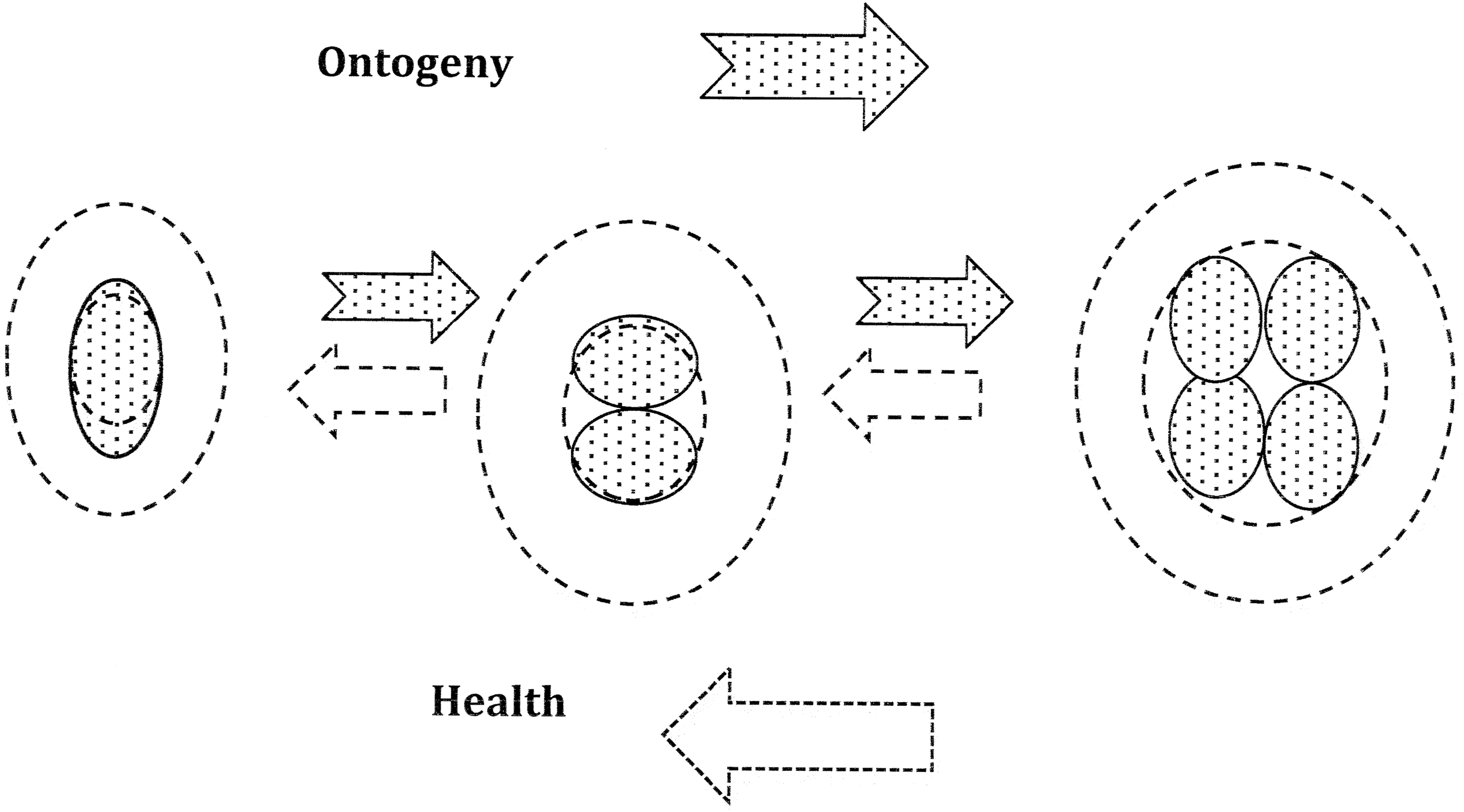
Ontogeny and health.
In Figure 2 we can now discount the time factor and visualize the two processes exactly counterpoised, and actively at work in every instant of the organism's life. Health ensures not only the wholeness of the organism but its uniqueness, its functional integrity, and its characteristic action pattern. 14
Without health, ontogeny cannot proceed. They are two facets of one qualitative process. Put another way, health is the drive to participate in creation, where creation is the process of forming, differentiating, sustaining, and participating in wholes.
The maturation of a multicell individual is, for all its complexity, a relatively simple dress rehearsal for life as an adult. Ontogeny deployed matter (organized around smaller whole cells) to realize a greater whole that was already known, previsioned within the mother cell and sustained by health-within.
Adult life is harder. The organism cannot yet know what relationships with peer-wholes may produce. The task is an adventure, relation by choice with other large wholes apparently independent from oneself, and creation with them of larger wholes as yet unknown. This is health-between (among multiple organisms).
The instantaneous affect of health is ease—well-being or happiness, the sensation of being creative. This is private to the participant-wholes. The order or balance progressively created in the relationship over time is, on the other hand, visible to onlookers from outside the relationship as beauty. These terms become more familiar in their progressive absence, as un-ease, dis-ease, and dis-order.
The most familiar human examples of larger wholes are mated pairs, families, communities, clubs, and nations. But humans relate to other wholes in their world—plants, animals, microbes, and all their products. Relating creatively with these environments as ecosystems also creates larger wholes.
Health-within preoccupies the feminine aspect within an organism. Health-between preoccupies the masculine aspect.‡ Both processes are centripetal: health-within toward the core being of the organism, its members; health-between toward the world outside, a grand universal whole.
Implications
1. If health describes the relationship of qualities in a scalar field, overlaid via a formative field upon a space-time universe of wave patterns and bringing these into a wholesome order, then a science and mathematical model of qualities and their behavior is long overdue. Does the helical shape of DNA lend itself as an antenna for receiving formative information from the scalar field? Progress only requires that good minds take these possibilities seriously.
2. Such a model enables us to rethink pathology. For instance, might cancer arise from a weakening or aberration of health-within, allowing cells to act autonomously?
3. We can also rethink therapy. Might homoeopathic dilution be a method for isolating the quality of a substance, particularly a tissue? Does acupuncture act on positions in the formative field, rather than the flesh of the patient?
4. There must be observable phenomena that can be used to indicate vigor, vitality, or “health-rate.” Commercial growers have, for example, used Kirlian photography 15 to check the viability of seed samples. Circular chromatography 16 of a cellular fluid generates radial patterns, not just circular fronts. What do these phenomena indicate?
5. Once health can be indicated as a whole, interventions—nutrition, education, medication, environmental management—can begin to be evaluated by their effect on health overall. Many low-cost interventions may prove to have disproportionately favorable and cost-effective outcomes.
6. A service for enhancing health can be designed to complement services to deter disease. This development would harness low-cost resources at the community level, encouraging and enabling individuals and families to explore their own lives competently and confidently. This opportunity would radically reduce demand on primary medical care, enabling medical services to do what they are designed for. A modestly resourced health-enhancement service may well in time set natural bounds to all medical demand, at last making sufficient supply a realistic possibility.
Footnotes
Acknowledgments
The author thanks Philip Conford, Prof. Ian Leck, David Lorimer, Ruth Pickles, and Richard Young for their thoughtful comments on drafts of this paper.
Author Disclosure Statement
No competing financial interests exist.