




Abstract
Background:
Exercise such as yoga may have health benefits for older adults with osteoporosis, but without attention to safe movement yoga can also increase the risk for injury.
Objective:
The current article provides suggestions for how to adapt yoga to the needs of older adults with osteoporosis.
Suggestions:
A general guidelines for exercise is that older adults with osteoporosis should participate in a multicomponent exercise program, including resistance and balance training. Contraindicated movements include end-range flexion/extension/rotation of the spine and internal/external rotation of the hip. Yoga postures that should be encouraged include postures emphasizing spinal alignment and extension to mid-range in standing and on the floor. Overarching considerations for participation in yoga are that classes should be designed for higher-risk older adults, led by an instructor who has had proper training with individuals with osteoporosis, should be a noncompetitive environment, and should give attention to which postures are safe and how to transition safely.
Introduction
O
Yoga is an increasingly popular form of exercise for older adults, benefitting physical and mental health by addressing such conditions as anxiety, fear, and depression; 5,6 however, if done incorrectly, some yoga postures can place a large, inappropriate stress on the vertebrae, which may increase the risk for vertebral fracture. 7 Indeed, vertebral fractures have been reported when older adults with low bone mass participate in yoga. 7 Yoga can be included in a multicomponent exercise program and has benefits for older adults with osteoporosis, including challenging balance and emphasizing spinal extension. However, both the postures and the transitions between postures must be completed safely by using good alignment and avoiding contraindicated movements. Given the uncertainty surrounding exercise for individuals with osteoporosis, it is important that both individuals practicing yoga and yoga instructors are aware of current evidence-based recommendations for safe exercise and movements. The goal of the current article is to suggest adaptations of the physical postures of yoga practice to the needs of older adults with osteoporosis.
Overarching Considerations for Practicing Yoga
If an individual has a history of vertebral fracture, is new to the yoga practice, or is feeling uncertain about how to complete postures safely, a physical therapist with training in osteoporosis management and yoga should be consulted for individualized education regarding alignment, transitions, the use of assistive aids, and the most appropriate exercises. In general, all postures should be performed with a focus more on controlled movements and less on the intensity of the posture. Postures should be taught with a strong focus on balance, proper muscle use, good alignment, sensory awareness, and monitoring of affect. Props (e.g., foam blocks, chairs, and blankets) can be used where appropriate to provide additional levels of support for fall prevention or to promote balance. Care should be taken with the use of props to ensure that older adults with osteoporosis do not use the prop to push to the end range. Well-developed yoga classes appropriate for individuals with osteoporosis will also address real-world movements and move beyond focusing solely on postures to incorporate pranayama, meditation, and mudra. 8
Every participant in the class is an individual and as such has different needs and is at a different stage of yoga practice. Those with compromised bone strength should not practice forceful or competitive yoga. 9 Forceful individual effort or manual correction by the instructor might be tempting to push a posture to the same level as other participants in the class, but it is necessary to work within individual safety limits. Likewise, postures involving challenges to balance require careful instruction so that clients demonstrating poor body control are given modifications that challenge balance but limit risk for falls or injury due to loss of postural control. It may be wise to have a secure support object nearby, such as a wall or handrail. Chairs can be used as support objects if they are secure and will not move or collapse if used to brace a fall.
Contraindicated Movements
Several movements and postures are contraindicated for older adults with osteoporosis because they can increase the risk for fractures by increasing the load on the spine, stressing peripheral joints such as the hip, or increasing the risk for falling. Contraindicated movements include repetitive, forceful, weighted, or end-range flexion, extension, or rotation of the spine; forceful internal or external rotation of the hip to the end range of motion; and high-impact movements (e.g., rapid, forceful, and explosive loading). 10 Flexion and rotation significantly increase the load on the spine 11 as a result of the combination of the weight of the upper body, contraction of the trunk flexor muscles, and strain of the ligaments in the spine. 12 The results of a recent consensus process advise against flexion and twisting of the spine to end range and forced external rotation of the hip. 10 However, some may be concerned that limiting spinal range of motion may reduce mobility or impair function of the tissues, muscles, or sensory systems.
The decision to participate in asanas that require movement throughout an entire range of motion needs to be made with careful consideration of the balance between an individuals' risk and potential for benefit. For example, someone without a history of vertebral fracture might consider a supine twist to end range done in a controlled manner, such that the supine position unloads the spine, minimizing risk. Someone with vertebral fractures might need to limit end-range twisting. Age and osteoporosis-related degeneration of the spine with a reduced ability of the discs to absorb shock further compromises the spine in flexion and rotation, increasing the risk for vertebral fracture. 12 Forceful rotation of the hip can cause significant stress on the hip joint, increasing its susceptibility to injury, while high-impact movements such as jumping between postures can place increased loads on the spine and can increase the risk for losing balance and falling. 10
Postures That Should Be Encouraged Require Caution with Transitions
Individuals with osteoporosis new to yoga should begin with postures that place the least amount of inappropriate or excessive loads on the spine or standing postures with a stable base of support to focus on proper alignment and postural control before progressing to more challenging weight-bearing postures. Therefore, supine postures or standing (on both feet with a stable base of support) postures emphasizing spinal alignment or extension should be the foundation, followed by progression to more challenging standing postures and then into prone postures. Examples of supine postures include Corpse or Bridge, while standing postures include Warrior, Mountain, or Chair. In standing, lower-extremity alignment should also be a focus to ensure that spinal alignment is not compromised by poor distal kinetic chain mechanics. Likewise, foundational prone postures, such as Crocodile, Sphinx, and Locust, should be encouraged. Postures completed on the floor require careful transitioning to the floor to maintain proper spinal alignment and minimizing forward flexion and rotation. Descending to the floor through bended knee, keeping the spine straight, and “log rolling” into supine or prone from side lying is ideal to minimize injury throughout transitions (Fig. 1). Individuals with hyperkyphosis may require a pillow to support their head during supine exercise to maintain the spine in neutral alignment.
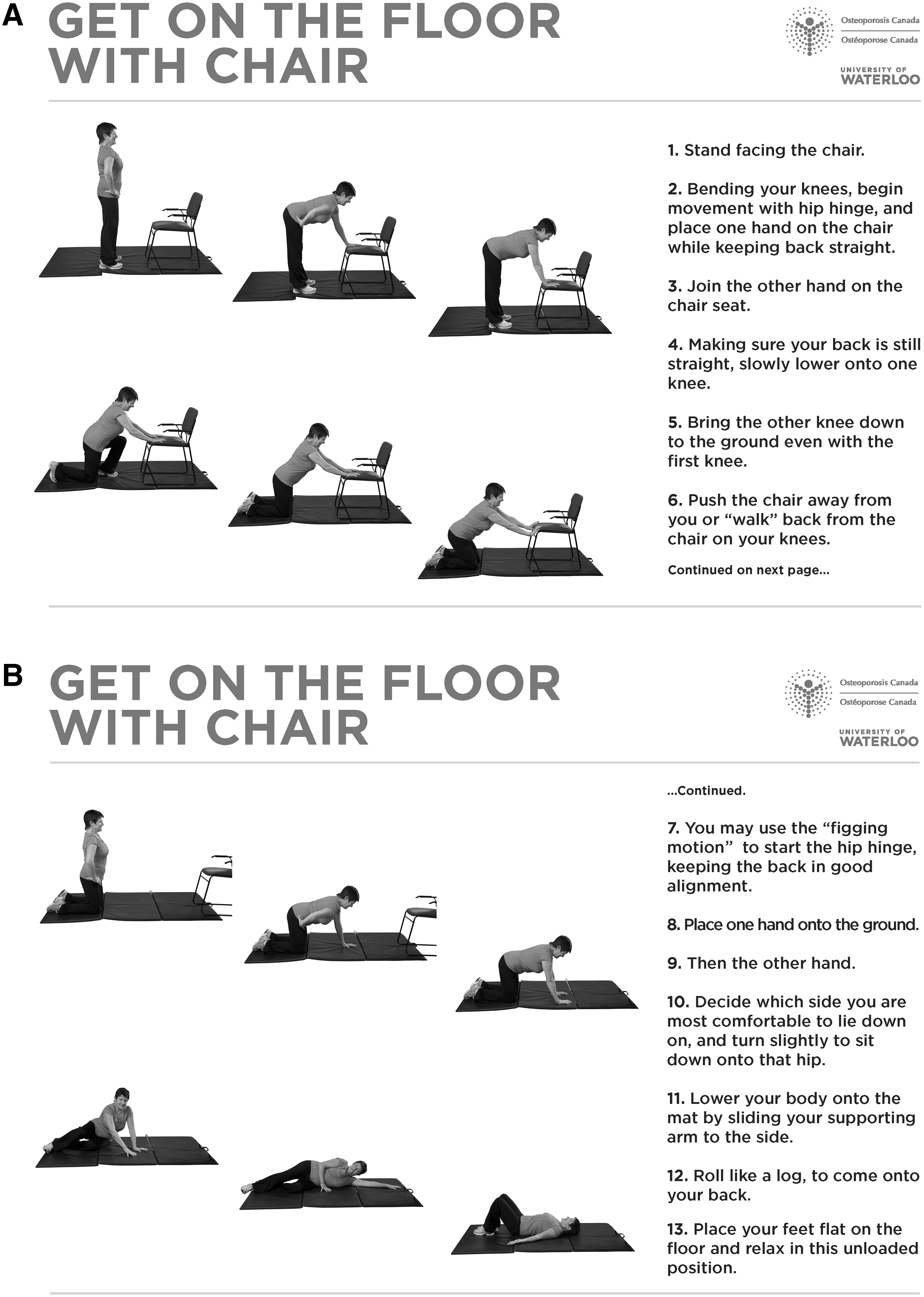
Safe transitions to the floor using a chair.
Postures That Can Be Encouraged but Should Be Done with Care
Some postures can be beneficial for older adults with osteoporosis, but transitioning into and out of the posture can place the spine in flexion and/or rotation. These postures are recommended, but training is required to ensure that safe transitions are completed with minimal flexion and rotation of the spine to decrease the risk for injury. For postures involving forward flexion, the individual should use a hip-hinge, flexing at the hips and knees while bringing the hips posterior to the base of support and maintaining the head over the base of support. For example, Downward Facing Dog encourages spinal extension, but moving into and out of the posture is often done through a flexed low back. Downward Facing Dog can be modified to be completed in standing over a chair and should be transitioned into and out of by using a hip-hinge.
Postures That Should Be Avoided
Yoga postures that should be completely avoided are those that place inappropriate and excessive forces on the vertebrae, increasing fracture risk (including end-range flexion and/or rotation, such as spinal rocking, Child's Pose, Spinal Twists, Ragdoll, Saw, and Plow), or place the hip in forced, end-range external rotation (e.g., Thread the Needle and Pigeon). 10 Any yoga posture that emphasizes end-range positioning and holds, including extension postures that are often encouraged, may need to be adapted for clients with osteoporosis. More advanced spinal extension postures (e.g., Bow, Navasana, and Scorpion) should be undertaken only by more experienced yoga practitioners with guidance from an instructor knowledgeable in prescribing exercise for individuals with osteoporosis to ensure appropriate alignment and postural control to maintain the posture.
Twisting postures can be performed, but they should be done in a slow, controlled manner in the supine position, where the spine is least loaded. A good example is Knee Down Twist, or Supta Matsyendrasana, which can be included in a vinyasa if the twist is not forced to end-range of motion, and if the transition in and out of the twist is in a controlled manner. It might be advisable to rest the knee on a support object (e.g., block or bolster) rather than let the weight of the knee pull the twist to end-range of motion.
The compressive forces of sitting 13 require extra awareness and postural modification; therefore, seated postures should be performed with extra caution or avoided completely. Rotation or forward flexion of the spine while seated further increases the loads on the vertebrae, increasing the risk for fracture. Proper training into how to transition from sitting into other postures is important to prevent fractures off the mat caused by moving mindlessly in daily life with poor strategies.
Conclusions
Exercise is recommended for older adults with osteoporosis, but attention should be paid to the type of exercise and to ensuring safety throughout. Yoga can be included in a multicomponent exercise program if consideration is given to which postures are safe and how to transition into and out of them. Older adults with osteoporosis wishing to participate in yoga should seek a class that is designed for higher-risk older adults and is led by an instructor with training in how to adapt exercise for individuals with osteoporosis. Yoga should be practiced in a noncompetitive environment, in a slow and controlled manner, with attention given both to the postures being performed and to the transitions between postures. Consultation with a physical therapist who has experience working with individuals with osteoporosis and a knowledge of yoga is recommended before participation in yoga for those with osteoporosis who are new to yoga, have a history of vertebral fracture, or are uncertain about what postures to modify or avoid.
Footnotes
Author Disclosure Statement
This research has been generously funded by a grant from the Government of Ontario. The views expressed are the views of the researchers and the study team and do not necessarily reflect those of the Government of Ontario. Lora Giangregorio is a Canadian Institutes of Health Research New Investigator, and received funding for infrastructure from the Canadian Foundation for Innovation and the Ontario Research Fund.