




Abstract
Objectives:
Recently, yoga classes specifically for women with premenstrual syndrome (PMS) have increased, but there is little research about the efficacy of these classes. The primary aims of this study were to evaluate the effect of yoga exercise on women with PMS and to evaluate the immediate change of attention performance after yoga classes.
Methods:
This study examined the attention task results of women with PMS. Eleven women with PMS and 9 women without PMS were recruited. The PMS group took the tests before and immediately after the yoga class both in the luteal and follicular phase of one menstrual cycle, while the control group took the tests only twice: once in the luteal phase and once in the follicular phase. Both groups were required to finish resting electroencephalography (EEG) and cognitive task of the 2-back task with EEG recording.
Results:
The alpha brain wave percentage was higher immediately after yoga exercise in the PMS group. This suggests that the participants felt more relaxed or were in a more peaceful mental condition after yoga exercise. In the 2-back task, the PMS group needed a longer reaction time to respond to the target stimulus in the luteal phase and performed better with higher accuracy and shorter reaction time after yoga exercise. The event-related potentials of the EEG recording displayed a significant variability at the P3 amplitude throughout the menstrual cycle in the PMS group, but the P3 amplitude was unchanged throughout the menstrual cycle in the control group.
Conclusion:
The results of this study suggest that women with PMS could attend short-term yoga exercise in the luteal phase to make themselves feel better and maintain a better attention level.
Introduction
C
Recently, yoga classes specifically for women with PMS have increased, but there is little research about the efficacy of these classes. Previous studies have shown that the practice of yoga improves cognitive function, 11 –15 although some studies have found contradicting results. 16,17 Given these conflicting results, and the lack of research about the effect of yoga on PMS, the primary aims of this study were to evaluate the effect of yoga exercise on women with PMS and to determine the immediate change of attention performance after yoga classes.
Methods
Participants
Volunteers were recruited from a college campus. Study participants had to be 20–30 years old, have a regular menstrual cycle of 25–45 days, have lead a sedentary lifestyle for the past 3 months, and be in healthy condition without the use of antipsychotics or drugs for cardiovascular disease or other chronic disease. Volunteers were verified by the translated version of Premenstrual Assessment Form (PAF) 18 to determine whether the participant could be classified as having PMS or not. The mean scores of the PAF were calculated from 18 subscales, and having three points or more in any one of the subscales satisfied the experimental requirement for the PMS group. These volunteers were invited into this experiment as PMS participants; the other volunteers whose scores on the 18 subscales were not higher than 3 points in any subscale were invited into the control group. The PMS participants attended the yoga classes for 6 weeks, and the control group participants maintained their regular lifestyle during this period. In this study, 60 volunteers completed the PAF, and 11 participants were thus recruited to be the PMS group while 9 age-matched participants were recruited into the control group (Table 1). The flow chart of subject recruitment through completion is shown in Figure 1.
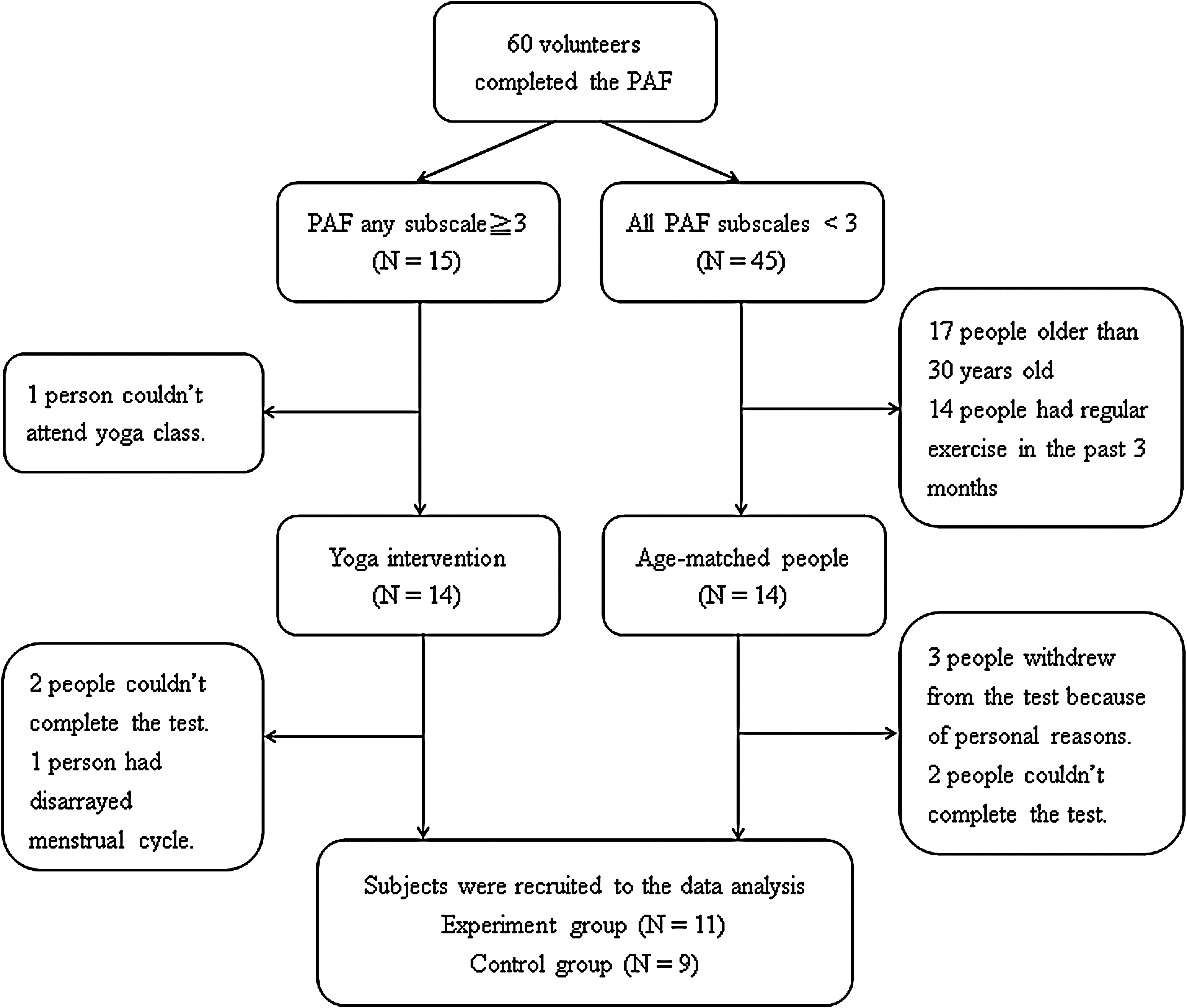
Flowchart of participant recruitment. PAF, Premenstrual Assessment Form.
Values are expressed as mean±standard deviation.
This study also used the Menstrual Distress Questionnaire (MDQ) to measure the severity of cyclical perimenstrual symptoms. The total mean scores (±standard deviation) from the MDQ for the PMS group in the luteal and follicular phases were 86.67±20.71 and 49.33±17.90, respectively. The paired t-test showed that total scores for MDQ were lower in the follicular phase than in the luteal phase (p<0.01). The independent sampling t-test demonstrated that the differences in baseline characteristics between the two groups were not significant.
Yoga class
Beginner's hatha yoga classes for the PMS group took place twice a week, consisting of 50 minutes for each session each time. Each 50-minute session consisted of 5 minutes of breathing exercises (pranayama), 35 minutes of yoga pose practice (asana), and 10 minutes of supine meditation/relaxation (savasana). Yoga poses were practiced in sequence, as follows: 1. Sitting poses: half sun breath, round back, side lean and forward bend (sitting cross-legged), side lean and forward bend (seated wide angle), and roll down/roll up. 2. Supine poses: bridge and knee to chest. 3. All four poses: cat seal, bali seal, side lean and rotate (low lunge), plank pose, and down dog. 4. Side lying: scissors and side plank. 5. Prone poses: locust pose and baby pose. 6. Standing poses: tree pose, chair pose, and standing forward bend.7. Supine poses: knee to chest (one leg, two legs).
All classes were started at the same time of day, from 8:00 pm to 8:50 pm, on Monday and Thursday each week. Participants attended yoga classes together; the classes were led by a trained and qualified yoga teacher. The teacher assisted all participants to attain the right yoga postures to avoid exercise injury and guided the breathing frequency. In total, the PMS group participants attended the class for 6 weeks.
Equipment and experimental setup
EEG system
A portable 40-channel EEG system (NeuroScan NUAMPS, Compumedics Neuroscan El Paso, TX) was used to record EEG data during the experiment. This study collected a total of 11 channels with a sampling frequency of 1000 Hz: 2 electrodes above and below the left eye for scanning the eye movement or blink, 2 at the right and left ears as reference electrodes, and 7 on 7 scalp positions (Fp1, Fp2, F3, F4, Fz, F7, F8). At first, the examiner assisted the participants to wear the quick-cap and adjusted the impedance of the electrodes to lower than 8.2 kOhm in order to start collecting EEG data. Subsequently, static brain wave data were collected over 7 minutes in a static sitting position (eyes closed), followed by 5 minutes resting time, and then the EEG data were collected as the participant executed the cognitive task delivered by Stim2 software (Compumedics Neuroscan), requiring about 23 minutes to accomplish all tasks.
STIm2 software
This study used Stim2 software (Compumedics Neuroscan) to devise the cognitive task. This software can control the stimulus sequence and duration of experiments and record the participants' responses. To analyze the EEG during the cognitive tasks, the Stim2 system acted synchronously to the Neuroscan, so that they started at the same time to record the participants' reaction time and the answers.
Cognition task design
This study used a 2-back task (Fig. 2) as the cognitive task, which was set to deliver 8 English letters as the stimuli, with the sequence of letters programmed randomly before the experiment. Each task had 5 sections, and each section had 62 stimuli; however, only 25% of all stimuli matched the letter 2 steps earlier, with a 1-minute break between 2 sessions. In this study, the response board was a computer keyboard, and when the target showed up, the participant was to press the “N” key to give the response.
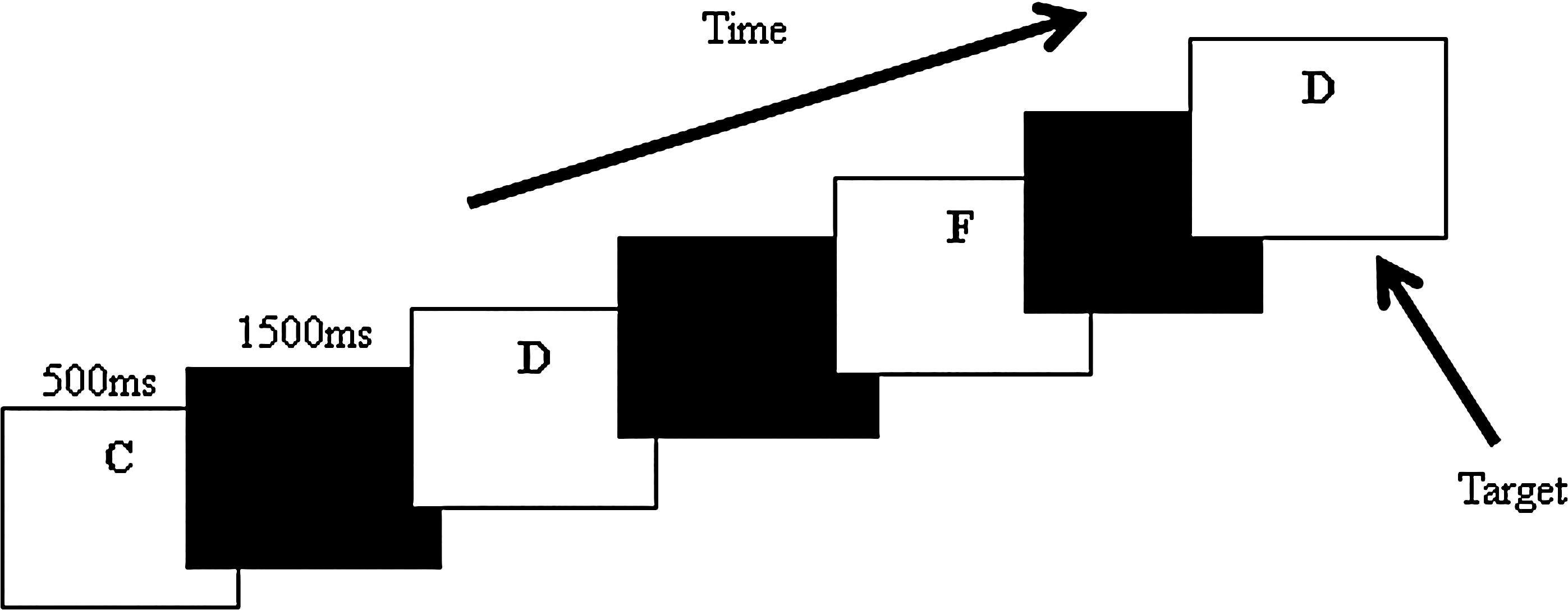
2-back task process and the target stimulus.
Experimental procedures
After starting the yoga classes, the first day of the menses of all participants was forecasted, and one experiment was arranged for each participant in her luteal phase and one in her follicular phase. The testing order was based on the participants' own menstrual cycle. Luteal phase was defined as the time within 7 days before the start of the period, and follicular phase was defined as day 5–day 12 of a normal menstrual cycle. The 2 testing days were arranged to take place within the 6-week yoga class. Each testing day included pre- and post-test, making a total of 4 experiments. In the first and third experiments (pretest), the participants completed the MDQ, resting EEG, and 2-back task combined with EEG before the yoga class. In the second and fourth experiment (post-test) they repeated everything except the MDQ, within 60 minutes after the yoga class. For the control group, resting EEG and 2-back task combined with EEG data were collected only twice: once in the follicular phase and once in the luteal phase of one menstrual cycle.
However, in some special situations, the participant was required to repeat the experiment within a few days. These special situations arose when the participant's menses didn't begin within 7 days or if an obvious noise disturbance during the experiment affected the participant.
Data analysis
This study analyzed the alpha wave percentage and the ERPs for the 2-back task. ERPs included N1, P2, N2, P300 (also called P3). The N1 and P2 components of the ERPs reflect cortical arousal and the orienting response, whereas the N2 and P300 components of ERPs reflect controlled processing.
Alpha brain wave
NeuroScan 4.4 software was used to block the EEG data from 60 seconds to 360 seconds (5 minutes total), and the 5 minutes of EEG data were filtered with a band-pass of 0.1–30 Hz. The epoch of the 5 minutes was 15000 milliseconds, and trials that contained voltage fluctuations exceeding ±100 μV or eye blinks exceeding ±50 μV were rejected. The averaged data were computed into the spectrum, to show the alpha wave percentage of the seven scalp positions. Finally, the alpha wave percentages were averaged for the seven scalp positions.
Accuracy and reaction time for the 2-back task
The reaction times for all the right responses on the 2-back task were averaged, and the accuracy was computed by summing all the right responses and then dividing by the number of the entire target stimulus.
ERPs of the 2-back task
The EEG data of the target stimulus were filtered with a band-pass of 0.1–30 Hz. ERPs were made for 1300 milliseconds, beginning at 100 milliseconds before stimulus onset and 1200 milliseconds after stimulus onset. Those that included voltage fluctuations exceeding ±100 μV, or eye blinks exceeding ±50 μV, were rejected. The amplitudes (μV) and latency (milliseconds) of the N1, P2, N2, and P3 components were then averaged for the seven scalp positions. After averaging, the N1, P2, N2, and P3 components were detected by the NeuroScan 4.4 software, and the definitions set for N1 (negative peak about 100–160 milliseconds after stimulus), P2 components (positive peak about 160–230 milliseconds after stimulus), N2 (negative peak about 230–280 milliseconds after stimulus), and P3 (positive peak about 280–400 milliseconds after stimulus); after these four peaks were detected, the amplitude and latency of N1, P2, N2, and P3 were recorded for data analysis.
Statistical analysis
This study used two-way repeated-measures analysis of variance with the two factors of menstrual cycle (luteal phase vs. follicular phase) and acute yoga exercise (before vs. after exercise) to analyze the static EEG of α power and the ERPs of the 2-back task (N1, P2, N2, P3) in the PMS group. By contrast, all the dependent variables of the control group were analyzed by the Wilcoxon test because the number of participants in the control group was not in keeping with the central limit theorem.
Results
Alpha wave percentage
The alpha wave percentage of the PMS group showed a significant main effect through yoga exercise (p=0.01) (Table 2), which was significantly higher after yoga exercise than before the exercise, but there was no significant effect on menstrual cycle and no interaction between them. The results for the control group did not significantly differ between the follicular phase and luteal phase (p=0.09).
p<0.05 compared with before exercise in PMS group.
p<0.01 compared with before exercise in PMS group.
p<0.01 compared with luteal phase in PMS group.
p<0.05 compared with luteal phase in PMS group.
PMS, premenstrual syndrome.
Accuracy and reaction time of the 2-back task
Performance accuracy for the PMS group significantly differed with regard to the main factor of yoga exercise (p=0.01) (Table 2); the task performance accuracy was higher after yoga exercise than before. There were two significant factors regarding reaction time: menstrual cycle (p<0.01) and yoga exercise (p=0.02). Participants reacted to the task faster in the follicular phase and after exercise. However, there was no significant interaction effect between menstrual cycle and yoga exercise. In the control group, no significant difference was seen between luteal phase and follicular phase with regard to accuracy and reaction time.
Event-related potential
In all the ERPs (Table 2), the P3 amplitudes in the PMS group showed a significant main effect in menstrual cycle (p=0.02). The amplitude of P3 was higher in the luteal phase than in the follicular phase. No significant difference was seen for the other factors or the other ERPs. In addition, there was no significant difference in the control group for latency and amplitude of ERPs between the luteal phase and the follicular phase.
Discussion
Yoga exercise effect on the alpha wave percentage
This study examined the difference in alpha wave percentage between follicular phase and luteal phase, and between the period before exercise and after exercise. The alpha wave percentage differed after yoga exercise. Previous studies have also found that the increase in alpha wave production by yoga exercise is closely associated with slower abdominal breathing, a finding consistent with other findings on the physiologic correlates of meditation and yoga. 19 –22 Kamie et al. found that alpha wave production increased during yoga exercise, and also with decreasing serum cortisol. 23 However, because the current study did not measure serum cortisol, it could not determine whether the serum cortisol changed after yoga exercise. Alpha brain waves are associated with states of peace, relaxation, creativity, mood elevation, and the release of serotonin, 24,25 and thus the elevation of alpha brain wave production may imply that the participants felt more relaxed after yoga exercise. This result might suggest that women with PMS who experience depression or anxiety or concentration difficulties should undertake short-term yoga classes during the luteal phase.
Accuracy and reaction time of the 2-back task
This study showed that women with PMS were reacting to the target stimulus significantly more slowly in the luteal phase. In past studies, researchers concluded that women have a diminished efficiency during the premenstrual phase, 4 a conclusion also reached in this study. However, this delayed reaction time during the attention task may mean that women with PMS also show poor performance on life tasks requiring a high amount of cognitive resources, such as driving for extended periods or concentration in a highly dangerous work environment. Previous studies have used yoga exercise to improve cognitive functions, such as delayed and immediate recall, 11 spatial memory, 12 and verbal retention. 13,14 A similar result was found in this study, using a different cognitive task; yoga exercises were seen to have a positive effect on both accuracy and reaction time. This demonstrated that women with PMS performed better (reacted faster and with higher accuracy) after yoga exercise. Furthermore, the last study about this issue found that women with PMDD showed both poor concentration and poor N-back task performance in the luteal phase, 7 consistent with the present result. The current study's result demonstrated that yoga exercise may allow women with PMS to mobilize more attention resources to concentrate on a given task.
P3 brain activity on the 2-back task
The P3 is assumed to be an indicator of controlled processing following the classification of deviant stimuli, and it appears to reflect memory and decision-making processes. 2,26,27 Some studies have mentioned the menstrual cycle effect on the P3 and found no significant difference in the amplitude and latency of P3. 2,3,5,6 The current study found the same result in the control group, in that P3 amplitude and latency did not change across the menstrual cycle. However, the present study found a significant menstrual cycle effect on the PMS group, wherein the PMS group had a lower P3 amplitude in the follicular phase. However, the task level did not change. Thus, the significant change between two phases may have been due to the PMS effect in the PMS group. Compared with previous studies, the P3 amplitude tended to be higher in the luteal phase, but this finding was not statistically significant. 3 The symptoms of the PMS participants therefore may have enhanced the P3 amplitude difference in the current study. However, no previous experiments appear to have resulted in the ERPs changing in women with PMS. The changes that did occur may correspond to changes in mood, behavior, or performance that have been found to occur premenstrually. 28,29 What is more, they were likely to have resulted from the effects of pain.
Because pain is a common symptom of PMS, it is a complex experience that might affect mood and behavior and can modify thought patterns leading to different brain activation during cognitive tasks. A previous ERPs study 30 identified a significantly larger amplitude of P3 in a pain judgment task than that in a simple counting task. This was the first study to assess ERPs in women with PMS by the 2-back task. However, the current study did not assess the pain effect and that of other emotions on the ERPs and reaction times; thus, this could be a key factor for future study to improve understanding of the relation between the pain effect and that of other emotions and the P3 amplitude and attention performance.
Conclusion
The acute yoga exercise enhanced the attention performance regarding both accuracy and reaction time, suggesting that women with PMS could perform better on attention tasks through yoga exercise. This study has shown that short-term yoga exercise in the luteal phase may be a good recommendation for women with PMS.
Footnotes
Author Disclosure Statement
No competing financial interests exist.