




Abstract
Objective:
The main aims of this study were to identify candidates for cognitive-enhancing herbal formulae from the Korean medicine literature and to obtain preliminary data that experimental and clinical researchers could use to develop new cognitive-enhancing drugs.
Methods:
The authors systematically searched for terms related to cognitive enhancement in Dongui Bogam (or Dongyi Baojian), a seminal Korean medicine book. They also reviewed the existing literature on the effects of candidates for cognitive-enhancing herbal formulae and their main constituents.
Results and Conclusions:
Twenty-three candidates were selected for cognitive-enhancing herbal formulae and their main constituents. For 14 herbal formulae among the 23 candidates, on average 5.6 published research papers per herbal formula describing cognitive-enhancing effects were found. In addition, some published papers were identified for 5 main constituents most frequently used to make up the 23 candidates.
Introduction
I
This study also sought to provide basic data for further experimental and clinical studies through a preliminary evaluation of the cognitive-enhancing effects of CCEHFs as reported in previous studies.
The research on herbal formulae has been continued from a recent study on individual herbs because combination therapy along with medicinal herbs is a basic principle of Korean medicine. 2 Using herbal formulae allows maximizing efficacy while minimizing toxicity. 3 An herbal formula is not the simple quantitative addition of individual herbs; rather, it produces an effect greater than the sum of its individual constituents. 4,5
Materials and Methods
The methods of this study are similar to those of the previous study. 1 In brief, two steps were used. In the first step, the Dongui Bogam was screened for TCEHFs and CCEHFs and lists were generated. In the second step, previous studies focusing on the cognitive-enhancing effects of the selected CCEHFs and their main constituents were reviewed. Each step was conducted as detailed below.
Selection of TCEHFs and CCEHFs
A total of 3901 herbal formulae (HF), excluding duplicates, are mentioned in the Dongui Bogam. The selected items were revised as per a revised edition of this book. 6 The terms describing the effects of herbal formulae (TEHFs) were divided into simple descriptive units to closely interpret the meaning of TEHFs depicting each herbal formula. A total of 11,639 TEHFs were analyzed one by one to determine whether they translated into antiaging and cognitive-enhancing concepts in modern science. As a result, a total of 15 candidates for TCEHFs were selected. Then, 26 experts of classic medical literature who are faculty members of formal institutes of Korean medicine and members of the Society of Korean Medical Classics were recruited. Questionnaires about the lists of candidates and the selection criteria for TCEHFs were created and distributed to the experts from July 24 to August 10, 2014.
Only TCEHFs chosen by more than 50% of the respondents were selected. The threshold was set at 50% so that the range of TCEHFs would be wide. The questionnaire was created by the authors and then finalized by an advisory panel consisting of basic and clinical Korean medicine researchers and biological science researchers (n = 6). The survey result signifies that the experts on Korean medicine literature agree that the 15 TCEHFs chosen by the authors appropriately reflect concepts depicting cognitive-enhancing function as an antiaging effect.
The final list consisted of 15 TCEHFs and 23 CCEHFs that contained at least 1 of 15 TCEHFs (Fig. 1).
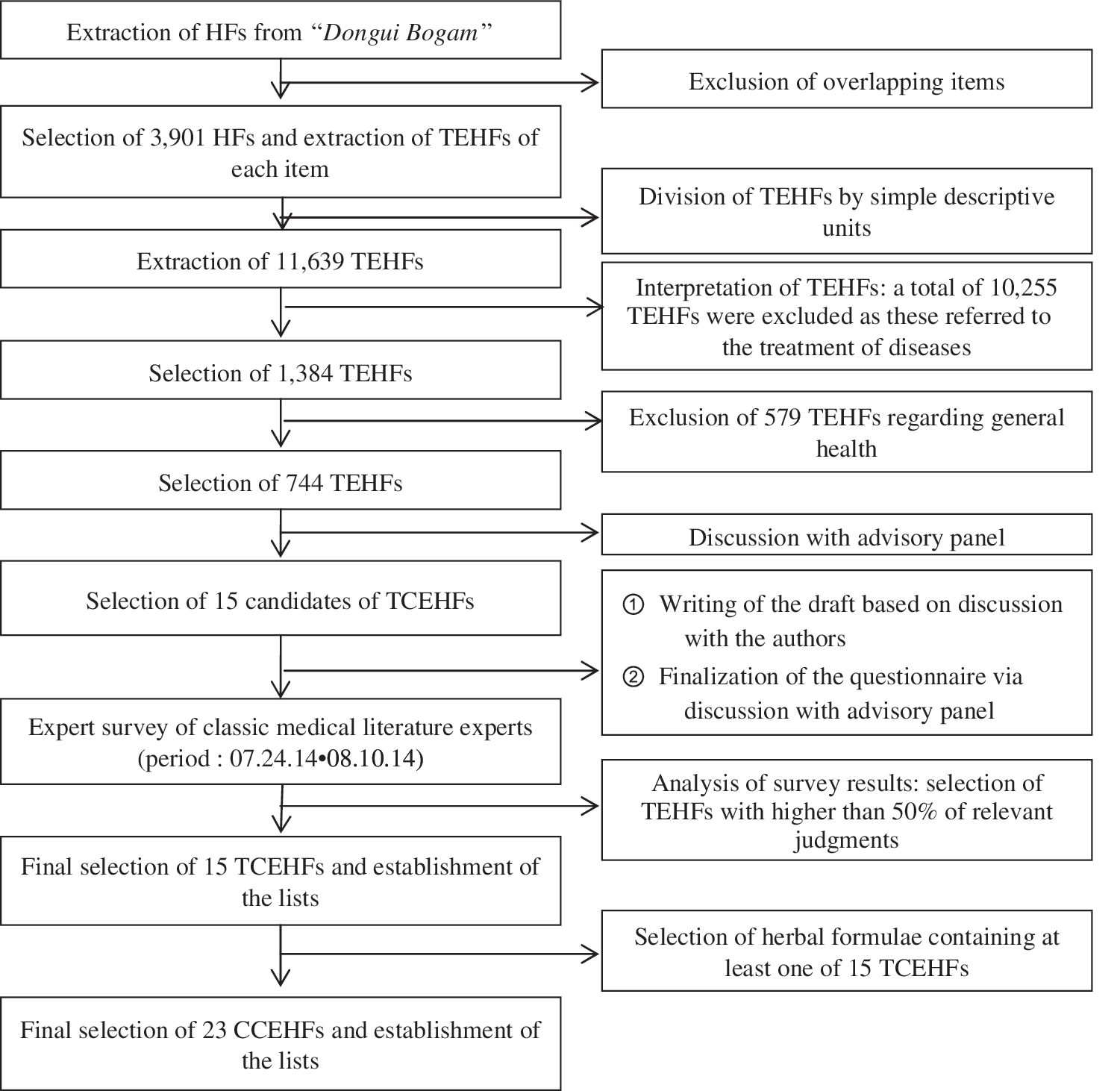
First research step: selection of the cognitive-enhancing effects of herbal formulae (TCEHFs) and candidates for cognitive-enhancing herbal formulae (CCEHFs) found in the Dongui Bogam. HF, herbal formulae; TEHF, the effects of herbal formulae.
Preliminary evaluation of cognitive-enhancing effects of CCEHFs via analysis of previous studies
The authors searched for previous studies on the 23 CCEHFs and decided whether the studies were related to antiaging and cognitive-enhancing research via discussion with the advisory panel (Fig. 2). Furthermore, studies were sorted into in vitro studies, in vivo studies, clinical studies, and reviews, and the result of each study was reanalyzed for research performance status. Korean databases (Ndsl, Oasis, and Riss) were searched for studies on Korean medicine, along with commonly used scientific databases (such as PubMed, Cochrane, and Scopus). The starting period for these study searches was not defined, but January 31, 2015, was set as the final time point. The following keywords were used: [name of the CCEHF] plus “age, aging.” (Published research papers on cognitive-enhancing effects were selected from among those on antiaging effects on the basis of expert's opinion.)
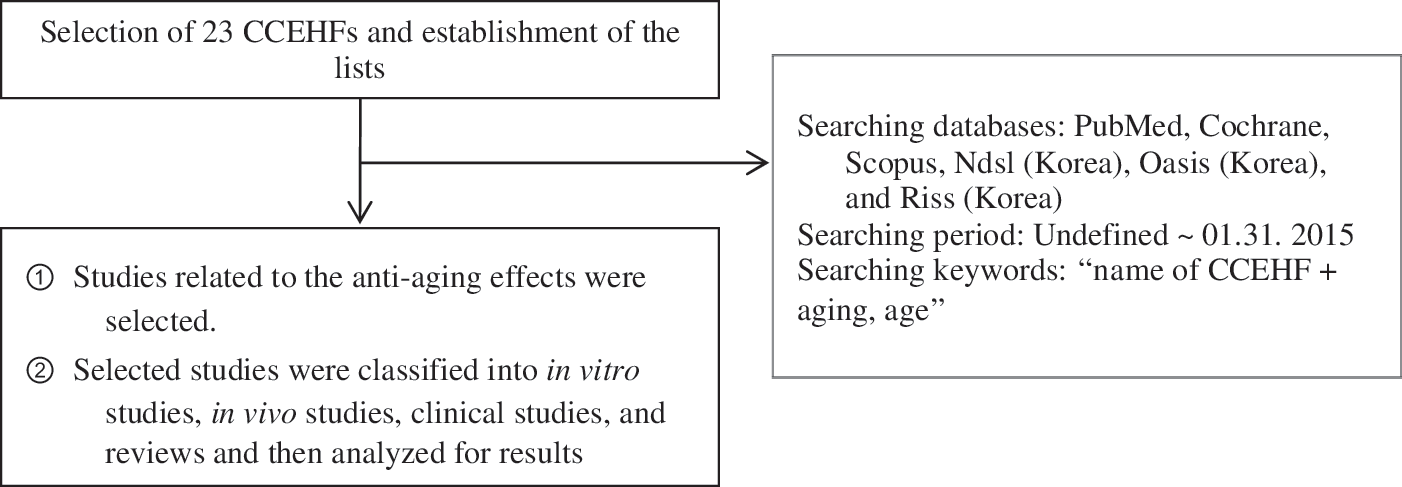
Second research step: preliminary evaluation for cognitive-enhancing effects of CCEHFs via analysis of the results of previous studies.
In addition, it was considered necessary to review the effects of the individual constituents as well as the effects of the herbal formula overall. Therefore, the top five herbs were selected in the order of frequency of use among all individual herbs that made up the 23 CCEHFs; the existing studies were then reviewed with regard to the cognitive-enhancing function of each herb among antiaging effects.
Results and Discussion
List of TCEHFs in the Dongui Bogam
All TEHFs of the 3901 HFs in the Dongui Bogam were divided into simple descriptive units; a total of 11,639 were obtained. TEHFs related to treatment of disease were excluded, and 1384 TEHFs were selected. A total of 744 TEHFs remained except for overlapping terms. Next, 165 TEHFs were identified as exerting specific antiaging effects, excluding 579 terms regarding general health from 744 TEHFs. Fifteen TCEHFs were identified as exerting specific cognitive-enhancing effects among the 165 TEHFs. The expert survey was administered to validate the method described previously. Ten of 11 respondents agreed with the validity of the first step, and 1 respondent disagreed (90.9% vs. 9.1%) (Table 1). The agreement ratio for validation of each TCEHF ranged from 53.8% to 100%. Hence, 15 TCEHFs were finalized via further analysis (Table 2).
Although some particular expressions of cognitive-enhancing effects of herbal formulae are recorded with different wording in the original text, the expressions are translated into the same words in English because they have similar meaning to each other. Hence, we defined them separately in this table.
List of CCEHFs in the Dongui Bogam
We selected 23 CCEHFs in the Dongui Bogam as CCEHFs depicted with at least more than one term for TCEHFs identified in the preceding process (Table 3).
Given space considerations, constituents of each herbal formula are provided in Supplementary Table S1. (Supplementary materials are available online at
Preliminary evaluation of cognitive-enhancing effects of CCEHFs via analysis of previous studies
Previous studies were analyzed regarding 23 CCEHFs. As a result, 181 previous studies on 14 CCEHFs were searched. Seventy-eight papers on 14 CCEHFs were finalized, excluding overlapping studies and those not related to antiaging effects and cognitive-enhancing effects (Fig. 3 and Table 4).

Number of previous studies on 14 CCEHFs.
Given space considerations, the 20 other herbal formulae are provided in Supplementary Table S2.
Korean databases.
VT, in vitro study; N, Ndsl; O, Oasis; R, Riss; VV, in vivo study; C, clinical study.
According to Figure 3 and Table 4, several studies evaluated the medicinal herbs (numbers refer to the number of studies): jiajiangubenwan (in vitro study [VT]: 2), jiajianbuxintang (in vivo study [VV]: 1; clinical study [C]: 1), jiaweiningshenwan (VT: 1), qianghuoyufengtang (VT: 1; VV: 1), kaisinsan (VT: 2; VV: 10), guipitang (VT: 4; VV: 13; C: 2; review: 1), liuweidihuangyuan (VT:4, VV:1), zibuyangrongwan (VV: 1), zhuangyuanwan (VT: 1, VV: 1), dingzhiwan (VV: 2), zhuzidushuwan (VV: 2), zhuquewan (VV: 1), tianwangbuxindan (VT: 3, VV: 4, C: 3), and congmingtang (VT: 3, VV: 13).
And according to Table 4, 9 of 23 CCEHFs (jiangxintang, guishendan, renshengao, sumazhou, shisiyouyuan, woxuetang, longnaochuanxiongwan, yunlinrunshenwan, chuanxiongshigaosan) have not been the subject of research studies. Among 14 herbal formulae, an average of 5.6 studies per herbal formula that described their cognitive-enhancing effects was obtained. More than 10 studies were performed on 4 items (kaisinsan, guipitang, tianwangbuxindan, and congmingtang); 1 study each was done on 3 CCEHFs (jiaweiningshenwan, zibuyangnongwan, and zhuquewan).
Some of the studies that sought to prove the cognitive-enhancing effects of CCEHFs have been inconclusive. Meanwhile, the previous studies on cognitive-enhancing effects of CCEHFs were found to show antioxidative and neuroprotective mechanism in the brain.
Preliminary evaluation of cognitive-enhancing effects of main constituents via analysis of previous studies
A total of 232 constituents made up the 23 CCEHFs, but after exclusion of overlapping herbs and combination of duplicate origins, 76 constituents remained.
Herbs used more than 10 times are Poria Sclerotium (21), Radix Ginseng (16), Radix Polygalae (14), Radix Angelicae Gigantis (13), and Radix Rehmanniae (11). Under the premise that the more frequently used constituents for 13 CCEHFs herbs have greater cognitive-enhancing effects, the main existing studies were analyzed with regard to their cognitive-enhancing effects as follows.
Previous studies on Poria Sclerotium and Radix Rehmanniae among the five herbs were not searched at all, and only one relevant study each was found for Radix Polygalae and Radix Angelicae Gigantis. Two studies reported cognitive-enhancing effects of tenuifolin extracted from Radix Polygalae and fermented Radix Angelicae Gigantis. 12,13 In contrast, 27 studies were found for Radix Ginseng, excluding overlapping studies. 14 –40 Most studies sought to verify the cognitive-enhancing effects of ginsenosides, the pharmacologically active ingredients in ginseng.
Conclusion
Fifteen TCEHFs and 23 CCEHFs were selected from the Dongui Bogam, and a preliminary evaluation of the cognitive-enhancing effects of CCEHFs and their main constituents was done via analysis of previous studies. The results of this study should lay the foundation of experimental and clinical research for development of new herbal formulae related to cognitive enhancement.
Footnotes
Acknowledgments
This research was supported by the Basic Science Research Program of the National Research Foundation of Korea (NRF) funded by the Ministry of Education (NRF-2013R1A1A2060970).
Author Disclosure Statement
No competing financial interests exist.
References
Supplementary Material
Please find the following supplemental material available below.
For Open Access articles published under a Creative Commons License, all supplemental material carries the same license as the article it is associated with.
For non-Open Access articles published, all supplemental material carries a non-exclusive license, and permission requests for re-use of supplemental material or any part of supplemental material shall be sent directly to the copyright owner as specified in the copyright notice associated with the article.
