




Abstract
Objectives:
The aim of this study was to evaluate the safety and the effect of dangguijagyag-san (DJS) on mild cognitive impairment (MCI).
Methods:
This study examined the administration of DJS ( ; angelica and peony formula) and was conducted at Uijeongbu Health Center in Gyeonggi-do, Korea, in 2013. Ninety-five of 118 patients diagnosed with MCI were followed up for 1 year after the study ended, and their medical records were analyzed.
Results:
The patients included 36 men (37.9%) and 59 women (62.1%). When the results from before the study began were compared with the results 1 year after the study ended, the overall average score according to the Korean-Montreal Cognitive Assessment (K-MOCA) showed a statistically significant increase, from 15.46 ± 5.30 to 18.54 ± 5.11, respectively. Both male and female patients recorded a significant increase in K-MOCA scores for all sections, including the visuospatial/executive section, the naming section, the attention section, the language section, the abstraction section, the delayed recall section, and the orientation section. Scores assessed by the Mini-Mental State Examination for Dementia Screening (MMSE-DS) showed a statistically significant increase, from 21.84 ± 3.59 before the study to 24.43 ± 3.13 after the study, but decreased slightly to 23.04 ± 3.36 at the 1-year follow-up. However, MMSE-DS scores measured before the study began increased significantly when compared with scores measured 1 year after the study ended.
Conclusions:
DGJYS improved the cognitive skills of patients diagnosed with MCI, and no adverse effects were observed. In the future, the efficacy of DGJYS must be objectively verified by using a randomized controlled trial.
Introduction
W
Because the per capita medical expenses of patients with dementia reached KRW1.86 million per month on average in 2010, 4 (a cost much higher than that of other chronic diseases), dementia is considered one of the elderly population's most feared diseases. Nevertheless, dementia has no clear treatment after diagnosis because its symptoms manifest only after the loss of nerve cells has progressed considerably. For this reason, it is crucial to treat and control dementia before symptoms appear.
Mild cognitive impairment (MCI) is a condition that has been associated with diminished cognitive skills. However, from a clinical perspective, a diagnosis of MCI falls short of a diagnosis of dementia. 5 Consequently, MCI has frequently been considered a predementia phase. Annually, approximately 10–15% of patients diagnosed with MCI progress to dementia, 6 –8 and some reports indicate that this contributes to approximately 40% of the total MCI patient population. 9 According to a report from Uijeongbu, Korea, patients diagnosed with MCI who developed dementia within 1 year of diagnosis made up 21.35% of the total population of confirmed MCI patients. Furthermore, this estimate would increase to 30% or more if unconfirmed MCI patients were included. 10 Because approximately 1%–2% of healthy persons develop dementia annually, the dementia onset rate in patients with MCI is particularly high, nearly 10–30 times higher than that of the general population.
Among traditional Korean herbal medicines, dangguijagyag-san ( ; angelica and peony formula) (DJS), known for its efficacy in improving cognitive skills of patients with dementia,
11,12
also had significant effects on patients diagnosed with MCI, a finding that deserves attention. By using the research records of administering dangguijagyag-san DJS to patients with MCI at the Uijeongbu Health Center and the medical records of the participating patients, an analysis was performed to determine the effect of DJS on cognitive skills, depression scale, and quality of life of patients with MCI. An analysis was also performed to ascertain the safety of the investigational product.
; angelica and peony formula) (DJS), known for its efficacy in improving cognitive skills of patients with dementia,
11,12
also had significant effects on patients diagnosed with MCI, a finding that deserves attention. By using the research records of administering dangguijagyag-san DJS to patients with MCI at the Uijeongbu Health Center and the medical records of the participating patients, an analysis was performed to determine the effect of DJS on cognitive skills, depression scale, and quality of life of patients with MCI. An analysis was also performed to ascertain the safety of the investigational product.
Materials and Methods
Participants
A total of 118 participants took part in the Mild Cognitive Impairment Management Program with Traditional Korean Medicine (MCI-MaP-TKM) program administered by the public health center in Euijeongbu in 2013. All subjects participated voluntarily and lived in Euijeongbu. The following were excluded: patients who took psychotropic drugs, patients who took more than five drugs, patients who did not take DJS more than 90% of the time, patients who did not answer the complete outcome questionnaire, and patients who did not agree with the research. Ultimately, after exclusion criteria were met, 95 participants were enrolled in this observational study.
Ethics approval
This study was conducted in accordance with procedures that were approved by the institutional review boards (IRBs) at the participating institutions and Kyung Hee University (IRB no. KHSIRB-14-084[EA]).
Procedures
At the Uijeongbu Health Center, the Mini-Mental State Examination for Dementia Screening (MMSE-DS) was administered to senior citizens older than age 65 years who reside in Uijeongbu. Education, background, and age were considered, and patients with MMSE-DS scores below the reference score were asked to take dementia diagnostic tests at a local hub hospital. The neuropsychiatrist at the local hub hospital conducted the Clinical Dementia Rating and Consortium to Establish a Registry for Alzheimer's Disease. To identify any underlying diseases, computed tomography (CT) was performed, and the results were comprehensively reviewed to diagnose normality, MCI, or dementia. Representatives from the Korean Medicine Health Promotion Center at the Uijeongbu Health Center informed patients diagnosed with MCI at the local hub hospital of the DJS administration study. The investigational product DJS was administered for 12 weeks to patients who wished to participate in the study and who signed the informed consent form. The MMSE-DS was administered to the participants 1 year after the study. Participants who scored below the reference score were asked to take dementia diagnostic tests at a local hub hospital again, whereas those who scored higher than the reference score were recommended to take a regular exam.
During the first visit, the study participants were informed of the entire study schedule. Additionally, they took the following tests: MMSE-DS, Korean-Montreal Cognitive Assessment (K-MOCA), Geriatric Quality of Life-Dementia (GQOL-D), and Geriatric Depression Scale-Korean (GDS-K). Participants who passed the basic health exam performed by a Korean medical physician were given a 2-week prescription of DJS. The participants then visited the health center every 2 weeks, individually underwent the basic health exam performed by a Korean medical physician, and, if no adverse events had occurred, received a 2-week prescription of DJS. The participants then took the MMSE-DS, the K-MOCA, the GQOL-D, and the GDS-K after 12 weeks had passed and the study ended. Subsequently, the participants took an additional MMSE-DS 1 year after the study ended (Fig. 1).
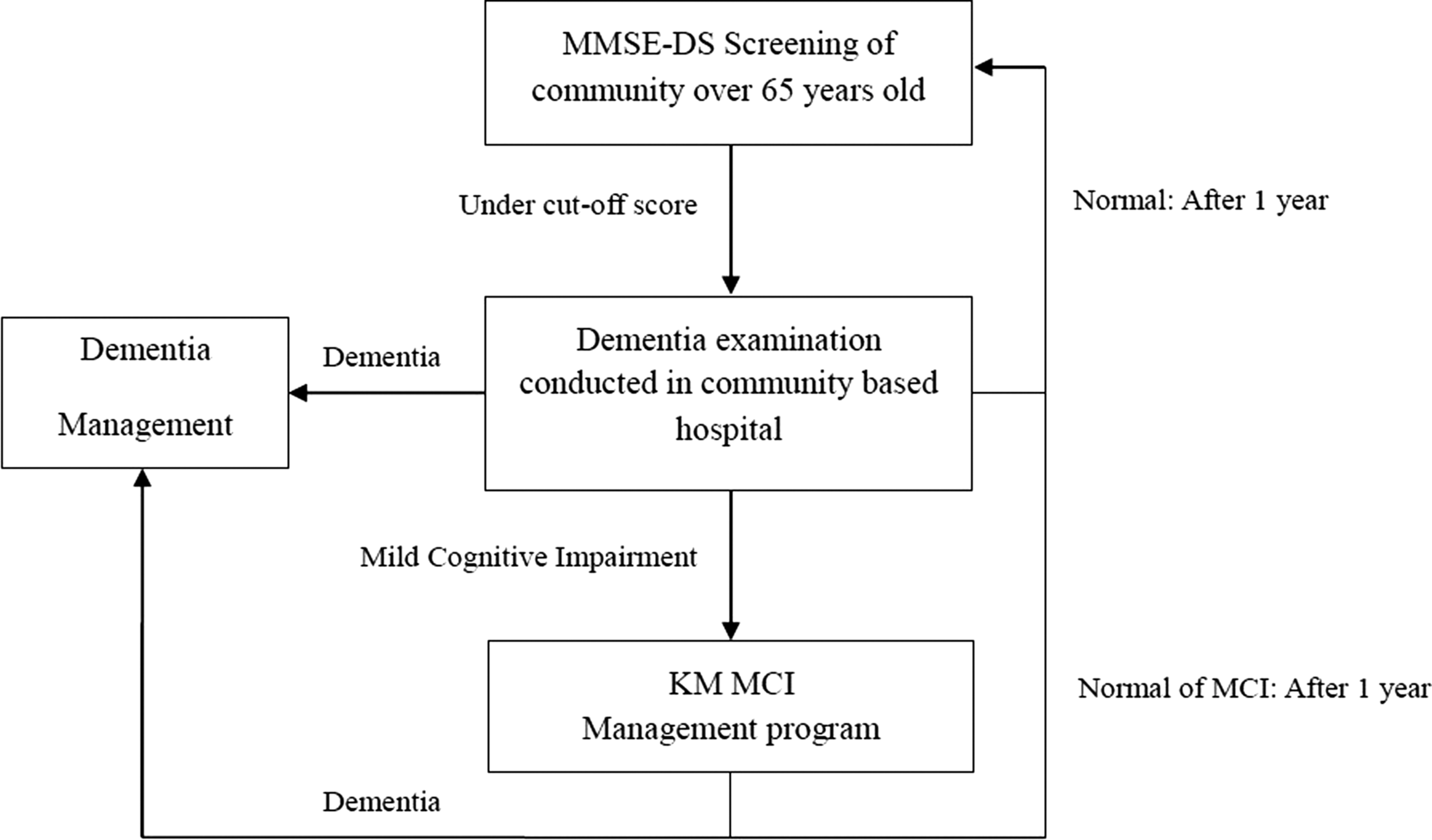
Process of traditional Korean Medicine (KM) Mild Cognitive Impairment (MCI) Management Program. MMSE-DS, Mini-Mental State Examination for Dementia Screening.
The investigational agent used in this study was DJS granules (Tsumura & Co., Ibaraki, Japan). The participants took 1 pack 30 minutes after a meal with warm water, twice a day. Each pack contained 1.875 g of DJS.
Statistical analysis
A paired t-test was used to evaluate the efficacy of MCI-MaP-TKM. A p-value less than 0.05 was considered to represent a statistically significant difference. Software used for all analyses was SPSS 15.0 for Windows (IBM, Chicago, IL).
Results
Sociodemographic characteristics
Of 95 total participants, 62.1% were women and 37.9% were men. Among male participants, the mean age and education level were 74.58 and 7.28 years, respectively. Those values were higher than the values in female participants. The average MMSE-DS score was 22.83 ± 3.10, and the overall mean K-MOCA score was 16.08 ± 4.53. Both scores were also higher among male participants (Table 1).
Unless otherwise noted, values are expressed as mean ± standard deviation. p-Values calculated by Student t-test comparing male and female participants.
MMSE-DS, Mini-Mental State Examination for Dementia Screening; K-MOCA, Korean-Montreal Cognitive Assessment; GDS-K, Geriatric Depression Scale-Korean; GQOL-D, Geriatric Quality of Life-Dementia.
Cognitive function, depression, and quality-of-life assessment
The K-MOCA scores before and after DJS treatment were 15.46 ± 5.30 and 18.54 ± 5.11, respectively. This difference was statistically significant (p < 0.001) (Table 2). Each of seven subcategory scores (visuospatial/executive, naming, attention, abstraction, delayed recall, and orientation) improved after 12 weeks of treatment, and improvement was statistically significant. The results of group analyses among both male and female participants also showed an increase in scores that was statistically significance (data not shown). The DJS treatment also improved depression and quality of life among male and female participants, and results were statistically significant (Table 2). The overall GDS-K score changed from 20.36 ± 3.99 before the treatment to 19.16 ± 3.33 (p = 0.001) after the treatment. Additionally, the mean GQOL-D score before treatment was 28.11 ± 7.23 and increased to 29.34 ± 7.07 after treatment (p < 0.001).
Unless otherwise noted, values are expressed as mean ± standard deviation. p-Values calculated by paired t-test.
Maintenance of cognitive function
The total MMSE-DS score increased from 21.84 ± 3.59 before treatment to 24.43 ± 3.13 after treatment, which was a statistically significant change (p < 0.001) (Table 3). At the 1-year follow-up, the total mean MMSE-DS score decreased to 23.04 ± 3.36.
Unless otherwise noted, values are expressed as mean ± standard deviation. p-Values calculated by paired t-test.
Comparing measurements before the intervention and after the intervention.
Comparing measurements after the study concluded and at follow-up.
Comparing measurements before the study began and at follow-up.
Safety assessment
No adverse events were reported except for two cases of indigestion.
Discussion
In Uijeongbu, the elderly population older than age 65 years represents 11.30% 13 of the total city population, which is higher than that of other Korean cities. Consequently, a registration project for patients with dementia has been actively pursued. However, patients with MCI with a high possibility of progression to dementia were not managed. For this reason, the Korean Medicine Health Promotion Center of the Uijeongbu Health Center carried out the DJS administration study to minimize the morbidity rate of dementia inpatients with MCI. This study analyzed changes in cognitive skills, depression scale, and quality of life of the participants before and after their participation in the study during 2013. Additionally, this study attempted to objectively verify the effects of the investigational agent.
The participants who took DJS for 12 weeks showed significant improvements in all categories of cognitive skills, depression scale, and quality of life. In the cognitive skills category, the participants posted significant improvements in all sections of K-MOCA. Specifically, considering that a major symptom of dementia is memory impairment, a clinical characteristic of the disease is that the damage to the temporal lobe appears first. Thus, execution of memory tasks is the best predictor of any progression to dementia. 14 Significant improvement in the delayed recall score is also meaningful. Additionally, the MMSE-DS score significantly improved not only immediately after the study concluded but also during follow-up observation 1 year after study end. This improvement indicates that the administration of DJS may lead to long-term effects on cognitive skills instead of a temporary improvement. Furthermore, the cognitive skills of patients with MCI improved regardless of their age, sex, or educational background, also demonstrating the substantial potential of DJS as a dementia-preventive drug for patients with MCI.
In this study, the mean GDS-K score was 20.36 ± 3.99 before the treatment. GDS-K is the Korean version of GDS. 15 GDS-K score of about 19–21 indicates moderate depression. Several studies reveled an association of MCI and depression. 16 –19 And public health services are primarily targeted to vulnerable groups, such as lower-income groups and elderly people living alone, and this would have affected the increase in GDS-K score.
After treatment, the GDS-K score changed to 19.16 ± 3.33. Before the study the authors had thought that cognitive impairment improved by way of improvement in depressive symptoms. However, in this study the change in GDS-K score was 1.2. Although the change to a score of 1.2 is meaningful, cognitive impairment may have been improved by improvement of not only depressive symptoms but also cognitive function.
Numerous recent studies have investigated drug treatments and nondrug interventions that can reduce or prevent a reduction in the cognitive skills experienced by patients with MCI. However, the efficacies of any particular drug treatment have not been proven because of the incidence of adverse effects and higher mortality rate among participants receiving drug treatment compared with participants taking placebo. 20
Because this study analyzed the results of a program carried out in a single city, Uijeongbu, the generalizability of the results is limited. Additionally, there are insufficient data to suggest changes in the cognitive skills of the participants because the MMSE-DS was conducted only 1 year after the program ended. Although the MMSE-DS is a useful tool when identifying patients with dementia, it has low sensitivity and specificity when used to test patients with mild dementia and is affected by the patient's educational background. Thus, the test is neither suitable to distinguish early dementia symptoms 21 –23 nor useful to analyze the characteristics of patients with MCI. 24 Moreover, the quality of life and the depression scale were not investigated 1 year after the program terminated. Instead, these measures were assessed using only a simple analysis comparing values measured before and after the program. Finally, the study merely analyzed the records of the participants without comparison with a control group; thus, the usefulness of the results was limited.
Because no methods targeting dementia prevention have been clearly proposed, it is important to lower the dementia progression rate of patients with MCI by using a Korean medical method. In addition, senile depression is a major risk factor for dementia 25 and the most common senile mental health disorder (affecting 1 of 10 persons over age 65 years). 26 Furthermore, depression is closely linked to the ability to perform physical and mental activities, to the perception of one's own health, and to quality-of-life factors such as happiness. 27,28 Therefore, it is noteworthy that participants diagnosed with MCI demonstrated improvements in depression, quality of life, and cognitive skills. Additionally, only 2 of 95 patients who took the dementia diagnostic tests 1 year after their participation in this study were diagnosed with dementia. Considering that 38 of 178 patients who took the dementia diagnostic tests 1 year after their diagnosis with MCI were later diagnosed with dementia in 2011 in Uijeongbu, the dementia progression rate in this study 1 year after diagnosis with MCI plunged by approximately 10-fold, from 21.35% in 2011 to 2.11% in 2013. This decrease in dementia progression rates appears to indirectly confirm that this program was effective at lowering the incidence rate of dementia in patients with MCI.
This study was conducted in a public center, and thus only an observational study was possible. In the future, it will be necessary to more objectively verify the effects of DJS by conducting a randomized controlled trial. The use of a traditional Korean medical treatment is anticipated to not only help improve the cognitive skills of patients with MCI but also boost the quality of life and minimize the progression of dementia in patients with MCI, thus contributing to public health and community well-being.
Conclusion
DJS was administered for 12 weeks to patients older than age 65 years who were diagnosed with MCI and living in Uijeongbu, Gyeonggi-do, Korea. The results were analyzed as follows. First, regardless of the patients' sex, age, and educational background, K-MOCA scores, MMSE-DS scores, GDS-K scores, and GQOL-D scores significantly improved during the study. Specifically, the K-MOCA scores significantly increased in all sections. Second, 1 year after the study ended, the MMSE-DS scores were lower than immediately after the study ended, but these scores were significantly higher than those measured before the study began. Third, only 2 of 95 participants (2.11%) were diagnosed with dementia 1 year after the diagnosis of MCI. Finally, during the 12-week trial of DGJYS administration, 2 cases of mild indigestion were reported.
Footnotes
Acknowledgment
This study was supported by a grant from Kyung Hee University (HI12C1889).
Author Disclosure Statement
No competing financial interests exist.