




Abstract
Introduction:
According to the Traditional Chinese Medicine theory of acupuncture, Baihui (GV20) is applied to treat neurological and psychiatric disorders. However, the relationships between neural responses and GV20 remain unknown. Thus, the main aim of this study was to examine the brain responses induced by electro-acupuncture stimulation (EAS) at GV20.
Materials and Methods:
Functional magnetic resonance imaging (fMRI) was performed in 33 healthy subjects. Based on the non-repeated event-related (NRER) paradigm, group differences were examined between GV20 and a sham acupoint using the regional homogeneity (ReHo) method.
Results:
Compared with the sham acupoint, EAS at GV20 induced increased ReHo in regions including the orbital frontal cortex (OFC), middle cingulate cortex (MCC), precentral cortex, and precuneus (preCUN). Decreased ReHo was found in the anterior cingulate cortex (ACC), supplementary motor area (SMA), thalamus, putamen, and cerebellum.
Conclusions:
The current findings provide preliminary neuroimaging evidence to indicate that EAS at GV20 could induce a specific pattern of neural responses by analysis of ReHo of brain activity. These findings might improve the understanding of mechanisms of acupuncture stimulation at GV20.
Introduction
A
Functional magnetic resonance imaging (fMRI) techniques have provided an opportunity for the neural mechanisms underlying acupuncture to be investigated. Using fMRI, much acupuncture research has focused on the manipulation effect by a repetitive on–off stimulation pattern. 6 –8,12 However, clinical and/or neuroimaging studies have indicated that sustained acupuncture effects and time variability exist, which could affect the conclusions drawn about stimulation effects. 9 –11,13 –16 Based on sustained acupuncture effects, other studies have explored brain responses to acupuncture stimulation. For example, Dhond et al. reported that the sustained effects of acupuncture altered the default mode network (DMN) and sensorimotor network (SMN). 13 Liu et al. further investigated the DMN at three different verum acupoints and one sham acupoint on healthy subjects. 11 Qin et al. reported that the altered functional connectivity of the amygdala related to acupuncture stimulation between the verum and sham acupoint acupuncture. 16 Meanwhile, the concept of sustained effects was also used for acupuncture treatment for certain disorders. Acupuncture stimulation on the Taichong and Hegu acupoints might modulate functional connectivity of the hippocampus in Alzheimer's patients. 17 Zhang et al. found that sustained effects of acupuncture induced alteration of the DMN in stroke patients. 18 The aforementioned studies suggest that sustained effects would be likely to be another optimal point for understanding the mechanisms of acupuncture.
As a vital acupoint, Baihui (GV20) is located at the intersection of the line connecting the midsagittal line of the head and the apexes of the two auricles, according to TCM theory. GV20 is used to treat neurological and psychiatric disorders such as dizziness, headache, stroke, and anxiety. 19 Although some studies have found that stimulation that combines GV20 with other acupoints is used to improve mental states, 20,21 knowledge of the specific patterns of brain responses induced by stimulation at GV20 remains limited.
The present study tried to focus on the sustained effects of acupuncture and to investigate the specific pattern of neural responses to electro-acupuncture stimulation (EAS) at GV20 by examining regional homogeneity (ReHo) 22 of brain activity after EAS. It was hypothesized that EAS at GV20 might induce a distinct pattern of ReHo compared with sham acupoints, which could be attributed to the specific functions of GV20.
Materials and Methods
Ethics statement
The present study was approved by the Ethics Committee of First Affiliated Hospital, Guangxi University of Chinese Medicine, China. All research procedures of this study were conducted in accordance with the Declaration of Helsinki. Verbal and written consent was obtained from each subject.
Subjects
Thirty-three right-handed Chinese subjects (15 male; aged 22–28 years) participated in this study. Subjects were acupuncture-naïve, non-smokers, and had no history of neurological or psychiatric disorder. Subjects had refrained from alcohol or drug consumption for at least one week before scanning. Female subjects were required to be not menstruating at the time of the scan.
Experimental procedure
The non-repeated event-related (NRER) paradigm 16 was applied in this study (Fig. 1). Twenty-minute continuous-wave EAS at GV20 or the sham acupoint was carried out by the same professional acupuncturist at 1 Hz, 2 mA ( SDZ-V-type; HuaTuo, Shanghai, China) outside the magnetic field. In this experiment, a sterile stainless-steel disposable needle (0.30 mm in diameter and 25 mm in length; HuaTuo, Suzhou, China) was inserted at GV20 on the head (Fig. 1A). Acupuncture was exerted with needling at Baihui along the midline at a 30° angle. Transverse insertion was made quickly from front to back, and the depth of needle ranged from 1 to 1.5 cm. Two electrodes were separately attached to the acupuncture needle and to a shallow 1 cm insertion point near to GV20. The sham point was chosen approximately 5 cm to the right side of GV20, but it did not coincide with any classically defined acupoint or meridian structure.
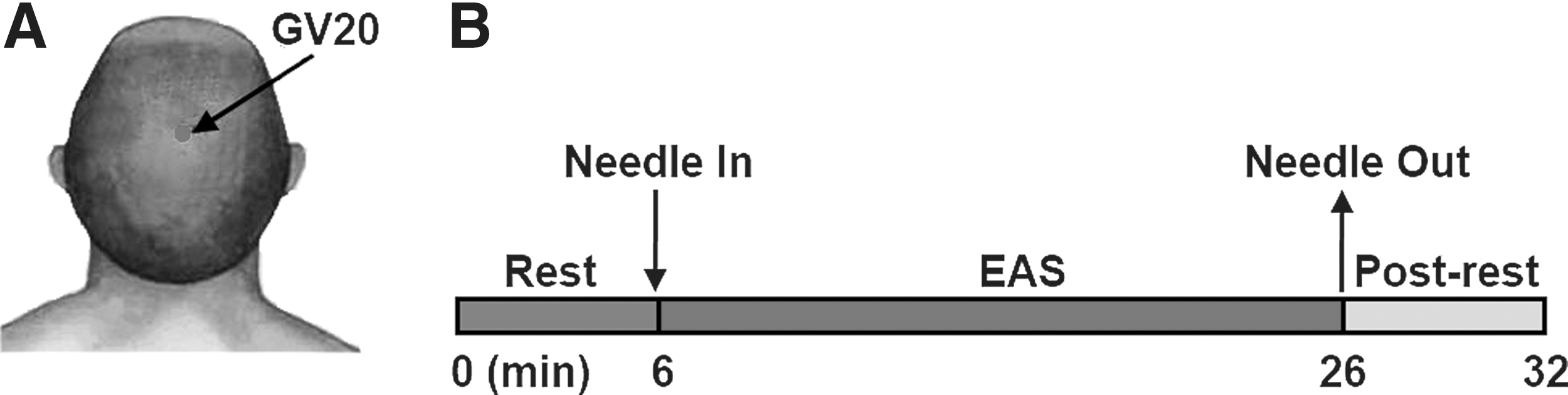
Experimental paradigm.
During the scan, each subject was instructed to keep their head still with the helpf of a foam pillow. They kept their eyes closed with blinders, and their ears were plugged with earplugs. Each subject was also asked to remain relaxed and to focus on the acupuncture sensations. At the end of the scan, the acupuncturist asked each subject whether he/she had slept during the scan. Each subject was further asked about the acupuncture sensations that they felt during the scan, including aching, soreness, numbness, fullness, sharp or dull pain, pressure, heaviness, warmth, coolness, tingling, itching, and any other sensations. The intensity of each sensation was measured using a 100-point visual analogue scale (0 = no sensation; 10–30 = mild; 40–60 = moderate; 70–80 = strong; 90 = severe; 100 = unbearable sensation). Considering sustained acupuncture effects, each subject was treated by EAS at the sham acupoint, followed by EAS at GV20 seven days later.
Data acquisition
The present experiment was performed using a 3.0 Tesla MR scanner (Siemens Medical, Erlangen, Germany) at the Department of Radiology, First Affiliated Hospital, Guangxi University of Chinese Medicine, Nanning, Guangxi, China, using a standard eight-channel birdcage head coil. Functional images were acquired with a single-shot gradient-recalled echo planar imaging (EPI) sequence (repetition time/echo time [TR/TE]: 2000 ms/30 ms; field of view [FOV]: 240 mm × 240 mm; matrix size: 64 × 64; flip angle: 90°; in-plane resolution: 3.75 mm × 3.75 mm; 31 slices). Three-dimensional T1-structural imaging was performed with a T1-weighted magnetization-prepared rapid gradient echo (MPRAGE; TR/TE: 1900 ms/2.22 ms; FOV: 250 mm × 250 mm; matrix size: 250 × 250; flip angle: 9°; in-plane resolution: 1 mm × 1 mm; slice thickness: 1 mm with no gaps; 176 slices).
Data preprocessing
Preprocessing was performed with SPM8 (
ReHo analysis was performed with the REST software package (
Statistical analysis
First, a paired t-test was used to examine differences of the baselines before EAS at the GV20 and at the sham acupoint. The focus was on the sustain acupuncture effects of the GV20 compared to the sham acupoint. Thereby, differences of ReHo results were measured using a two-sample t-test during the post-stimulation periods. Age and sex were not seen as covariates of interest in the analysis. All of the contrasts had a threshold of significance of p < 0.05 (false discovery rate [FDR] corrected) and a cluster size of more than five voxels.
Results
Psychophysical results
Four subjects did not complete the whole study. The data for the remaining 29 subjects were analyzed. Based on their oral responses, all of the subjects stayed awake during the scan. Soreness, numbness, fullness, and dull pain were primary de qi sensations in the current study (Fig. 2).
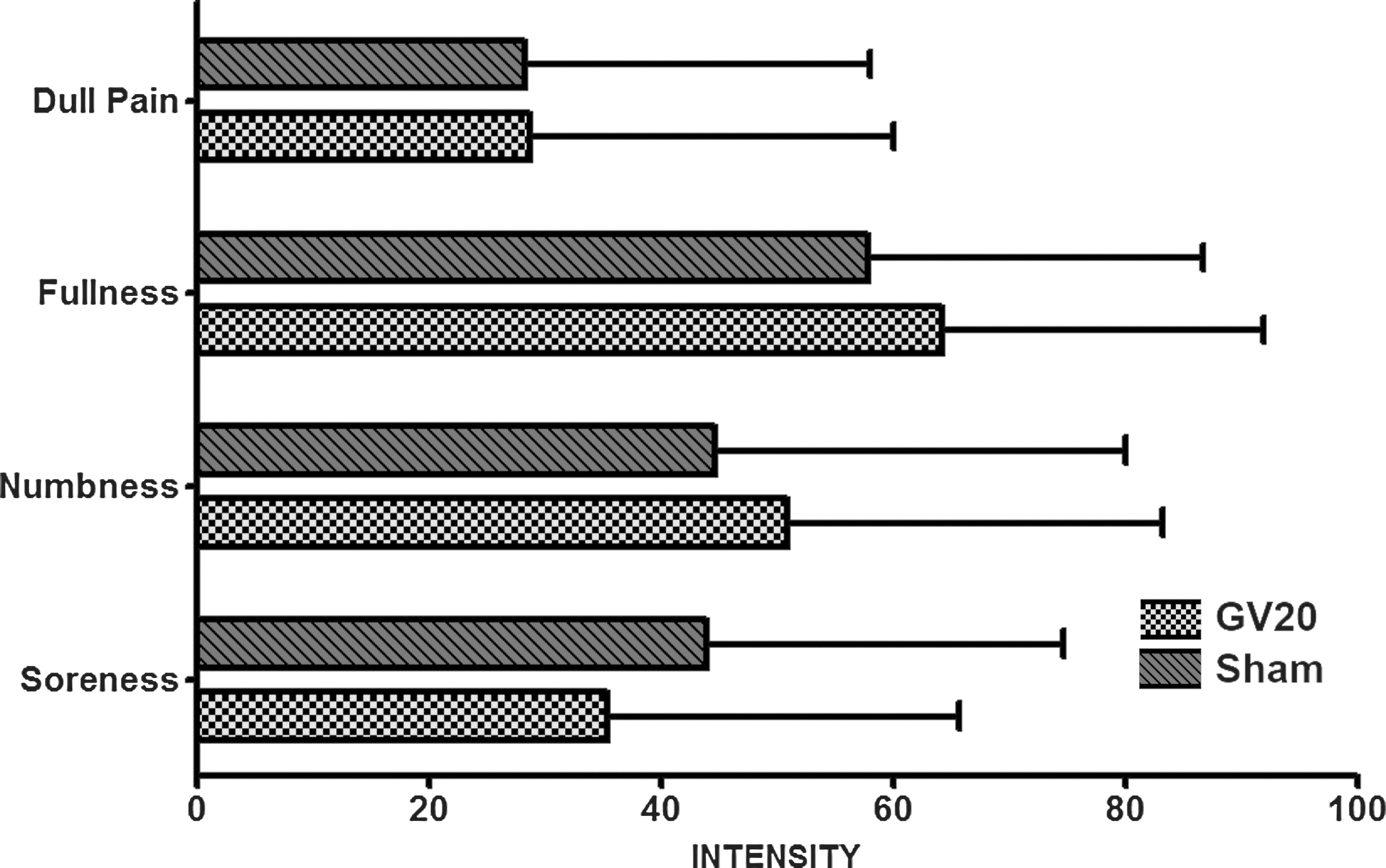
Psychophysical response. Soreness, numbness, fullness, dull pain, heaviness, and tingling were the primary de qi sensations. The intensity of each sensation was measured with a mean score with standard deviation bars on a scale from 0 denoting no sensation to 100 denoting an unbearable sensation.
Imaging results
The results showed that there were no ReHo differences during the baseline state (before EAS at GV20 and the sham acupoint). After EAS, compared with the sham acupoint, EAS at GV20 induced increased ReHo in the orbital frontal cortex (OFC), middle cingulate cortex (MCC), and precentral cortex and precuneus (preCUN), and decreased ReHo in the anterior cingulate cortex (ACC), supplementary motor area (SMA), thalamus, putamen, and cerebellum (Fig. 3).
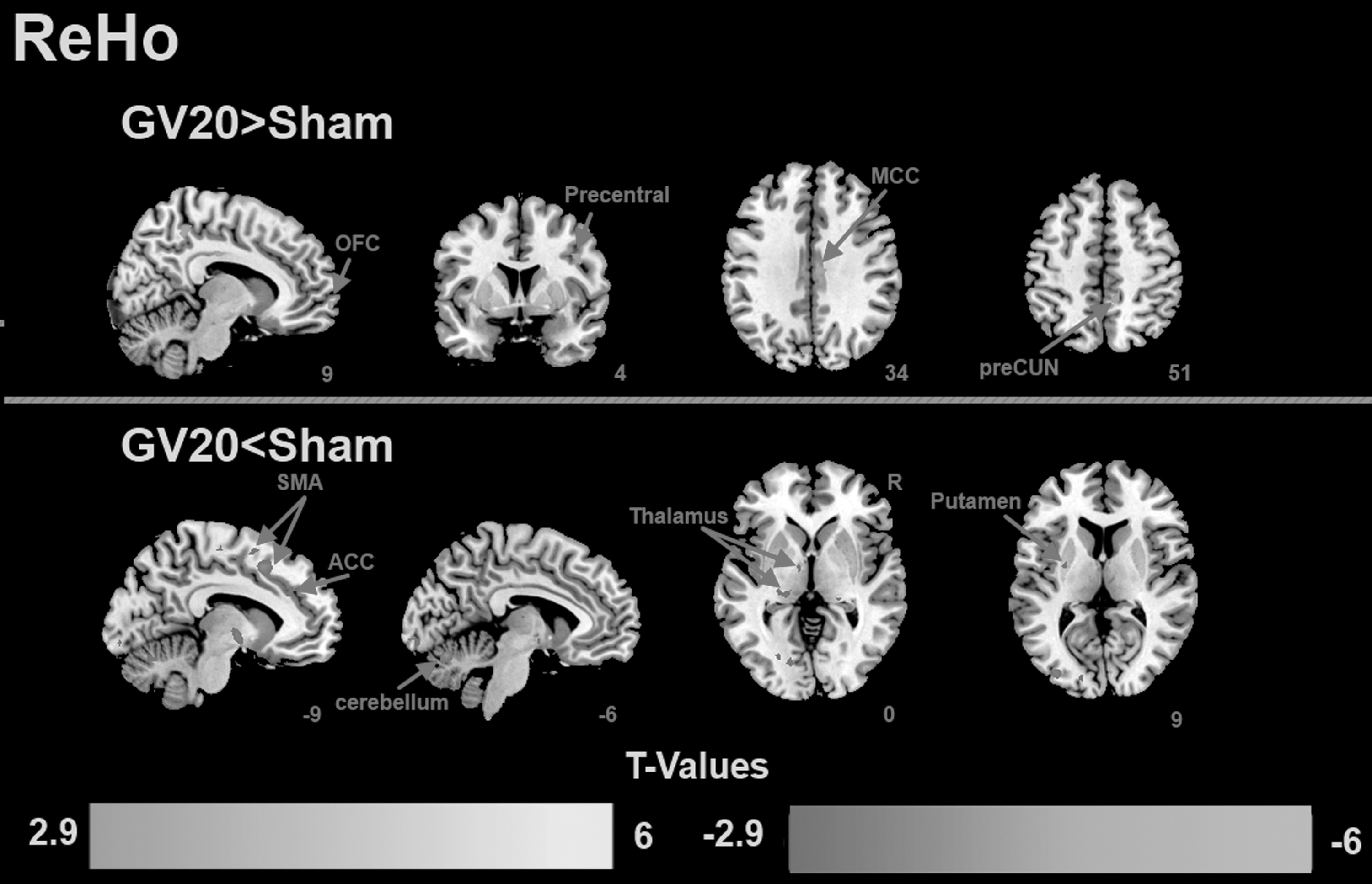
Brain regions showing increased (light gray) or decreased (darker gray) ReHo induced by EAS at GV20 compared with the sham acupoint.
Discussion
In this study, fMRI and the ReHo method were used to investigate the characteristic pattern of neural responses to EAS at GV20 in healthy subjects based on sustained effects of acupuncture. The findings show that compared with a sham acupoint, GV20-related EAS induced different a ReHo pattern, including increased ReHo in the OFC, MCC, and preCUN, and decreased ReHo in the ACC, SMA, thalamus, putamen, and cerebellum.
EAS is commonly applied in the clinical setting. One of the main advantages in using EAS in acupuncture research is its capacity to set stimulation frequency and intensity objectively and quantifiably. 12 EAS has been reported to produce more widespread fMRI signal alterations than manual acupuncture does. 24 On the other hand, GV20 on the Governor Vessel is located at the highest point of the head, and is used to relieve dizziness, headache, and anxiety by acupuncture stimulation, which demonstrates the effect of acupuncture at GV20 on modulating vascular, endocrine, immune, and/or nervous systems. 19 Thereby, EAS at GV20 were adopted in the present study, which might be close to clinical practice.
The results show that EAS at GV20 induced increased ReHo in the OFC. As a central hub, the OFC is implicated in integrating and modulating neural activation to monitor and control emotional responses. 25 Patients with psychiatric disorders, such as social anxiety disorder 26 and depression, 27 have abnormal activation within the OFC. Alterations in the OFC have also been found in patients with episodic migraine. 28 Furthermore, altered neural responses of the OFC have been shown to be related to acupuncture analgesia. 29 Together, it is speculated that the increased ReHo in the OFC might show special modulatory effects of EAS at GV20, which might offer a possible explain for GV20-related intervention in psychiatric disorders and/or migraine.
There is a circuit implicated in various aspects of emotional and cognitive processing, including the ACC. 30,31 Electrical stimulation in the ACC could induce autonomic and visceromotor responses. 32,33 ACC is also associated with inhibitory pain modulation and cognitive modulation of pain emotion regulation. 34 Furthermore, ACC is related to autonomic and classical conditioning functions, such as sad events. 34 These findings could indicate that decreased ReHo values in the ACC could contribute to modulatory effects of EAS at GV20 on emotion and pain processing.
PreCUN, a part of the associative cortices, is the widely distributed network associated with other cortical and subcortical regions to be enrolled in processing external and self-generated information. It has been shown that preCUN is involved in a wide spectrum of higher-order cognitive tasks, such as self-processing operations. 35 Furthermore, preCUN plays an important role in the DMN. Neuroimaging studies have suggested that the DMN is disrupted in mental disorders. 36 The present results provide potential evidence to support that EAS at GV20 could modulate the DMN, which is related to increased ReHo in the preCUN
As a part of the basal ganglia, putamen is a critical component of the striato–thalamo–cortical circuitry implicated in motivational processing, habitual behavior, and action initiation. 37 Dysfunctional activation in the putamen may underlie abnormal emotional processing. 38 Moreover, putamen exhibits decreased responses to positive emotional stimulation and increased responses to negative emotional stimulation. In this study, decreased ReHo values in the putamen could demonstrate the positive modulatory effects of GV20 on the emotion network by special neural responses of putamen induced by acupuncture.
Although the cerebellum has anatomical connections with the frontal cortex and limbic regions, the cerebellum's fundamental function is poorly understood. Several studies have shown that the cerebellum is implied in many functions, such as cognitive and affective. 39 –41 Studies of depressive disorders have discovered dysfunction of the cerebellum in the studied patients. 42,43 Thereby, the current findings could illustrate that decreased ReHo in the cerebellum might be attributed to the specific modulatory effects of EAS at GV20. From another point of view, EAS at GV20 might provide a way to modulate the dysfunction of the cerebellum.
Based on the assumption that the hemodynamic characteristics of every voxel within a functional cluster could be similar, the ReHo method measures the similarity of the time series of a given voxel to those of its nearest neighbors in a specific condition, and suggests the coherence of spontaneous neuronal activity. 22 The coherence could be disturbed by different experiment conditions. 22,44 Thereby, ReHo may provide more information of regional spontaneous activity. Some research has verified the effectiveness of this proposed method, such as studies of Alzheimer's disease, 23 Parkinson's disease, 45 and attention deficit hyperactivity disorder. 46 The present our findings could demonstrate that GV20-related EAS produced different ReHo in the various brain regions. The different pattern of coherent neuronal fluctuations is likely to be attributed to both the specific function of GV20 and methodological contribution.
There are some limitations to the present study, which must be considered. First, the neural responses induced by EAS at GV20 were considered in only healthy subjects. It was worth investigating the neural responses of patients with psychiatric disorders in future studies. Second, the sample size in this study was not particularly large. The findings should therefore be retested in larger samples.
Conclusions
This study investigated the characteristic pattern of spontaneous neuronal activities induced by EAS at GV20 using fMRI and the ReHo method. The current results suggest a specific ReHo pattern of GV20-EAS modulation on certain brain regions, including the OFC, MCC, preCUN, ACC, SMA, thalamus, putamen, and cerebellum. It is hoped that these findings provide neuroimaging evidence to elucidate the mechanisms underlying acupuncture stimulation at GV20.
Footnotes
Acknowledgments
The present study was supported by the Guangxi Natural Science Foundation (Grant No. 2011GXNSFA018176); the Guangxi Educational Commission Foundation (Grant No. 200911LX200); the National Natural Science Foundation of China (Grant No. 81471738, 81303060); and the Fundamental Research Funds for the Central Universities.
Author Disclosure Statement
No competing financial interests exist.