




Abstract
Objectives:
This analysis provides a description of the manual-therapy elements of sobadores practicing in North Carolina, using videotapes of patient treatment sessions.
Design:
Three sobadores allowed the video recording of eight patient treatment sessions (one each for two sobadores, six for the third sobador). Each of the recordings was reviewed by an experienced chiropractor who recorded the frequencies of seven defined manual-therapy elements: (1) treatment time; (2) patient position on treatment surface; (3) patient body part contacted by the sobador; (4) sobador examination methods; (5) primary treatment processes; (6) sobador body part area referencing patient; and (7) adjunctive treatment processes.
Results:
The range of treatment time of 9–30 min was similar to the treatment spectra that combine techniques used by conventional massage and manipulative practitioners. The patient positions on the treatment surface were not extraordinary, given the wide variety of treatment processes used, and indicated the sobadores treat patients in multiple positions. The patient body part contacted by the sobadores indicated that they were treating each of the major parts of the musculoskeletal system. Basic palpation dominated the sobadores' examination methods. The sobadores' primary treatment processes included significant variety, but rubbing was the dominant practice. The hands were the sobador body area that most often made contact with the patient. They all used lubricants.
Conclusions:
Sobadores' methods are similar to those of other manual-therapy practitioners. Additional study of video-recorded sobador practices is needed. Video-recorded practice of other traditional and conventional manual therapies for comparative analysis will help delineate the specific similarities and differences among the manual therapies.
Introduction
M
Sobada is a traditional form of manual therapy that has been practiced by sobadores in Mexico and in other Latin American countries for hundreds of years. 7,8 Sobada, “a traditional healing technique which involves rubbing,” could be translated as “massage.” 8 Sobadores practice has been reported in the United States, 9 with news articles about sobadores available on the web. 10 Although broadly distributed across the Americas, sobadores and their practices are not well described in the U.S. health literature, with detailed analyses limited to those of Anderson 7 and Hinojosa. 9 Anderson, an anthropologist, chiropractor, and physician, describes sobador practices based on the commonly used manual-therapy terms of massage, mobilization, and manipulation, but does not differentiate massage, mobilization, and manipulation into mutually exclusive processes. 7 Hinojosa discusses massage and manipulation by sobadores, but does not mention mobilization. 9
This analysis provides descriptions of the elements of manual therapy for three sobadores practicing in North Carolina using video recordings of patient treatment sessions. The elements of sobador manual therapy observed are: (1) treatment time; (2) patient positions on treatment surface; (3) patient body part contacted by the sobadores; (4) sobadores' examination methods; (5) primary treatment processes; (6) sobadores' body part area referencing patient; and (7) adjunctive treatment processes.
Data used in this analysis are from a larger study intended to understand how Mexican immigrants integrate the use of traditional Mexican sobadores with the use of conventional healthcare in North Carolina. North Carolina's Latino population grew by 111% from 2000 to 2010, from 378,963 to 800,120 people. 11 By 2010, North Carolina's population was 8.3% Latino. Mexican immigrants account for most of the Latino population in the United States and in North Carolina. Latinos in the United States are much less likely than the general population to have health insurance, 12 and they face great barriers in accessing high-quality healthcare services. 13
Methods
Participants and data collection
The study team partnered with community organizations in several North Carolina counties to recruit sobadores who were born in Mexico, currently practicing, and willing to be video recorded. There were no exclusion criteria. Three sobadores agreed to participate and allowed the study team to record eight treatment sessions: six with one sobador, and one each with the two other sobadores. Several sobadores contacted by the community organizations did not want to be recorded due to fear of legal implications. Once the sobadores consented to have their treatments video recorded, patients were asked if they would participate. Sobadores and patients gave signed informed consent. Sobadores received a $10 incentive for each recorded treatment session; patients received a $5 incentive. All procedures were approved by the Wake Forest School of Medicine Institutional Review Board.
Those who conducted the video recording of the treatment sessions were trained to be consistent and accurate. They were instructed to video record by including in the frame the patients' joint areas above and below the patient part being treated, and the sobador's joint area above and below the area of the sobador's body that was making contact with the patient.
The lead author evaluated each of the videos. This author is a licensed chiropractor who graduated from the Palmer College of Chiropractic (Davenport, IA) in 1982, and has more than 33 years of continuous chiropractic practice experience. In addition, he is an expert in qigong, and has practiced qigong since 1997, taught qigong since 2002, and served as a Board Member of the National Qigong Association from 2009 to 2015. He has studied different forms of hands-on therapy in addition to chiropractic manipulation, including myofascial release and organ massage. He has received research training through a one-year (2009–1010) fellowship supported by the National Center for Complementary and Integrative Health.
Measures
Seven elements of sobador manual therapy practice were identified through observations of the videos. Each element and resulting description had to be evident from viewing the video. Elements and descriptions were developed to be mutually exclusive and could be easily observed in the videos.
The treatment time is the time period calculated from time stamps indicated on the video. Patient position on the treating surface has the values of prone, face down and parallel with the ground; supine, face up and parallel with the ground; seated, the spine upright and the patient's weight on the buttocks; standing, the spine upright and the patient's weight on the feet; and side up, lying with the spine parallel to the horizon. Patient body parts contacted by the sobador are spine-pelvis, head, arms, legs, ribs, and abdomen. The sobador's examination method includes palpation, range of motion, and strength testing. Palpation can be for condition (identifying the level of involvement or status of tissues in the region of dysfunction), position (identifying positional faults or altered relationships between adjacent bony structures), or motion (identifying the degree of accessory motion within a joint). 14,15
Sobador primary treatment processes are essential to describing the manual therapy process (Table 1). The six primary processes are rubbing, stretching, pressure, pulsing, short leverage ballistic, and long leverage ballistic. Each primary process has five components to its definition: amplitude, velocity, repetition, holding, and leverage. Amplitude is distance moved by the treating body part (hand, arm, chest, mid-back), which can be long, short, or none. Velocity is the speed of the treating body part, and can be high, low, or none. Repetition is the number of times the treating movement is performed, and can be multiple, one, or none. Holding is a process of both hands holding the body part stationary, and has the values yes or no. Leverage refers to the distance of the thrusting body part from the muscle or joint being treated, and can be long or short.
Rubbing, stretching, and pressure are included in massage. Rubbing is a stroking movement that usually has long amplitude, low velocity, multiple repetitions, with no holding, and short leverage. Stretching is a pulling movement. The movements usually have short amplitude, low velocity, multiple repetitions, with holding, and long leverage. Pressure is a focused and relatively stationary hold. The movements usually have no amplitude, no velocity, no repetition, holding, and short leverage. Pulsing, a component of mobilization, is an oscillatory movement, which usually has long amplitude, low velocity, multiple repetitions, with no holding, and long leverage. Short leverage ballistic and long leverage ballistic are types of manipulation. Short leverage ballistic is a brisk movement with short leverage. The movements usually have short amplitude, high velocity, with one repetition, with no holding, and with short leverage. Long leverage ballistic is a brisk movement with long leverage, and usually has a short amplitude, high velocity, one repetition, with no holding, and long leverage.
For one of the six primary processes to be counted, it had to be substantially present and separate from another process. The time period for a frequency count was the time on the video. A primary process that occurred was only counted once for a patient. As there were eight patient videos, the highest count would be eight for any of the six primary processes. Patient count in Table 2 refers to the measure being observed at least once for a patient.
The sobador's body part areas that contacted the patient were hand, arm above the hand, mid-back and arms, and chest and hands. The hands refer to any aspect of the hands. When the arms and mid-back method of the sobador contacts the patient, the sobador stands back to back with the patient and they interlock arms. The sobador, using his/her spine as the fulcrum, flexes forward and produces an extension of the patient's mid-spine. This is usually applied as a ballistic, manipulative maneuver. When the chest and hands of the sobador contacted the patient, the sobador stands at back of the patient with his front facing the patient. The sobador then places the patient in a partial “full nelson”–like position. The sobador, using his/her chest as a fulcrum, then extends and stretches the patient's spine. The sobador may flex and then extend the patient's spine in this process to gain momentum. This is usually applied as a ballistic, manipulative maneuver.
Sobador adjunctive treatment processes supplement the hands-on therapy process. Adjunctive processes are devices, poultices, lubricants, and other. A device is a tool to facilitate manual therapy. A poultice is a soft, moist mass applied to a body part. A lubricant is a substance used to reduce friction where the sobador's hand makes contacts with the patient's body. Other is something that is not listed as a lubricant, device, or poultice.
Results
Sobador and patients
Sobador A was a man from Mexico in his sixties, who has lived in the United States for about 30 years. Currently retired, he had little formal education. He started learning about sobada from his grandmother when he was in his early teens, and has worked as a sobador for more than 30 years. Sobador B was a woman from Mexico in her late fifties. She has lived in the United States for more than 10 years. Currently unemployed, she has little formal education. Her parents began teaching her sobada while she was in her early teens, and she has worked as a sobador for more than 30 years. Sobador C was a man about 60 years old. He was born in Mexico, but has lived in the United States for more than 30 years. His formal education included some college, and he was employed in construction. He began learning sobada from his grandmother and father when he was a young child. He has practiced sobada for almost four decades. Sobador A was recorded treating one patient. Sobador B was recorded treating one patient. Sobador C was recorded treating six patients.
The eight patients were all immigrants from Mexico. The three women and five men were all young and middle-aged adults. Seven of the eight patients had no health insurance. They had different occupations, including farmworker, construction worker, babysitter, dog trainer, and real-estate agent. All sought treatment for musculoskeletal problems.
Treatment
Treatment times ranged from about 9 to 30 min, with the average treatment time being about 20 min. Prone, supine, seated, standing, and side positions on the treating surface were all used (Table 2), but not by each sobador. Supine and prone were used by all the sobadores. Sobador A used the side position. Sobador B used only the supine and prone positions. Sobador C used all of the positions, using the seated position frequently for arm work. The spine-pelvis was the most common patient body area treated, followed by the arms and legs. The least treated areas were the head, ribs, and abdomen. Sobador A treated all the body areas. Sobador B treated all but the abdomen. Sobador C treated all parts but the head.
Palpation, for position and motion, was the examination method demonstrated by all three sobadores. Sobador B used motion less frequently than Sobador C and Sobador A did. Sobador C demonstrated the repeated use of motion. Range of motion testing and strength testing were visible in the treatment methods of Sobador C. Sobador C tested the end range of motion of a patient's shoulder and the grip strength of another patient.
The most frequent treatment process used by each of the sobadores was rubbing; which dominated the treatment time segments of the videos for all patients. Rubbing usually occurred along the long axis of the body part worked (Fig. 1). Stretching, pulsing, and short leverage were used about half as frequently as rubbing, and were usually inserted into breaks in rubbing. Pressure and long leverage were the least frequently used methods. Sobador A used rubbing, and short and long leverage. Sobador B used only rubbing. Sobador C used all the primary processes, and routinely moved seamlessly among each of the six treatment processes. When Sobador C treated the arms of a patient, he usually did so with the patient in the seated position. Sobador C used his size and strength when using force in his treatment process; for example, he partially sustained the weight of one larger patient when he used mid-back and arms contact, and of one heavier patient when he used chest and hands contact (Fig. 2).

Rubbing with the assistance of a lubricant. Color images available online at
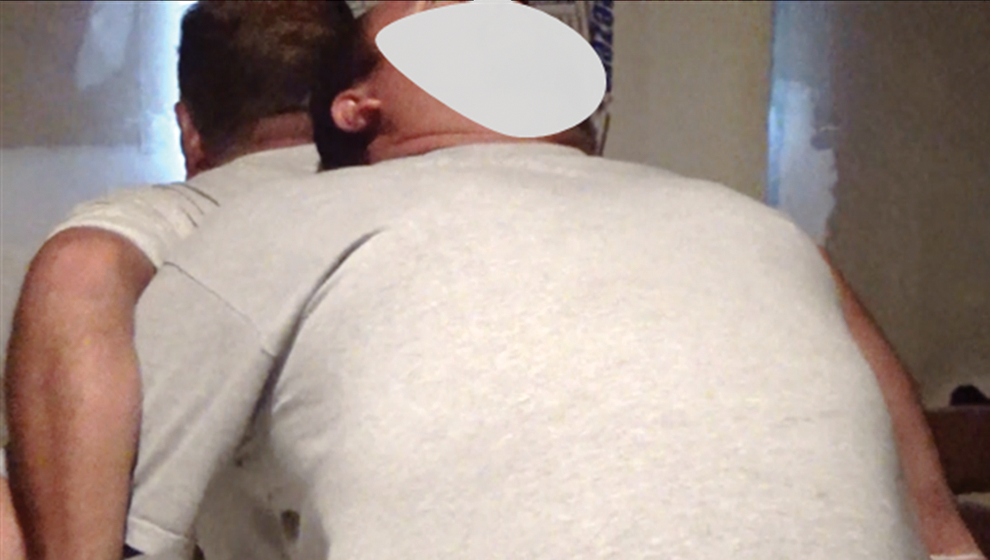
Sobador partially sustaining the weight of a larger patient using his mid-back and arms. Color images available online at
The hands were used by all sobadores as the dominant body part area that made contact with the patient (Fig. 3). The hands of the sobador were used at every treatment session. Sobador B only used her hands. Sobadores A and C also used their arms above the hand as patient contact points. Sobador C used all four body parts.
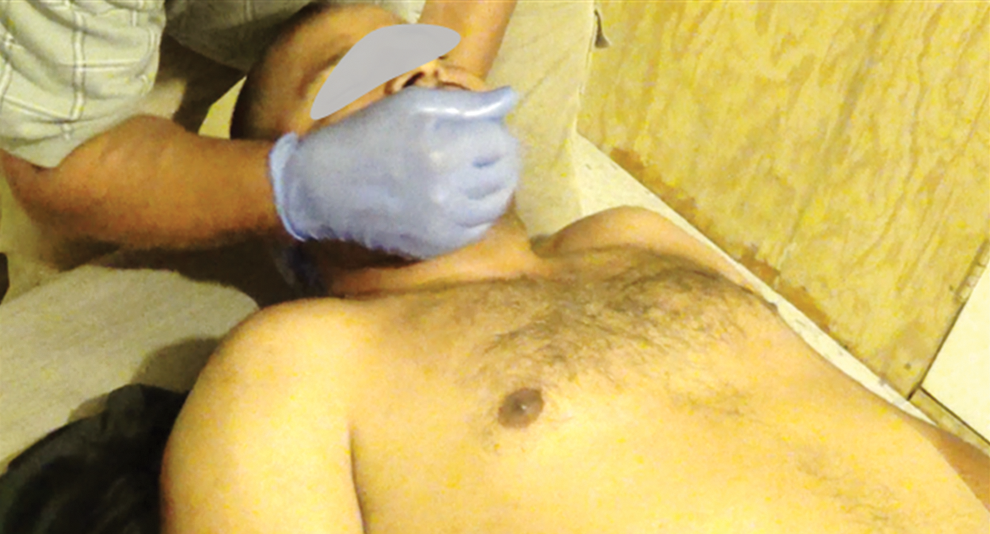
Sobador preparing for a ballistic maneuver. Color images available online at
Sobador adjunctive treatment processes included lubricants, devices, poultices, and other. Each sobador used lubricants of some kind in the manual therapy process. Sobador A used a device to assist with the manual therapy process. This device was a seat belt like strap that Sobador A wrapped around the pelvis of the patient. Using the strap, Sobador A tied a knot around an approximate one foot piece of what appeared to be a polyvinyl chloride pipe (Fig. 4). The sobador tightened the compression of the wrap by torqueing the strap using a polyvinyl chloride pipe. The sobador then performed short manual-therapy processes at the pelvic area while the strap was torqued on the patient's pelvis. Sobador B or C did not use such a device. Sobador C applied a poultice with each of his six patients. He held the poultice in place by supporting it under the patient's clothing, using a flexible support or wrap. He used poultices on a wide variety of body parts: the spine-pelvis, arms, legs, and abdomen, but not the head and ribs. Sobador C drew a small circle on a patient at the lower aspect of the right lower abdominal quadrant with a marker, and Sobador A covered the body of one patient briefly with a cloth after treatment.

Application of manual therapy with a device. Color images available online at
Discussion
Treatment provided by the three sobadores was consistent and similar to that provided by other manual therapies. The range of treatment time of 9–30 min was similar to the treatment spectra that combine techniques used by conventional massage and manipulative practitioners. 16 The patient treatment positions indicated the sobadores were capable of treating patients in multiple positions. The different treatment positions were not extraordinary, given the wide variety of treatment processes used. These five treatment positions were similar to the treatment positions used by conventional manual-therapy practitioners. 17 The patient body part contacted by the sobador indicated the sobadores were treating each of the major parts of the musculoskeletal system. Sobador A's and C's abdominal work suggested that treatment was directed at organs in addition to the musculoskeletal system. While abdominal (visceral) manual therapy (manipulation) is not well known, this method is offered by manual therapists. 18,19
Basic palpation dominated the sobadores' examination methods. Palpation is considered a significant analysis method in manual therapy. 20 The sobadores' primary treatment processes included significant variety. The dominant practice was rubbing. This is consistent with the definition of sobada as massage. Differences in practice preferences were apparent among the sobadores. Massage requires physical strength 21 ; this was especially true of the two male sobadores who used methods that required upper body strength and use of several parts of the body. The female sobador avoided the techniques requiring more upper body strength. The body areas of the sobador that contacted the patient were dominated by the hands. This is consistent with the basic definition of manual therapy. 22 The arm above the hand was used by the male sobadores.
The sobadores all used lubricants, a massage-therapy treatment process. 23 The device used by Sobador A provided torsion pressure to facilitate the manipulative process; such devices are used by conventional manual therapy practitioners. 24 Marking a patient is also a manual therapy practice to help focus the treatment. 25 Sobador C used poultices; although the poultice techniques are traditional, Lewit mentions it as a substitute for electric muscle stimulation in conventional manual therapy. 26
The sobadores' methods are similar to those of other manual therapy practitioners. Massage therapists press, rub, and otherwise manipulate the muscles and other soft tissue. 4 Chiropractors manipulate and mobilize the entire body. 27 Naturopaths employ similar methods of tissue loading (tension, compression, rotation, bending, and shearing). 28 Tuina practitioners, a Chinese system of manual therapy, hold, pull, rock, and manipulate. 29 Ayurvedic massage uses strokes that are used in traditional massage. 30
This analysis adds to knowledge about the use of manual therapy among traditional and conventional healers. It uses relatively distinct terms to provide clear descriptions and understanding of sobadores practices, rather than general statements about massage, mobilization, and manipulation used in earlier discussions. 7,9 It illustrates how Mexican immigrants to the United States, who often face barriers in health-service utilization, want the type of care that sobadores provide. Many immigrants are undocumented and do not have access to insurance through the Affordable Care Act. 31 If conventional providers understand the type of care sobadores provide, they can better direct patients to licensed care that is the same or similar when clinically indicated.
The results of this analysis should be interpreted in light of its limitations. The study is limited to three sobadores treating eight NC patients, and two of these sobadores were recorded treating one patient. Because a wide variety of practices were seen with only three sobadores, we expect that different practices will be documented with additional sobador treatment evaluations.
In conclusion, additional study of video-recorded sobador practices is needed to understand the sobador traditional manual-therapy methods. Video-recorded practice of other traditional and conventional manual therapies for comparative analysis is also needed to delineate the specific similarities and differences among the manual therapies. Comparative documentation will help providers understand the manual-therapy care their patients receive. The delineation of similarities will improve documentation of the efficacy of hands-on therapies.
Footnotes
Acknowledgments
This research was funded by a grant from the National Center for Complementary and Integrative Health (R21 AT007255).
Author Disclosure Statement
No competing financial interests exist.