




Abstract
Objective:
Extracts of the Chinese herb Tripterygium wilfordii Hook F (TwHF) have potent anti-inflammatory functions and are widely used to treat rheumatoid arthritis and Crohn's disease. They have also been considered as potential drugs in the treatment of multiple sclerosis and its animal model, experimental autoimmune encephalomyelitis.
Methods:
A systematic search of MEDLINE, EMBASE, PubMed, and the China National Knowledge Infrastructure (CNKI) was performed. We reviewed many Chinese- and English-language articles.
Results:
Recent studies have indicated that TwHF extracts, such as triptolide and tripchlorolide, are able to attenuate progression of this neuroimmunologic disorder because of their immunoregulatory, neurotrophic, and neuroprotective effects, but use of these extracts is often accompanied by acute and chronic toxicity.
Conclusions:
This review systematically summarizes the effects, safety consideration, and molecular mechanisms of action of TwHF extracts with regard to their inhibition of microglia activation, T cell functions, and transcriptional activation of nuclear factor (NF)-κB signaling.
Composition and Toxicity of Tripterygium wilfordii Hook F
T
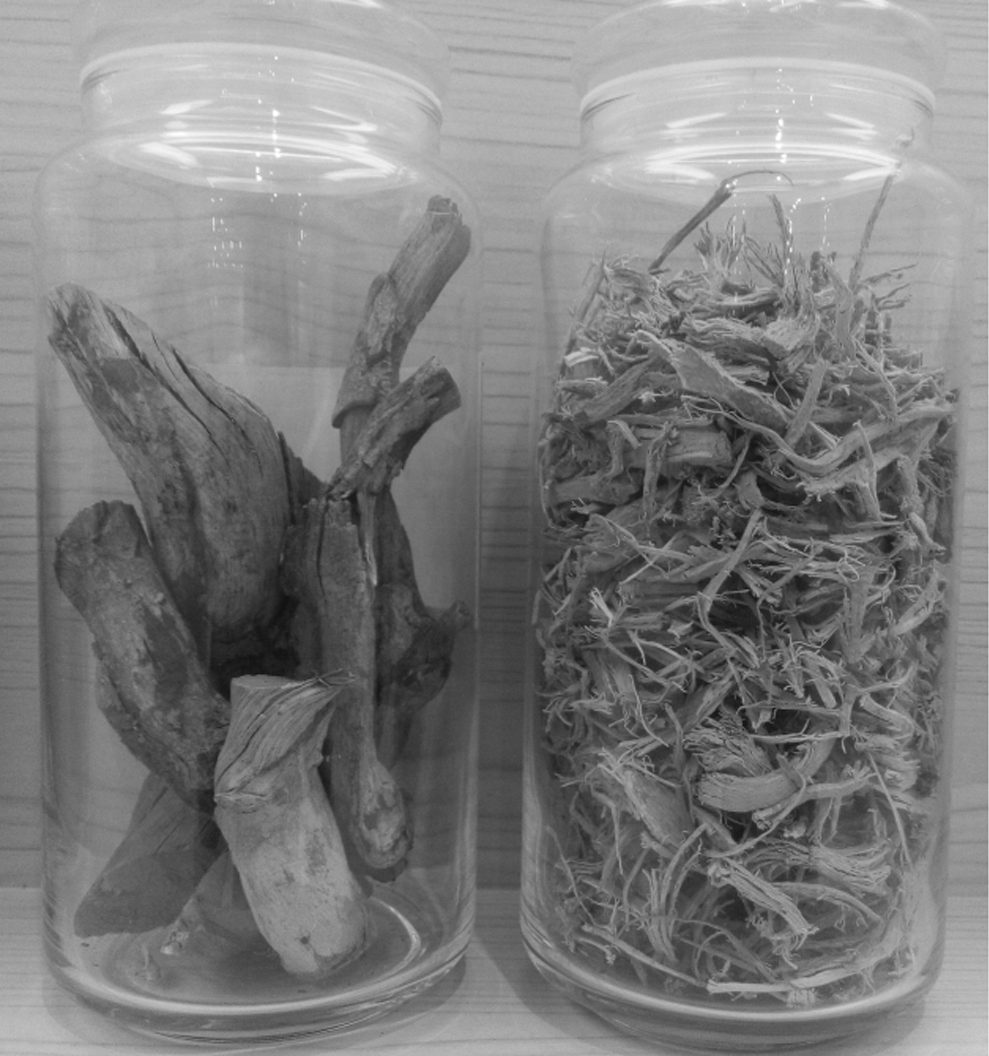
Dried root and rhizome of Tripterygium wilfordii Hook F.
Since tripterine, an effective component, was firstly extracted from TwHF in 1936, 3 more than 100 TwHF extracts have been found, mainly including alkaloids, diterpenoids, triterpenes, sesquiterpenes, and polysaccharides. 4 Studies have focused on diterpenoids, containing triptolide, tripdiolide, 16-hydroxytriptolide, (5R)-5-hydroxytriptolide, tripchloride, and tripterine, all of which have a variety of pharmacologic activities, including anti-inflammatory, anticancer, antibacterial, disinfectious, and anti-HIV effects. 1 However, the toxicity of TwHF extracts, principally manifested as injury to the circulatory, digestive, myocardial, and nervous system and kidney, largely limits their clinical application. 5
Acute toxicity appears at high doses of TwHF preparation, resulting in multiple organ failure or even death. Ni et al. showed that 140 g of TwHF water decoction could induce acute renal failure, circulatory failure, and shock. 6 The safety and efficacy of long-term administration of TwHF were recently studied in a 52-week clinical trial among 198 patients with Crohn's disease treated with high-dose (2.0 mg/kg per day) versus low-dose (1.5 mg/kg per day) TwHF. 7 The results demonstrated that high-dose TwHF induced a more prolonged remission in patients compared with the low-dose formulation, and these two doses resulted in a similar number of chronic adverse events, mainly including leukopenia and hepatic and renal dysfunction. Although 8.8%–11.3% of patients needed to withdraw from the trial, most drug adverse events from TwHF ceased spontaneously or after dose adjustment. A 2.0-mg/kg daily TwHF dose was thus more effective and better tolerated in patients with Crohn's disease, with the requirement of a monthly blood test. 7
The toxic mechanism of TwHF is mainly attributed to therapeutic factors. For example, triptolide, a major active principle of TwHF that is effective in treatments of autoimmune diseases, could markedly induce oxidative stress and the release of lactate dehydrogenase in HepG2 cells. 8 Therefore, many studies have focused on their toxicity by using different methods, mainly including the following: (1) Structure modification of these compounds, 9 such as (5R)-5-hydroxytriptolide (LLDT-8), a triptolide-derived compound, which showed enhanced anti-inflammatory effects with reduced cytotoxicity; (2) a combination of compounds derived from TwHF extracts with compounds derived from other traditional medicines 10 –13 (e.g., TwHF-induced toxicity could be decreased by combination of TwHF and Radix et rhizoma notoginseng); (3) changing formulation and the methods of administration 14,15 (e.g., compared with triptolide, triptolide-loaded nanostructured lipid carriers could prolong mean residence time, delayed Tmax, and decreased Cmax and was associated with reduced subacute toxicity in male rats); (4) effective processing methods 16,17 (e.g., cleansing, sheep-blood processing, and heat processing), which could decrease toxicity and increase efficacy of TwHF.
Efficacy of TwHF on Multiple Sclerosis and Experimental Autoimmune Encephalomyelitis
Multiple sclerosis (MS) is an inflammatory demyelinating disease that causes significant disability for most patients. The pathologic hallmarks for MS include perivascular T cell infiltration and disseminated demyelinating lesions in the white matter of the central nervous system (CNS). 18 Experimental autoimmune encephalomyelitis (EAE) is an experimentally induced inflammatory demyelinating disease of the CNS that has many clinical and pathologic features in common with MS and thus is an animal model of MS. 19 Current MS therapies include corticosteroids, interferon (IFN)-β, mitoxantrone hydrochloride, azathioprine, cyclophosphamide, immunoglobulin, plasma exchange, and stem cell transplantation, but none of them is ideal. 20,21 Much attention has been recently paid to the effect of traditional medicines on MS.
TwHF attracted the interest of researchers on the basis of its excellent pharmacologic activities. TwHF tablets exhibit enhanced clinical effect and immunosuppressive action compared with corticosteroids. 22 Recent studies have shown that triptolide could be an active suppressor of EAE, 23 and LLDT-8, a triptolide derivative, could suppress T cell proliferation and activation, thereby reducing the incidence and severity of clinical paralysis in EAE. 24 Triptolide is also effective for suppressing murine EAE, an effect related to the downregulation of IFN-γ and upregulation of interleukin (IL)-10 secretion in splenocytes. After intervention with triptolide, inflammatory cell infiltration was decreased in both grey and white matter of spinal cords of EAE mice (Fig. 2). 25,26 Together, TwHF extracts could be considered a potential drug for MS.
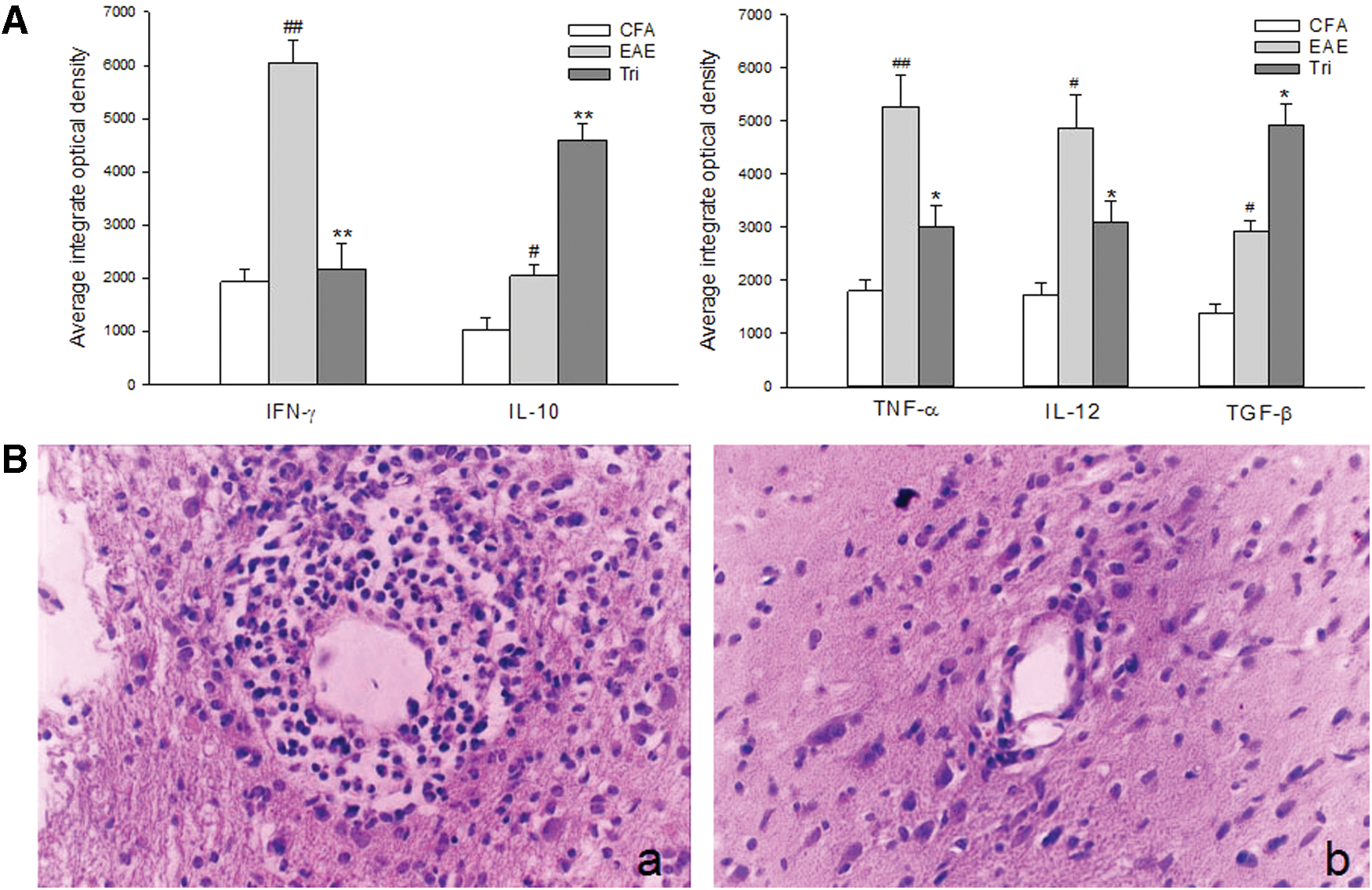
Triptolide effectively suppressed peripheral and central nervous system inflammation.
Mechanisms of Action of TwHF Extracts on MS/EAE
MS is a T cell–induced inflammatory autoimmune disease of CNS. Many different cells and components of adaptive and innate immunity play an important role in the development of MS/EAE, including antigen-specific T cells, activated B cells and plasma cells, activated microglia/macrophages, astrocyte, and monocytes. These cells produce matrix metalloproteinases (MMPs), autoantibodies against neurons/oligodendrocytes, chemokines, and inflammatory cytokines (such as tumor necrosis factor-α [TNF-α], IFN-γ, IL-17, IL-2, and IL-12), all of which could induce demyelination, oligodendrocyte death, and axonal or neuronal injury in the lesions of patients with MS and in EAE. 18,19,27,28 However, the regulatory T (Treg) cells and γδ T cells, which played a crucial role in regulating immune homeostasis and secreted anti-inflammatory factors transforming growth factor-β (TGF-β) and IL-10, had also been detected in lesions. 18 Taken together, the autoimmune inflammation depends on a good balance between inflammatory and regulatory responses, and the relapse/remission of MS has been correlated with increases or decreases in the quantity and activity of immune cells (Fig. 3).

Mechanisms of action of Tripterygium wilfordii Hook F (TwHF) extracts on multiple sclerosis/EAE. TwHF extracts showed immunosuppressive and anti-inflammatory effects through inhibiting immune cell activation and reducing inflammatory factors (  ), increasing the number of regulatory T cells (Treg cells) (
 ), which secrete TGF-β and IL-10, and improving the impermeability of the blood–brain barrier (BBB) by downregulating adhesion molecules (
 ). CNS, central nervous system; Cox-2, cyclooxygenase-2; CXC, chemokine receptor; ICAM-1, intracellular adhesion molecule-1; iNOS, inducible nitric oxide synthase; MMP, matrix metalloproteinases; PGE2, prostaglandin E2; Th, T helper; VACM-1, vascular cell adhesion molecule-1; VLA-4+, very late antigen-4+. Color images available online at
Anti-inflammatory effect of TwHF extracts on MS and EAE
Anti-inflammation has been recognized as the main bioactivity of TwHF extracts, which had exhibited excellent therapeutic effects on MS and EAE. This bioactivity is mainly mediated by the following mechanisms: (1) inhibiting the secretion of a variety of proinflammatory mediators that mediate inflammatory and immune injury and (2) inhibiting the activation of inflammatory cells through inhibiting their signal pathways, such as the nuclear factor (NF)-κB signal pathway (Fig. 3). In lesion of MS and EAE, T helper (Th) 1 and Th17 cells are the effector T cells, which can secrete many pro-inflammatory cytokines, including IL-17, IL-6, IL-1, IFN-γ, and TNF-α, and blocking the function of these cells and cytokines effectively inhibits CNS inflammation. 29,30 Thus, while the key for suppressing MS/EAE is reducing pro-inflammatory cells and their cytokine production, TwHF extracts may well meet this goal.
Fu et al. 24 reported that LLDT-8 inhibited MOG35–55-induced T-cell proliferation and activation in EAE, and triptolide downregulated Th17 cell differentiation via regulating cyclooxygenase-2/prostaglandin E2 (COX-2/PGE2) axis in synovial fibroblasts from rheumatoid arthritis. 31 Triptolide also significantly inhibited the combination of nuclear translocation GATA3 or nuclear factor of activated T cells and IL-13 gene promoter in activated T cells, thus downregulating IL-13 production. 32 Furthermore, triptolide inhibited expression of TNF-α, IL-12, and IL-6, 33 all of which play important roles in EAE development.
One of the hallmarks of MS/EAE lesions is the activation of microglia, the CNS resident immune cells that play a key role in neuroinflammatory reaction. Hyperactive microglia lead to neuronal damage by releasing a variety of cytotoxic mediators, including chemokines, pro-inflammatory cytokines, arachidonic acid derivatives, excitatory amino acids, and reactive oxygen intermediates. Triptolide was able to inhibit microglia activation and proliferation and reduce the secretion of TNF-α and IL-1β in microglial cultures in a dose-dependent manner. 34 Triptolide also inhibited COX-2, CCL2, CCL5, PGE2, and intracellular superoxide anion expression in microglia. 27,35 –37 Furthermore, tripchlorolide significantly reduced inducible nitric oxide synthase and nitric oxide in both mRNA and protein levels in activated microglia. 38 Similarly, triptolide hampered spinal nerve ligation–induced activation of glial cells (astrocytes and microglia) in the spinal dorsal horn without influencing neurons, indicating a direct inhibition of glial activation. 39 Together, these findings offer clear evidence that TwHF extracts could suppress differentiation, activation and trafficking of microglia.
Anti-inflammatory effect of TwHF extracts is through inhibiting NF-κB activity
NF-κB is the key transcription factor that governs expression of genes encoding pro-inflammatory cytokines and enzymes, including IL-1, IFN-γ, TNF-α, and COX-2. 40 Increased NF-κB DNA–binding activity in microglia and invading macrophages was observed in active lesions in patients with MS, which induces serious neurotoxicity. 41 TwHF extracts could inhibit early cytokine gene transcription in related inflammatory cells at the NF-kB target sequence after specific DNA binding. 42 TwHF extracts also suppressed NF-κB–binding activity in various immune cells, such as lipopolysaccharide (LPS)-stimulated Raw 264.7 cells, astrocytes, and dendritic cells. 43 –46 Triptolide may exert its immunosuppressive effects on NF-κB activation in the nucleus after the development of high-affinity specific DNA binding 47 or inhibit NF-κB nuclear translocation by inhibiting phosphorylation and degradation of IκBα. 33 Triptolide also potently diminished LPS-induced COX-2 expression and PGE2 synthesis in microglial cultures, and its anti-inflammatory effect may be via a mechanism that involves inactivation of the p38-NF-κB-COX-2-PGE2 signaling pathway. 48 Furthermore, tripchlorolide and triptolide could induce apoptosis of inflammatory cells and protects neuronal cells from microglia-mediated β-amyloid neurotoxicity through inhibiting NF-κB and mitogen-activated protein kinase pathway. 49,50 In addition, triptolide sensitized glioma-initiating cells to temozolomide, thus synergistically augmenting repression of NF-κB signaling and enhancing apoptosis of these cells. 45 These results indicate that TwHF extracts can play the anti-inflammatory effect by affecting all of the steps of NF-κB activation, including phosphorylation, ubiquitination, degradation of IκB, nuclear translocation, and DNA binding of NF-κB.
Immunoregulatory effect of TwHF extracts on MS and EAE
Because Treg can suppress the inflammation induced by effector T cells, as shown in Figure, it will be important to define the factors/approaches that control the quantities of Treg cells or the balance between Treg and effector T cells. Indeed, IFN-β and glatiramer acetate, two clinically used MS medications, suppress the production of pro-inflammatory cytokines by inducing Treg cells. 51,52 Similarly, TwHF extracts may also be able to regulate the balance between Treg and effector T cells. For example, triptolide not only inhibited proliferation of MOG35–55–specific T cells and Th1/Th17 differentiation 24,53 but also upregulated expression of Forkhead box p3, an important marker for CD4+CD25+ Treg cells, in splenocytes. 33 These effects indicate an immunomodulatory effect of TwHF extracts.
Effect of TwHF extracts on blood–brain barrier
The CNS is isolated from systemic circulation by the blood–brain barrier (BBB), which is composed of two basement membrane layers: one consists of endothelial cells of blood vessels, and the other astrocyte end feet. With the increase in the expression of vascular cell adhesion molecule-1, intracellular adhesion molecule-1, and integrin very late antigen-4+, Th1 and Th17 cells are able to transmigrate the BBB into the CNS of patients with MS. 18,19 These cells in the brain then release a large amount of matrix metalloproteinase-9 (MMP-9), which further injures the BBB (Fig. 3). TwHF extracts could hinder the pathological process through reducing the above-mentioned factors. Indeed, triptolide treatment reduced MMP-9 expression in CNS of EAE rats 54 and downregulated intracellular adhesion molecule-1 expression, 55 thus preventing a tight binding of the T cells to the endothelial cells and trafficking immune cells through the BBB and inhibiting the entry of T cells into the CNS parenchyma.
Neuroprotective Effect of TwHF Extracts
Accumulating data in recent years have demonstrated the neuroprotective potentials of triptolide, which protects neural cells and promotes nerve regeneration and functional recovery after spinal cord and brain injuries. 56, 57 The mechanism underlying these effects may include the following aspects: (1) suppressing the production of pro-inflammatory cytokines within injured nerves (as shown in an in vitro study, triptolide protected dopaminergic neurons from inflammation mediated damage through inhibiting chemokine receptor-2 activity 58 ); (2) inhibiting antioxidative stress (e.g., the neuroprotective effects of triptolide may be partially mediated by the direct inhibition of COX-2 expression and PGE2 production 59 ); and (3) inhibiting activation of NF-κB and phosphorylation of p38, extracellular signal-regulated kinase 1/2 (p42/p44), and protein kinase B of neuronal cells. Indeed, the inhibitory effect of triptolide on NF-κB activation may contribute to its neuroprotective effect against LPS-elicited decrease in dopamine uptake. 60 These findings indicate the possibility of triptolide as a therapeutic agent for neuronal injury. Together, triptolide may protect neural cells from damage induced by various neurotoxins by its anti-inflammatory, antioxidative stress properties. 61
Summary
TwHF extracts consist of a variety of promising compounds with multiple bioactivities, particularly in nervous system autoimmune diseases. The precise mechanisms of their action have not yet been elucidated; understanding the detailed action and targets of TwHF extracts is, therefore, essential for enhancing their therapeutic efficacy and reducing systematic toxicity in clinical application. With the progress being made in neuroimmunologic research, TwHF extracts could be a potential therapy for autoimmune diseases of the CNS, but with close monitoring of their side effects and toxicity.
Footnotes
Acknowledgments
This study was supported by the 2011 Cultivation Project of Shanxi University of Traditional Chinese Medicine (no. 2011PY-1), Research Project Supported by Shanxi Scholarship Council of China (2014-7), Doctoral Scientific Research and Startup Foundation for Doctors of Shanxi Traditional Chinese Medicine College, and Shanxi University of Traditional Chinese Medicine Fund (no. 81473577). The authors thank Katherine Regan for editorial assistance.
Author Disclosure Statement
No competing financial interests exist.