




Abstract
Objective:
This study analyzed the efficacy of aromatherapy in improving work performance and reducing workplace stress.
Subjects:
The initial sample comprised 42 administrative university workers (M age = 42.21 years, standard deviation = 7.12; 10 male).
Intervention:
All sessions were performed in a university computer classroom. The participants were randomly assigned into an aromatherapy group (AG) and a control group (CG), and they were invited to participate in a specific session only once. They were seated in front of a computer. During the intervention period, some oil diffusers were switched on and were in operation throughout the session with petitgrain essential oil for AG sessions and a neutral oil (almond) for CG sessions. At the same time, participants completed a computer task on a specific Web site typing on their keyboard until they had finished it. The single times were different for all participants and were recorded on the Web site as “performance time.”
Outcome measures:
Before and after the intervention, participants completed anxiety and mood state questionnaires (the Stait–Trait Anxiety Inventory [STAI] and the Profile of Mood States [POMS]). Heart-rate variability (HRV) was measured before (PRE), during (20–25 min), and after (POS) the intervention to analyze autonomic nervous system regulation.
Results:
The AG performed the Web site task 2.28 min faster than the CG (p = 0.05). The two groups showed differences in the following HRV parameters: low frequency (p = 0.05), high frequency (p = 0.02), standard deviation of all RR intervals (p = 0.05), and root mean square of differences (p = 0.02). All participants in all groups showed a decrease from PRE to POST for STAI (p < 0.001), Tension-POMS (p < 0.001), and Vigour-POMS (p = 0.01) scales.
Conclusions:
Aromatherapy (inhaling petitgrain essential oil) can improve performance in the workplace. These results could be explained by an autonomic balance on the sympathetic/parasympathetic system through a combined action of the petitgrain main components (linalyl acetate, linalool, and myrcene). The final effect could be an improvement of the mental and emotional condition by a combination of reducing the stress level and increasing the arousal level of the participants in terms of attentiveness and alertness.
Introduction
W
Many stress reduction–related methods have been investigated, and various approaches have been involved in workplace stress management. Aromatherapy is one of these approaches, thanks to its easy implementation and effectiveness. 6 It is used by an increasing number of people around the globe, and clinical research into this field is also expanding every year. This discipline has grown in importance as an area in alternative medicine with proven high efficacy in reducing stress and improving mood disorders. 7 Aromatherapy is an ancient tradition herbal medicine, and it was used in some ancient countries, such as Egypt, China, and India, thousands of years ago. It is a kind of natural treatment method utilizing the chemical structure and effects of plant essential oils, which when extracted from herbs, roots, leaves, flowers, and other plant parts can be used to treat various diseases. 8
Aromatherapy has significant therapeutic potential because each essential oil has a unique combination of chemical compounds that interact with the body's chemistry and thereby affect specific organs, systems, and the body as a whole. For example, some studies have shown that certain essential oils decrease anxiety-related behavior and improve some illnesses in humans and animals. 9,10 Essential oils are the principal component of aromatherapy. They are concentrated volatile compounds formed as secondary metabolites in aromatic plants and are characterized by a strong odor. Their biological effects may be the result of the synergistic effect of all the molecules together or only of the main molecules found in larger concentrations in these oils. 11
The essential oil can be absorbed into the body through three main channels: the skin, the digestive system, and the olfactory system. Sense of smell plays an important role in the physiological function of an individual because the olfaction response is immediate and it is directly extended to the brain; it seems to be related to emotional behavior. 12 The odor molecules of essential oils are transported to the brain by olfactory sensory neurons in the nasal cavity. Thus, they stimulate smell–memory work and influence memory, thoughts, and emotions. Even a small amount of smell molecules taken by respiration causes an indirect physical effect by activating smell memory or by infiltrating the blood. 13,14 The inhalation of essential oils triggers an olfactory response that leads to powerful mental and emotional behavioral changes, which address the body, mind, and spirit for mental, emotional, and physical wellness. 15 Some studies have shown that aroma has an important impact on attention level, cognitive performance, creativity, mathematical success, writing skills, motor skills, and increased perception and memory. 16
The present study pays particular attention to the essential oil petitgrain (Citrus aurantium (fe); CA). CA belongs to a large family, Rutaceae, members of which are cultivated worldwide as fruit crops. Traditionally, populations in several countries have relied on preparations obtained from Citrus species to treat problems related to the nervous system, especially symptoms of anxiety or insomnia. 17 In folk medicine, CA is used for the treatment of sunstroke and gastrointestinal disturbances. It is also known to be a relaxant. 18 Recently, some studies have shown that CA has sedative and anxiolytic-like effects. Lehner et al. found that CA reduced the anxiety levels of patients, specifically women, when this oil was scattered in the lobby of a dental office. 19 Another study showed that CA (administered orally and derived from the petals and stamens of petitgrain oil) reduced the preoperative anxiety of patients scheduled for elective minor surgery. 20 CA has increasingly been used in several studies, and its chemical components have been described as linalool (20.2–27%), linalyl acetate (45–55%), and myrcene (1.3–12.12%). 21 Myrcene, a kind of monoterpene, is a component biologically active in the central nervous system. 17,21 The other main components—linalool and linalyl acetate—have sedative effects. 21,22
The absorption of essential oil via inhalation may affect the autonomic nervous system (ANS) and induce the reaction of the limbic system, hypothalamus, and hormone system. It could affect both parts—the sympathetic nervous system and the parasympathetic nervous system—which function primarily in opposition to each other. 6
Heart-rate variability (HRV) has become a popular research tool because it reflects changes in the cardiac autonomic regulation. 23 Hence, HRV is considered as a window to the ANS. HRV analysis is a valuable, simple, and non-invasive method for analyzing the continuous changes in the sympathetic–parasympathetic balance of the ANS. HRV refers to the variation in the time interval between consecutive heartbeats (the RR interval), and when there is variation at rest, it can be interpreted as a sign of healthy cardiac function. 24 This analysis has been established during the past few decades as a reliable tool to assess the status of the cardiovascular autonomic function. Thus, it has been frequently used in the analysis of physiological signals in different clinical and functional conditions. 25
Taking all this into account, the purpose of this study was to analyze the efficacy of aromatherapy in improving work performance and reducing the workplace stress. Specifically, the effects of smelling CA during a simulated computer work session were examined to see if performance time when typing on a keyboard improved. At the same time, the possible effects of HRV and mood/anxiety state questionnaires were analyzed to explain the results in terms of sympathetic–parasympathetic balance, stress reduction, and changes in arousal or attention level.
Material and Methods
Participants
The initial sample comprised 42 administrative university workers (M age = 42.21 years, standard deviation [SD] = 7.12; 10 male). All participants met the following inclusion criteria: (1) aged between 26 and 55 years; (2) no clinical diagnosis of autonomic dysfunction; (3) no clinical diagnosis of respiratory, cardiovascular, endocrine, or systemic disorder; and (4) no problems with olfactory function. All participants consented to collaborate voluntarily and provided informed consent before participating in the study. The ethics committee of the university approved the study in advance.
Study design
A randomized controlled trial was used. The participants were recruited from university administrative staff through an institutional e-mail advertisement. All of them were used to sitting and typing in front of a computer for most of the working day. The participants were randomly assigned to the aromatherapy group (AG) or the control group (CG), and they were invited to participate in specific sessions for each group on different days. They were not aware of which group they were assigned to. Explanations were provided regarding the nature and purpose of the study: to investigate coping effects of plant fragrance on workplace stress. All participants were asked not to consume any food or beverages containing alcohol or caffeine after the evening of the day preceding the experiment. They were also asked not to do vigorous physical activity for 24 h before testing.
Aromatherapy and essential oils
The participants inhaled essential oils from four diffusers that allowed the smell to be dispersed fully throughout the room. Two kinds of oils were used, one for each group. The AG inhaled petitgrain oil (CA; Italian, Production batch: IF745, Neroly Co. Ltd, Hong Kong). The CA that was used was 100% pure, and it was diluted to 2%. The predominant constituents were linalyl acetate (45–55%), linalool (20–27%), and myrcene (1.3–12.12%). The CG inhaled sweet almond oil (Prunus dulcis, mill [PD]; American, Production batch: YA637; Neroly Co. Ltd). The predominant constituents were palmitoleic acid (60–68%), linoleic acid (17–30%), and palmitic acid (6–8%). PD is a vegetable oil and has a neutral smell.
Questionnaires
This study used three cognitive instruments. The first was a global “Feeling Scale,” asking “how do you feel today?” Participants had to choose one value on a 0–10 scale (where 0 = “very bad” and 10 = “very good”). The second instrument was a short version of the Profile of Mood States (POMS). 26 Fifteen items measure mood states by five scales: the Tension scale, where the higher the score, the more tense the subject is; the Depression scale, where the higher the score, the more depressed the participant is; the Hostility scale, where the higher the score, the more hostile the subject feels toward others; the Vigor scale, a positive scale, where the higher the score, the more energy the subject has; and the Fatigue scale, where the higher the score, the more tired the participant feels. All five scales contain three items that are scored on a scale from 0 = “nothing” to 10 = “very much.” The third instrument was the State–Trait Anxiety Inventory (STAI), 27 which was used to measure the participants' pre- and post-intervention cognitive anxiety. The STAI scale comprises 20 items, and the participants were asked to rate the intensity of each symptom on a scale ranging from 0 = “not at all” to 3 = “very much,” resulting in scores ranging from 0 to 60. The higher the score, the more anxiety state the subject has.
HRV instruments
Participants' session ratings of continuous heart rate (RR or beat-to-beat cardiac intervals) were collected and analyzed with Fitlab® Team system (
Procedure
The participants were randomly distributed into six sessions (seven subjects each) on different days, three for the AG and three for the CG. All sessions were performed in a university computer classroom between 10:00am and 11:30am, and each participant attended a session only once. When the participants arrived at the computer classroom, they were asked to wear the cardiac chest band (Bluetooth connected) and to rest in a sitting position in front of a computer, as they would in their workplace. First, participants were required to fill out the STAI-State, POMS, and the Feeling Scale questionnaires. Second, HRV-Pre was tested for 5 min with the participants at rest (sitting, with the eyes open, placing the hands on their knees, with no activity, with natural breathing, and without speaking; see Fig. 1). Third, at the end of HRV-Pretest, the oil diffusers were switched on and remained operational throughout the session with CA for the AG sessions and PD for the CG sessions (Fig. 1A). At the same time, a researcher explained for about 15 min how to complete a neutral computer task on a specific Web site. This task was the same for all participants, and consisted of completing 10 standard forms. All participants began to complete this task individually, typing on their keyboard until they had finished it (step B–D in Fig. 1). The single times (B–D) were different for all participants, and were recorded on the Web site as “Performance Time.” A period of 5 min-HRV (Fig. 1C) was recorded at 20–25 min after the start of the inhalation period (A). 28 By 40 min after inhalation began (A), all participants had finished their Web site task, and their HRV was recorded for a period of 5 min (POST; step D–E in Fig. 1), under the same conditions as the HRV-Pretest. Finally, participants were asked to fill out the POST questionnaires (STAI-State, POMS, and the Feeling Scale).

Experimental procedures and data collection. Before: State–Trait Anxiety Inventory (STAI) and Profile of Mood States (POMS) questionnaires. PRE: 5 min HRV-Pretest.
HRV analysis
RR intervals from 5 min periods were analyzed in accordance with the recommendations of the Task Force of the European Society of Cardiology and the North American Society of Pacing and Electrophysiology. 29 For the time-domain analysis, the mean of RR intervals (RRmean), the standard deviation of all RR intervals (SDNN), and the root mean square of differences (RMSSD) of successive RR intervals were calculated. For frequency domain analysis, all RR series were resampled at 3 Hz using a cubic spline prior to the HRV analysis. The power spectrum of the resampled time series was estimated using a fast Fourier transform algorithm after removing the mean of the time series and multiplying the time series by a Hann window. The power of the very low frequency band (VLF) was estimated by integrating the power spectrum for frequencies <0.04 Hz. Accordingly, the power of the low frequency (LF) band was computed in the range 0.04–0.15 Hz, and the power of the high frequency (HF) band was computed in the range 0.15–0.4 Hz. Additional calculations included the LF/HF ratio, LF, and HF values expressed in normalized units (LFnu and HFnu).
Statistical analysis
Data are expressed as the mean ± SD. One-way analysis of variance (ANOVA) was used to detect possible differences between the AG and the CG in all parameters and variables of the study. An ANOVA according to a general linear model (GLM) was performed to show HRV differences between the two groups in terms of evolution throughout the three HRV stages of the session (PRE, 20–25 min, and POS). A power analysis was calculated (α = 0.05), and the results ranged between 0.500 and 0.996 for the different significant parameters. All calculations were performed using the IBM SPSS Statistics for Mac OS v21 (IBM Corp., Armonk, NY). The significance threshold was set at p < 0.05. Calculation of HRV parameters was carried out with MATLAB.
Results
Among the 42 initial participants, five did not complete the study because they showed too many artefacts in the HRV recordings. In the AG, 20/21 participants completed the study; in the CG, 17/21 participants completed the study. There were no statistically significant differences between the AG and the CG with regard to age (AG: 43.0 ± 6.4 years old; CG: 43.2 ± 6.8 years old) or sex (AG: 20% male; CG: 31.6% male; see Table 1). No significant differences between the two groups were found for HRV control variables such as taking medication, doing physical activity, and drinking coffee.
NS, no significance.
The one-way ANOVA showed that the AG performed faster than the CG did: the performance time for the AG was 17.35 ± 3.13 min, and for the CG it was 19.63 ± 3.87 min (p = 0.05; see Table 1).
Table 2 shows the differences in the HRV parameters between the two groups at baseline (PRE), at 20–25 min from the start of the inhalation period, and after the inhalation period (POS). An ANOVA according to a GLM showed differences between the two groups in terms of evolution throughout of the three stages of the session (PRE, 20–25 min, and POS) for the following HRV spectral parameters: LF, such that AG showed a larger LF decrease between PRE and 20–25 min than CG did, and CG showed a larger LF increase between 20–25 min and POS than AG did (p = 0.05; see Fig. 2A); HF, such that AG showed a larger HF decrease between 20–25 min and POS than CG did, and CG showed an HF increase at this stage (p = 0.02; see Fig. 2B). Figure 2C and D shows the differences between groups with a trend to significance for HFnu (p = 0.08) and LFnu (p = 0.08). The VLF parameter also showed a trend toward statistical significance (p = 0.058). GLM analysis showed differences between the two groups for the time domain HRV parameters: SDNN (p = 0.05; Fig. 2E) and RMSSD (p = 0.019; Fig. 2F). There were no significant differences between the two groups for the ratio LF/HF, RR mean, and HR mean.
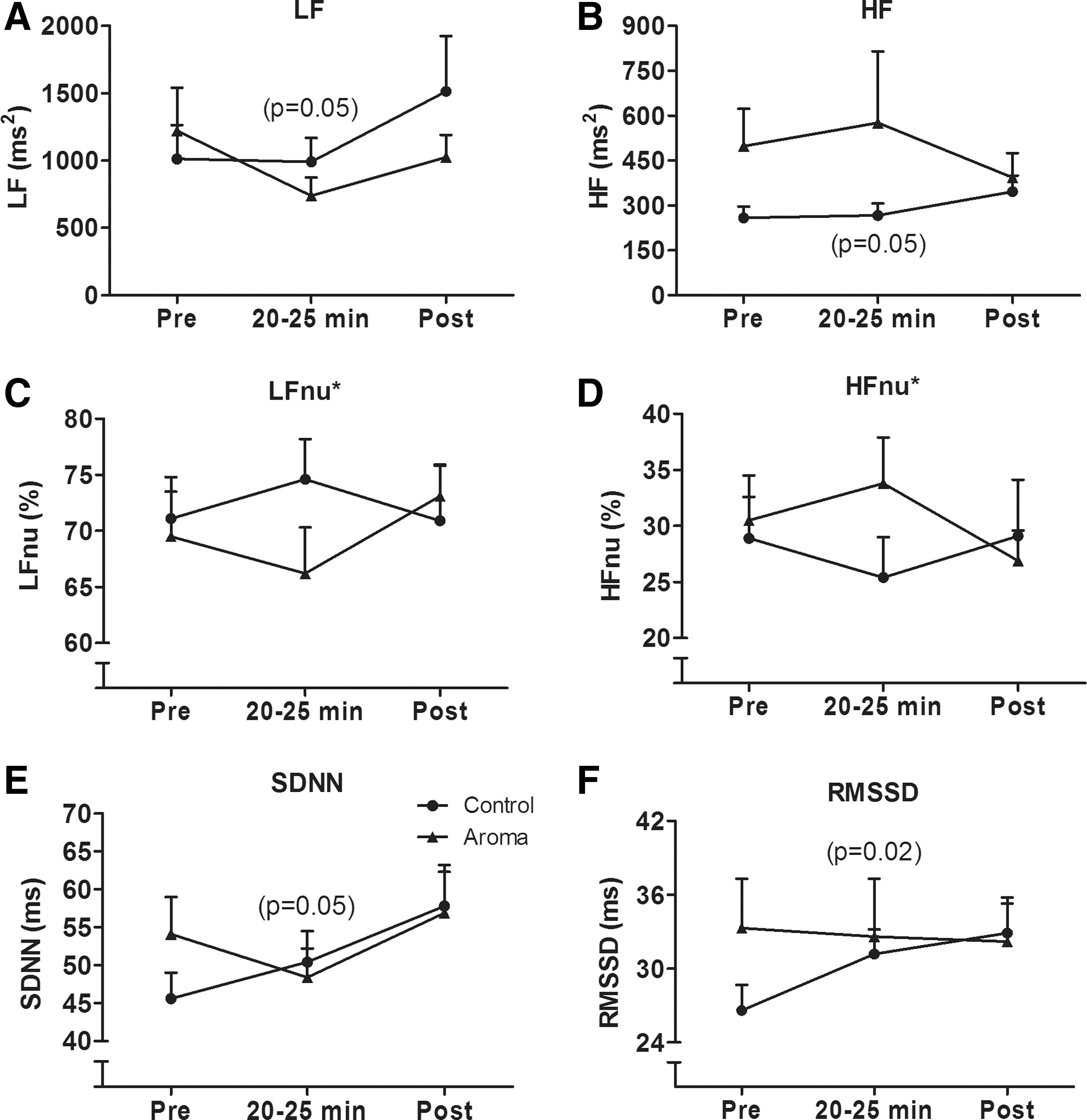
Comparison of HRV parameters during the inhalation period between the two groups at baseline (PRE), at the 20–25 min period, and after the inhalation period (POST).
Total differences for all sample: POST > PRE.
Total differences for all sample: PRE > POST.
Trend to significant differences between the two groups.
Significant differences between the two groups.
HRV, heart-rate variability; HR, heart rate; SDNN, standard deviation of all RR intervals; RMSSD, root mean square of differences of successive RR intervals; LF, low frequency; HF, high frequency; NS, no significance; VLF, very low frequency.
There are no differences in the questionnaires scorings between the two groups in terms of evolution from before (PRE) to after (POST) the session. However, there were significant differences for all participants, not group depending, between PRE and POST for the STAI (p < 0.001), Tension (p < 0.001), and Vigour (p < 0.015) scales. In all cases, the participants showed a decrease from PRE to POST.
Discussion
This study confirms the importance of aromatherapy as a way to improve quality of life and performance in the workplace. Inhaling CA in a simulated computer work session improved the performance time when typing at a keyboard, and it also produced some changes in HRV. Thus, the AG (inhaling CA) finished the task >2 min before the CG (inhaling PD), when doing the same task, which consisted of completing specific web forms. With the aid of the HRV analysis, this result can be explained by a combination of reducing the stress level and increasing the attention level of the participants.
A very common workplace task in all the world was chosen for this study. Typing with a keyboard in front of a computer for a full workday is a usual task in many jobs such as university staff, bank staff, or administrative staff in any company. The participants in this study were administrative university staff, and a non-specialized computer task was chosen: to complete a limited number of questionnaires and self-reports about the participant's own lifestyle. Thus, there were no right or wrong answers, and all participants knew the answers. The best performance required thinking of the answers quickly and typing fast on the keyboard. All items had to be completed, after which the participant was asked to click on the last option of “Save.” An individualized report was provided to all participants about their lifestyle, and all of them completed the items with coherent answers. The participants were randomly assigned to two groups, so that they were balanced in terms of mental and typing agility. Hence, under these conditions, the performance improvement of the AG group (>2 min faster than the CG) must be attributed to the aromatherapy effects (inhaling CA).
The problem of job-related stress is currently increasing and is potentially affecting employee performance and personal health. 30 Studies have been carried out about relieving mental load in the workplace through strategies such as analyzing exercise effects on autonomic balance, 25 or the effects of aromatherapy in alleviating work-related stress. 31 A growing number of studies have described the efficacy of aromatherapy in this field. 32 However, few studies have examined the effects of aromatherapy directly on work performance through the autonomic balance. This study has contributed to this by using HRV analysis to explain the performance improvement in the AG by stress reduction due to the effect of aromatherapy.
This stress reduction could be explained by a specific effect on the ANS. For this purpose, this study analyzed HRV in three 5 min periods: before inhalation, 20 min after inhalation began, and after the inhalation period. The main HRV findings reveal significant differences between both groups in HF- and LF-related parameters. These indexes have been used to reflect primarily sympathetic and parasympathetic influences. 33 The larger LF decrease between PRE and 20–25 min in the AG could be explained by a specific effect of inhaling CA reducing the sympathetic activity during the task performance. Otherwise, the sympathetic effect could be effective during the last session period, where the CG shows a larger LF than the AG did. In this last session period (between 20–25 min and POST), the parasympathetic activity (showed by HF) is different in both groups. This same trend can be seen for the standardized parameters. Thus, the most important aromatherapy effect is the increase in parasympathetic activity (HF and HFnu increases) for the AG between PRE and 20–25 min, combined with a decline in sympathetic activity (LF and LFnu decreases) for this group in the same period. These changes could produce a sympathetic/parasympathetic balance of the ANS, improving attention control and facilitating performance. In addition, the significant decrease of the SDNN parameter in the AG during the task (PRE and 20–25 min) means less cardiac variability than the CG, and could be interpreted as an increase in arousal. This higher arousal could enable the AG to pay more attention to the task, thereby improving performance. Thus, inhaling CA could improve the mental and emotional condition in terms of attentiveness and alertness.
The study also analyzed the cognitive levels of anxiety and mood state as stress symptoms. However, no differences were found between the two groups. Significant differences were found for all participants for anxiety scores (STAI) and psychological tension (POMS). They showed less anxiety values after the session, but these global results were expected because they had just performed a theoretical stressful task. More than one aromatherapy session may be needed to obtain more cognitive anxiety reduction in the AG. What is the mechanism of action underlying the performance improvement effect of inhaling CA? Aromatherapy could drive ANS activity toward a balanced state. 6 This balance could be explained by the combined action of CA's main components. Some of these components have a sedative effect, such as linalyl acetate and linalool, which could induce changes on the parasympathetic activity. 22 In line with this, Kuroda et al. found that HF power increased more significantly at 21 min after 6 min of olfactory stimulation with linalool. 34 In a similar vein, the present study found changes at 20–25 min after starting the inhalation period. Thus, CA seems to have an increasing effect on parasympathetic activity in the AG (HF and HFnu), which was clearly higher at the end of the session (POST). Meanwhile, the CG decreased HF and HFnu values in the POST period. Myrcene is another component in CA that could have some activation effects by stimulating the sympathetic activity. 15 Myrcene, a kind of monoterpene (1.3–2.12%), could possibly be related to the release of norepinephrine, a neurotransmitter linked with the sympathetic activity stimulation. 6 This could help to explain the increase in arousal levels in the AG. Similar results have been found with inhaling pepper oil, which induced an increase in adrenaline concentration, while inhalation of rose oil decreased the adrenaline level. The same stimulating effects of essential oils on sympathetic and parasympathetic activity have been reported, for example estragon oil or grapefruit oil. These essential oils, like pepper oil, consist of components such as limonene, pinene, or methyl chavicol, which possibly mediate the stimulating effect on sympathetic activity. Furthermore, alcohol such citronellol, geraniol, nerol, and patchouli alcohol were detected in rose oil and patchouli oil, which induced inhibition of parasympathetic activity. 35
The olfactory system interactions could be another mechanism of action to explain the effects of CA through an interaction with central nervous system structures (e.g., hypothalamic, limbic, thalamic), which control the level of autonomic and behavioral arousal. 9 The olfactory neuroanatomy is intertwined, via extensive reciprocal axonal connections, with primary emotion areas, including the amygdala, hippocampus, and orbitofrontal cortex and other parts of the limbic system. The odor molecules of essential oils are transmitted to the brain by olfactory sensory neurons in the nasal cavity. Thus, they stimulate smell–memory work and influence memory, thoughts, and emotions. 36 Further studies are needed to evaluate the olfactory system interactions and another possible action mechanisms underlying the workplace stress and performance improvement effect of aromatherapy.
Conclusion
This study confirms that aromatherapy (inhaling petitgrain essential oil) can improve performance in the workplace. The most important aromatherapy effect was the increased parasympathetic activity for the AG between PRE and 20–25 min period, combined with a decline in sympathetic activity for this group in the same period. These changes could produce a sympathetic/parasympathetic balance of the ANS, improving attention control and facilitating performance. This balance could be explained by a combined action of the petitgrain main components (such as linalyl acetate, linalool, or myrcene). On the one hand, some of these components have sedative effects, which could induce changes on the parasympathetic activity. On the other hand, other components could have some activation effects by stimulating the sympathetic activity. The final effect could be an improvement of the mental and emotional condition by a combination of reducing the stress level and increasing the arousal level of the participants in terms of attentiveness and alertness.
Footnotes
Acknowledgment
This study has been supported by the Spanish grant DEP2015-68538-C2-1-R from Ministerio de Economía y Competitividad (Spanish government).
Author Disclosure Statement
No competing financial interests exist.