




Abstract
Background/Objective:
Bodily processes have been intimately linked to social-cognitive and affective functions, such as compassion and empathy. Yet, little is known about how awareness of bodily processes influences social awareness and vice versa, especially in nonobservational but experiential investigations. This study investigated the relationship between psychometrically reported body and social awareness (including altruism, empathy, perspective-taking, and compassion) in 90 yoga and yoga-/mediation-naive control participants. In modern postural yoga, advanced practitioners claim both increased compassion and inner focus.
Methods:
Multiple regression analyses were conducted to predict (1) the level of yoga practice from body awareness and social awareness skills in the yoga group and (2) body awareness from social skills in both groups.
Results:
Body awareness and compassion were significant positive and independent predictors of yoga expertise. This finding supports practitioners' anecdotal claims but also implies that both functions tap into different aspects of yoga expertise. When body awareness was predicted, altruism emerged as a significant negative predictor in the yoga group (but not control group) as a function of yoga practice.
Conclusion:
These results might compellingly suggest that, despite high compassion, heightened bodily self-awareness might increase a self-centred perspective and limit altruistic acts in advanced yoga practitioners.
Introduction
B
Recent lines of evidence on this matter stem from interoception research related to the perception of visceral activity from inner organs (e.g., heartbeat detection). 7 For example, interoceptive sensitivity to participants' heartbeat modulates social-autonomic responses in a social distances task (i.e., the experimenter performed caress-like movements at different distances from their hand). 8 Lenggenhager and colleagues 9 showed that listening to one's own heartbeat influenced socioeconomic exchanges in the “ultimatum game” (e.g., increasingly unfair offers and subjective feelings of unfairness). Together, these findings highlight that bodily representations or body awareness can have a profound effect on social responses. It is unclear from the present state of research how social sensitivity modulates body awareness or self-awareness or how exactly body awareness is shaped by social contexts. 1
Interoceptive sensitivity and heartbeat detection have been shown to represent one aspect of body awareness that needs to be integrated with proprioceptive signals to achieve a complete awareness as a whole. 10 Instead of manipulating attention to interoceptive signals or grouping and comparing participants into good versus bad perceivers on the basis of heartbeat tracking or heartbeat discrimination, 11 –13 the current study used a novel approach to investigate interactions between body and social awareness and test body experts, specifically practitioners of postural yoga (e.g., Ashtanga yoga). Advanced yoga practitioners claim both enhanced inner focus as well as compassionate thoughts, feelings, and behaviors toward others. In addition, the authors previously demonstrated that yoga practitioners indeed report significantly higher subjective awareness of bodily/visceral processes compared with people without yoga practice 14,15 and that they show better processing of internal, proprioceptive-vestibular signals. 16 As such, the discipline may enable the ability to (1) address open questions in the field concerning interactions between body awareness and social skills and (2) investigate potential contributions to or modulations of these variables as yoga expertise develops.
Practitioners with varying levels of yoga experience and yoga-/mediation-naive controls completed several questionnaires, tapping into body awareness and social awareness, including altruism, empathy, perspective-taking, and compassion. Individual scores on these questionnaires were subjected to multiple regression analyses in order to predict (1) yoga experience from body and social awareness in yoga participants and (2) the level of body awareness from social sensitivity for all participants. Investigating body expertise such as in yoga may constitute not only a novel but also a more ecologically valid and comprehensive approach to study the interplay between body and social awareness.
Materials and Methods
Participants
Ninety adult participants were recruited. Forty-five yoga practitioners were compared with 45 age-, sex-, and education-matched control participants without any yogic or meditative experience and other agonistic sport experience (Table 1).
Unless otherwise noted, values are expressed as mean (range).
NA, not applicable.
For reasons of sample homogeneity, all yoga participants practiced the same yoga style, namely Ashtanga yoga. Ashtanga yoga classes are characterized by a fixed sequence of postures with increasing levels of complexity. Practitioners can advance to the next series only if they can physically master all postures of that level. Like other yoga experts, Ashtanga yoga practitioners are involved in meditative practices and breathing exercises. 14
Ashtanga yoga consists of four levels or “series,” each characterized by a fixed sequence of postures with increasing levels of complexity. Ashtanga yoga is a unique style of yoga that focuses on the nonvisual experience of the body in space. It is taught in supervised self-practice, with teachers adjusting the student's body if the asanas (postures) are incorrectly maintained, without giving any other visual or verbal instructions. There are no mirrors in the room; furthermore, the gaze remains focused on defined points on the body or room. Thus, to correctly achieve/maintain yoga asanas, participants must rely on a very good sense of their body in space and on strong skills in interpreting vestibular or other internal information coming from the body. Table 1 provides detailed information on the practice of the yoga practitioners.
Yoga participants were recruited in local Ashtanga yoga schools in Rome and by postings in social media (e.g., the yoga-specialized Facebook group “Ashtanga Yoga Italy”). All procedures were approved by the ethics committee of the Santa Lucia Foundation and were in accordance with the ethical standards of the Declaration of Helsinki. Participants were paid €7.50 per hour for participation.
Questionnaires
Questionnaires assessed bodily self-awareness, compassion, empathy, perspective-taking, and altruism. Body awareness was assessed with the Awareness subscale of the Body Perception Questionnaire (BPQ). 17 On 45 items, participants rated how aware of various body processes they are during most situations (e.g., “I am aware of how fast I am breathing,” “I am aware of my skin itching,” or “I am aware of muscle tension in my arms and legs”). Awareness is rated on a 5-point scale (from 1 = never aware to 5 = always aware). The total score was obtained by summing up all 45 responses.
Altruism was assessed via the self-report Altruism Scale. 18 It contains 20 items (e.g., “I have delayed an elevator and held the door open for another”), which are rated on a 5-point rating scale (1 = never, 2 = once, 3 = more than once, 4 = often, 5 = very often). Each participant's total score is calculated by summing up responses.
Empathy was measured with the Empathic Concern subscale of the Interpersonal Reactivity Index (IRI). 19 This subscale consisted of seven items (e.g., “I often have tender, concerned feelings for people less fortunate than me”) rated on a 5-point scale (1 = never true, 2 = almost never true, 3 = sometimes true, 4 = often true, 5 = always true). The total score was obtained by summing up all responses. The same instrument was used to estimate the participants' perspective-taking ability. The seven items of the IRI's Perspective-Taking subscale (e.g., “I try to look at everybody's side of a disagreement before I make a decision”) were rated on a 5-point scale (see above), and responses were consequently summed up.
Compassion was assessed via the C4 subscale of the Temperament & Character Inventory (TCI). 20 Items from TCI have to be evaluated as true or false according to participants' personal opinions (e.g., “Most of the time I quickly forgive anyone who does me wrong”).
Yoga participants additionally completed a demographic questionnaire, developed by the authors, in which they were debriefed regarding their yoga practice (e.g., their level, duration, and frequency of practice, their motivation) and other aspects of an embodied lifestyle. Some of this information was transformed into indexes and used for subsequent analyses (see next section).
Statistical analyses
Statistical analyses were performed by using SPSS software, version 22 (IBM, Armonk, NY). The significance level was set at p < 0.05. Regression analyses were the main focus of this study and were performed to parsimoniously examine possible relationships between high body and social awareness, also taking into account individual differences and body expertise.
Two complementary multiple regression analyses were conducted to predict (1) yoga expertise as a criterion variable from five predictor variables (body awareness, altruism, empathy, perspective-taking, and compassion) in the yoga group and (2) body awareness as a criterion variable from the same four social-cognitive predictor variables in both groups. Predictor variables were always entered simultaneously. For the first regression analysis, a global experience/expertise score was calculated by considering the number of years of total yoga practice and the frequency (i.e., times per week participants practice). These two variables were then converged by multiplication (years of yoga practice × times a week × weeks in a year) to obtain a global estimate of what the authors refer to as yoga expertise. This single index represents an estimate of the total time, continuity and regularity of yoga practice. For regression analyses, the Cohen f 2 was also computed: R2 /(1 − R2 ) on AdjR2 as an index of effect size.
Results
Descriptive statistics for each group are shown in Table 2. Multiple regression analyses were used to develop a model for possible interactions between body awareness, body expertise, and social awareness/skills.
Values are expressed as the mean ± standard deviation (range).
The first multiple regression analysis was conducted to predict yoga expertise from body awareness, altruism, empathy, perspective-taking and compassion. This five predictor model was able to account for 35.1% of the variance in the criterion variable (R = 0.593; AdjRsquare = 0.266; F[5, 38] = 4.113; p = 0.004). Only body awareness (β = 0.521; p = 0.0008) and compassion (β = 0.348; p = 0.013) had significant partial effects in the full model and were shown to be significant predictors of variability in yoga expertise in the practitioners, with a Cohen f 2 of 0.36. Table 3 details the results. As can be seen, both significant predictor variables had positive regression weights, indicating that yoga practitioners with higher body awareness and compassion achieved higher yoga expertise (see also scatterplots in Fig. 1), after adjustment for the other variables in the model.
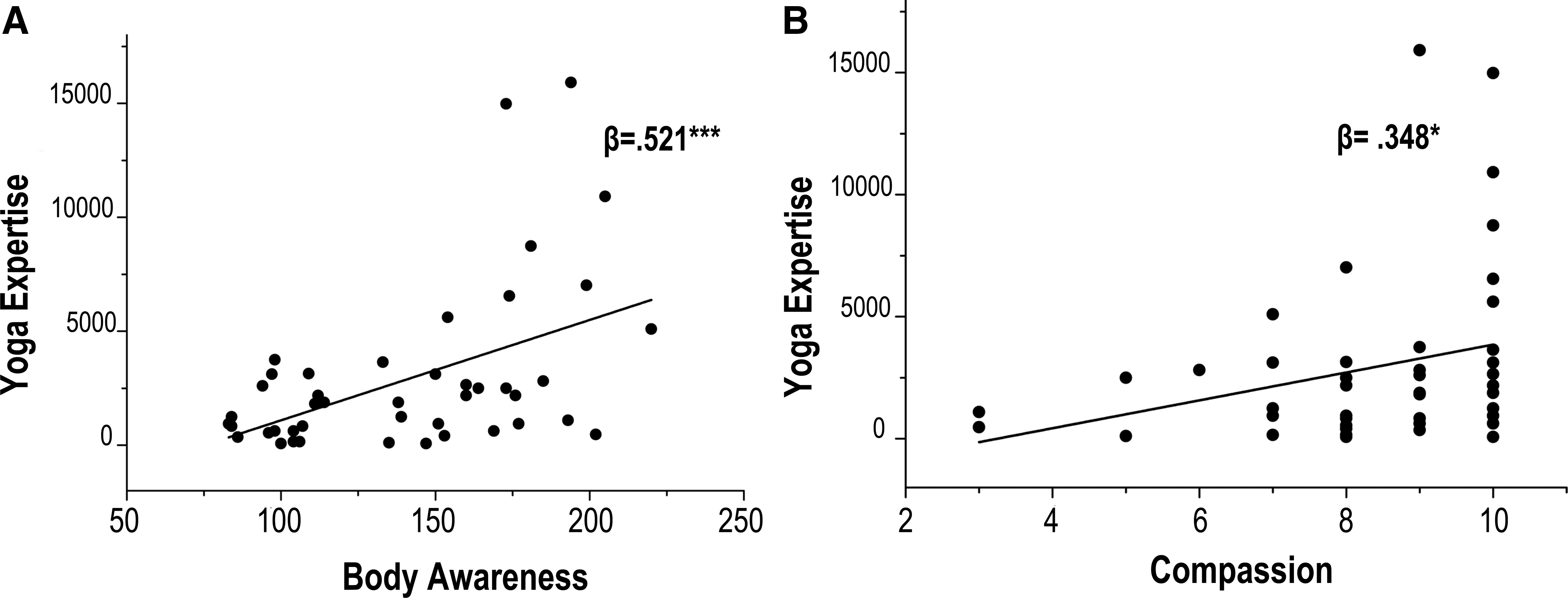
Predictors of Yoga expertise.
p < 0.05.
p < 0.001.
A second multiple regression analysis was conducted to predict the amount of body awareness in the yoga and control group from the four remaining social-cognitive parameters (altruism, empathy, perspective-taking, and compassion). This model accounted for 17% of the variance in the criterion variable in the yoga group (R = 0.413; AdjRsquare = 0.085; F[4, 39] = 2.003; p = 0.113) and 7.8% in the control group (R = 0.279; AdjRsquare = −0.017; F[4, 38] = 0.825; p = 0.518) and failed to significantly predict body awareness in both groups. After addition of yoga expertise as a predictor variable to the model in the yoga group (see first analysis), the model reached significance and accounted for 38.4% of the variance in the criterion variable body awareness (R = 0.620; AdjR 2 = 0.384; F[5, 38] = 4.746; p = 0.002). In this revised model, yoga expertise (β = 0.495; p = 0.0008) and altruism (β = −0.334; p = 0.019) (see Table 4) emerged as significant predictors for body awareness, with a Cohen f 2 of 0.61. The negative regression weight for altruism indicates that a less altruistic behavior was associated with higher body awareness in yoga practitioners (Fig. 2).
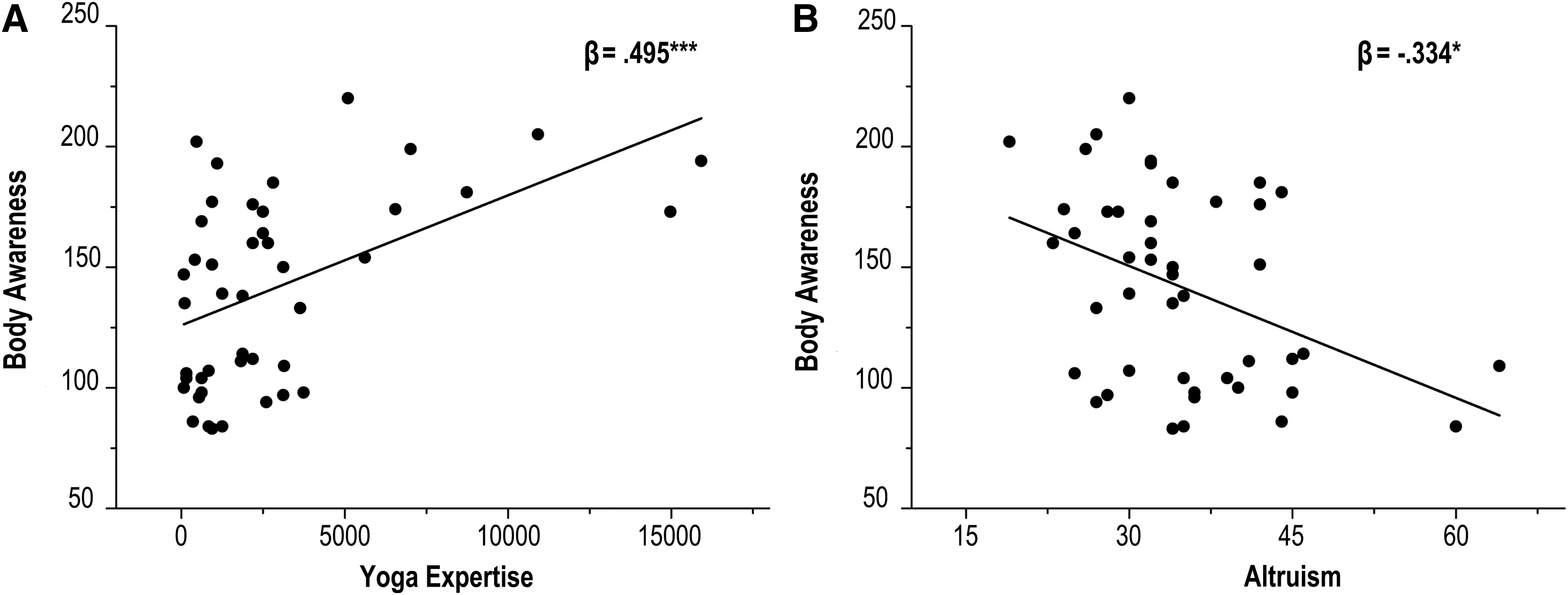
Predictors of body awareness in yoga participants. Individual body awareness scores on the Body Perception Questionnaire are plotted against scores on
p < 0.05.
p < 0.001.
Discussion
This study explored how body and social awareness interact and how such interaction contributes to body expertise, such as achieved in yoga. The study found that yoga expertise was intimately linked to body awareness. In addition, compassion was positively related to yoga expertise: The more compassionate the practitioners were, the more advanced or immersed they were. There was no direct relationship between compassion and body awareness, indicating that the observed link between yoga and compassion was unrelated to body awareness. In contrast, there was a negative relationship between body awareness and social awareness, specifically altruism, in the yoga group—but only when yoga expertise was added to the multiple regression model. In other words, the higher the yoga practitioners' bodily self-awareness, the less altruistic behavior was reported. These findings provide compelling evidence that, despite high compassion, heightened yoga-related awareness of one's own bodily and visceral processes might increase a self-centred perspective and limit altruistic acts.
Ashtanga yoga represents one type of modern postural yoga, characterized by an intense physical practice with a focus on the proprioceptive-vestibular feeling of the body in space. Practitioners claim that a long and continuous practice promotes (bodily) self-awareness (“As you are continually admonished to be aware of and to feel your body in the postures, practicing creates an awareness of the body and how it works” 21 ). The current study offers empirical support for this claim by showing that this type of yoga is indeed associated with a heightened experience of one's own body, indicated by higher self-reported body awareness. 14 Moreover, and this is novel, there was a positive reciprocal relationship between body awareness and yoga practice: The more continuous and advanced the practice, the higher the bodily self-awareness reported on the BPQ. 17 This is in line with previous investigations of more meditative trainings, such as mindfulness meditation, which has been associated with interoceptive awareness-specific functional plasticity in the middle and anterior insula. 22 In contrast, meditators (Tibetan Buddhist and Kundalini) and nonmeditators did not differ in a heartbeat detection task 23 —evidence against the notion that practicing attention to internal body sensations in meditation without sensorimotor training, such as in yoga, necessarily enhances interoceptive awareness. 23
Yet, Ashtanga yoga represents more than physical or sensorimotor training—it also reflects an embodied lifestyle; nonviolence (ahimsa) and compassion (karuna) are essential ethical guidelines to live a yogic life. 24 Compassion has been defined as the feeling or deep sympathy for another person's suffering, accompanied by a wish to relieve it. 25 One of the aims of mind–body contemplative practices is to increase compassion. 26,27 The current study indeed found corroborating evidence that compassion varies along with Ashtanga yoga expertise, beyond the sensorimotor or body-perceptual aspects of the practice (as it was not predicted or mediated by body awareness in the multiple regression model). It has been suggested that bodily representations may facilitate social skills in specific ways. 8,3 More specifically, Ferri and collaborators 8 hypothesized that good social skills not only reflect high sensitivity to relevant cues from the social world but also perceive signals arising from the inside. The authors suggested that interoceptive sensitivity contributes to social/interpersonal representations and, moreover, that people with higher or lower interoceptive sensitivity differ in social cognition. 8 The current data are in line with this notion. Compassion was measured with a subscale of the TCI, 20 which conceives of compassion as one aspect of the personality trait cooperativeness. As such, compassion would not be a malleable (e.g., influenced by yoga practice or meditation) but stable element. Unfortunately, the present study cannot distinguish whether higher compassion is a consequence of yoga practice or rather the expression of a tendency to adopt a specific lifestyle as a prerequisite of yoga expertise. Nonetheless, whether compassion is stable or malleable, it has been shown that mind–body practices, which can modify higher-order self-awareness, might also have the power to dynamically shape personality traits. 28
The negative relationship between body awareness and altruism, which we observed in the yoga group, seems contradictory to the previously discussed positive relationship between yoga expertise and compassion. First, although closely related, altruism and compassion are not strictly the same. Altruism has been defined as the capacity to perform costly acts that confer benefits to others, 29 while compassion refers to the emotional response of caring for and wanting to help those who are suffering 25,30 in order to foster altruistic acts. This study assessed altruism with the self-report Altruism Scale, 18 which contained items explicitly directed at actual regular pro-social behavior (e.g., holding door open, changing money) rather than attitudes or emotions. Second, and related to the previous line of reasoning, distinct aspects of Ashtanga yoga practice might be associated with compassion versus altruism. Previous studies that investigated compassion and altruism tested expert meditators 31 or asked participants to undergo some kind of compassion/meditation/mindfulness training. 32 Modern postural yoga, such as Ashtanga yoga, includes implicit as well as explicit features of meditation. Crucially, while meditation is not the primary or only aspect of the discipline, the experience of the body or the movement is.
It is possible that in Ashtanga yoga, increased compassion relates to the meditative aspect of the practice (and, thus, body awareness does not play a role here, as also indicated by the first multiple regression analysis), while altruism also relates to the physical aspect of the yoga practice and body awareness (see second multiple regression model). As such, increased body awareness might lead practitioners toward a more self-centered perspective or lifestyle. In fact, one may observe that when paying close attention to one's own mental or bodily sensations, one becomes less aware of the outside world. In contrast, when one pays more attention to others, one's own sensations are often ignored. This is in line with one of the authors' previous studies, in which increased feedback of one's own visceral processes (i.e., heartbeat) seemed to foster a self- centered perspective and drive socioeconomic exchanges in an “ultimatum game.” 9 Similarly, predominant or salient complex physical sensations, such as pain, have been associated with decreased altruistic behavior. 33
In fact, Ashtanga yoga practice is individual and personal and is often deeply embedded into a specific lifestyle. The more regular and continuous the practice gets (i.e., six times a week, every morning), the more practitioners might be dedicated and immersed into this lifestyle and the heavier the focus on this self-realization. This interpretation is supported by the fact that only when yoga expertise was added as a predictor to the regression analyses did the negative relationship between altruism and body awareness in the yoga group emerge. The new awareness of one's own body during practice can also make the body and its sensations claim too much attention, as the practitioner becomes more perceptive of it, 21 also indicating an attentional/awareness shift from the outside to the inside.
Conclusions
Together, these results suggest that body awareness and compassion are intimately tied to yoga practice, with mutually beneficial effects. While compassion itself was not related to levels of body awareness, altruism was. Tellingly, in yoga practitioners but not controls, altruism decreased with increasing body awareness, an effect associated with yoga experience. Compassion and altruism might be tackled by different aspects of yoga aimed at involving the physical (including body awareness) or meta-level of the training. Investigating body expertise such as in yoga, instead of manipulating attention to interoceptive signals, may constitute not only a novel but also a more ecologically valid and comprehensive approach to study the interplay between body and social awareness. Yet, for assumptions concerning directional and causal aspects of the revealed relationships, future—possibly longitudinal—studies are necessary, for example, by following up on yoga practitioners as they advance and become immersed in their practice.
Footnotes
Acknowledgments
S.M.A. was supported by an Italian Ministry of Health (RF-2010-2312912).
N.D. was supported by a fellowship of the German Research Foundation (DFG; DA 1358/1-1).
Author Disclosure Statement
No competing financial interests exist.