




Abstract
Objective:
Psoriasis is a chronic immune-mediated disorder of the skin. The disease manifests itself with red or silvery scaly plaques distributing over the lower back, scalp, and extensor aspects of limbs. Several medications are available for the treatment of psoriasis; however, high rates of remission and side-effects still persist as a major concern. Siddha, one of the traditional systems of Indian medicine offers cure to many dermatological conditions, including psoriasis. The oil prepared from the leaves of Wrightia tinctoria is prescribed by many healers for the treatment of psoriasis. This work aims to decipher the mechanism of action of the W. tinctoria in curing psoriasis and its associated comorbidities.
Design:
The work integrates various pharmacology approaches such as drug-likeness evaluation, oral bioavailability predictions, and network pharmacology approaches to understand the roles of various bioactive components of the herb.
Results:
This work identified 67 compounds of W. tinctoria interacting with 238 protein targets. The compounds were found to act through synergistic mechanism in reviving the disrupted process in the diseased state.
Conclusion:
The results of this work not only shed light on the pharmacological action of the herb but also validate the usage of safe herbal drugs.
Introduction
M
More often, the natural products are subjected to concentration, fractionation, and purification processes to yield a single biological active compound. 3 It is still a routine custom of scientific researchers to investigate medicinal plants just to identify the single chemical compound responsible for the therapeutic effect. 4 Considering that the biological activity of the natural source may be the result of combination of various compounds, the isolation process may lead to the reduction of the biological activity. 5 It is a well-established fact that sometimes complex mixtures of compounds in the herbs show greater potency than isolated compounds. 6 Information from trials evaluating the efficacy of whole plant extracts when compared to purified compounds revealed that the potency of the later is reduced as a result of purification of the extract, leading to more isolated fractions or sole compounds. 7 Accordingly, the complex composition is a major advantage of herbal medicines. The components of the herbs have multiple activities that result in an increased activity, which may be due to synergy, cumulative effects, or enhancement of bioavailability. 4,8
Systems pharmacology is a systems-based approach which is used to understand drug actions for drug discovery. Systems pharmacology takes into account the genomic variations and molecular complexity, while describing the physiological and pathophysiological responses of the drugs at tissue, organ, and organism levels. 9 The integration of systems pharmacology approach with drug designing notions reveals that the drugs act on multiple targets involving multiple diseases. The connections established between the target proteins and bioactive components assist in understanding the interactions between them, which in turn shed light on their mode of action. 10 In addition, the pharmacokinetic evaluations provide a deeper understanding of the components involved in the production of therapeutic response.
Wrightia tinctoria (Roxb.) R.BR. belongs to the Apocynaceae family and commonly termed as nilapalai and vetpalai in Tamil. Vetpalai thailam prepared from the leaves of W. tinctoria is the most commonly prescribed Siddha herbal medication for skin diseases, in specific psoriasis. 11 The “777 oil” made from the fresh leaves of the plant exhibits various analgesic, anti-inflammatory, and antipyretic activities and it is a highly cited medication for the treatment of psoriasis. 12 Various studies have documented the topical and oral efficacy of the plant in curing psoriasis. 13,14
This work employs a combined systems pharmacology approach that integrates the basic drug designing strategies, multiple target prediction methods, and network pharmacology approaches to answer the following questions: (1) what are the major bioactive components of W. tinctoria; and (2) what are the targets of these bioactive components. The outcome of this research work provides a deeper understanding of the chemical and pharmacological basis of W. tinctoria, including its mode of action to cure psoriasis. The work also highlights the importance and efficacy of safe herbal medicines in treating various dermatological disorders such as psoriasis.
Materials and Methods
Compound database building
Fresh leaves of W. tinctoria were collected from Katpadi taluk, Vellore district, Tamil Nadu (India), during the month of May 2016. The leaves were authenticated by Prof. P. Jayaraman, Director, Institute of herbal botany (Voucher. No: PARC/2016/3254). The leaves were washed thoroughly with distilled water and shade dried for 10 days. One thousand grams of dried leaves was grounded to fine powder and soaked in n-hexane for 24 h and dried for 48 h. Ten grams of dried powder was extracted with 100% methanol, petroleum ether, and chloroform, respectively, using cold maceration method for 48 h. The extracts were filtered and dried using rotator vacuum evaporator and subjected for gas chromatography-mass spectrometry (GC-MS) analysis. The compounds present in the three extracts were identified by comparing their mass spectra and retention time with the Wiley 9.0 and National Institute of Standards and Technology libraries. The structures of the compounds were retrieved from PubChem 15 and published literatures. The structures were optimized and the Simplified Molecular Input Line Entry System (SMILES) of the compounds were generated using ChemSketch.
ADMET prediction and drug-likeness evaluation
An early pharmacokinetic profiling of the compounds can prevent late-stage attrition in the drug evaluation phase.
16
In herbal medicine, the identification of the bioactive components, which possess good pharmacokinetic profiles, is a crucial step to assess the therapeutic efficiency of the herb. Various molecular properties such as molecular weight (MW), number of hydrogen bond donors (nHBDon), number of hydrogen bond acceptors (nHBAcc), and octanol and water partition coefficient (AlogP) were computed along with the number of rotatable bonds (nRotBt), number of aromatic rings (nAR), and total polar surface area (TPSA) to evaluate the pharmacokinetic properties of the compounds.
17
Since the plant is prescribed for both oral and topical applications, the skin permeability predictions were computed using PreADMET server (
Drug-likeness (DL) measures the compounds resemblance with the available drugs. The calculation was based on the similarity of the functional groups or physical properties with the known drugs. Quantitative Estimate of Drug-likeness (QED), a quantitative metrics for assessing the DL, was measured using DruLito. The QED value ranges between 0 (all properties nonfavorable) and 1 (all properties favorable). 19
Oral bioavailability prediction
Oral bioavailability (OB) plays a major role in the development of bioactive molecules as therapeutic agents. Poor OB is the most crucial reason for the development of an unsuccessful drug in drug discovery process; hence, it is valuable to screen the compounds for the OB. 20 A support vector machine-based binary classifier was built to predict the bioavailability of the compounds. Around 1,596 molecules from the drug bank were used for the classifier building. Seven molecular properties (MW, ALogP, nHBAcc, nHBDon, nRotBt, nAR, and TPSA) governing the OB rate were computed for all the drug bank 21 compounds using PaDEL. 22 Around 1,177 compounds were used to train the classifier and 392 compounds were used to test the classifier. The cost and gamma parameters were set to 4 and 0.2, respectively. Radial bias kernel was used for the classification. The classifier's efficiency was measured using various accuracy measures. Sensitivity and specificity of the classifier were predicted to be 91% and 99%, respectively. The overall accuracy of the classifier was 97.95%. The Matthews correlation coefficient (MCC) was found to be 0.914. The overall accuracy measures of the classifier validate the performance of the classifier in discriminating the OB of the drugs.
Target prediction
The compounds from the herbs exhibit their mode of action by binding to specific proteins. Certain bioactive compounds in the herb might target multiple proteins due to the presence of multiple bioactive components. The target identification aids in elucidating the mechanism of action of W. tinctoria through the analysis of compound–target (C-T) network. The bioactive compounds' targets were retrieved from STITCH 4 server. 23 When no direct hits were found for the compound, the protein hits were retrieved based on the Tanimoto's index (>0.9).
The C-T network was constructed and visualized using Cytoscape 2.8.1. 24 In the C-T network, a compound and a target are denoted as a node. Interactions between the nodes denote the edges. To understand the essentiality of each node and how the nodes reflect the signal transduction between the related nodes, we computed two statistical metrics, the degree and betweenness. Degree corresponds to the number of interacting partners, while betweenness correspond to the ratio of shortest paths passing through a node to the total number of paths through the nodes. 25 To decipher the contributions of the targets involved in various biological processes, gene annotation studies were carried out. The biological processes of the targets were mined using DAVID server. 26
Results
The GC-MS analysis identified a total of 235 and 176 compounds from the methanol and petroleum ether extract, respectively (Supplementary Figs. S1–S3; Supplementary Data are available online at
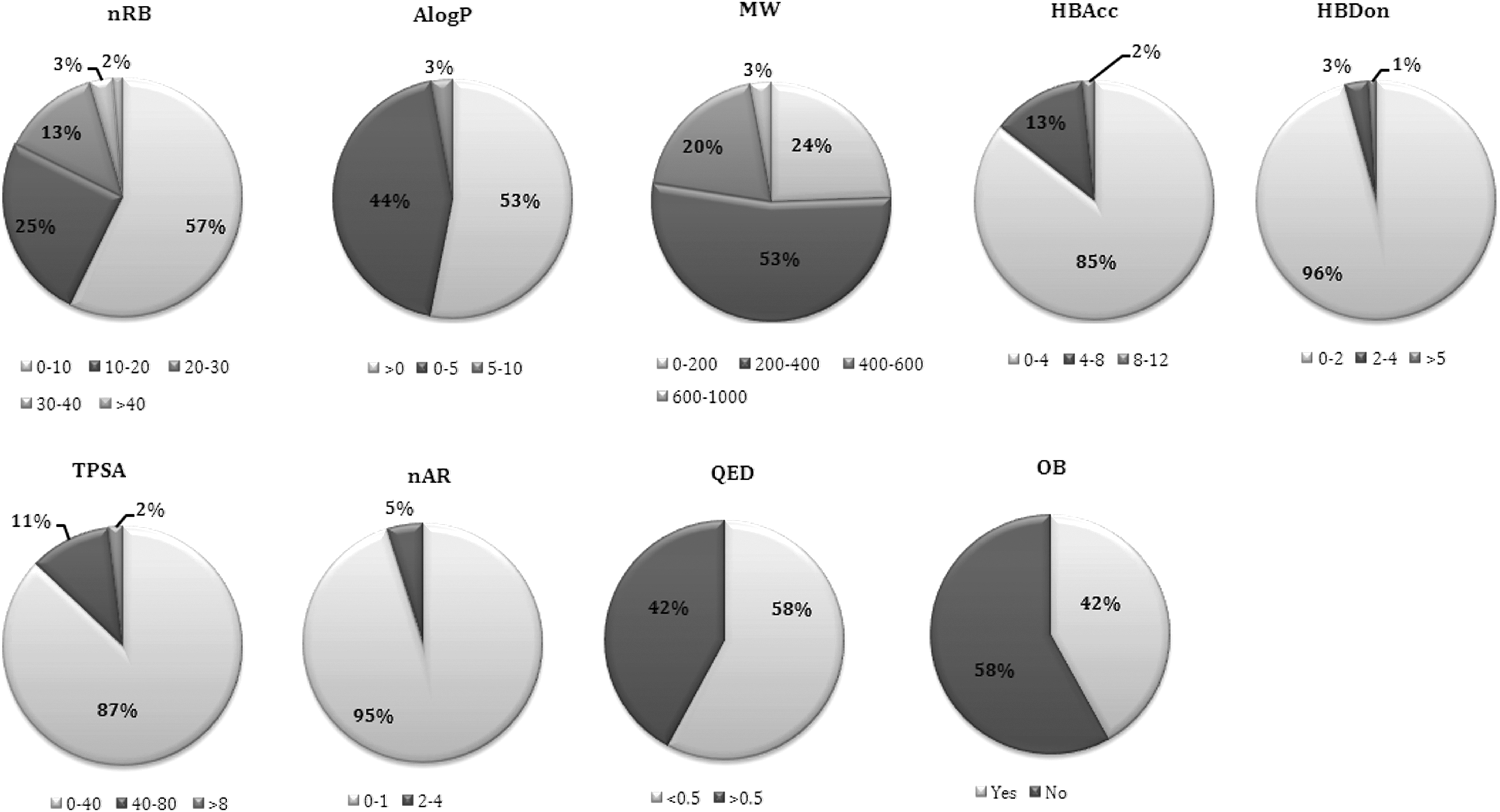
The distribution of molecular properties of 312 compounds obtained after first phase of selection.
DL and OB analysis
Quality measure, DL, associates the pharmacokinetic and pharmaceutical properties of the compounds. DL minimizes the time and cost of drug discovery process along with the development of potent drugs. Hence, DL is considered a highly fruitful filter. OB, another pharmacokinetic parameter, which computes the percent of oral dose reaching the systemic circulation to exhibit the desired pharmacology action was also considered a screening measure, since poor orally bioavailable drugs fail to produce the required action. The compounds were screened for the possession of desired absorption, distribution, metabolism, excretion and toxicity (ADMET) properties. One hundred and twenty-six compounds possessing required ADMET properties along with satisfying DL, OB, and skin permeability were finally retained for further analysis.
Target fishing
Due to the presence of numerous bioactive components in W. tinctoria, a major challenge lies in the identification of molecular targets contributing to its pharmacological nature. The detection of the targets aiding the bioactive components to perform the desired action will help in deciphering the mechanism of action of the herb under molecular level. Among 126 compounds, 67 compounds (Table 1) were mapped to the 238 targets (Table 2) by STITCH database. Fifty-nine compounds without any relevant targets were eliminated from further analysis. Minimum 1 and maximum 10 proteins were targeted by the compounds. An average of five protein hits was maintained by the majority of the compounds in the list revealing the promiscuous roles of few compounds.
Compound target network analysis
Sixty-seven compounds along with their 238 potential target hits were mapped to generate a compound–target bipartite graph (Fig. 2). The network contained a total of 305 nodes (67 compounds and 238 proteins) and 328 edges. The connectivity distribution of the network measured by the centralization parameter is found to be 0.026 and the network heterogeneity, which reflects the tendency of a network to incorporate various hub nodes, was found to be 1.127. These parameters together indicate that few compounds and proteins may be biased and act as key players in the C-T network. Lanosterol synthase (LSS) (T141) has the highest number of compound connections, while many protein hits maintained a minimum of one connection with the active components in the compound list. The degree of few nodes had a huge number of C-T interactions, while many nodes had few or smaller interactions. The result was consistent with the fore-mentioned centralization and heterogeneity measure. In the compound list, 32 compounds possessed degree connectedness more than 5. The average degree connectedness for the compounds is found to be 4 with 18 compounds (C4, C12, C16, C26, C27, C29, C36, C42, C43, C48, C53, C56, C58, C61, C63, C64, C65, and C66) possessing a maximum of 10 protein connections. When the interacting protein partners were investigated, we observed LSS (T141) established the maximum of eight connections, followed by LDLCQ3 (T136) with six connections, and AR (T22) with five connections. These highly connected nodes were attributed as hubs of the network, which were considered to play a significant role in treating the disease or its associated effects.
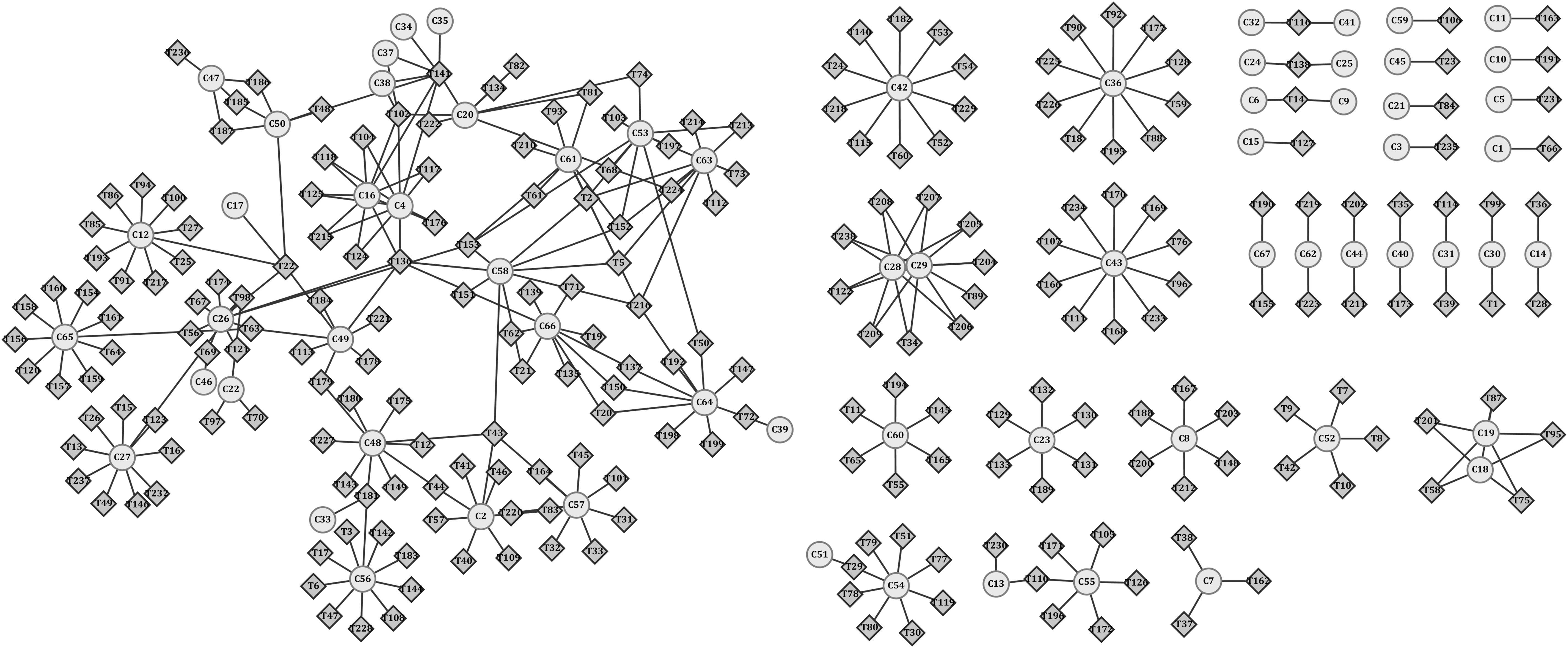
A global perspective of compound–target (C-T) network. The circular nodes and diamond nodes denote the candidate compound and targets for Wrightia tinctoria, respectively.
Nodes with a high betweenness score indicate that the node in certain paths is crucial in maintaining the node connectivity. A node is considered significant if it incorporates many paths that link pairs of nodes. Fifteen compounds (C7, C8, C14, C23, C30, C31, C36, C40, C42, C43, C44, C52, C60, C62, and C67) and three protein targets (T14, T116, and T141) were observed to have a high betweenness value of 1. When the network parameters were analyzed, we noted that the degree and betweenness were correlating with each other. The top three compounds (C36, C42, and C43) with high degree were also observed to possess large betweenness.
Discussion
C-T network: mechanism of action of W. tinctoria
The investigation of network parameters revealed that the nodes in the network have multiple connections establishing a synergistic path to exhibit its activity. The multicompound, multitarget mechanism acts as a background for governing the therapeutic efficiency of W. tinctoria.
Among the potential protein target hits, four proteins such as APOE (T21), CAT (T46), IL12B (T123), and TP53 (T228), which were previously associated with psoriasis, emerged as direct targets for five compounds. Disruption of lipid metabolism is an important characteristic feature in the pathogenesis of psoriasis. The continuous loss of lipids through the psoriatic lesions disrupts the lipid homeostasis. 27 Lipid metabolism in the epidermis is tightly regulated by the expression of the apolipoprotein E (APOE). Normal healthy skin secretes 85 mg of cholesterol within a time period of 24 h; on the contrary, the psoriatic skin loses 1–2 g of cholesterol with the scales during the same period. 28 The compounds C58 and C66 are the direct controllers of APOE (T21) from the herb. α-Sitosterol (C58), a structural homolog of cholesterol and cholesterol (C66), itself was supplemented by the herb to compensate the lost component. The plasma and erythrocytes of the psoriatic patients were reported to have increased levels of catalase, CAT (T46). The antioxidant enzyme is involved in the reduction of hydrogen peroxide. Pyrogallol (1, 2, 3 benzenetriol) (C2) is a generator of free radical and is involved in the suppression of mouse lymphocytes in a concentration-dependent manner. The elevated expressions of CAT enzyme in the psoriatic skin neutralize the free radicals through its scavenging activity. 29 Since psoriasis is an immune-mediated disorder, the compound was found to suppress the humoral immune response at high doses, hence prescribed as a topical remedy for psoriasis. Pyrogallol is found to be the direct hit for CAT enzyme. The transcriptional factor p53 (T228) is an important regulator of cell cycle. The protein inhibits the cell division in response to DNA damage and making time for DNA repair. The protein can also trigger apoptosis. An elevated expression of p53 has been reported in both the lesional and uninvolved skin parts of psoriasis patients. 30 Despite elevated expression of proapoptotic p53, apoptosis in psoriatic lesions remains impaired. Tryptanthrin derivative (C56) was detected as an inhibitor of p53 protein in our analysis. Tryptanthrin has been reported to decrease the amount of mutant p53 in MCF-7 cell line. 31 Psoriasis is a TH1-mediated disease with enhanced expression of IL-12 in the psoriatic lesions. IL-12 stimulates the pathogenic inflammatory T cells leading to the induction of psoriasiform lesions in mice. 32 The compound benzoic acid, 3-hydroxy, 1-methylpropyl ester (C27) is identified as a direct inhibitor for the IL-12 (T123). Pyrogallol (C2) has been proven to induce the activity of Caspase 3 (T43) and Caspase 8 (T44), thus leading to the activation of apoptosis by the mitochondrial pathway. 33 The compounds arrested the apoptosis induction by p53, but induced the same process through Caspase 3 (T43) and Caspase 8 (T44).
Involvement of targets in the impaired biological process in psoriasis
The careful assessment of the network revealed that the number of targets interacting with the herbal compounds was found to be involved in major biological processes, which were impaired in psoriasis. The epidermal keratinocytes in psoriatic lesions undergo hyperproliferation with incomplete differentiation and decreased apoptosis along with the formation of Munro's microabscesses. Proteins related to keratinocyte proliferation such as FYN (T109), SART1 (T196), and Top2A (T227) were observed in the target list. TOP2A (topo-isomerase 2α) implicated in DNA strand repair mechanism was found to be elevated in rapidly proliferating cells. The inhibitors of the enzyme arrest the protein-DNA cleavable complex leading to DNA strand breaks and finally resulting in cell death. 34 SART1 encoding SART1(800) expression was elevated in highly proliferating cells. The silencing of SART1 has been reported to induce apoptosis in a Caspase 8-dependent manner. 35 Fyn, a nonreceptor tyrosine kinase, plays a major role in epidermal keratinocyte differentiation and transformation. Several studies suggested that the knockdown of Fyn disrupted the T cell receptor-induced activation of mature T cells. 36 Proteins promoting apoptosis such as CASP3 (T43) and CASP8 (T44) also appeared in the target list. The hyperproliferating keratinocytes are supplied with rich blood vessels contributed by proteins involved in angiogenesis such as platelet-derived growth factor receptor (PDGF-β) (T167), which is validated by the enhanced expression of PDGF-β in the psoriatic lesions. 37 Another protein involved in angiogenesis is thymidine phosphorylase (TYMP) (T236), a key factor in controlling the vascular growth. The protein is attributed to be identical to platelet-derived endothelial cell growth factor. However, the mechanism by which it induces the angiogenesis has not been elucidated completely. 38
Conclusion
This work utilizes the network pharmacology approach to decipher the mechanism of action of W. tinctoria prescribed for the treatment of psoriasis. The work utilizes combined in silico strategies to unravel the chemical and pharmacological mechanisms of herbal drug. This work established connections between 67 compounds with 238 potential protein targets. The compounds were found to act in a synergistic way by suppressing the immune system and inducing or reviving the disrupted mechanisms such as apoptosis. This work is an attempt to highlight the importance of safe and effective traditional system of medicine offering cure to various dermatological disorders, including psoriasis.
Footnotes
Acknowledgments
We thank VIT University for providing the computational facilities. We acknowledge Dr. Sathya Subramani, professor and head, Department of Physiology, CMCH, Vellore, for providing laboratory facilities and Dr. Soosai Manickam, associate research officer, Department of Physiology, CMCH, Vellore, for assisting in the extraction process and GC-MS analysis.
Author Disclosure Statement
No competing financial interests exist.
References
Supplementary Material
Please find the following supplemental material available below.
For Open Access articles published under a Creative Commons License, all supplemental material carries the same license as the article it is associated with.
For non-Open Access articles published, all supplemental material carries a non-exclusive license, and permission requests for re-use of supplemental material or any part of supplemental material shall be sent directly to the copyright owner as specified in the copyright notice associated with the article.
