




Abstract
Objective:
Several intervention studies have suggested that foot massage and cognitive behavioral therapy (CBT) are beneficial for reducing the stress response. However, no randomized control trials have been conducted to examine these effects in middle-aged women, who are more commonly exposed to stress relative to others. This study aimed to examine the effects of combined self-administered foot massage and CBT on the psychophysiological stress response in Korean middle-aged women.
Design:
Randomized controlled trial.
Setting:
Subjects were recruited from the social welfare center in Sahmcheok, Kangwondo, Korea. The subjects performed some of the massage at the center and some at home, and CBT was performed at the center.
Subjects:
Fifty-three women aged 45–64 years were randomly assigned to Group A (intervention, n = 31) or B (usual care, n = 30).
Intervention:
Combined self-administered foot massage and CBT.
Outcome measures:
Depression, anxiety, stress, blood pressure, heart rate, blood glucose (BG), and oxygen saturation were measured at baseline and 3-week follow-up.
Results:
Mean depression scores (p = 0.021), stress scores (p = 0.009), systolic blood pressure (SBP) (p = 0.035), and BG levels (p = 0.007) had decreased significantly subsequent to the intervention.
Conclusion:
Combined self-administered foot massage and CBT led to reductions in depression, stress, SBP, and BG levels. Therefore, the intervention could be an effective means of reducing the stress response in middle-aged women.
Introduction
T
There is a growing body of literature suggesting that complementary and alternative therapies could provide effective treatments for stress. Foot massage is one of the treatments that is considered beneficial. Foot reflexology is based on the theory that reflex points corresponding to human organs are distributed throughout the feet. 6 A randomized controlled trial (RCT) found that self-administered aroma foot massage decreased blood pressure and anxiety in community-dwelling men and women aged 27–72 years. 7 Similarly, another RCT involving 19 care workers providing care for older people with dementia showed that stress levels in the intervention group who received a foot massage for 10 min during their shift decreased significantly relative to those observed in a control group, who rested silently for 10 min during their shift. 8 Furthermore, another study found that receiving a foot massage for 20 min per day for 4 days reduced anxiety in patients recovering from coronary artery bypass graft surgery. 9
Cognitive behavioral therapy (CBT) is one of the most effective psychological therapies for managing stress, depression, and anxiety. 10,11 The aim of CBT is to change negative emotional and behavioral responses by modifying cognitive evaluation. 12 In the context of stress response, this is achieved through stress education, goal setting, and development of effective strategies for problem solving and stress management. These strategies are important because they could improve mood, resilience, and self-efficacy. For example, a previous study reported that CBT reduced negative emotions and enhanced self-efficacy, self-care behavior, and glycemic outcomes in patients with type 1 diabetes. 13 Another study showed that CBT was the best nonpharmacological treatment for insomnia in cancer patients. 14
This literature indicates that foot massage and CBT are associated with improvements in mental conditions and reductions in stress in middle-aged women. However, while many studies have examined the efficacy of foot massage or CBT alone, the number of RCTs that have assessed the effects of combined foot massage and CBT on psychophysiological stress in middle-aged women is limited. Accordingly, this RCT aimed to evaluate the effects of combined self-administered foot massage and CBT on psychological and physiological stress in Korean middle-aged women.
Materials and Methods
Subjects
Women aged 40–64 years who had enrolled at a social welfare center in Sahmcheok, Kangwondo, Korea were eligible for inclusion in the study. Subjects who had open wounds on their feet, had a bleeding disorder, took medication for hypertension or diabetes, or participated in a similar study in 2015 were excluded from the study.
This study was approved by the Ethical Committee of Kangwon National University and complied with the ethical standards of the Declaration of Helsinki. Written informed consent was obtained from each participant.
G*Power version 3.1.9.2 program 15 was used to estimate the required sample size for an independent t test with a significance level of 0.05, statistical power of 0.80, and an effect size of 0.80, based on a previous study. 16 The results showed that 26 subjects were required for each group, but 68 were recruited to account for potential dropout. The subjects were randomly assigned to Group A (intervention, n = 34) or B (usual care, n = 34) using Research Randomizer computer software. 17 As shown in the flowchart in Figure 1, four women dropped out before the baseline examination because of health conditions or scheduling conflicts, and three women dropped out before the follow-up examination because there were scheduling conflicts or they had moved to a different area. Ultimately, 61 subjects (Group A: n = 31; Group B: n = 30) were included in the study.
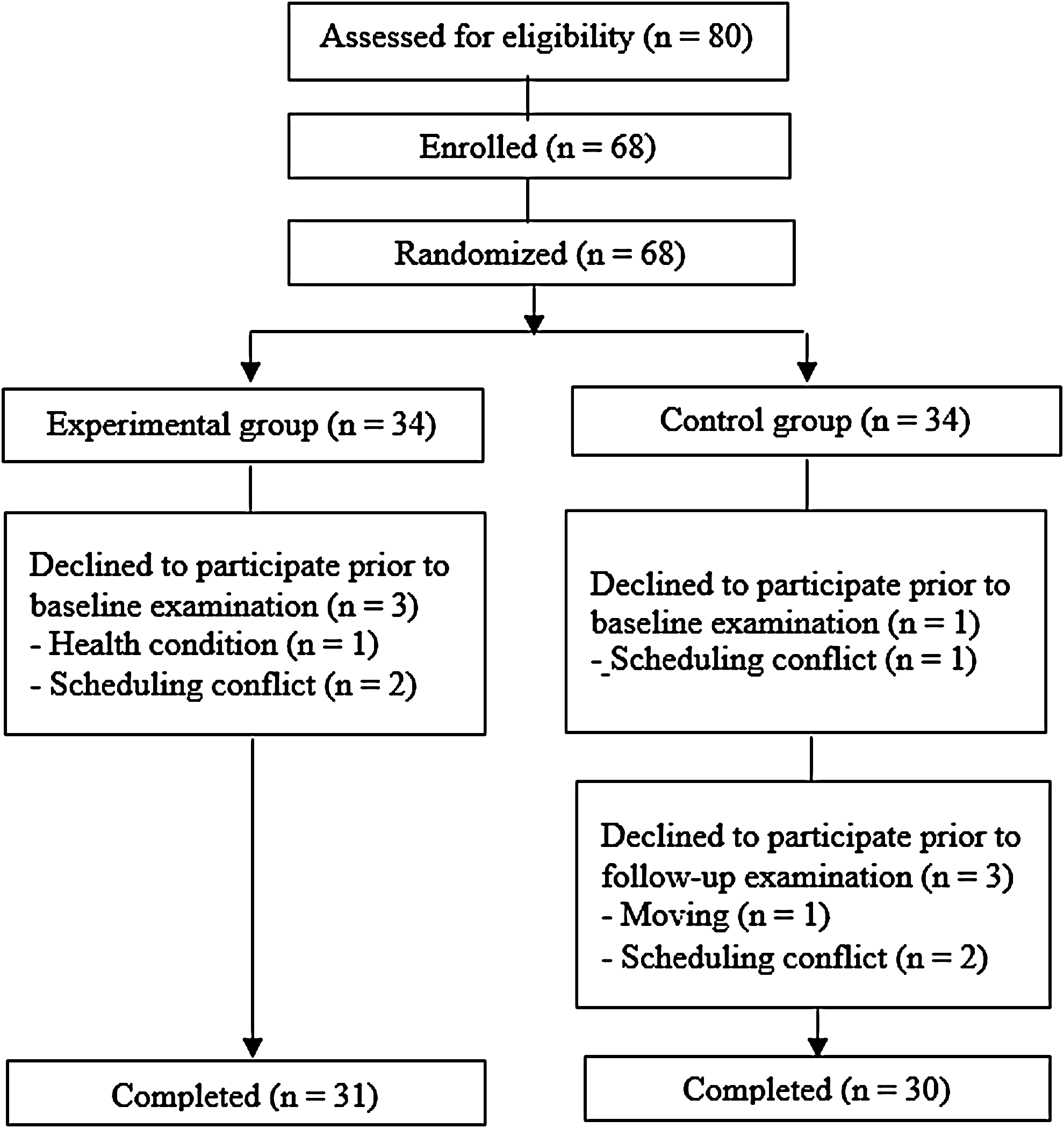
Subject flow diagram.
Combined foot massage and CBT program
Rather than implementing a temporary, passive intervention, we provided subjects with training in self-administered foot massage, to allow them to manage their health continuously. Therefore, we developed a protocol for training in self-administered foot massage and used this to train the subjects. A researcher with a foot reflexology license provided the training three times per week over eight sessions. Once the principles of foot massage had been explained, the subjects performed the massage themselves while watching the researcher's demonstration. The subjects were then provided with a massage protocol booklet, massage oil, and a finger-pressure rod and instructed to practice the massage daily at home. The foot massage course consisted of three steps: preparation, relaxation massage, and reflex point massage. The entire course lasted 60 min. In the preparation step, the subjects placed their feet in warm (45°C–52°C) water at a depth of 10 cm above the ankle for 10 min, while sitting comfortably in a chair. In the relaxation massage step, the subjects poured an appropriate amount of massage oil onto their hands and rubbed the tops of their feet, any sore areas, the sides of their feet, and their ankles, Achilles tendons, heels, and calves to generate heat. This procedure was performed for 10 min, three times for each foot. In the reflex point massage step, the subjects stimulated 62 reflex points corresponding to parts of the body, with their hands or a finger-pressure rod providing midlevel pressure to avoid pain. Massage was performed on each foot for ∼15 min. Upon completion of the entire massage procedure, the subjects drank tea or water and relaxed for 5 min. The subjects performed the massage daily, with eight sessions completed at the social welfare center and nine sessions completed at home.
The CBT program focused on removing psychological barriers, to improve stress management, and helped the subjects to identify, challenge, and reframe their negative beliefs and feelings. Subjects were provided with information sheets and homework assignments. The topics addressed in the CBT were as follows: (1) goals and barriers; (2) rational and irrational thinking; (3) appropriate and inappropriate emotion; (4) rational and irrational beliefs; and (5) coping with stress. A 50-min CBT session was provided before the eight massage sessions held at the social welfare center.
Outcome measures
Psychological measures
Depression, anxiety, and stress were included as psychological measures and assessed using the Depression Anxiety Stress Scale 21 (DASS 21). 18 DASS 21 is the brief version of the 42-item DASS, which has been used to evaluate the severity of a range of symptoms that are common in depression, anxiety, and stress. 19,20 DASS 21 has been used widely since it has demonstrated good validity and reliability. 21,22 The instrument includes 21 questions divided equally between three dimensions: depression, anxiety, and stress. Responses are provided using a four-point Likert-type scale ranging from 0 (did not apply to me at all over the past week) to 3 (applied to me very much or most of the time over the past week). During the development of the scale, Cronbach's αs were 0.72, 0.71, and 0.71 for depression, anxiety, and stress, respectively. In the current study, Cronbach's αs were 0.83, 0.81, and 0.85 for depression, anxiety, and stress, respectively.
Physiological measures
Systolic blood pressure (SBP), diastolic blood pressure (DBP), HR, blood glucose (BG), and oxygen saturation (SaO2) were measured as physiological factors. After subjects had been resting on a chair for 10 min, their SBP, DBP, and HR were measured using an automatic sphygmomanometer (Meditec, Seongnam, Korea) on their right arms while they were in the seated position. Second measurements were taken 2 min later, and the mean values for the measurements were used in the analysis. BG was measured using a digital glucometer (SD Biosensor, Suwon, Korea) after at least 8 h of fasting. SaO2 was measured using an oxygen saturation infrared sensor (Mek-ICS, Paju, Korea) on the right index finger.
Statistical analysis
All of the data were expressed as mean ± standard deviation. The homogeneity of Groups A and B was analyzed using t or Chi-square tests. The effects of the intervention on depression, anxiety, stress, SBP, DBP, HR, and BG were analyzed using t tests. Changes in BG, which differed significantly between the two groups at baseline, were determined using an ANCOVA, with the baseline measurement as a covariate. Data analysis was performed using SPSS Statistics for Windows version 20.0 (IBM Corp., Armonk). The significant level was set at p < 0.05.
Results
Subjects' baseline characteristics
Subjects' baseline characteristics are shown in Table 1. The results of the homogeneity analysis showed no significant difference between Groups A and B, but BG differed significantly between the two groups (p = 0.044).
Percentage (%) or mean ± standard deviation.
Calculated from the chi-square test for categorical variables or t test for continuous variables.
Psychological variables: depression, anxiety, and stress
The results showed significant reductions in both depression and stress subsequent to the intervention. Group A's depression scores were 14.4 before and 11.5 after the intervention, while Group B's scores were 13.2 before and 13.8 after the intervention (p = 0.021). Similarly, Group A's stress scores were 15.4 before and 12.2 after the intervention, while Group B's scores were 14.2 before and 15.4 after the intervention (p = 0.009). In addition, there was a reduction in anxiety subsequent to the intervention, but this was nonsignificant. Group A's anxiety scores were 14.7 before and 12.8 after the intervention, while Group B's scores were 13.4 before and 13.9 after the intervention (p = 0.076; Table 2).
p-Values for the intervention effects were calculated via t test.
p-Values for the intervention effects were calculated via ANCOVA with a baseline measure as a covariate.
Physiological variables: SBP, DBP, HR, BG, and SaO2
The results showed reductions in both SBO (Group A: preintervention = 127.1 mmHg, postintervention = 124.7 mmHg; Group B: preintervention = 126.7 mmHg, postintervention = 127.8 mmHg; p = 0.035) and BG (Group A: preintervention = 112.5 mg/dL, postintervention = 102.7 mg/dL; Group B: preintervention = 106.1 mg/dL, postintervention = 107.6 mg/dL; p = 0.007) subsequent to the intervention (Table 2).
Discussion
The study was conducted to determine the effects of combined self-administered foot massage and CBT on psychophysiological stress in Korean middle-aged women.
The results showed that the intervention reduced depression and stress. Similarly, Krohn et al. 23 reported that breast cancer patients' depression and stress decreased following a foot massage intervention consisting of 10 sessions, which were conducted twice per week, and Choi and Lee 16 reported that self-administered foot massage, performed for 30 min per day for 3 days, reduced depression and stress in postpartum women. In addition, an RCT conducted by Milgrom et al. 24 showed that six CBT sessions delivered over the course of 12 weeks reduced postnatal depression and stress. Consistent with these findings, mean depression and stress scores decreased subsequent to the intervention in this study. In addition, this study focused on community-dwelling, middle-aged women, rather than hospitalized patients, and demonstrated the effectiveness of combined self-administered foot massage and CBT in reducing depression and stress in this population. Gould et al. 25 reported that CBT was significantly effective in reducing depressive symptoms in older people in 23 RCT studies; this could explain the reduction in depression observed subsequent to the intervention in this study. In other words, CBT-induced reductions in depression could contribute to enhanced mood in both older people and middle-aged women. As some studies have demonstrated that foot massage and CBT activated the parasympathetic nervous system, which increased physical relaxation and comfort, 26,27 it appears that the primary effects of the intervention involved reductions in depression and stress, followed by inhibition of the sympathetic nervous system and activation of the parasympathetic nervous system. Therefore, combined self-administered foot massage and CBT could be effective in reducing depression and stress and improving mental health.
Another important finding was that combined self-administered foot massage and CBT was effective in reducing SBP, DBP, HR, BG, and SaO2. Similarly, a previous study demonstrated that 12 sessions of self-administrated aroma foot massage conducted three times per week for 4 weeks reduced SBP by 2.0 mmHg in 55 subjects aged 27–72 years. 7 In addition, an RCT involving 26 women and 7 men from a large Swedish company showed that SBP decreased by 4.7 mmHg following 10 CBT sessions delivered over 4 months. 28 In this study, subjects received CBT and performed combined self-administered foot massage eight times over the course of 3 weeks, which resulted in an average SBP reduction of 2.8 mmHg. The SBP reductions observed in this study were therefore similar to those observed in previous studies. With respect to BG, levels decreased significantly following the intervention. Sajedi et al. 20 reported a reduction in BG in children with diabetes mellitus who received Swedish massage for 15 min three times per week for 3 months. In addition, Snoek et al. 21 reported a reduction in HbA1c subsequent to CBT in patients with type 1 diabetes and comorbid depression. According to Hinton, 29 CBT increases the capacity for emotion regulation that increases vagal tone, which is strongly associated with reductions in blood pressure (BP) and BG levels. Furthermore, CBT contributes to mental relaxation, while foot massage improves circulation and increases parasympathetic activity. 30,31 Therefore, the combination of foot massage and CBT could improve BP and BG via an increase in vagal tone.
The study had several strengths. For example, it was the first RCT to demonstrate the positive effects of combined self-administered foot massage and CBT on psychophysiological stress in community-dwelling, middle-aged women. In addition, the intervention could be easy to implement because it is easily conducted in the community to prevent stress-related diseases. Despite these strengths, the study was subject to some limitations. For example, subjects might have been more health-oriented and interested in the program relative to the general population, as they volunteered to participate in the study via an advertisement at a social welfare center. Therefore, we should consider differences in the effects of specific age categories or gender when this program is implemented publicly. In addition, the study lacked a follow-up period; therefore, the long-term effects of the intervention remain unclear.
Conclusions
The results of the study showed that the combination of self-administered foot massage and CBT resulted in significant reductions in depression, stress, SBP, and BG levels. Therefore, the intervention could be an effective means to improve mental and physical health in middle-aged women.
Footnotes
Author Disclosure Statement
No competing financial interests exist.