




Abstract
Objectives:
Radiation-induced oral mucositis is one of the problems experienced by 70%–80% of patients receiving radiation therapy (RT). This randomized controlled trial assessed the effectiveness of black mulberry molasses in the prevention of oral mucositis in head and neck cancer patients receiving RT.
Interventions and Outcome measures:
Eighty head and neck cancer patients scheduled to undergo RT to the oropharyngeal mucosa were randomly assigned to receive RT (42) or RT plus mulberry molasses (38). The research data were collected with a Patient Description Form, Common Terminology Criteria for Adverse Events, version 4.0, an Oral Assessment Guide, and the University of Washington Quality of Life Assessment Questionnaire.
Results:
The incidence and severity of oral mucositis were lower in the black mulberry molasses group. However, black mulberry molasses usage was an only independent and significant factor in prevention of mucositis [HR 0.63 (%95 GI 0.40–0.98)]. There were no differences between the quality of life scores of experimental and control groups.
Conclusions:
This randomized controlled study showed that black mulberry molasses usage is an effective intervention in the prevention of the radiation-induced mucositis of head and neck cancer patients. However, to confirm these results, further studies are needed.
Introduction
C
Treatment for head and neck cancers primarily involves three modalities: surgery, radiation therapy (RT), and chemotherapy (CT). These treatments are administered separately or in combination with each other. 1,2,6 During the treatment, a lot of acute and late adverse effects can be experience by most of the patients and these effects can impact the patient physically and emotionally.
Radiation-induced oral mucositis is one of these treatment-related side-effects. It is a common toxicity for head and neck cancer patients 7,8 and experienced by 70%–80% of patients receiving RT, and management is regarded as necessary and inevitable. 9 Mucositis-associated symptoms arising during RT or chemoradiotherapy (CRT) of head and neck cancer may lead to pain, dysphagia, dehydration, micronutrient deficiencies, weight loss, and potentially life-threatening aspiration. 8 The presence and consequences of oral mucositis frequently result in diminished quality of life through its association with increased pain, declining performance status, the inability to eat, and the need for a feeding tube. 7
Many interventions to prevent and treat RT-induced oral mucositis in head and neck cancer patients have been assessed. Some evidence of the effectiveness of three interventional therapies (Aloe vera, antibiotics, and honey) has been described in two Cochrane meta-analyses performed by the same authors. 10,11 A new intervention was proposed as a consequence of these studies and involved systemic zinc supplements administered orally for the prevention of oral mucositis in oral cancer patients receiving RT or CRT following the guidelines of Multinational Association for Supportive Care in Cancer/International Society of Oral Oncology. 12,13
In Turkey, black mulberry molasses is a foodstuff that is widely used as traditional intervention for the treatment of mucositis by local people. 14 –16 The efficacy of black mulberry in treating oral mucositis in patients receiving CT has been investigated 17 ; however, findings of studies of the efficacy of black mulberry with patients receiving RT for head and neck cancers are not available.
Thus, this randomized controlled study was planned to assess the effectiveness of black mulberry molasses in prevention of radiation-induced oral mucositis among head and neck cancer patients.
Materials and Methods
Setting and participants
This randomized controlled trial was conducted at the Istanbul University Institute of Oncology from December 2012 to June 2013. The research group consisted of 80 head and neck cancer patients over the age of 18, who were willing to be included in the study. None of the participants had experienced metastasis, and all of them had received RT for oropharyngeal mucosa. All participants could read and converse in Turkish and had at least a primary school level of education.
The sample size and power to predict effect differences with respect to mucositis changes in the two groups were statistically computed depending on the prevalence of oral mucositis in head and neck cancer patients who have received RT and expected effectiveness of the black mulberry molasses. The incidence of oral mucositis among patients receiving head–neck radiotherapy was reported to be 70%–80% in the literature. 9 However, there are no studies examining the efficiency of this approach for patients undergoing head–neck radiotherapy. Black mulberry features are similar to honey. In Cochrane meta-analysis, the protective and healing effects of honey in management of oral mucositis related with head–neck radiotherapy were examined. In these studies, honey was stated to have a decreasing effect on oral mucositis at a ratio of 40%. 10 In light of these data for sample calculation, a decrease of 40% in severity of oral mucositis was deemed significant and the acceptable value for α and β was set as 0.05 and 0.20, respectively. The required sample was determined to be 37 for each group.
Each potential patient participant was initially screened by the research nurse and invited into the study. About 388 patients were approached at the Head and Neck Clinic during the study period. The number of patients who met the inclusion criteria for the study was 180. However, only 83 patients agreed to participate in the study. Formal written and signed consent was elicited from all participating patients. According to the previously prepared randomization list, 83 patients were randomly assigned to the experimental or control group. The randomization list was prepared using = RAND() function of the Excel program, with a value between 0 and 0.5 excepted as control group and coded as 0 and between 0.51 and 0.99 excepted as intervention group and coded as 1. Once enrolled in the trial, three patients withdrew; two from the experimental group and one from the control group. Of the original group of 80 patients, the final number in the experimental group was 38 and control group was 42. Patients' reasons for dropping from the study were do not want to use the mulberry molasses and want to withdraw from the study (Fig. 1).
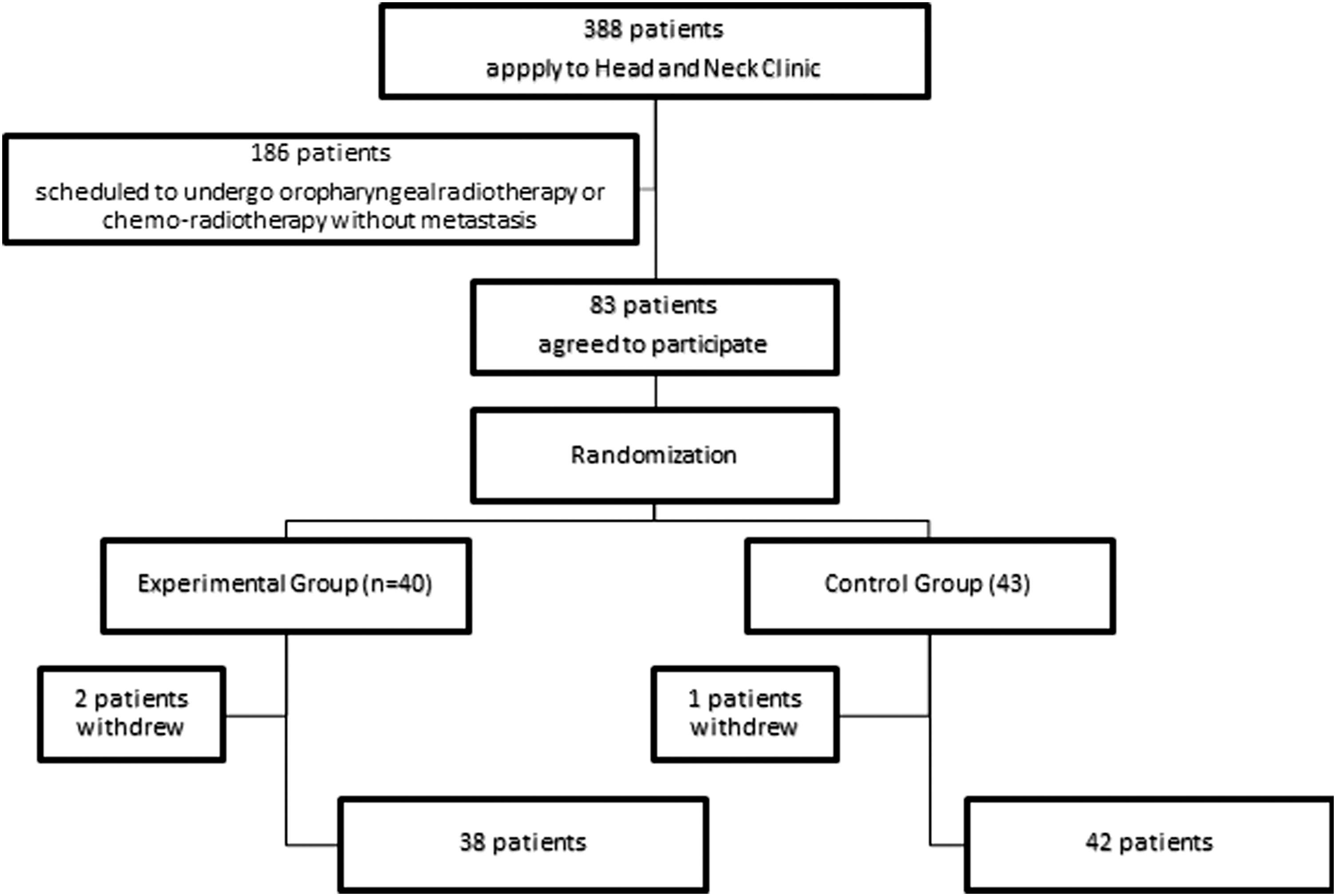
Flow of participants through the study sample calculation, a decrease of 40% in severity of oral mucositis was deemed significant and the acceptable value for α and β was set as 0.05 and 0.20, respectively. The required sample was determined to be 37 for each group.
Intervention
The black mulberry molasses used in the study was prepared and bottled industrially for the study by a company in Izmir, Turkey. Turkey's agricultural and rural affairs ministry oversees standardization of the preparation. Black mulberries are boiled together with water (the ratio of blackberry and water is 1:1). After boiling, the solution is sieved by using either a metal sieve or gauze. After the initial sieving process, the solution is boiled again and then left to cool in an uncovered container. The container is kept in a sunny and dry place until the molasses is ready. After this process, the molasses is bottled, untouched by hand. One bottle can fulfill a person's daily requirement, which is the amount needed to rinse their mouth with mulberry molasses three times a day.
The study protocol was also constituted depending on that used in honey studies. 18 –21 In one study, patients with head and neck cancer, who were undergoing RT, took honey in their mouth and then swallowed it slowly to coat the mucosa, both before and after RT. 19 In the other two studies, patients with head and neck cancer, who were undergoing RT, took honey in their mouth and then swallowed it slowly to coat the mucosa, 15–20 min before RT; 15–20 min following RT; and again, 6 h later for a total of three times per day. 18,21 In all studies, the patients in the control group received RT only. 18,19,21
In light of these data, the experimental group took black mulberry molasses in their mouths for a few minutes (1–3 min) and swallowed it three times a day: 15–20 min before RT, 15–20 min following RT, and again, 6 h later, in this study.
Measures and instruments
To assess the effects of the black mulberry molasses preparation on oral mucositis, four data collection forms were used: the Patient Information Form, the National Cancer Institute Common Terminology Criteria for Adverse Events, version 4.0 (NCI–CTCAE v4.0), the oral assessment guide (OAG), and the University of Washington Quality of Life Assessment Questionnaire (UW-QOL). At the first interview, all patients were assessed using the study measures and grading tools. These measures were conducted and completed under the guidance of a clinical trial nurse researcher. After baseline measurement every week, NCI–CTCAE v4.0 and OAG were administered, and every 3 weeks (at the third and sixth week), the UW-QOL was completed during RT. The NCI–CTCAE, v4.0, and OAG were used to rate the progress of the radiation-related changes in the oral mucosa, and the UW-QOL was used to assess the relationship between disease-related QOL and the oral mucositis experience of patients during RT. Patient follow-up was completed by evaluating the delayed side-effects of RT on day 90 using NCI–CTCAE v4.0, OAG, and UW-QOL.
Patient information form
The patient information form developed by the researchers was used on the first interview with the patients to assess the personal (age, income level, employment status, education) and disease-related (diagnosis, surgical therapy, RT) characteristics suggested as factors affecting the occurrence and severity of oral mucositis.
The National Cancer Institute Common Terminology Criteria for Adverse Events, version 4.0
The NCI–CTCAE, v4.0, is a set of descriptive terms for adverse events reported in oncology. In this study, the authors used the descriptive terminology only to determine the severity of oral mucositis. According to this guideline, the severity of oral mucositis is graded as Grade 1—asymptomatic or mild symptoms, intervention not indicated; Grade 2—moderate pain not interfering with oral intake, modified diet indicated; Grade 3—severe pain interfering with oral intake, what recommendation?; Grade 4—life-threatening consequences, urgent intervention indicated; and Grade 5—death. 22
Oral assessment guide
The OAG is the clinical assessment guide that assesses the clinical and functional changes of the oral cavity in eight categories—voice, swallowing, lips, tongue, saliva, mucous membranes, gingiva, and teeth/dentures—each of which are rated by three levels of description: normal findings = 1; mild alterations = 2; and definitely compromised = 3. The overall OAG score is the sum of all subscale scores (range = 8–24). Content-related and construct validity, clinical utility, and high trained nurse–nurse inter-rater reliability (r = 0.912) have been reported. The OAG took ∼5 min to complete. 23
The University of Washington Quality of Life Assessment Questionnaire
The UW-QOL is a brief and easy-to-administer self-report questionnaire that evaluates the quality of life of patients with head and neck cancer. The UW-QOL6 includes 12 domains. Each question is scaled from 0 (worst) to 100 (best) according to the hierarchy of responses. 24 It is a 12-item scale with three additional global questions; the scale is scored from 0 to 100 with higher scores indicating greater quality of life.
Ethical considerations
The Ethics Committee of the Istanbul University Faculty of Medicine and Research Committee of the Istanbul University Institute of Oncology approved this study. The required permission was obtained from the administration of Istanbul University, Oncology Institute. As previously stated, patients were informed. Verbal consent and written consent form were obtained.
Data analyses
Data analysis was performed using the SPSS software, version 21 (IBM SPSS Statistics 21). Descriptive statistics were used to show the distribution of personal, illness, and mucositis-related characteristics (Tables 1 and 2).
SD, standard deviation.
Comparative nonparametric tests (Mann–Whitney U and χ 2 tests) were used to assess the effectiveness of black mulberry molasses preparation for the management of oral mucositis.
The Kaplan–Meier method was used to assess the difference in mucositis development time between the two groups.
Cox regression analyses were conducted to predict the factors affecting mucositis development in the study group. The variables included in the Cox regression analyses were type of intervention group (experimental group vs. control group), age of the patients (<55 vs. >56), type of diagnosis (oral and pharyngeal cancers vs. laryngeal cancer), regular teeth cleaning (yes vs. no), pre-RT dentist control (yes vs. no), smoking (yes vs. no), type of treatment (RT/CRT), and the total radiation dose (≤60 Gy/>60 Gy). The mean age value was taken on the basis of determination of the age threshold. For the type of diagnosis, nasopharynx, oropharynx, and oral cavity diagnoses were combined on the one hand and the larynx and hypopharynx on the other, according to the area of radiation. The significance was set as p < 0.05.
Results
Patient characteristics and disease-related findings
Most of the patients in the experimental group were males (73.7%), 86.8% of the patients were married, 65.8% of the patients had completed secondary education, 44.7% of patients were retired, and their mean age was 55.42 ± 11.78 (Table 1). Most of them were diagnosed with having nasopharynx cancer (28.9%), 73.7% had also received surgical treatment, 36.8% received RT, and 63.2% had received CRT (Table 1).
Most of the patients in the control group were males (76.2%), 88.1% of the patients were married, 42.9% of the patients had completed secondary education, 33.3% of patients were retired, and their mean age was 45.50 ± 11.30 (Table 1). Most of them were diagnosed with having oral cavity cancer (35.7%), 29.4% had surgical treatment also, 42.9% received RT, and 57.1% received CRT (Table 1).
There was no difference in demographic or patient clinical characteristics (age, gender, marital status, education, level of income, working status) between the experimental and control groups (Table 1).
As shown in Table 2, there was no difference in the daily dose of RT or in the duration or total dose of RT between the experimental and control groups. Most patients were smokers and did not drink alcohol. Many patients did not complete any pre-RT dental control and did not brush their teeth regularly (Table 3).
Oral mucositis and black mulberry molasses
In the first week of the treatment and day 90 after the treatment, none of the patients had experienced oral mucositis. The average values of the severity of oral mucositis were higher in the control group than in the experimental group after the second week of RT up until the end of RT (Fig. 2). The first treatment-related oral mucositis developed in the control group was during the second week of RT. In the experimental group, the first treatment-related oral mucositis developed in the third week of RT (Table 4).
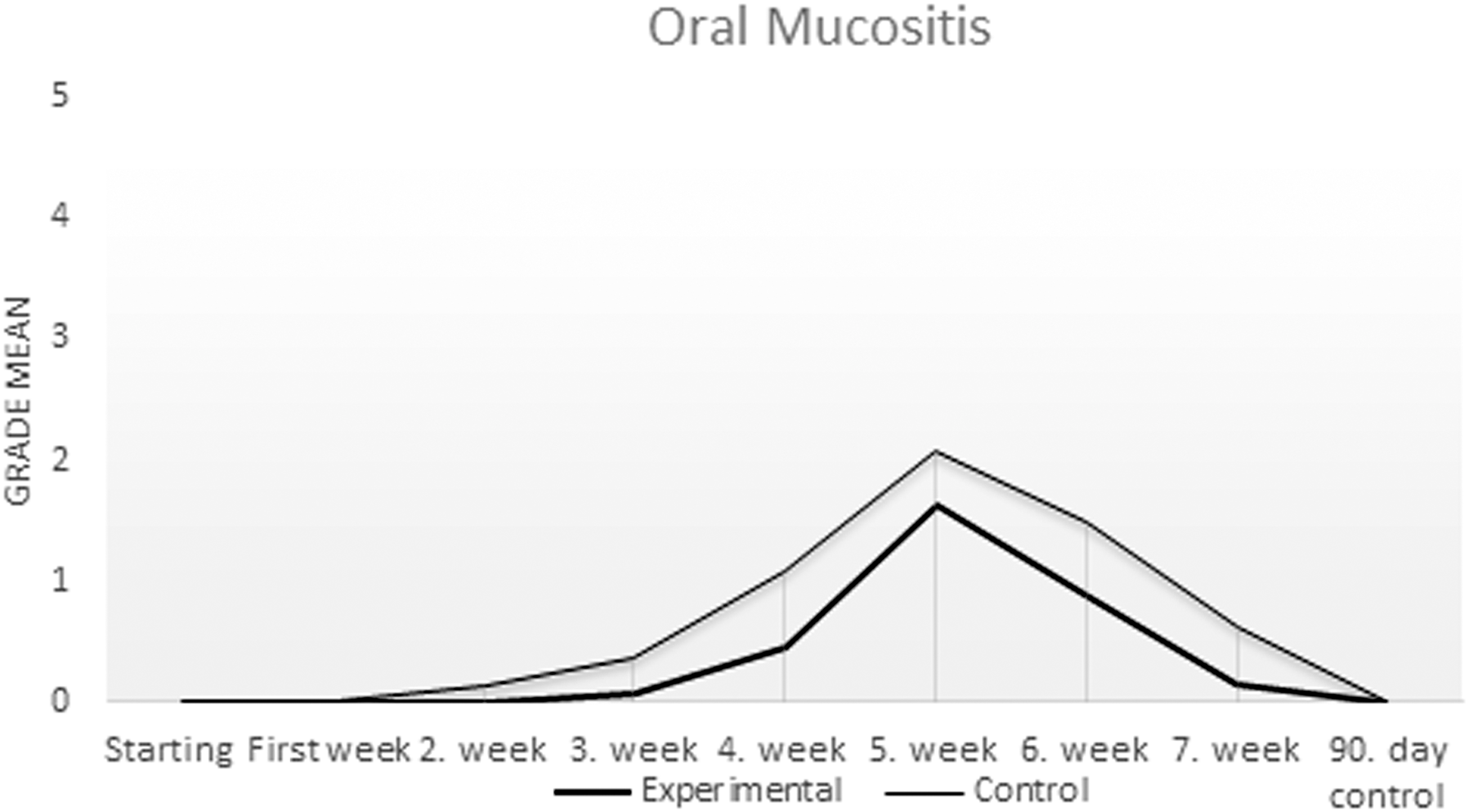
Mucositis—radiation toxicity average values by week (follow-up of the second week [zMWU = −2.15; p = 0.03], follow-up of the third week [zMWU = −2.66; p = 0.008], follow-up of the fourth week [zMWU = −3.18; p = 0.001], follow-up of the fifth week [zMWU = −2.6; p = 0.009], follow-up of the sixth week [zMWU = −2.74; p = 0.006], and follow-up of the seventh week [zMWU = −3.50; p = 0.0001]).
Statistically significant outcome values are in bold.
RT, radiation therapy; E, experimental; C, control.
The incidence of oral mucositis was significantly higher in the control group than in the experimental group at the third, fourth, and seventh weeks of RT (third week [χ 2 = 7.55, p = 0.006]; fourth week [χ 2 = 7.83, p = 0.005]; and seventh week [χ 2 = 12.67, p = 0.0001]) (Table 4). The severity of oral mucositis was significantly higher in the control group than in the experimental group at the fourth and sixth week of the treatment (G0–1 vs. G2–3 for the fourth week [χ 2 = 6.18, p = 0.01]; for the sixth week [χ 2 = 7.24, p = 0.007]; G0 vs. G1 vs. G2–3 for the fourth week [χ 2 = 10.19, p = 0.006]; and for the sixth week [χ 2 = 7.57, p = 0.02]) (Table 4).
The average pain assessment score due to oral mucosa was lower in the experimental group than in the control group at weekly follow-ups during treatment. Pain in the oral mucosa developed earlier in the control group and this development was found to be statistically significant in the control group (
Patients' quality of life was assessed four times: at the beginning of the therapy, at the third week of the treatment, at the sixth week of the treatment, and at the 19th day after the treatment (Table 5). The control group had a lower quality of life score when compared with the experimental group. Compared with the experimental group, the control group had a lower UW-QOL score in the sixth week of radiotherapy at a statistically significant level (t = 3.76, p < 0.00).
Statistically significant outcome values are in bold.
QOL, Quality of life.
Stepwise Cox regression analyses showed that black mulberry molasses usage was the only independent and significant factor in mucositis prevention in the head and neck cancer patients receiving radiotherapy (risk ratio, 0.63; 95% CI 0.40–0.98). It appeared that black mulberry molasses accounted for a 38% reduction in the formation of the mucositis, reduced gum sensitivity, and pain. An RT dose above 60 Gy was associated with increased weight loss, and the value of this significance was 73% (risk ratio, 0.27; 95% CI 0.10–0.71).
Discussion
Radiation-induced oral mucositis is experienced by 70%–80% of patients receiving RT. 7 –9 Oral mucositis leads to a reduction in patients' quality of life through its association with increased pain, declining performance status, inability to eat, and the need for a feeding tube. 7 Thus, many different interventions have been investigated for the management of oral mucositis related to RT in head and neck cancer patients. In the authors' country, black mulberry molasses is used as one of the interventions in lay person management of oral mucositis for reasons other than side-effects from RT. Understanding both the prevalence-associated pain of this side-effect and the country's familiarity with black mulberry preparations, the authors designed this study to determine the effectiveness of black mulberry molasses in the prevention of radiation-induced oral mucositis in the head and neck cancer patients.
Both the characteristics of the patient population and RT regimen in the study patients were consistent with those reported in the literature. The literature indicates that head and neck cancer is more common in males and that most patients are over 50 years of age and that the incidence of head and neck cancer increases with age. 20 In this study, men constituted the majority of patients, with a mean age of 55 years. With this in mind, the group of patients who participated in this study was similar to that reported in the literature. Surgery, RT, and CT are used in the treatment of head and neck cancers. 25 RT takes place 5 days per week, with the daily therapeutic dose of 2 Gy. The total treatment dose ranges from 50 to 70 Gy. 6,25,26 A 60–66 Gy total dose of treatment is planned in the treatment of postsurgical intervention. 25 In this study, this was performed on patients using a similar dose with RT 5 days per week in accordance with the general literature.
Oral mucositis is characterized by erythematous oral lesions, edema, ulceration, and pain, which is considered as one of the most common side-effects of RT, CT, and CRT. One study reported that the incidence of ulcerative mucositis was 97%; and RT, and CRT, 100%. 27 Oral mucositis developed in 90%–97% of patients and 60%–83% of those had severe oral mucositis. 7,28 Fifty percent of the patients who received RT had a peak oral mucositis of grade 3 severity. 29 In this study, 8.3% of the grade 3 oral mucositis developed in the experimental group and 41.5% of the grade 3 oral mucositis developed in the control group. Looking at the effects of honey, one study showed that 15% of grade 3 oral mucositis developed in the experimental group and 65% of grade 3–4 oral mucositis developed in the control group. 18 In another study involving honey, it was reported that 75% of grade 3–4 mucositis developed in the control group and 20% of grade 3–4 mucositis developed in the experimental group. 19 In this study, grade 4 oral mucositis did not develop.
When examining the studies involving honey, it appears that severity of mucositis decreased by ∼50%. In this study, the severity of mucositis decreased less dramatically by ∼38%. This difference can be attributed to patients who developed grade 4 mucositis in the other studies. Radiation-induced oral mucositis began within 3 weeks of initiating radiation treatment, with symptoms worsening over the ensuing weeks. For most patients, symptoms peak between 5 and 7 weeks, although occasionally patients will experience peak symptoms after completion of therapy. 30 In this study, oral mucositis developed in the control group by the second week of treatment, and in both groups, it reached the highest level in the fifth week of treatment. Mulberry molasses delays the formation of oral mucositis and has been found to reduce its severity. In a laboratory study, 14 mulberry molasses was effective with oral candida. Another study indicated that it is effective in oral mucositis for patients receiving CT. 17 This study supports the finding that mulberry molasses may be efficacious in a variety of contexts.
Oral mucositis causes pain and sensitivity of mouth and throat, with swallowing, taste, and other oral functions seriously affected. 27,31,32 Cheng et al. reported that as the severity of oral mucositis increased, the pain experienced by patients receiving RT or CT also increased. 32 Murphy et al. reported that pain increased over time in radiation-induced mucositis; 39%–60% of patients experienced severe pain in the first and second treatment weeks and in the fifth and sixth treatment weeks. 33 In this study, oral mucosal pain peaked in the fifth week of treatment; and toward the last week of treatment, the pain was found to decrease in both groups. The results support the findings of Cheng et al. and Murphy et al. 32,33
The authors found that quality of life in the experimental group was lower than that of the control group, but only in the sixth week of treatment. Experimental group patients' quality of life began to rise at 3 months following treatment. In the literature, an increase in quality of life could be seen 1 year after treatment. 34,35 The results are similar, in that there was no noticeable change initially, but change did occur at 3 months.
Conclusions
To the authors' knowledge, there have been no previous studies investigating the effectiveness of black mulberry molasses in the prevention and treatment of radiation-induced mucositis in head and neck cancer patients. This randomized controlled study showed that black mulberry molasses may be an effective intervention in the prevention of radiation-induced oral mucositis of head and neck cancer patients. However, further experimental studies are advised to substantiate or refute these findings.
Footnotes
Author Disclosure Statement
No competing financial interests exist.