




Abstract
Background:
The composition of intestinal microbiota is very important in human health. Gastrointestinal disturbances are among the symptoms commonly reported by individuals diagnosed with chronic diseases, such as inflammatory bowel disease, autism, and chronic fatigue syndrome. The effects of probiotics and prebiotics for dysbiosis have been reported in many studies. Bowel nosodes are homeopathic remedies made from human gut microbiota.
Objective:
Bowel nosodes made from the intestinal bacteria of European patients from the 1900s were administered to Japanese patients suffering from gastrointestinal disturbances, such as constipation and diarrhea, to determine their therapeutic efficacy.
Methods:
Twenty-eight outpatients from Yoko Clinic (11 males, 17 females; age range, 4–72 years) were enrolled in this study. One nosode remedy was selected for each case. Patients took six pills for 2 days. After a month, the effect of each treatment was evaluated using the Glasgow Homeopathic Hospital Outcome Scale (grade +4 to −4).
Results:
Patient number of each grade was +4 (N = 2), +3 (N = 4), +2 (N = 7), +1 (N = 3), 0 (N = 7), with no negative grades. Of the 23 patients analyzed, 69.6% showed some type of improvement, and no harmful effects from taking bowel nosodes were observed; 26% of patients showed major improvement or were “cured.”
Conclusion:
It is difficult to find correct constitutional remedies as they often require high-level techniques and time. Since there are only 11 main bowel nosode remedies, they are easier to choose from and cheaper to use and develop than classical constitutional remedies. Herein, 69.6% of dysbiotic patients taking bowel nosodes showed improvements, and no harmful effects were reported by any patient. These results suggest that the homeopathic bowel nosodes are a useful method for controlling gastrointestinal disturbances.
Background
T
Homeopathy is an alternative medicine that treats diseases according to the Similia principle, “let like be cured by like” (similia similibus curentur). This means that a certain drug selected to treat a condition, usually in a low-dose preparation called “potency,” can evoke similar symptoms when given to healthy volunteers in higher doses. The low-dose preparations are prepared according to a special procedure that includes serial dilution steps called “potentization.” Many reports have shown that homeopathy is very effective for many diseases and symptoms. 4
Bowel nosodes are ultramolecular homeopathic preparations derived from bacterial isolates from the gut cultured in vitro from stools of subacutely and chronically ill European patients from the 1900s. Nosodes were first developed by Edward Bach 5 and continued by John and Elizabeth Paterson. Herein, bowel nosodes were administered to dysbiotic Japanese patients.
Introduction
A poor diet and/or the inability to process food for bioavailability reduce the body's ability to cope and can create an environment that favors disease and metabolic disorder. 2,3 The benefits of a balanced intestinal microbiota are a strong digestive system, enhanced nutrient bioavailability, a strong immune system, increased cellular viability, as well as removal of metabolic by-products and environmental toxins. Recently, technical developments in genetic and peptide sequence analyses have revealed the status of microbiota in greater detail. Each individual has a different microbiota depending on his or her contact with his or her mother's microbiota during labor, whether or not he or she was breastfed, the daily diet, environmental and mental lifestyle stressors, and use of antibiotics. It has been reported that ethnicities can be a factor for different microbiota. 6 For example, Japanese gut microbiota typically contain marine bacteria since seafood is a staple of the Japanese diet. 7 Previously, the author reported that different probiotics have different effects on individual microbiota and have to be taken for a long period of time. Thus, the compatibility of different probiotics with each person's system should be considered. 8
Edward Bach was a bacteriologist and a homeopathic doctor at the Royal London Homeopathic Hospital in the 1920s. Along with clinician Charles Wheeler, he discovered that the intestinal microbiota was disturbed in patients with chronic illnesses. 9 They believed that overgrowth of certain nonlactose-fermenting bacteria was more prevalent in the stool of sick people than in the healthy. John Paterson continued to research the effects of homeopathic remedies on microbiota and found that patients who took bowel nosodes experienced improvement in their symptoms. 9,10 Bowel nosodes are now used for dysbiosis and chronic disease. They act by altering host flora symbiosis, perhaps allowing the gut to discharge unhealthy groups from biofilms that coat the gastrointestinal mucosa. This appears to allow the gut to repopulate spontaneously with healthier microbiota. However, the exact mechanism of action is unknown. Bowel nosodes were originally used for subacute or chronic, as well as gastrointestinal, symptoms. Because there are only eleven main kinds of bowel nosode remedies, they are easier to choose from than classical remedies and only require taking the pills for 2 day. Hence, they are often more cost-effective compared to classical remedies or supplements, such as probiotics or prebiotics. This study focused on the effects of bowel nosodes on gastrointestinal symptoms.
Materials and Methods
Population
Procedures in the present study conducted from October to December 2015 were in accordance with the guidelines of the Declaration of Helsinki (2000) for human experimentation, and all subjects provided informed consent. Twenty-eight outpatients (11 males, 17 females; age range, 4–72 years; mean age ± standard deviation, 43 ± 19.6 years) from Yoko Clinic (Kitakyushu, Japan) were enrolled.
Materials and study design
There are eleven main kinds of bowel nosode remedies (Morgan Pure, Morgan Gaertner, Dysentery Co., Proteus, Sycotic Co., Gaertner, Bacillus No. 7, Bacillus No. 10, Mutabile, Faecalis, and Coccal Co.). Each remedy was used for each patient to treat his or her symptoms based on the Materia Medica (see next page). Each patient took his or her remedy (30C potency) for 2 days (three times/day, on waking, midmorning, and bedtime, without food). After 1 month, any changes in symptoms were evaluated using the Glasgow Homoeopathic Hospital Outcome Score 11 (GHHOS: Fig. 1).
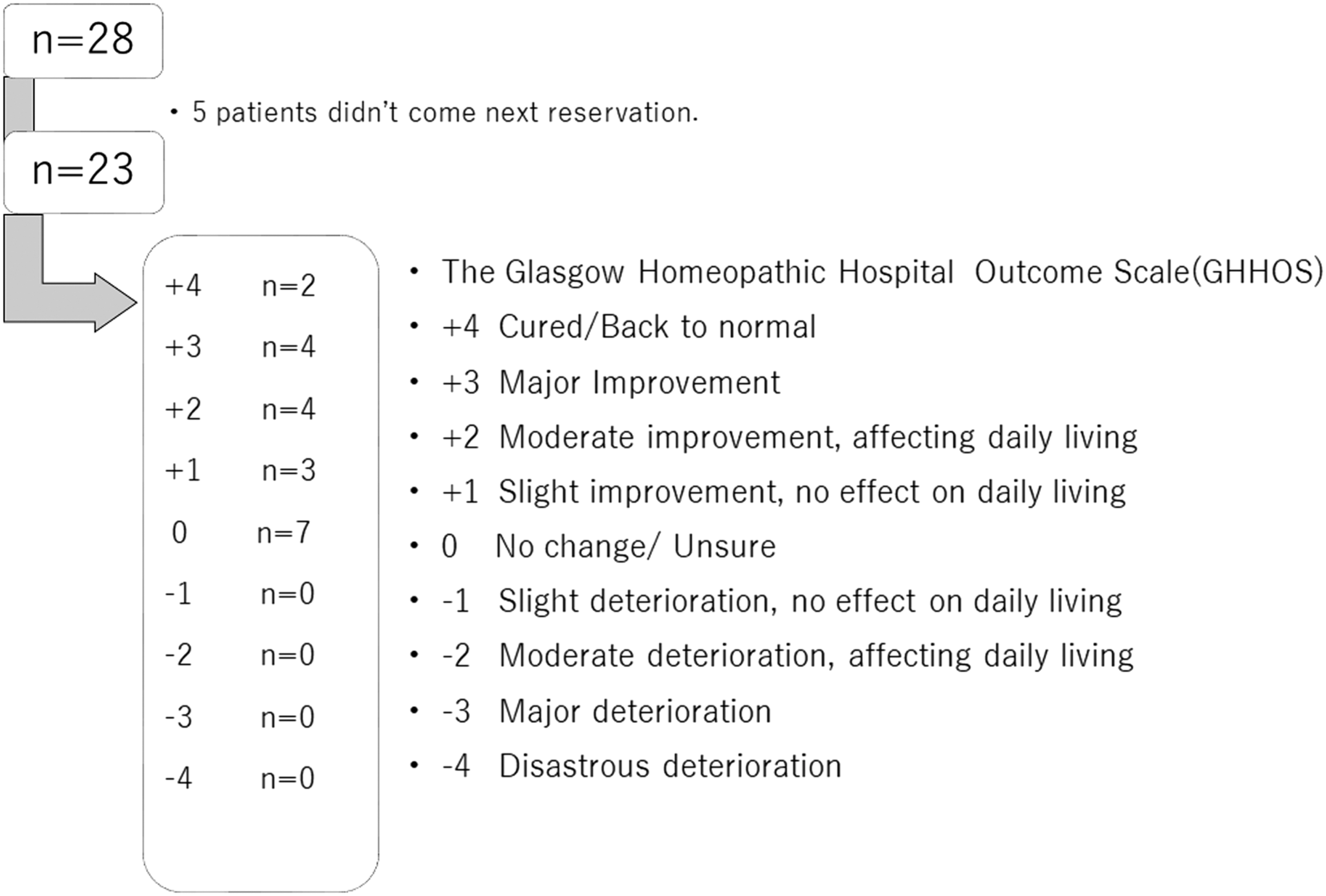
Schema of this study and evaluation of the effects of homeopathic bowel nosode remedies using the Glasgow Homeopathic Hospital Outcome Score.
Results
Eleven different bowel nosode remedies were used, including Sycotic Co. (N = 7), Gaertner (N = 6), Morgan Pure (N = 5), Proteus (N = 5), Dysentery Co. (N = 2), Morgan Gaertner (N = 2), and Coccal Co. (N = 1). The Figure shows that 5 patients did not show up for evaluation; therefore, results are indicative of 23 total patients. The number of each GHHOS grade for the 23 patients was +4 (N = 2), +3 (N = 4), +2 (N = 7), +1 (N = 3), 0 (N = 7), and there were no negative grades. Of the 23 patients evaluated, 69.6% showed some type of improvement, and 26% of patients showed major improvement and/or were “cured.” Furthermore, there were no harmful effects induced by taking any of the bowel nosodes. Patient gastrointestinal symptoms are shown in Table 1. Below is a brief overview of the Materia Medica description of each bowel nosode type and a description of the effective case for each remedy used.
Numbers in parenthesis refer to the number of cases with those symptoms.
Materia Medica
Morgan Pure
This remedy is made from Morganella morganii, which has histamine-producing capabilities isolated from the gut of fish. 9 Traditional homeopathic remedies are Calcarea carbonica, sulfur, and Hepar sulfur. Morgan Pure treatment is specifically linked to skin and liver conditions of a chronic nature, constipation, and/or diverticulitis. MIND: introverted, depression, fears, and restlessness. HEAD: congestive headache and vertigo. ABDOMEN: pain in anterior areas, heartburn, and nausea. CARDIOVASCULAR: hypertension. MUSCULOSKELETAL: arthritis and swollen, painful joints. SLEEP: poor sleep. SKIN: substantial irritation, eczema, redness, and hair loss.
Case: A 72-year-old female with reflux esophagitis had chief complaints of heartburn and recurrent skin rush of legs and constipation. She had a history of alopecia and pollen allergies, a cataract operation, osteoarthritis of both knees, osteoporosis, colonic diverticulitis, and arrhythmia. She took a proton pump inhibitor, activated vitamin D, a laxative every day, and a nonsteroidal anti-inflammatory drug. She was sleepy during the day. The author advised her to stop taking the proton pump inhibitor and nonsteroidal anti-inflammatory drug unless suffering severe symptoms and to try not to lie down after eating a meal. After 2 weeks, many of her symptoms improved, including her sleepiness during the day, sleeplessness at night, eruption of the legs, and heartburn with only one to two pills/week. However, she still had issues with constipation and mild heartburn when lying down at night. This patient was assigned 30C Morgan Pure × 6 pills/2 days and recovered from all of her symptoms without any other medicine after 4 weeks (GHHOS grade +4). Furthermore, any symptoms had not recurred as of her 1-month follow-up.
Morgan Gaertner
This remedy is made from Aeromonas, Edwardsiella tarda, Escherichia blattae, and Hafnia alvei. Traditional remedies are Lycopodium, Nux vomica, and Sulfur. Morgan Gaertner treatment is linked to the liver, gall bladder, colon, kidney, and vaginal conditions, as well as constipation and/or flatulence; flatulence is the most characteristic symptom. MIND: self-centeredness, anxiety, short-temper, jealousy, and fear of crowds. HEAD: headache and migraine, nasal catarrh, and flushing during headache. CARDIOVASCULAR: palpitation. MUSCULOSKELETAL: arthritis and pain under shoulder blades. UROGENITAL: renal stones and premenstrual tension. SLEEP: poor sleep. SKIN: pruritus and psoriasis.
Case: A 57-year-old female with irritable bowel syndrome had chief complaints of constipation, diarrhea, and flatulence with abdominal pain after meals. She had a history of uterine myoma, rheumatic arthralgia, and sleep problems. This patient was assigned 30C Morgan Gaertner × 6 pills/2 days. After 2 weeks, her abdominal pain and diarrhea improved, but she still had constipation and felt unsatisfied with her bowel movements (GHHOS grade +2).
Dysentery Co
This remedy is made from Shigella spp., which invades the intestinal mucosa and produces an enterotoxin that causes abdominal pain and tenesmus, and is related with excessive use of antibiotics. All symptoms tend to be worse when in a warm room.
Traditional remedies are Arsenicum album and Argentum metallicum. Dysentery Co. is linked to treatment of colon, small intestine, and airway issues, and gastrointestinal symptoms include diarrhea. MIND: nervousness, anxiety, insecurity, excitability, phobias, and lack of confidence in new situations. HEAD: frontal headache. FACE: muscle twitches and vision upsets. ABDOMEN: chronic indigestion, flatulence, duodenal ulcers, pain in both the stomach and intestine, and mucous in stools. CARDIOVASCULAR: anticipatory palpitation. MUSCULOSKELETAL: twitches, tightness, and rheumatism of shoulders and neck. SLEEP: sleepless due to mental activity. SKIN: warts.
Case: A 69-year-old female with ulcerative colitis had chief complaints of diarrhea with mucous three to five times/day. She took mesalazine and had sleep problems since foreign travel. She was very anxious and had digestive problems. This patient was assigned 30C Dysentery Co. × 6 pills/2 days. The treatment improved her stomach pain and her stool became normal or was soft to watery without mucous three times/day. She was also able to reduce mesalazine (2400–800 mg/day) (GHHOS grade +3).
Proteus
This remedy is also related to histamine but compared to Morgan Pure, Proteus is more for treatment of local anal or vaginal skin problems. Traditional remedies are Natrum muriaticum, Ignatia, and Magnesium muriaticum. Proteus is linked to the treatment of automatic nerve, central nervous system (CNS), peripheral nerve, and muscle issues. Allergic conditions involving the digestive tract are another indication for Proteus, as well as constipation and/or diarrhea, duodenal ulcer, and irritable bowel syndrome. MIND: brainstorms, feeling stressed, irritability, depression, dislike being ignored, and closed personality with a tendency toward being alone. HEAD: frontal headache and vertigo. FACE: eyes sensitive to light. ABDOMEN: duodenal ulcers, flatulence, and vomiting. CARDIOVASCULAR: angina pectoris and palpitation. UROGENITAL: cystitis and irregular menses. RESPIRATORY: bronchitis, coryza, or blocked nasal passages. MUSCULOSKELETAL: cramps and spasms. SKIN: edematous swellings.
Case: A 55-year-old female with chronic fatigue syndrome had chief complaints of rheumatic arthritis, urticaria on abdomen, digestive problems, constipation, and flatulence. She was struggling with these symptoms for 5 years. During the last 2 years, those symptoms were deteriorating. She had a history of uterine myoma, ovarian cysts, and sleep problems. She was advised to improve her diet and get plenty of rest. After 1 month, her rheumatic arthritis improved. However, her other symptoms persisted. This patient was assigned one 200C Natrum Muriaticum pill every night. She was then able to sleep by Natrum Muriaticum without medicine but still had digestion problems. This patient was then assigned 30C Proteus × 6 pills/2 days, which led to the recovery from her abdominal pain, flatulence, and stool problems (GHHOS grade +2).
Sycotic Co
This remedy is made from Enterococcus and Branhamella catarrhalis, diplococcal bowel organisms characterized by their inability to ferment lactose, and is made from many patient's nosodes. Infections with a strong etiology are indications for use of this remedy. Traditional remedies are Calcarea carbonica, Thuja, and Pulsatilla. Sycotic Co. treatment is specifically linked to urologic, rheumatic, and arthritic conditions, as well as constipation and/or loose stool and flatulence. Other symptoms associated with its use are a great sensitivity to cold and a general feeling of worsening symptoms in damp and/or cold weather. MIND: irritability, peevishness, restlessness, shyness, depression, and fear of the dark, being alone, and animals with a desire to hide in fear. HEAD: frontal headache with vertigo, sinusitis, and excessive sweating at night. FACE: twitches, photophobia, catarrhal discharge from the nose, ears, and eyes, and mouth ulcerations. ABDOMEN: chronic inflammation, nausea, and flatulence. CARDIOVASCULAR: anemia. UROGENITAL: inflammation, warts and polyps, and cystitis. RESPIRATORY: inflammation, catarrhal conditions, asthma, hay fever, and cough with thick sputum. MUSCULOSLELETAL: rheumatism and arthritis. SLEEP: restless and dreams. SKIN: warts and cysts, painful brittle nails, cracking skin.
Case: A 63-year-old male had abdominal pain, depression, asthma, and diverticulitis for 10 years. His history included pyelonephritis and hyperlipidemia. He suffered from abdominal pain and diarrhea after eating meat. He was also very busy and stressed. This patient was assigned 30C Sycotic Co. × 6 pills/2 days. He recovered from all symptoms after 4 weeks (GHHOS grade +4).
Gaertner
This remedy is made from Salmonella spp. and related to malnutrition. Traditional remedies are Phosphorous, Silica, and Mercurius solubilis. Gaertner treatment is linked to small intestine and lymph node issues, as well as gastrointestinal symptoms appearing after Salmonella infection, including dysbiosis, diarrhea, and malnutrition. MIND: nervousness, overactivity, heightened sensitivity to stimuli, intelligent, easily upset, and fearful. HEAD: vomiting-induced headache. FACE: mouth ulcers and eruptions around the lips and tongue. ABDOMEN: stomach pain, offensive diarrhea, and inability to digest fats. CARDIOVASCULAER: palpitations. MUSCULOSKELETAL: arthritis. SLEEP: restless sleep. SKIN: eruptions on the back, head, and neck.
Case: A 36-year-old male with bacterial overgrowth in the small intestine had chief complaints of diarrhea since experiencing food poisoning at the age of 16 years. He also had a panic disorder and depression. He took a selective serotonin reuptake inhibitor and mexazolam (benzodiazepine). He was advised to eat a gluten-free, casein-free elimination diet and also elimination diets (eggs and coffee) that caused immunoglobulin G food intolerance. Although he still had nausea, he experienced a slight improvement from his diarrhea. This patient was assigned 30C Gaertner × 6 pills/2 days. After this treatment, he recovered from his nausea and diarrhea except when he ate beef at restaurants (GHHOS grade +3). His symptoms returned after 3 months, likely because he began to eat much more sugar and carbohydrates again. He did not continue the diet therapy or have any further consultations.
Bacillus No. 7
This remedy is made from Citrobacter spp. and is generally associated with fatigue. Traditional remedies are Kali carbonicum and Iodum. Bacillus No. 7 is linked to treatment of muscle, joint, and thyroid problems, and gastrointestinal symptoms include feelings of fullness and constipation. MIND: mental lethargy, tiredness, and tension. HEAD: dull headaches and vertigo. CARDIOVASCULAR: slow pulse and hypotension. UROGENITAL: loss of sexual function and pain in vulva. RESPIRATORY: asthma and tonsillitis with swelling throat. MUSCULOSKELETAL: poor muscle tone, weakness, stiffness, cramping at night, and swollen painful joints. SLEEP: light, restless, and unrefreshing sleep with difficulty falling asleep. SKIN: cracking skin and ganglia on hands.
Case: No patient was assigned this remedy in this study.
Bacillus No. 10
This remedy is made from Gardnerella and related to fluorine associated with bones, joints, and teeth. Traditional remedies are Calcarea carbonica and Fluoricum. Bacillus No. 10 treatment is linked to the mouth, vagina, anal, gallbladder, and urethra. Gastrointestinal symptoms are abdominal pain and diarrhea. MIND: overactivity, anxiety, depression, irritability, sensitivity, and excessive and obsessional behaviors. HEAD: frontal headaches. FACE: halitosis, bleeding gums, and bloody saliva. ABDOMEN: nausea, vomiting, pain in gallbladder from fats, and irritation around the anus. RESPIRATORY: cough and thick mucus. MUSCULOSKELETAL: arthritis in the left knee. SKIN: flat or pointed warts on hands and feet and profuse perspiration from axillae.
Case: No patient was assigned this remedy in this study.
Mutabile
This remedy is made from Salmonella spp., Escherichia coli, and Morganella. This remedy is regarded as changeability. Traditional remedies are Pulsatilla and Cimicifuga. Mutabile is linked to the treatment of instability, urethra, and diverticulum. Gastrointestinal symptoms are diverticulitis. MIND: capriciousness and insecurity. UROGENITAL: urinary infection, cystitis, and albuminuria. RESPIRATORY: asthma alterations with skin symptoms. SKIN: changeability.
Case: No patient was assigned this remedy in this study.
Faecalis
This remedy is made from Bacillus faecalis and Alcaligenes. Traditional remedies are Sepia. Faecalis treatment is linked to colon, lymph duct, skin, and urethra conditions, as well as changeable stool. MIND: expressed or suppressed anger and frustration for long durations.
Case: No patient was assigned this remedy in this study.
Coccal Co
Traditional remedies are Tuberculinum and Calcarea carbonica. This remedy is beneficial for low-grade persistent infections, especially those linked to the skin.
Case: A 62-year-old female presented with hematuria. She had a history of recurrent childhood tonsillitis, diarrhea, and struggled with urticaria for 5 years until the age of 20 years. She was advised to change her diet, eliminating food additives and processed foods, then she recovered from all symptoms except a sore throat. This patient was assigned 30C Coccal Co. × 6 pills/2 days and recovered from her sore throat. (GHHOS grade +3).
Discussion
Technologic developments, especially in genome analysis, have revealed products of the microbiome in greater detail allowing better understanding of the cross talk between the microbiome and human gastrointestinal system. A healthy gastrointestinal tract may not be properly established from birth due to different factors, such as the environment inside the mother's uterus, whether or not the child was breastfed, and ingestion of different medications (e.g., antibiotics), daily diet, environmental toxins, and stress. One report showed that the effect of a strict vegetarian diet on the microbiota is very different from those with different diets. 12 Improper microbiota can induce autism, allergic diseases, metabolic syndrome, immune disorder, and inflammatory bowel disease.
Dysbiosis causes low-grade inflammation and production of other toxic peptides. For example, lipopolysaccharides are a structural component of bacteria, which provide low-grade tonic stimulation of the innate immune system. Lipopolysaccharides cause intestinal mucosa permeability and lead to systemic and/or CNS inflammation. Bacterial proteins can cross-react with human antigens to stimulate dysfunctional responses from the adaptive immune system. Bacteria are also anaerobic, generating metabolic products (e.g., ammonia and lactic acid) that can be neurotoxic to humans in large concentrations. Bacteria in healthy intestines can produce hormones and neurotransmitters that are identical to those produced by humans. However, dysbiosis inhibits production of proper hormones and neurotransmitters, thereby influencing the entire body, including the skin, CNS, and immune system. Gut bacteria directly stimulate afferent neurons of the enteric nervous system and send signals to the brain via the vagus nerve, affecting the hypothalamic–pituitary–adrenal axis. 13 Louveau et al. found that intestinal bacteria affect structural and functional features of the CNS and lymphatic vessels, 14 meaning dysbiosis can directly influence the CNS through lymphatic vessels. Dysbiosis can also cause memory, mood, and cognition issues, alcoholism, chronic fatigue syndrome, fibromyalgia, restless leg syndrome, multiple sclerosis, and autism.
Studies have shown that introduction of other/new bacteria to resident microbiota has been suggested to change the condition of various diseases. For example, recurrent Clostridium difficile infection, Crohn's disease, or ulcerative colitis has been shown to be successfully treated by fecal microbiota transplantation (FMT). 15,16 Similar results have come from probiotic supplementation, particularly with allergic and pollen diseases, skin disorders, and constipation. However, according to the previous study, 8 some patients' microbiota deteriorated when they took certain probiotics, suggesting possible incompatibility with their system. Considering the microbiota of each person is different, care should be taken when taking probiotics to avoid potentially harmful effects.
Constitutional homeopathic remedies are very useful for improving chronic diseases or symptoms. However, it is often difficult to find proper constitutional remedies because it requires high-level skills and much time. In contrast, homeopathic bowel nosode remedies are easier to choose from. Bowel nosodes are made from human intestinal microbiota and were originally used to cure chronic disease. In the 1920s, Edward Bach and Charles Wheeler discovered that the stool microbiota was disturbed in patients with chronic illnesses. They believed that overgrowth of certain nonlactose-fermenting bacteria was more prevalent in the stool of sick individuals rather than healthy ones. Although they were unable to reveal the entire microbiome, they were able to observe changes in cultured microbes by microscope, as well as changes in patient symptoms. Therefore, they believed these remedies acted like a vaccine. Later, John Paterson continued to research the effects of homeopathic remedies on microbiota and found that patients who took bowel nosodes experienced improvement in their symptoms. 9,10 Since there are a smaller number of these types of remedies, they are easier and cheaper to use than classical constitutional remedies.
In this study, the author selected 11 bowel nosode remedies for patients with gastrointestinal symptoms. The results showed that 69.6% of included patients (N = 23) showed some type of symptom improvement, and there were no harmful effects observed from their ingestion. Although these remedies were made from the feces of European patients from the 1900s, they significantly helped improve gastrointestinal symptoms of present-day Japanese patients. Thus, these results suggest bowel nosodes are a useful method for controlling gastrointestinal disturbances in patients worldwide. Furthermore, the short 2-day treatment period promotes better compliance with their use than supplements and constitutional remedies. However, it should be noted that some patients showed recurrent symptoms after several months, and use of bowel nosodes for recurrence produced little to no beneficial effects compared to their first use. This suggests that new different types of dysbiosis occurred, largely due to taking antibiotics, an unhealthy diet, and stress, among other factors. In future, the author aims to further analyze the bowel nosode remedies before and after use with genomic approaches.
Conclusions
Herein, the author evaluated the effect of homeopathic bowel nosode remedies on Japanese patients with gastrointestinal disturbances. The most important factors for improving the microbiome are a proper diet and stress-free lifestyle, and not probiotics or FMT alone. One report showed that the effect of a strict vegetarian diet on the microbiota is very different from those with different diets. 11 In this study, the majority of patients showed improvement of some symptoms before even using the bowel nosode remedies simply because they changed their lifestyle and reduced their medication intake. Hence, healthcare workers and clinicians should advise and focus on diet and lifestyle in addition to therapeutic methods, such as probiotics, homeopathy, and FMT. Furthermore, these results showed that bowel nosodes could improve 70% of patient symptoms without side-effects. These results suggest that bowel nosodes may help improve dysbiosis, act like FMTs, probiotics, or vaccines, can be taken in smaller doses/concentrations, produce little to no side-effects, and are low cost.
Footnotes
Author Disclosure Statement
No competing financial interests exist.