




Abstract
Objectives:
The last systematic review of physicochemical research performed on homeopathic preparations was published in 2003. The aim of the study is to update and expand the current state of knowledge in the area of physicochemical properties of homeopathic preparations. In part 1 of the study, we aim to present an overview of the literature with respect to publication quality and methods used. In part 2, we aim to identify the most interesting experimental techniques. With this, we aim to be in a position to generate meaningful hypotheses regarding a possible mode of action of homeopathic preparations.
Methods:
A two-step procedure was adopted: (1) an extensive literature search, followed by a bibliometric and quality analysis on the level of publications and (2) a thorough qualitative analysis of the individual physicochemical investigations found. In this publication, we report on step (1). We searched major scientific databases to find publications reporting physicochemical investigations of homeopathy from its origin to the end of 2015. Publications were assessed using a scoring scheme, the Manuscript Information Score (MIS). Information regarding country of origin of the research and experimental techniques used was extracted.
Results:
We identified 183 publications (compared to 44 in the last review), 122 of which had an MIS ≥5. The rate of publication in the field was ∼2 per year from the 1970s until 2000. Afterward, it increased to over 5.5 publications per year. The quality of publications was seen to increase sharply from 2000 onward, whereas before 2000, only 12 (13%) publications were rated as “high quality” (MIS ≥7.5); 44 (48%) publications were rated as “high quality” from 2000 onward. Countries with most publications were Germany (n = 42, 23%), France (n = 29, 16%), India (n = 27, 15%), and Italy (n = 26, 14%). Techniques most frequently used were electrical impedance (26%), analytical methods (20%), spectroscopy (20%), and nuclear magnetic resonance (19%).
Conclusions:
Physicochemical research into homeopathic preparations is increasing both in terms of quantity and quality of the publications.
Introduction
H
The mode of action underlying specific effects of highly diluted homeopathic preparations could not yet be established, which strongly hampers the acceptance of homeopathy. A variety of models have been proposed. These can be categorized as local models 11 –18 and nonlocal models. 19 –23 For recent review of the theory, the reader is referred to the reviews by Schulte and Endler 24 and Bellavite et al. 25
However, any theoretical model needs to be supported by experimental evidence. The aim of this systematic review is to compile and interpret previously published research on physicochemical investigations of homeopathically potentized preparations, to refine existing hypotheses, and generate new ones, and so direct future experiments. It is also an update of previous systematic reviews of physicochemical investigations 26,27 and a specification of a broader bibliometric evaluation of homeopathic basic research in general. 28
In this article, we present the literature search, quality analysis, and bibliometric description on the level of publications. In a second step, in a follow-up publication, individual investigations will be extracted from the high-quality publications and analyzed in detail, with the aims of identifying most interesting experimental techniques, identifying empirical evidence (if any) of specific physicochemical features of homeopathic preparations, determining most promising areas of research, and generating hypotheses regarding a possible mode of action of homeopathic preparations.
Methods
Protocol and registration
This review was planned and conducted in accordance with the Preferred Reporting Items for Systematic Reviews and Meta-Analyses (PRISMA) guidelines. 29 The protocol was not registered in any database; as such databases are geared toward registering health-related systematic reviews.
We made the distinction between “publications” and “investigations”. A publication can report on results of several different investigations. On the other hand, a single investigation can be presented in several publications. To simplify the analysis, the procedure was split in two parts. This study focuses its analysis per “publications”—a deeper per “investigation” analysis will be presented in a subsequent publication.
Eligibility criteria
To be eligible for this systematic review, investigations reported in the publications needed to
• be experimental
• investigate physicochemical properties of homeopathic preparations
• investigate potency levels ≥6x or 3c
• be published before the end of 2015.
Publication types included papers in peer-reviewed and not peer-reviewed journals, theses, books, book sections, and conference proceedings. Conference abstracts were excluded, because their word limits did not allow for a detailed description of the methodology and results.
There was no language restriction (papers in English, German, French, and Russian were evaluated).
Publications were excluded, if they
• described experiments with enzymes, bacteria, cells, plants, animals, or humans
• described mathematical models or theoretical thought experiments
• were a translation of another publication in a different language.
Publications that described several experiments were included if at least one experiment fulfilled the inclusion criteria.
Information sources
The following databases were searched, from the beginning of each database until the end of 2015: HomBRex, PubMed, Web of Science, Embase, and Scopus. Personal literature collections were also included.
Search
Search terms were as follows: homeopath*, high dilutions, very dilute aqueous solutions, very high dilutions, ultrahigh aqueous dilutions, extremely diluted solutions, extremely diluted aqueous solutions, ultramolecular aqueous dilutions, and serially diluted and agitated solutions. These were combined with physicochemistry keywords.
In HomBRex, the search was by Field “Physical chemistry.”
In Web of Science, the search strategy was as follows: Keywords: Homeopath*. Restricted to Research areas: chemistry OR microscopy OR biophysics OR physics OR materials science OR science technology other topics OR instruments instrumentation OR medical lab technology. In SCOPUS and PubMed; the search terms were as follows: ([homeopath* or homoeopath* or “ultra high dilution” OR “serial* agit*”]) AND (NMR OR Spectrom* or spectrosc* or conducti* OR AFM OR Thermolumi* OR lumine* OR dielectric OR densitometry OR refractometry OR microcal* OR ultrasound OR “Surface Tension”).
The International Journal of High Dilution Research was searched by scanning the table of contents for all years available.
The personal literature collection of S.B. was searched by the following keyword: Phys*.
Further references were added from earlier reviews. 26,27
The search was performed by two authors independently (S.B. and A.T.) and then combined in EndNote.
Manuscript Information Score
Full-text papers were screened for inclusion and exclusion criteria (see above). Papers matching these criteria were then evaluated according to a Manuscript Information Score (MIS). The present MIS scoring scheme is based upon an MIS used for the rating of bioassay publications, 5 –7 which was adapted for the rating of physicochemical publications, defined at the beginning of the review. The MIS used in this review provides a score assessing the quality of reporting, with items specifically relevant for physicochemical research into homeopathic preparations.
Five assessment areas were each attributed a score between 0 and 2, providing a final maximum MIS score of 10. The categories considered were as follows: experimental procedure, materials, measuring instruments, potentization, and controls. The specifics of the scoring scheme are presented in Table 1.
Five assessment areas were given a score between 0 and 2, leading to a maximum of 10 points. Only studies with MIS ≥5 were included in the review.
MIS, Manuscript Information Score.
Scoring was performed by two reviewers independently. Differences in MIS scores greater than one were resolved by discussion between the reviewers. No reviewer scored his own publications. Authors of the publications were not contacted for obtaining additional (missing) data.
Data items
The following data were extracted from each publication: • Publication type (Peer-reviewed journal, Not peer-reviewed journal, Journal peer review unknown, Conference proceedings, Book or book section, Thesis) • Publication year • Techniques used, categorized in 11 groups: Electrical impedance, Analytical methods, Spectroscopy, Nuclear Magnetic Resonance (NMR), Imaging methods, Calorimetry, Electrochemistry, Luminescence, Chromatography, Raman spectroscopy, Various physical • Country of origin (the country of the corresponding author was selected when authors were from several countries) • MIS (see above).
Results
Three hundred and three references were identified through searching databases and personal libraries. For 14 references, no full text was available (some books could not be found in the libraries accessible to us, and some PhD theses could not be obtained in full text), such that only 289 could be retrieved in full text. Out of these 289 publications, 106 were excluded for various reasons (Fig. 1). Finally, 183 publications were included in this bibliometric evaluation
11,12,16,30
–209
(Fig. 1). The full list of included publications along with their associated MIS score, Country, Publications Type, and Methods used is provided as Supplementary Data (Supplementary Data are available online at
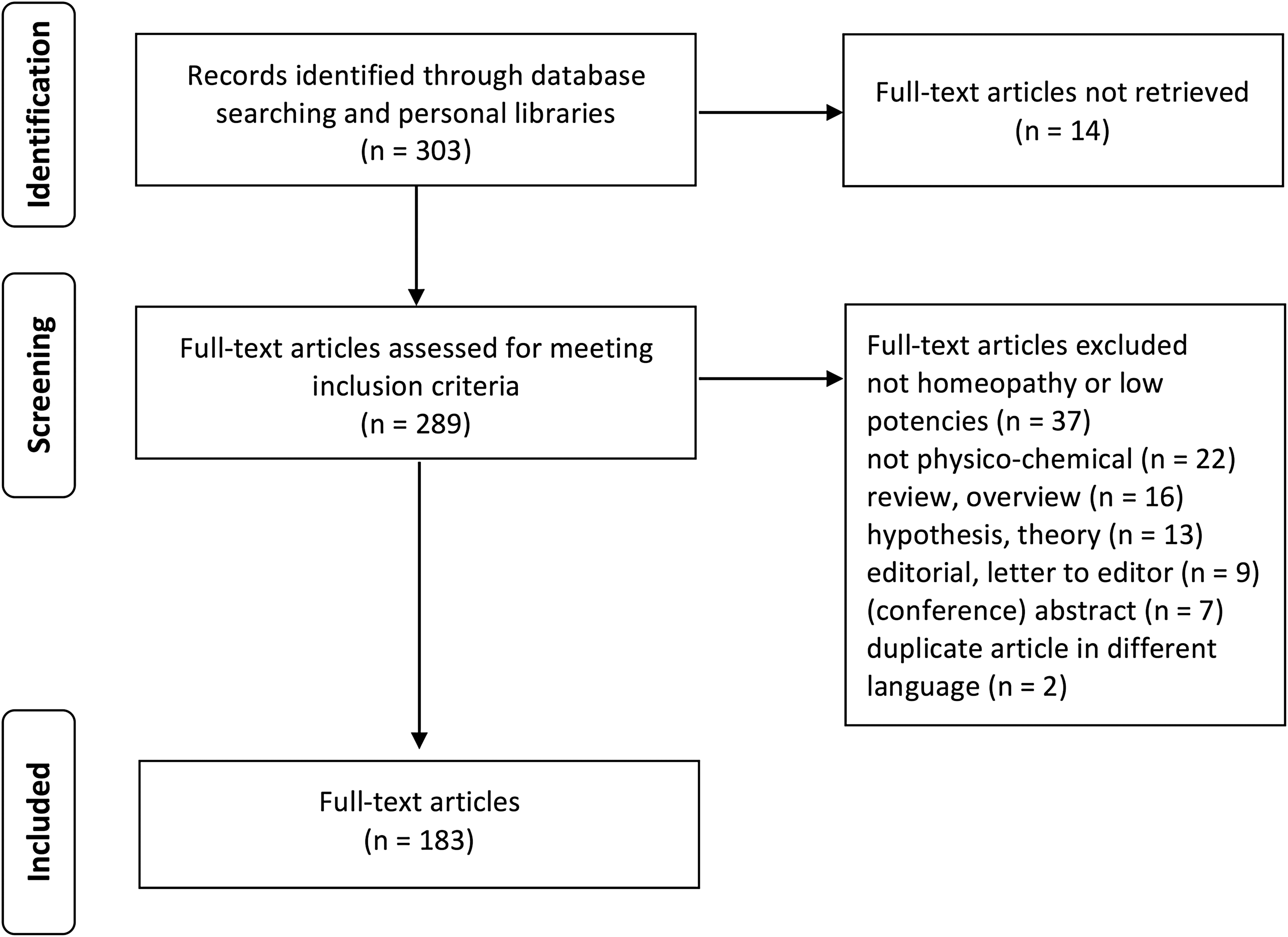
PRISMA flow diagram of paper inclusion.
Publication type and journals
Most papers appeared in peer-reviewed journals, with 68% of all publication peer reviewed. Seventy-three percent of the publications with an MIS ≥5 were peer reviewed (Table 2). Table 3 presents the journals having published more than five publications. We see that the journal Homeopathy (formerly British Homeopathic Journal) has published the most with 24 publications in the field and has carried on publishing in recent years (17 publications from 2000 onward). Interestingly, the Journal of the American Institute of Homeopathy, which published 11 papers in this field, has stopped publishing physicochemical research in recent years. Similarly, the Annales Homéopathiques Françaises has stopped publishing in this field (six publications before 2000). On the other hand, journals like the International Journal of High Dilution Research, the Journal of Thermal Analysis and Calorimetry, and the Journal of Molecular Liquids have been publishing in this field from 2000 onward (seven publications from 2000 onward each).
MIS, Manuscript Information Score.
Development over time
Figure 2 presents the number of publications over time. The number of publications has been increasing markedly around 2000 from ∼2 publications per year to over 5.5 publications per year from 2000 onward (see insert in Fig. 2). The first publication we found dates back to 1842 and was performed by a German author, Carl Mayrhofer, who studied the grinding of metals through solid trituration by microscopic investigation. 158 The following publication was a French study, which appeared in 1935, 206 followed in 1936 by the first British publication. 52
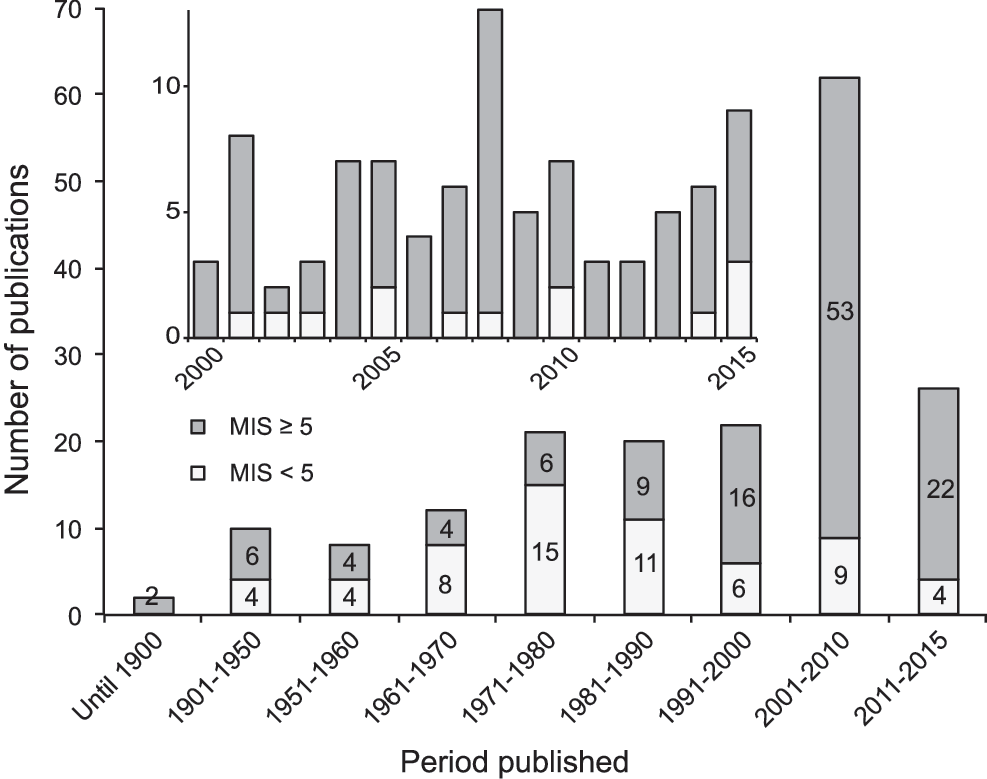
Publications of physicochemical studies of homeopathic preparations per time period. MIS, Manuscript Information Score.
Reporting quality
The rate of agreement in the MIS—defined as one or less point difference between the two reviewers scoring the papers—was greater than 85%. One hundred and twenty-two of the 183 publications (67%) were scored with an MIS ≥5 and rated as publication with “acceptable reporting quality.” Fifty-six of the 183 publications (31%) were scored with an MIS ≥7.5 and rated as publication with “high reporting quality.”
The quality of the papers, as determined by MIS ≥5, has also risen sharply in recent years, with only 35% of publication in the 80s having an MIS ≥5 compared to 82% in the current decade (Fig. 2). Looking at the distribution of MIS scores over the years, we see that the average MIS score has increased significantly since 1990 from 4.2 to 6.9 (data not shown). Considering that 50% of publications were published in 2000 or after, it makes sense to look more closely at recent years. Before 2000, only 12 (13%) publications had an MIS ≥7.5 (defined as “high-quality”), with most publications having MIS scores around 4 (Fig. 3). The picture is considerably different from 2000 onward, where 44 (48%) publications had an MIS ≥7.5. On average, over the whole time range, 30% of publications had an MIS ≥7.5.
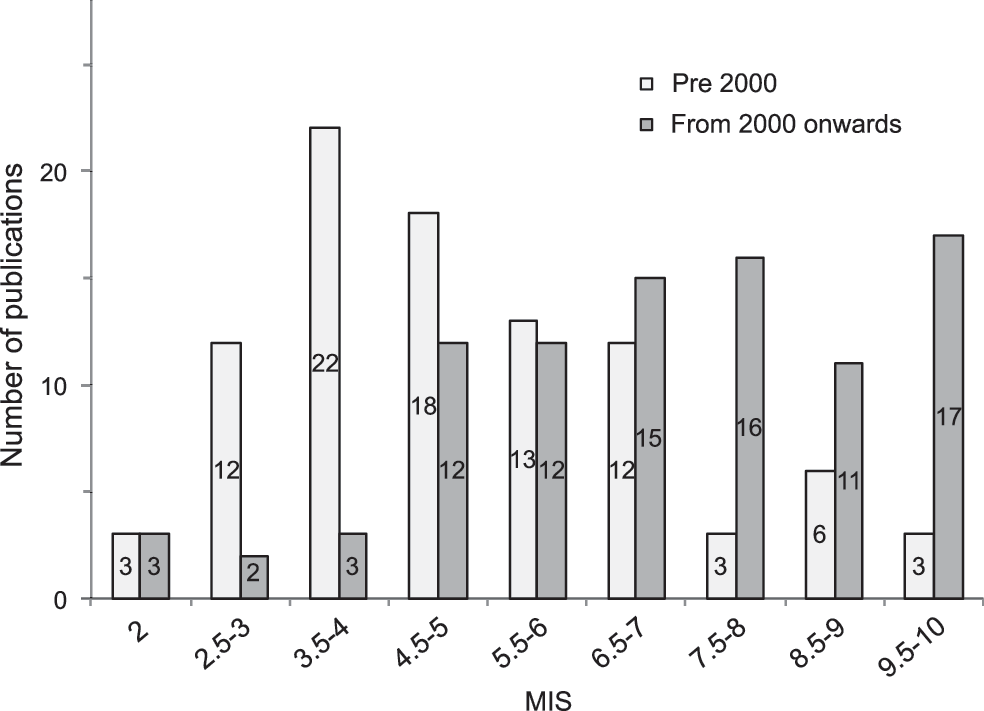
Distribution of Manuscript Information Scores (MIS) (average of two scorings from two reviewers) for the publications before 2000 and from 2000 onward.
Geographic distribution
Figure 4 presents the breakdown of publications by country (more specifically, the country of the corresponding author). Most publications came from Germany with 42 publications (23% of all publications), France with 29 publications (16%), India with 27 publications (15%), and Italy with 26 publications (14%). Germany and Italy have been publishing the most publications with MIS ≥5 (25 each, i.e., 20%). From 2000 onward, the breakdown per country is somewhat different with Italy (26% of publications), India (22%), and Germany (14%) appearing most active in the field in recent years (Fig. 5).

Number of publications per country for all 183 publications. MIS, Manuscript Information Score.
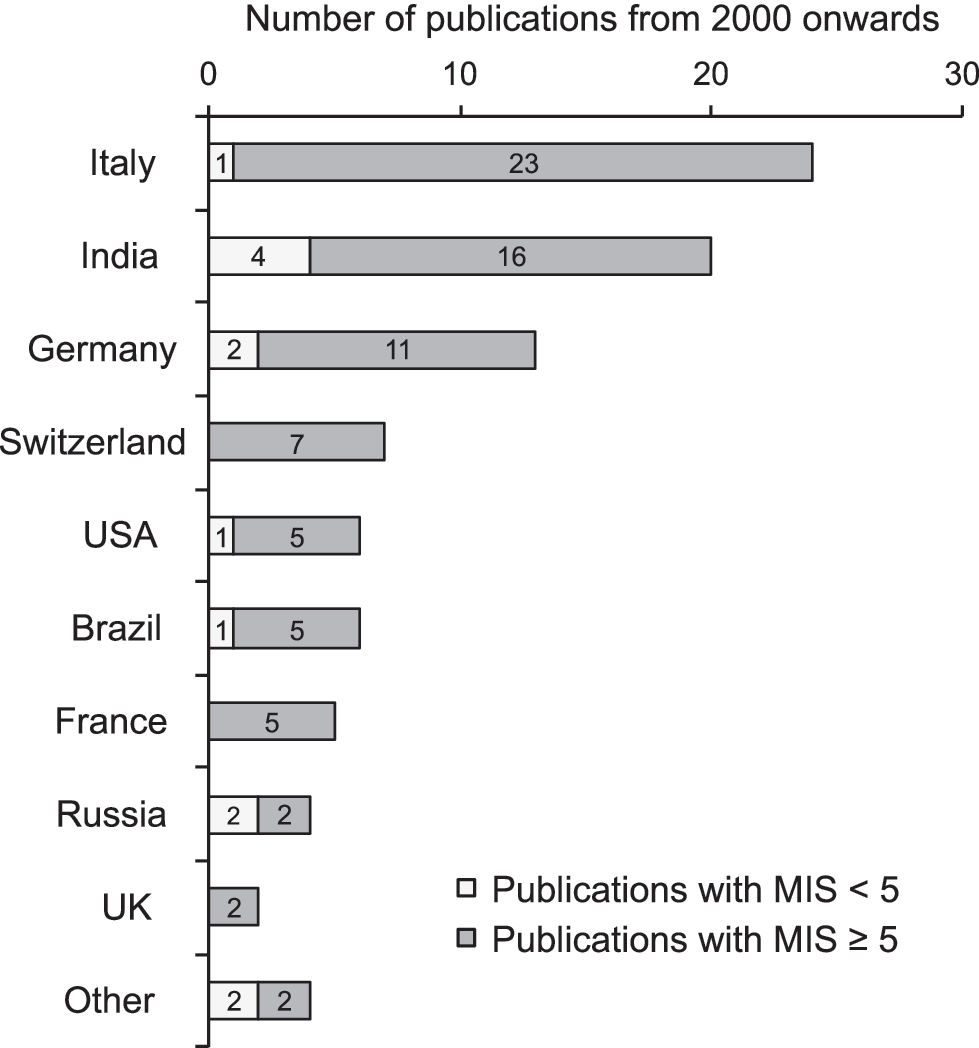
Number of publications per country from 2000 onward. MIS, Manuscript Information Score.
Techniques
A variety of experimental techniques have been used to investigate homeopathic dilutions. The experimental techniques were categorized in 11 categories: Electrical impedance (which included dielectric constant, dielectric relaxation, resistance, capacity, and impedance), Analytical methods (Inductively Coupled Plasma-Mass Spectrometry, Atomic Absorptions, radioactive tracers, and neutron activation), Spectroscopy (Ultra-Violet, Visible, Infra-Red, and Fourier-Transform Infra-Red), NMR (NMR spectroscopy and NMR relaxation times), Imaging methods (Kirlian photography, X-rays, photography, microscopy, crystallization, Transmission electron microscopy, Calorimetry, Electrochemistry (including pH measurements), Luminescence (fluorescence and thermoluminescence), Chromatography (including thin layer chromatography), Raman spectroscopy, Various physical (any other technique that did not fit another category).
The breakdown of the number of publications per investigation technique used is shown in Figure 6. One paper may present experiments using several techniques. Techniques most commonly used were electrical impedance with 48 publications using this technique (26% of publications), analytical methods (37 publications—20%), spectroscopy (37 publications—20%), and NMR (34 publications—19%).

Breakdown of publications in terms of investigative technique used (see text for more detailed description of what each category included). One publication can report on more than one technique. MIS, Manuscript Information Score.
The picture, which emerges in terms of techniques used from 2000 onward, is very similar (data not shown). If one looks more closely at the geographical breakdown of investigative techniques from 2000 onward (data not shown), we observe that certain countries weigh heavily in certain techniques. Italy accounts for 100% of calorimetry experiments, 69% of electrical impedance experiments, and 57% of use of analytical techniques, whereas most spectroscopy experiments were performed in India (35%) and Switzerland (24%). Finally most NMR experiments were performed in France (33%) and India (27%). This shows the “hotspots” in physicochemical homeopathic research from 2000 onward.
Discussion
Overview
Our investigation identified 183 publications in physicochemical research of homeopathic preparations, starting with a first German publication in 1842. 158 Of these 183 publications, 122 (66%) had an MIS ≥5 reflecting acceptable reporting quality. The number of publication per year has risen over time with a marked increase around 2000, leading to 50% of publications appearing from 2000 onward. Over 63% of publications were peer reviewed (73% for publications with MIS ≥5).
Previous reviews and search strategy
Becker-Witt et al. published a previous review in 2003, which focused on the quality of physical research in homeopathy. 27 They included investigations using measurements of dielectric strength, NMR, and spectroscopy (UV, Vis and IR), and explicitly excluded techniques such as refractometry, microcalorimetry, surface tension, conductivity, densitometry, and many others. They consulted MEDLINE, EMBASE, Current Contents, and the Karl and Veronica Carstens Foundation. Their search strategy yielded 44 publications with only 6 publications (14%) being considered of high quality (Score for Assessment of Physical Experiments on Homeopathy [SAPEH] score >7). Our search strategy was wider, including areas that had been excluded from the Becker-Witt study. For comparison, we found 95 publications before 2000, 12 of which (13%) have an MIS ≥7.5 (equivalent to “high quality”). One further explanation for the higher number of publications in our review could also be our use of the specialized HomBRex database of basic research in homeopathy, which was not available at the time of the Becker-Witt literature search. 210
Indeed, many of the old publications are not referenced in modern databases (e.g., Web of Science); so we had to rely on specialized databases such as the HomBRex database. 210 Because of this lack of referencing of older publications, it is possible we missed some older references. In principle, this could only be resolved by manual scanning of older journals, which was beyond the scope of this review. Nonpublished investigations were also out of scope for this review.
Quality assessment
Becker-Witt et al. introduced the so-called SAPEH score in their 2003 review. 27 This score is based on three fundamental quality constructs: methodology, experiment standardization, and presentation. The SAPEH score was designed to assess overall study quality.
In our review, we decided to restrict the quality assessment to “reporting quality” in five fields of particular interest for physicochemical investigations of homeopathic preparations: experimental procedure, materials, measuring instruments, potentization procedure, and controls (Table 1). The idea of this procedure is to include only publications in a more detailed qualitative evaluation that reported enough experimental details for the reviewers to understand what was actually done in the study presented. Any judgment whether the study design used was meaningful, whether the controls used were adequate, and whether any conclusions were justified compared to the data presented was postponed to the detailed qualitative evaluation.
The MIS design was also inspired by the prepublication checklist put together by Stock-Schröer in 2015 in the Reporting Experiments in Homeopathic Basic Research (REHBaR) scheme. 211 However, the REHBaR scheme is a publication guideline for proper presentation of the work and not a tool to evaluate quality or methodological aspects.
A 2015 review by Schulte and Endler carried on the work of Becker-Witt, investigating the quality of publications using experimental methods in ultra-high dilutions, 2004–2014. 24 They analyzed nine publications published in the journal Homeopathy. Overall quality of the nine papers analyzed was low (one publication with SAPEH = 5). Our analysis did not include any restriction on the journal where the findings were published. We found, in contrast, 66 publications over the same period, 2004–2014, 59 of which had an MIS ≥5. A quick look at these publications reveals that the majority were indeed not published in the journal Homeopathy. Accordingly, our conclusions are somewhat different than Schulte's: where Schulte reports that studies in the field have been appearing at a steady rate, we find a marked increase from 2000 onward, the majority of which was not published in the journal Homeopathy and hence was not analyzed by Schulte. Also, the rather low incidence of high-quality publications reported is not reflected in our findings where we see a significant increase in quality from 2000 onward, with 44 (48%) publications having an MIS ≥7.5, corresponding to “high reporting quality”.”
Geographic distribution
With its long history in homeopathy, Europe currently dominates, in terms of number of publications, with 115 publications (63%), with Germany leading with 42 publications (23%) followed by France with 29 publications (16%), and Italy with 26 publications (14%). Coming in second place overall, we have India with 27 publications (15%).
This European dominance has decreased slightly in recent years with 53 publications (58%) from 2000 onward (Fig. 5). This can be attributed mostly to the strong appearance of Indian research over the last few years with 20 publications (22%) from 2000 onward versus 7 (8%) before 2000. Similarly, we notice that most of Italy's publications appeared in the last few years with 24 publications (26%) appearing from 2000 onward versus 2 (2%) before 2000.
The 2014 review by Clausen et al., 28 which also included in vitro and in vivo experiments, reported on 1,383 publications. They found the main countries publishing in this field to be France with 267 publications (14%), Germany with 246 publications (13%), and India with 237 publications (13%).
Conclusions
We found 183 publications reporting physicochemical experiments investigating homeopathic dilutions. The rate of publication in the field has increased from ∼2 per year from the 1970s until 2000 to over 5.5 publications per year since then. The reporting quality of the studies has increased over the years with a significant increase from 13% of publications rated as “high reporting quality” before 2000 compared to 48% since then. Europe is leading in terms of total number of publications, Germany (23% of publications) leading in front of France (16%) and Italy (14%). India has been making steady progress in the field in recent years (15%). The most frequently used techniques were electrical impedance (used in 26% of publications), analytical methods, spectroscopy, and NMR techniques (∼20% each).
Footnotes
Acknowledgments
We thank the Karl and Veronica Carstens Foundation and DHU library for providing us full-text references.
Author Disclosure Statement
S.W. is an employee of Hevert-Arzneimittel, Germany; however, none of the publications included in this review used Hevert products.
References
Supplementary Material
Please find the following supplemental material available below.
For Open Access articles published under a Creative Commons License, all supplemental material carries the same license as the article it is associated with.
For non-Open Access articles published, all supplemental material carries a non-exclusive license, and permission requests for re-use of supplemental material or any part of supplemental material shall be sent directly to the copyright owner as specified in the copyright notice associated with the article.
