




Abstract
Objectives:
To identify the immediate and middle-term effects of the right carotid sinus compression technique on blood pressure and heart rate in hypertensive patients.
Design:
Randomized blinded experimental study.
Settings:
Primary health centers of Cáceres (Spain).
Subjects:
Sixty-four medicated patients with hypertension were randomly assigned to an intervention group (n = 33) or to a control group (n = 31).
Intervention:
In the intervention group a compression of the right carotid sinus was applied for 20 sec. In the control group, a placebo technique of placing hands on the radial styloid processes was performed.
Outcome measures:
Blood pressure and heart rate were measured in both groups before the intervention (preintervention), immediately after the intervention, 5 min after the intervention, and 60 min after the intervention.
Results:
The intervention group significantly decreased systolic and diastolic blood pressure and heart rate immediately after the intervention, with a large clinical effect; systolic blood pressure remained reduced 5 min after the intervention, and heart rate remained reduced 60 min after the intervention. No significant changes were observed in the control group.
Conclusions:
Right carotid sinus compression could be clinically useful for regulating acute hypertension.
Introduction
H
The carotid sinus is a dilatation of the internal carotid artery with baroreceptors to capture mechanical blood pressure variations. Carotid baroreceptors are sensitive to stretching stimuli and, therefore, excited by tensional changes in the vessel wall, which would activate a fast blood pressure regulation reflex by controlling blood function and arteriolar tone. 4 Thus, the baroreflex is capital to avoid excessive fluctuations of blood pressure and to control the adaptation of the cardiovascular system to acute hypotensive situations, such as postural changes, metabolic disturbances, or pharmacologic responses. 5 However, sustained hypertension can cause changes in the vessel wall distensibility and an adaptation of the reflex. 6
The stimulation of the carotid sinus as a means of producing baroreflex activation has been effective in inducing hypotension and bradycardia responses in healthy individuals and patients with drug-resistant hypertension. 7 The objective of the present study was to compare the immediate and middle-term effects (1-, 5-, and 60-min postintervention) of the right carotid sinus compression technique versus a placebo technique on blood pressure and heart rate in two groups of adults with hypertension (intervention vs. control).
Materials and Methods
Participants
Sixty-four adults with hypertension were recruited in three primary health centers of Cáceres Health Area (Casar de Cáceres, Malpartida de Cáceres, and Valdesalor, Spain). Inclusion criteria were as follows: (1) diagnosis of hypertension, (2) been following a pharmacologic treatment for hypertension, (3) adherence to the pharmacologic treatment, and (4) age between 20 and 55 years. A member of the research group made a personal interview with every volunteer informing of the objective of the study and the procedure. All volunteers were informed that the objective of the study was to test the effects of a manual technique on blood pressure and heart rate in individuals with hypertension; volunteers were informed of being randomly allocated to one out of several groups and that each group would be treated with a different manual technique that could have effects in the vascular system, regulating blood pressure and heart rate. Volunteers were able to ask any question about the study and its procedures. Exclusion criteria were double checked, in the personal interview and at the participant's medical history: (1) antecedents of renal disease, (2) antecedents of cerebrovascular pathology, (3) antecedents of hypersensitivity of the carotid sinus, (4) sinusal pathology, and (5) carotid arterial occlusion. The study was performed in accordance with the principles of the Declaration of Helsinki and Declaration of Edinburgh and approved by the Ethics Committee of the Scientific European Federation of Osteopaths. All the participants signed informed consents before the beginning of the procedure.
Sample size was estimated after a previous pilot study with the software Tamaño de la Muestra 1.1, Pontificia Universidad Javeriana (Bogotá, Colombia). The pilot study showed values of 140.0 ± 8 mmHg for the control group and 134.00 ± 8 mmHg for the intervention group. Thus, to get a power of 80% and detecting significant differences for independent samples, a minimum of 29 participants per group would be needed (a total sample of 58 subjects).
Procedure
Intervention and assessments were performed in the participants' health centers, mentioned above. Participants were assigned randomly to one out of two treatment groups, intervention group (n = 33, mean age = 41.54 ± 9.66, 23 females) and control group (n = 31, mean age = 38.03 ± 7.35 years, 21 females), by a professional from the health center, unaware of the study design and of the procedure, by means of a randomization table. Participants and evaluators who collected data remained unaware of the number of study groups and the treatment allocation group, to ensure participant blinding and outcome assessor blinding, respectively. Participants were informed that they were applied a technique that could have effects in the vascular system, but they were unaware of the group where they were assigned. The intervention and the control group were similar in age and sex (both p > 0.11).
Assessments and interventions were performed in a room with a temperature of 21°C and without acoustic pollution. Participants were instructed to lie on a stretcher on a supine horizontal position. After 2 min for stabilizing the patient, the assessment of systolic and diastolic heart blood pressure and heart rate was performed (preintervention) by a trained member of the research team unaware of the group assigned to each patient. Immediately after, a trained osteopath physiotherapist, member of the research team (A.M.C.C.), different from the one making the assessments, performed the intervention or the placebo technique, depending on the group assigned to the patient. One minute after the end of the technique, a new assessment of blood pressure and heart rate was performed. Afterward, participants remained lying on the stretcher, and a new assessment was carried out 5 min after the end of the intervention. After this assessment, participants were asked to wait sitting in a calm waiting room and were asked to go into the assessment room and lie on the stretcher for the last assessment, 60 min after the end of the intervention. Assessment times were established with a chronometer. All assessments were performed by the same evaluator. The professionals performing the intervention and the assessments were senior, both physical therapists and osteopaths with more than 10 years of clinical experience.
The intervention group received pressure on the right carotid sinus for 20 sec. The right side was chosen according to previous studies showing side-dominant effects toward the right carotid sinus in patients with hypertension. 7 The participant lied down in a supine horizontal position. Patients were instructed to maintain their arms along their body and to rotate their head leftwards. The osteopath physiotherapist located the carotid sinus below the angle of the mandible according to the procedure described by Lim et al., 8 at the point of maximal pulsation. 9 The maneuver was performed pressing slightly with the thumb for 20 sec, in a perpendicular way, holding the pressure and removing it in the same way as it was applied. The duration of the procedure was controlled with a chronometer. To standardize the pressure and technique, the same investigator performed all interventions. Figure 1 displays the carotid sinus compression procedure.
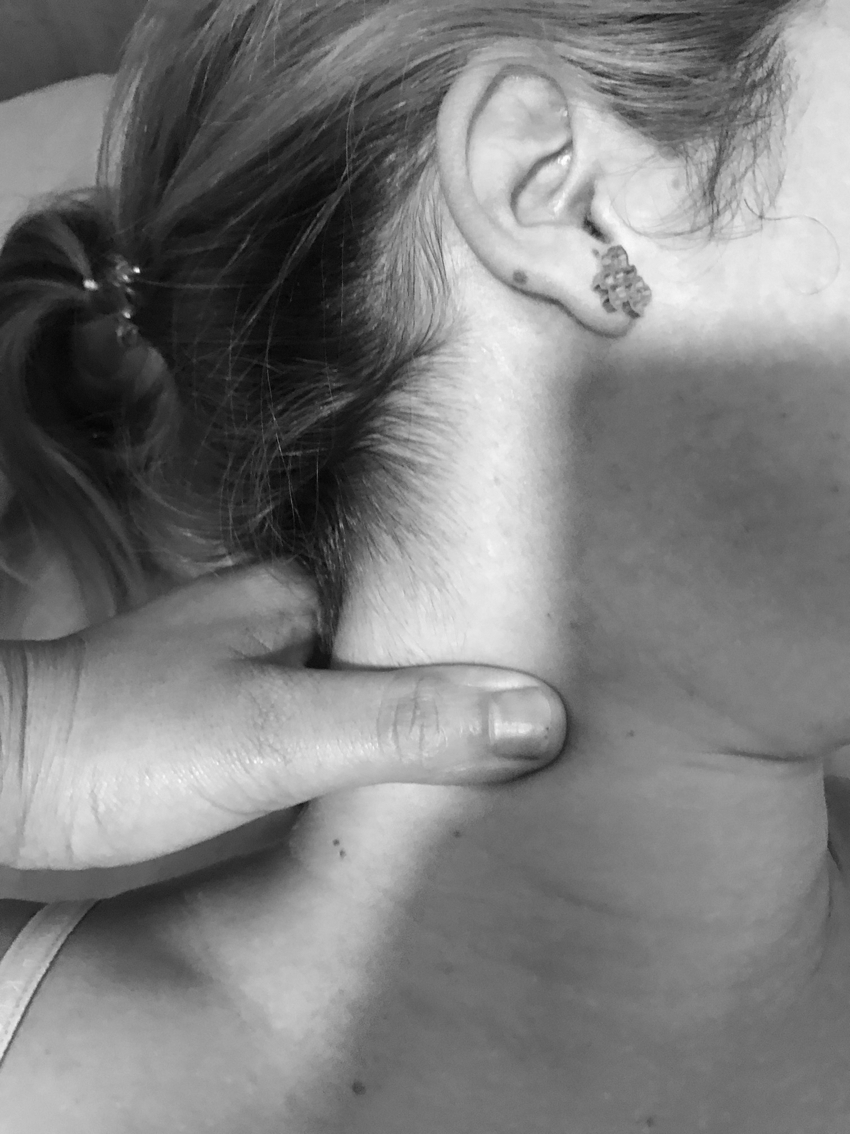
Physiotherapist's hand position during the carotid sinus compression.
The control group received bilateral nontherapeutic light touch (nonpainful) on the radial styloid processes of both arms during 20 sec. Radial styloid processes were chosen as control “intervention” locations because they have not been previously related with any vascular regulation and were near the radial artery, a location popularly known for pulse and heart rate assessment. Pulse pressure has been described as a risk factor for coronary events in hypertensive subjects. 6 In addition, the radial styloid is a reference point for locating the radial artery in heart-related procedures, such as cardiac catheterization 10 or carotid angiography 11 . Thus, using the styloids, processes could seem to the participant as a technique related to cardiac procedures. A bilateral location was selected to imitate the bilateral radial approach of interventions for chronic coronary occlusion. 12 No patient reported pain or soreness during the procedure.
Assessments
Both groups (intervention group and control group) underwent assessments of blood pressure and heart rate before, immediately after, 5 min after, and 60 min after the procedure. Blood pressure and heart rate were determined by the use of a digital sphygmomanometer (OMRON RX-1) placed on the patient's left arm. This device has been recommended to measure blood pressure and heart rate. 13 All assessments were performed with the participants in a horizontal supine position because it has been reported that heart rate is more constant and low in this position. 14
Statistical analysis
Means and standard deviations of the variables were calculated. The Kolmogorov–Smirnov test showed a normal distribution of all the quantitative variables (all p > 0.05). Demographic and clinical characteristics of the groups were compared with t test for independent measures for continuous variables and with Chi-squared for categorical variables. Analyses of variance were performed to test changes in blood pressure and heart rate with GROUP (intervention vs. control) as a between-subject factor and TIME (preintervention vs. immediate postintervention vs. 5-min postintervention vs. 60-min postintervention) as a within-subject factor. Post hoc analyses were performed using post hoc Bonferroni correction for multiple comparisons. To calculate the clinical effect, Cohen d index was used, where an index higher than 0.8 indicates large clinical effects, an index between 0.5 and 0.8 indicates a moderate clinical effect, and an index lower than 0.2 indicates a small clinical effect of the intervention. Analysis was performed with SPSS version 15.0. Significance level was set at p < 0.05.
Results
The preintervention systolic blood pressure was of 143 ± 5.95 mmHg (mean ± standard deviation), and diastolic blood pressure was of 94.53 ± 3.82 mmHg. No significant differences were found between the groups in the preintervention assessment (both p > 0.072). Nevertheless, the intervention group showed higher heart rate than the control group in the preintervention assessment (intervention group = 73.15 ± 8.37 rates per minute, control group = 68.67 ± 8.44 rates per minute, p = 0.037). Table 1 displays the values of systolic and diastolic blood pressure and heart rate in the two groups at the preintervention assessment.
Systolic blood pressure showed a significant interaction effect GROUP × TIME (F(3,60) = 5.675, p = 0.002), indicating significant changes in the systolic blood pressure in the different assessments only in the intervention group, whereas no significant changes were observed in the control group (all p > 0.40). Thus, post hoc comparisons showed that the intervention group decreased the systolic blood pressure between the preintervention vs. the immediate postintervention and the preintervention vs. the 5-min postintervention (both p < 0.006). Cohen d index showed a large clinical effect in the immediate postintervention (d = 0.882) and a moderate clinical effect at the posterior postintervention assessments (both d > 0.36) for the intervention group (Table 2). A main effect GROUP confirmed lower systolic blood pressure in the intervention group than the control group (F(1,62) = 6.49, p = 0.013). Table 1 displays the evolution of systolic blood pressure in the two groups.
Diastolic blood pressure showed a significant interaction effect GROUP × TIME (F(3,60) = 10.90, p < 0.001), indicating significant changes in the diastolic blood pressure in the different assessments only in the intervention group, whereas no significant changes were observed in the control group (all p > 0.242). Post hoc comparisons showed that the intervention group decreased the diastolic blood pressure between the preintervention vs. the immediate postintervention and preintervention vs. 5-min postintervention (both p < 0.001). Nevertheless, a significant increasing of the diastolic blood pressure was observed in this group between immediate postintervention and 5-min postintervention vs. 60-min postintervention (both p < 0.004). Thus, although there was an immediate reduction of the systolic pressure immediately after the intervention, these effects did not remain along the time. Cohen d index showed a large clinical effect in the immediate postintervention and in 5-min postintervention (both d > 1.1) and a low clinical effect at the posterior postintervention assessments (d = 0.178) for the intervention group (Table 2). Main effects GROUP (F(1,62) = 12.06, p = 0.001) and TIME (F(3,60) = 10.90, p < 0.001) indicated lower diastolic blood pressure in the intervention group compared to the control group and significant changes among the four time periods. Table 1 displays the evolution of diastolic blood pressure in the two groups.
Heart rate showed a significant interaction effect GROUP × TIME (F(3,60) = 12.49, p < 0.001), indicating significant changes in heart rate in the different assessments only in the intervention group, whereas no significant changes were observed in the control group (all p > 0.081). Post hoc comparisons showed that the intervention group decreased the diastolic blood pressure between the preintervention and all the postintervention assessments (all p < 0.001). Cohen d index showed moderate clinical effects in all the postintervention assessments for the intervention group (all d > 0.670) (Table 2). A main effect TIME (F(3,60) = 7.32, p < 0.001) confirmed the differences between the preintervention and all the following assessments. Table 1 displays the evolution of heart rate in the two groups.
Discussion
The objective of the present study was to explore the immediate and middle-term effects of the right carotid sinus compression technique on blood pressure and heart rate in hypertensive patients. Carotid sinus pressure was effective in decreasing systolic and diastolic blood pressure and heart rate in medicated hypertensive patients compared to a control group who undertook a placebo technique. The effects on heart rate remained at middle term (60 min postintervention).
These results obtained in hypertensive patients are similar to those reported for healthy individuals and patients with drug-resistant hypertension, who also experienced a decrease in systolic blood pressure, heart rate, and total peripheral resistance after the right carotid sinus massage 7,15 –17 or after an electrical carotid sinus stimulation. 18 Moreover, systolic blood pressure values showed a duration of the effects similar to those previously observed in studies with other manual techniques, such as myofascial induction, Atlas vertebra realignment, or acupuncture. 2,3,15,16,19 It is further surprising that effects remained for a similar time as those obtained with electrical stimulation of the sinus baroreceptor, where blood pressure increased 6 min after the device deactivation. 20 It has recently established the role of the baroreflex activation on the attenuation of sympathetic activity on long-term blood pressure regulation mechanisms, such as vasculature peripheral resistance, cardiac function, and renal excretory function, while increasing cardiac vagal regulation. 21,22 Their technique appears as having acted in the baroreflex sufficiently to achieve this middle-term physiologic regulation.
As in previous research, 7 the present effects were more consistent in the regulation of systolic than diastolic blood pressure. The systolic blood pressure has been mostly related to the cardiovagal baroreflex sensitivity, which modulates heart rate in response to changes in systolic blood pressure, 23 while the diastolic blood pressure has been related to the sympathetic nerve activity. 18 Nevertheless, it has been suggested that baroreceptors in the aortic arch are more important contributors than baroreceptors of carotid sinuses to differences in the cardiovagal baroreflex sensitivity and heart rate control. 18,24 As many of osteopathic manipulations provide lasting relaxation and anxiety reduction, 2,25 their intervention may have activated the parasympathetic nervous system, as well as the cardiovagal reflex, contributing to reduce sympathovagal imbalance and to middle-lasting effects on heart rate.
This study has some limitations that must be taken into account for the adequate interpretation of the results. Heart rate values were different in both groups at the preintervention assessment, and their results showing a decrease of this variable in the intervention group may be related to a normalization of the values.
Conclusions
The right carotid sinus compression may be effectively used to regulate cardiovascular parameters in patients with hypertension. These results are clinically significant, as hypertension is a leading cause of cardiovascular morbidity and mortality. 1,26 This technique may constitute an alternative approach to regulate hypertension in drug-resistant patients. Further research to investigate the duration of the effects, with longer assessment times, the feasibility in different types of hypertensive patients, or the prognosis value of the technique is warranted.
Footnotes
Author Disclosure Statement
No competing financial interests exist.