




Abstract
Objectives:
Oncology providers are often confronted by patients who use complementary or alternative therapies, but have limited knowledge or confidence on how to advise patients on appropriate use. Despite this, there are few opportunities for oncology providers to learn about complementary or alternative therapies, while at the same time there is a high demand for integrative oncology (IO) training. To address a gap in IO educational opportunities, and particularly for nonphysicians, we created the Integrative Oncology Scholars (IOS) Program. The program's goal is to train 100 IO leaders and facilitate partnerships between them and complementary practitioners.
Design:
Four iterations of a year-long National Cancer Institute-funded educational program that combines in-person team-based learning and eLearning to teach the evidence, application, and philosophy supporting IO.
Settings:
In-person sessions take place at the University of Michigan, and eLearning is implemented using a Canvas website (Instructure, Inc., Salt Lake City, UT).
Subjects:
Nurses, social workers, physician assistants, psychologists, physicians, pharmacists, and physical/occupational therapists with active oncology practices.
Educational intervention:
Four cohorts of 25 oncology providers per year will learn the evidence base for complementary and alternative approaches to a wide number of oncology topics, including symptom control, dietary supplements commonly used by cancer patients, diet, and the utility of specific integrative approaches for common oncology side-effects such as fatigue.
Outcome measures:
A mixed methods approach will be used to evaluate overall IOS Program progress and individual scholar's impact on IO research, education, and clinical endeavors.
Results:
The first cohort of 25 IOS has been recruited and their education will begin in Summer 2018. Scholars come from 13 states and represent 23 different healthcare systems.
Conclusions:
The IOS Program has the potential to increase the number of trained IO providers, educators, and researchers in the United States.
T
Despite this high level of use, communication about complementary and integrative medicine (CIM) use between oncology providers and patients is not ideal. Over half of oncology providers do not ask about CIM use 3,4 and indicate the main reasons being a lack of knowledge about CIM approaches and not knowing what to do with the information once collected. 3,5,6 This lack of communication can leave patients and their families with many unanswered questions, can result in negative (e.g., herb–drug) interactions and toxicities, 7,8 and may prevent patients and survivors from receiving treatments that could help reduce cancer treatment side-effects and improve quality of life. 9 Also, while the majority of CIM treatments are being delivered in the community by complementary providers, few oncology professionals and complementary providers communicate or are aware of the others' practice. Oncology professionals rarely refer patients to complementary providers, with oncologists only referring for more information about complementary therapies 16% of the time, and nurses and social workers 13% and 36% of the time, respectively. 4,10 One possible solution to the unsatisfactory interaction around CIM for both patients and providers (conventional and complementary) is education.
Oncology providers have expressed a desire to be more informed and to receive more education about oncology-specific CIM. 6,11 Until recently, however, no oncology-specific CIM training has been available and the majority of educational opportunities have been designed for physicians (e.g., in the form of fellowships), despite the multidisciplinary and growing professional diversity of oncology teams. 12 In response to this educational gap, we have designed the Integrative Oncology Scholars (IOS) Program.
The IOS Program is funded by a National Cancer Institute R25 grant. It has the joint goals of training 100 integrative oncology (IO) leaders over 4 years and facilitating partnerships between IO leaders and complementary practitioners within their communities. Eligible participants, who are designated as IOS, include a multidisciplinary selection of physicians, physician assistants, nurses, psychologists, social workers, physical or occupational therapists, and pharmacists, who are actively engaged in clinical oncology practice. IOS instructors are experts in the field of IO and/or adult education and reflect the multidisciplinary nature of the program with professions as diverse as patient advocates to oncology clinicians. Details on course instructors, program eligibility, and how to apply are available on the IOS Program website.*
IOS participate in a year-long course that blends in-person and eLearning methods (see Table 1). The eLearning methods have been designed for the scholars to learn at their own time without didactic instruction. Content of the eLearning modules differ, but can include evidence of integrative therapies for a specific symptom, links to and explanations of resources for evaluating integrative therapies, audio or video clips of key experts in the field of IO, and evidence-based case studies. In-person sessions utilize a team-based learning (TBL) strategy. TBL is an interactive instructional strategy that provides learners with chances to apply conceptual knowledge through a sequence of activities that includes individual work, team work, and immediate feedback. 13
Integrative Oncology Scholars attend three in-person sessions at the University of Michigan, Ann Arbor, Michigan.
CINV, chemotherapy induced nausea and emesis; GI, gastrointestinal; IO, integrative oncology; TCM, Traditional Chinese Medicine.
As part of the TBL model we will employ a flipped classroom approach. In the flipped classroom approach scholars will read key materials, watch lectures, or complete modules before coming to class, and then engage in active educational strategies to maximize educational effectiveness during in-person class time. 14 These strategies will include group discussion sessions, case studies, as well as demonstration and role-playing. Cancer patients, their families, advocates, and community-based complementary providers will be invited to be part of the curriculum to bring their experiences into the learning environment. Use of TBL and flipped classroom strategies improve short-term outcomes in health professions' curricula, 15 and out-perform traditional lecture-based continuing medical education in both short-term knowledge retention and daily practice behavior. 16
IOS will be required to complete a capstone project on the subject of a significant gap in education, clinical practice, or research in IO. To encourage connections between complementary providers and oncology professionals, IOS will identify at least two complementary providers in their communities who are practicing at least 2 days per week with at least 25% of their clients being cancer patients or survivors. The two complementary providers also need to be practicing in different domains of integrative medicine as defined by the National Center for Complementary and Integrative Healthcare (NCCIH). † IOS will be required to observe, experience, and communicate with each provider for a minimum of 8 h each with the goal of developing open and respectful dialog and for building networks within their communities. Complementary providers will also be invited to participate in the capstone project, for example, in a pilot clinical trial, of the IOS, as appropriate.
To evaluate the IOS Program, we will use a mixed method approach employing tools developed from the University of Michigan Integrative Faculty Scholars Program in Integrative Healthcare and modified for the IOS Program. Overall, the IOS evaluation plan is composed of three elements: (1) evaluate overall IOS Program progress, (2) monitor individual IOS advancement, and (3) evaluate the IOS Program and make adjustments for subsequent cohorts, as needed.
We will also assess IOS progress toward nine goals focused on building IO research, clinical and educational impact: (1) writing applications for IO NIH funding, (2) authorship of IO publications, (3) presenting at IO-related conferences, (4) academic appointments to a faculty (or equivalent) position, (5) gaining employment in an IO team, (6) obtaining an IO leadership position, (7) individual IO-focused research grant support from NIH or other sources, (8) leadership as an IO “resource” person, and (9) improved IO clinical skills and knowledge as measured by a self-assessment tool.
Our ultimate goal is to improve the care of cancer patients by integrating evidence-based CIM practices, thereby enhancing quality of life and potentially survival. While being able to track these outcomes would be ideal it is outside the scope of the program to do so.
The first cohort of 25 IOS has been accepted and will begin the program in August, 2018. The cohort is comprised of 10 physicians from radiation, medical, and surgical oncology as well as primary care, dermatology, and palliative care; 5 advanced practice nurses; 5 social workers; three physician assistants; 1 pharmacist; and 1 physical therapist. Several of the social workers and nurses coordinate cancer survivorship programs at their institutions. IOS come from 13 states and the District of Columbia and represent 23 U.S. healthcare systems, including comprehensive cancer centers (refer to Fig. 1).
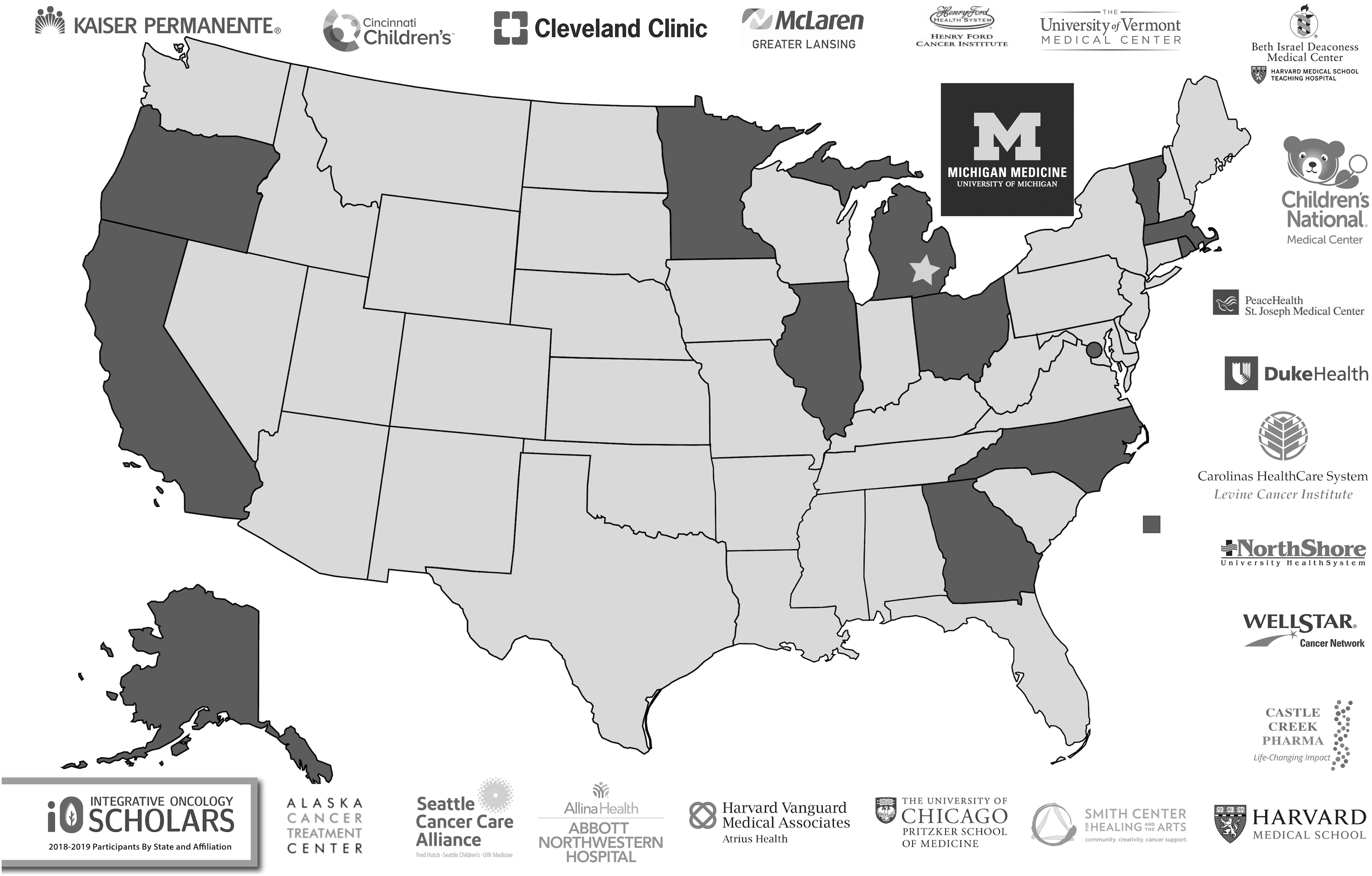
Where the first cohort of 25 Integrative Oncology Scholars come from by state and healthcare system.
In conclusion, the IOS Program has the potential to increase the number of trained IO providers, educators, and researchers in the United States. Our goal in future IOS cohorts will be to target professions, states, and healthcare systems not represented or poorly represented in our first cohort.
Footnotes
Acknowledgment
This work was supported by the National Institutes of Health (Grant No. R25CA203651).
Author Disclosure Statement
No competing financial interests exist.