




Abstract
The consumption of black tea and green tea has been shown to be beneficial for cardiovascular health. Because the chemical composition of the two teas varies widely, the purpose of the study was to investigate whether the consumption of green tea and black tea had different effects on the arterial system. Thirty-three healthy subjects received a single dose of green tea (dose = 0.05 g/kg) and black tea (dose = 0.05 g/kg) in different weeks. Radial blood pressure and radial pulse pressure were measured before and after drinking tea. The harmonic analysis was performed on radial pressure waves, and harmonics (Cns) were recorded. The results showed that both black tea and green tea consumption significantly increased the C1, C2, C6, C7, C8, C9, and C10 of the radial pressure wave. Furthermore, the results confirmed that the consumption effect of green tea on C6–C10 increase is greater than that of black tea. This report also found a subtle difference that consumption of green tea increased C4, whereas consumption of black tea increased C3. We concluded that black tea and green tea have similar patterns in higher harmonics, but with varying degrees.
Introduction
Tea has neuroprotective 1 and antiatherosclerotic 2 properties that improve cardiovascular health. Tea is made from the leaves of Camellia sinensis plants and can be classified according to the level of fermentation. Green tea is usually made from spring tea and is quickly steamed to prevent fermentation, which is rich in theanine and four catechins. Black tea is usually made from summer tea leaves and is fully fermented by the withering and curling process, which mainly contains caffeine and oxidized multimeric catechins such as theaflavins and thearubigins.
Our recent study on the radial pulse spectrum suggested that black tea can improve brain perfusion. 3 The analysis of nth harmonic amplitudes (Cn, n = 1–10) of radial pulse wave is an effective way to investigate the status of arterial system, based on resonance effect. 4 Since green tea and black tea are composed of different main ingredients (oxidized multimeric catechins and nonoxidized catechins), it is interesting to investigate whether green tea and black tea are equally effective in improving cardiovascular health. Jochmann et al. demonstrated that green tea and black tea both activate endothelial nitric oxide synthase and increase blood flow-mediated vasodilation in healthy individuals. 5 However, to the best of our knowledge, there was no significant evidence to prove that whether green tea has the similar effect on radial pressure spectrum as black tea. Therefore, this study aimed to further investigate the short-term effects (within 2 h after tea consumption) of green tea and black tea consumption on radial blood pressure. We further performed the harmonic analysis to evaluate the hemodynamic state of the arterial system, quantifying the pulse waveform changes before and after tea consumption.
A total of 33 healthy subjects aged 48 ± 15 years (range: 28–63 years; 22 men and 11 women) enrolled in the study after obtaining approval from the Institutional Review Board of the Renai Branch of the Taipei City Hospital (IRB no.: TCHIRB1010710). All participants signed informed consent. We conducted a self-controlled repeated measurement design study in which all the enrolled subjects consumed San-Xia green tea and black tea (from the same tea farm) in different weeks, respectively. The detailed comparing procedures and dietary restrictions were the same as our previous experiments described. 3 The radial artery pulses were measured with validated instrument TD01C (MII-ANN Technology, Taiwan) 6,7 before and after drinking of San-Xia green tea (dose: 0.05 g/kg, Experiment 1) and San-Xia black tea (dose: 0.05 g/kg, Experiment 2). Experimental measurements were taken after a 10 min rest at a controlled temperature of 23°C–25°C in a quiet room, with procedures as previously described. 7 This protocol aimed to let the enrolled subjects to relax and conducted the radial pulse measurement at a reliable resting state. In this study, Experiments 1 and 2 were conducted in random order to compare the short-term effects of green tea and black tea on the radial pressure waveform.
The results showed that both green tea and black tea reduced heart rate (green tea: from 1.38 ± 0.03 to 1.25 ± 0.41 Hz; black tea: from 1.32 ± 0.03 to 1.17 ± 0.03 Hz; p < 0.01) and increased diastolic blood pressure (green tea: from 72 ± 1 to 74 ± 1 mmHg; black tea: from 70 ± 2 to 72 ± 1 mmHg; p < 0.05) within 120 min. Only black tea increases short-term systolic blood pressure (from 116 ± 2 to 119 ± 2 mmHg; p < 0.05) and pulse pressure (from 46 ± 1 to 48 ± 1 mmHg; p < 0.01). There is a significant difference in the effects of consumption of green tea (from 47 ± 11 to 45 ± 2 mmHg) and black tea on pulse pressure (p < 0.01). For harmonic analysis, C1, C2, and C6–C10 were all increased after drinking green tea and black tea (Fig. 1). However, the effect of green tea on C6–C9 is greater than that of black tea (p < 0.05). The effect of green tea and black tea on C6–C10 is maintained for a long time, whereas changes in C1, C2, and C3 returned to near baseline values at 120 min post-test measurement. Furthermore, compared with the pretest harmonics, the consumption of black tea increase C3 (p < 0. 01), whereas the consumption of green tea increases the C4 (p < 0.05). The effect of green tea consumption on C4 may be due to vasodilation of catechins and
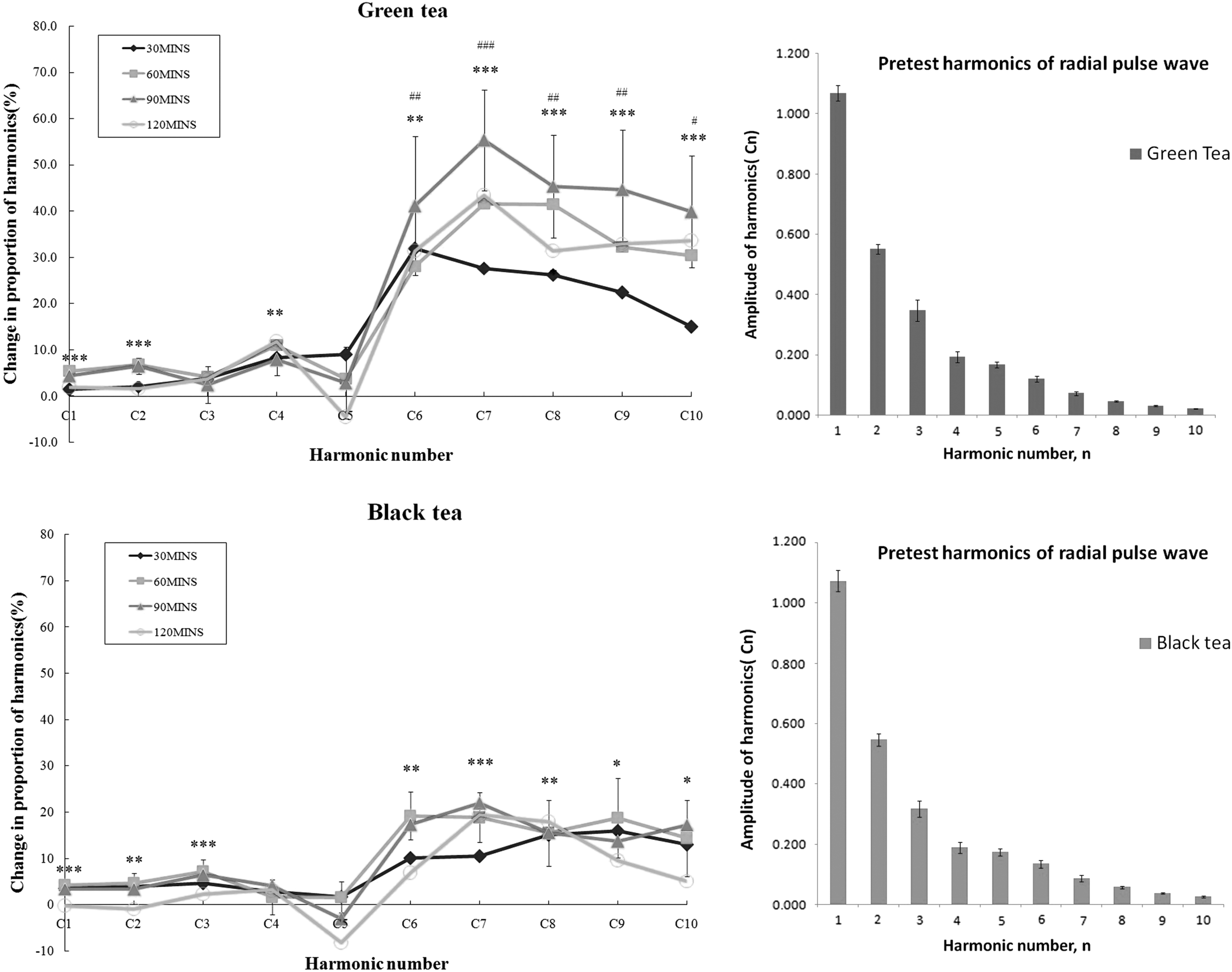
The effect of 0.05 g/kg dose of green tea (n = 33) and black tea (n = 33) on radial pulse spectrum. Left panel is the test results after 30, 60, 90, and 120 min were calculated as the percentage change in harmonics relative to the pretest control results. The error bars indicate the standard error of the harmonic component for 30 min after tea. Right panel is the pretest harmonic amplitudes for green and black tea at baseline. *, **, and *** indicate that the 90-min post-test harmonics are significantly different from the pretest harmonics (p < 0.1, p < 0.05, and p < 0.01). #, ##, and ### show that the effect of green tea is significantly different from that of black tea at 90 min (p < 0.1, p < 0.05, and p < 0.01).
In conclusion, the results demonstrated that the consumption of green tea and black tea had a similar effect on C6–C10, but had different degrees of influence. In the lower harmonics of the radial pulse, the intake of green tea and black tea affects C4 and C3, respectively. Analysis of harmonic components could effectively help us understand the overall impact of food or herb on the arterial system during the course of the experiment. We anticipate this article to be the starting point for discovering the effects of different teas on the arterial system through different processing techniques.
Footnotes
Author Disclosure Statement
No competing financial interests exist.