




Abstract

Introduction
Hippotherapy and therapeutic riding are powerful rehabilitation treatments with the ability to aid those with physical 1 –3 and emotional 4 –6 disabilities. Both therapies combine physical and occupational therapy practices with an uplifting 6 recreational activity. The uplifting nature of these treatments fits well with previous studies of traditional therapy treatments that document better recoveries in patients with positive mind-sets. 7 Activities that promote high enjoyment have the best chance of ensuring children's participation. 8 We assessed the effect of client excitement, happiness, and comfort on self-reported and instructor-reported improvements during hippotherapy and therapeutic riding at Windrush Farm in Massachusetts, one of the first therapeutic riding centers in the United States.
Methods
A Likert-style survey was distributed to 27 clients of varying ages and diagnoses and their corresponding instructors immediately after completion of their therapy sessions (Supplemental Data). Two clients were surveyed twice, after two different sessions. Seven questions asked clients about their mind-sets and emotional states during their riding sessions. A similar Likert survey of seven questions was given to their instructors. The instructor responses assessed observed improvement, comfort, excitement, and happiness. The study was approved by Windrush Farm and the Endicott College IRB. All clients or their guardians consented to participate in the surveys.
Client and instructor responses to each survey question except age were compared using dependent samples sign tests to determine whether differences existed between clients' and instructors' perceptions of hippotherapy and therapeutic riding sessions. Stepwise multiple regression analysis determined the factors (clients' excitement, happiness, comfort, and horse cooperativity) that influenced clients' self-perceived improvement and instructors' assessment of client improvement. p ≤ 0.05 was considered to be significant for all tests. Relationships between client age, independence, and the aforementioned factors were examined by correlation analysis.
Results
Clients' excitement for the therapeutic session and clients' comfort significantly impacted their self-perceived improvement (multiple regression, β = 0.78 and 0.43, respectively; p < 0.05). The clients' excitement, happiness, comfort, and horse cooperation did not have an effect on the instructors' view of improvement (multiple regression; p < 0.05). There was a strong correlation between client excitement and happiness (R 2 > 0.7), as rated by both clients and instructors. A moderate correlation was observed between client comfort and horse cooperativity when rated by clients (R 2 = 0.62), but not instructors (R 2 = 0.17). The collinearity between variables may explain why only two of these factors impacted clients' self-perceived improvement. Overall, clients tended to rate their attitudes and experiences ∼10% more positively than their corresponding instructors (Fig. 1; dependent samples sign test, n = 58, p < 0.05). Age had no clear impact on client or instructor responses.
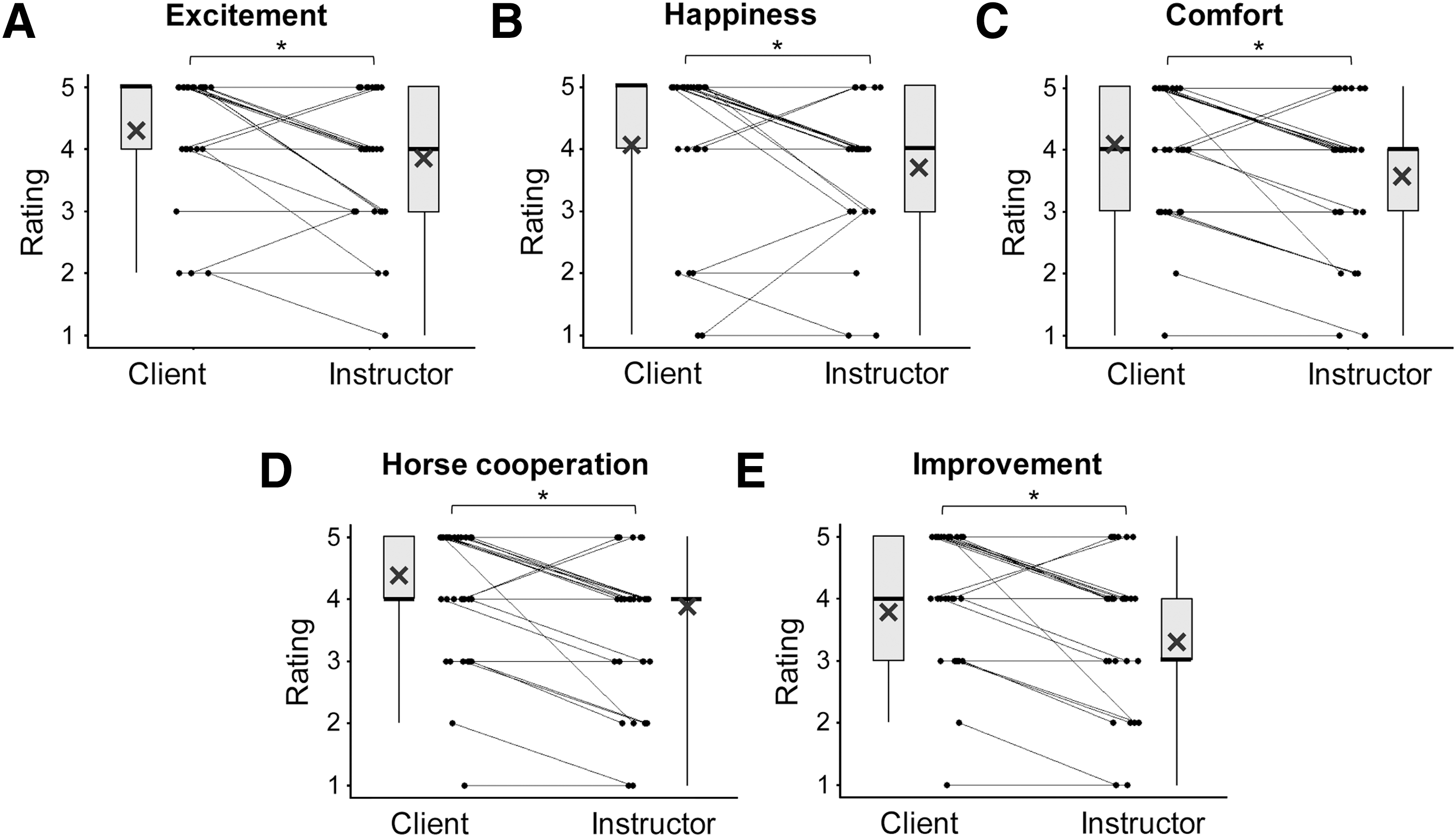
Comparison of client and instructor perceptions of hippotherapy sessions. Clients and their instructors were asked to rate clients' excitement for the session
Discussion
Overall, clients receiving hippotherapy and therapeutic riding treatments in this study reported high scores for excitement, happiness, comfort, and self-perceived improvement, supporting previous studies that demonstrated improved emotional status with therapeutic riding. 4 –6 The high client scores suggest that hippotherapy and therapeutic riding are uplifting experiences 6 that may encounter less resistance by clients compared with conventional therapies. Clients may also view hippotherapy and therapeutic riding as more of a recreational activity than a treatment. The positive mind-set developed by clients of these equine-assisted therapies may encourage rehabilitation adherence, mental health, and, ultimately, improved patient outcomes, especially in children. 7
Clients' scores for excitement, comfort, and happiness did not have a direct impact on instructor-rated improvement. These findings contradict previous studies, where positive and optimistic mind-sets were associated with more successful and quicker recoveries. 7 Future studies should investigate the personal, situational, cognitive, and emotional factors supported by these equine-assisted therapies to unveil the aspects of client mind-set contributing to rehabilitative success in these therapeutic programs. It would also be interesting to identify how a client's mind-set during hippotherapy and therapeutic riding differs from their mind-set during more traditional therapies.
Footnotes
Author Disclosure Statement
No competing financial interests exit.
Funding Information
No funding was received for this article.
Supplementary Material
Supplementary Data
References
Supplementary Material
Please find the following supplemental material available below.
For Open Access articles published under a Creative Commons License, all supplemental material carries the same license as the article it is associated with.
For non-Open Access articles published, all supplemental material carries a non-exclusive license, and permission requests for re-use of supplemental material or any part of supplemental material shall be sent directly to the copyright owner as specified in the copyright notice associated with the article.
