




Abstract

Introduction
Demand for cannabidiol (CBD) oil has increased possibly due to perceived “medicinal benefits” and the lack of psychoactive effects of tetrahydrocannabinol. 1,2 Although not approved by the U.S. FDA, CBD products are readily available for purchase with minimal to no regulation on quality. 3 Google Trends (GT), a web-service offered by Google, Inc., provides a relative search volume (RSV) that is a sampled estimate of a particular query share according to location and time normalized by the highest query of the period in a 1–100 scale. We hypothesized that GT RSV data could reflect public interest in CBD oil and performed a cross-sectional analysis based on the data search for CBD oil compared with other integrative therapies.
Methods
Data were downloaded from GT on July 29th to 31st, 2019, using “United States” as country, “All Categories” as category, and “Web Search” as type of search. Time range was “Past 5 Years” for comparison of treatments and “Past 90 days” for interest by states. We selected treatments from the NCI Integrative Therapies webpage 4 that had the greatest RSV on GT query. “Vitamin D” was included because of its wide availability. To compare more than GT's limit of five treatments, we adjusted the RSV numbers by a reference—acupuncture—and rescaled them by the highest RSV for the period in a scale from 0 to 100.
Trend presence was evaluated using the Mann Kendall (MK) test and magnitude was estimated using the Sen's Slope Estimator (both apply to nonparametric data). For state comparisons we tested the normality distribution of the data using Shapiro–Wilk normality test and difference of means with one-way ANOVA. All statistical analyses were done in R version 3.5.1.
Results
Year trend analysis for CBD oil shows an upward trend from 2014 to 2018, possibly interrupted in 2019 (MK p-value >0.05), as described in Figure 1A, which may have been due to federal intervention. 3 The greatest magnitude of trend was in 2018 (Sen's slope = 3.850). Regarding treatment comparisons, positive trends were found for all selected integrative treatments (MK p-value <0.001 and Sen's slope >0). Milk thistle, coenzyme Q, and aromatherapy had estimates near zero (0.001, 0.002, and 0.002, respectively), whereas “cbd” and “oil cbd” had the highest (0.26 and 0.13). When compared relatively with “oil cbd,” all other treatments, except “cbd,” had <10% of the reference estimate (vitamin C, the third highest slope was 0.012, 8.7% of “oil cbd” slope). We already expected “cbd” to have a higher estimate as it encompasses not only “oil cbd” but also other “cbd”-related queries in its data. Figure 1B shows the RSV graph for each treatment.
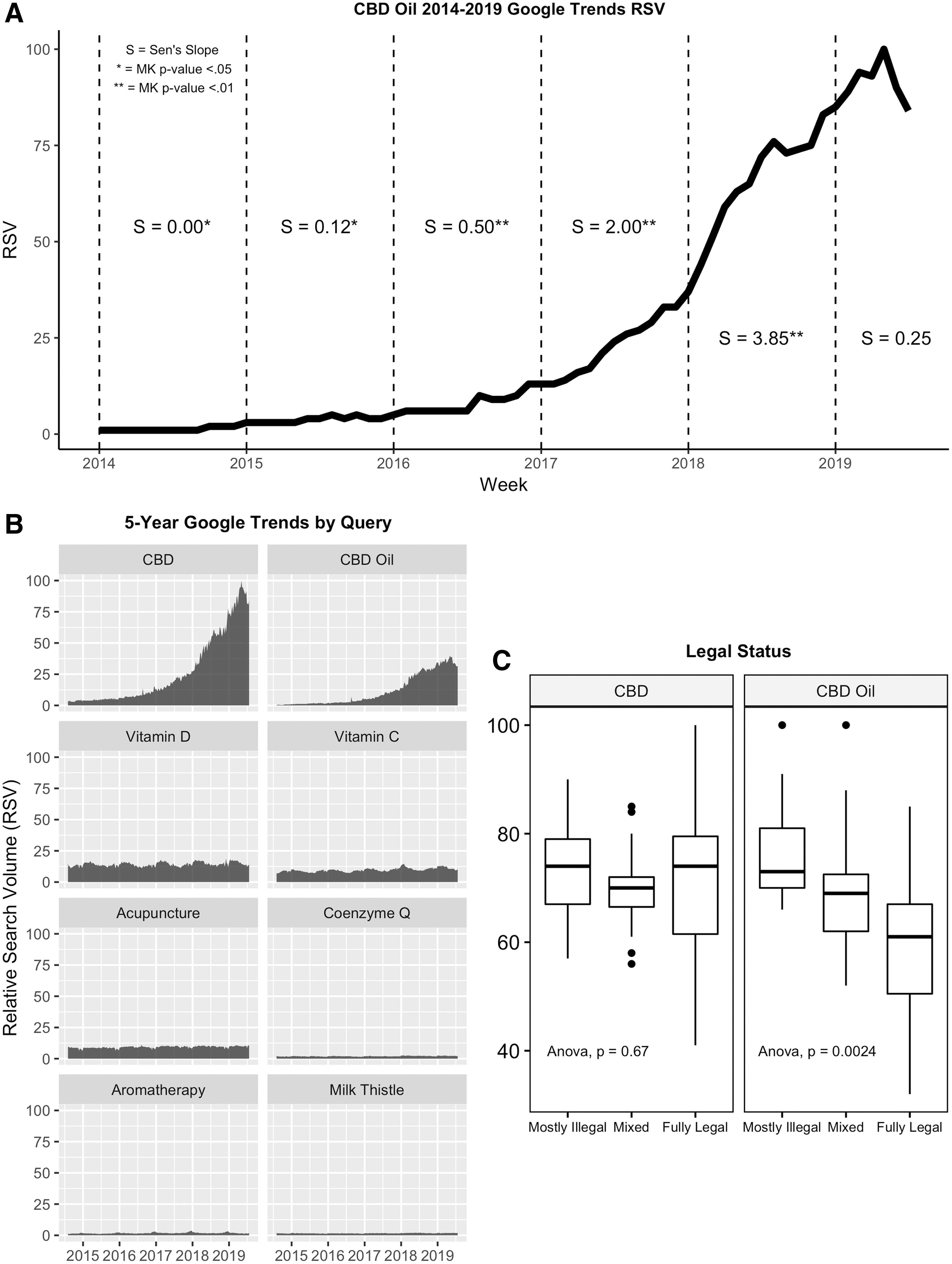
The “top” 25 related queries analysis for “oil cbd” by year (Table 1) has shown a shift from disease to symptom-related queries in recent years. Although “cbd oil cancer” query decreased with regard to rank position from 2014 to 2016 (9th to 20th rank) and disappeared from the rank in the following years, an increase in symptom management queries was observed with the inclusion of pain in 2015 and anxiety in 2017, and this trend persists until now. States where marijuana and its derived “cbd” products are illegal have a higher RSV for “oil cbd,” but not “cbd,” possibly showing public interest in “cbd oil” as an alternative to other cannabis-derived products in these states (Fig. 1C).
Cannabidiol Oil “Top Related Queries” and Its Respective Rank (1st to 25th) by Year
We show only queries that appeared in three or more years. A blank space means the query was below the 25th rank for that year. Table is sorted by number of list inclusions since 2014 (maximum = 6). Shift from disease such as cancer-related queries to symptom-related queries, mostly pain and anxiety is in bold.
Conclusion
Our article extends and complements a recently published article on this subject 5 by describing specifically CBD oil, a derivative of CBD that has different regulatory laws and thus prone to different consumer behaviors. Moreover, we added insights into people's specific interests for search. There is a trend toward an increasing interest in CBD oil among general public compared with other integrative therapies and a shift from disease such as cancer-related queries to symptom-related queries, mostly pain and anxiety. The higher search volume for CBD oil in CBD illegal states may reflect the search for alternative less regulated CBD-derived products in these regions. Despite the increasing interest shown among public, there is little if any formal training on this topic in medical education, which creates a challenging situation for health professionals to provide reliable information to patients. Increased physician awareness and education in this area could help facilitate open communication regarding CBD oil use and discussion of associated side effects and interactions. 6,7
Footnotes
Author Disclosure Statement
V.S. receives research funding for clinical trials from Novartis, Bayer, GlaxoSmithKline, Nanocarrier, Vegenics, Celgene, Northwest Biotherapeutics, Berghealth, Incyte, Fujifilm, Pharmamar, D3, Pfizer, Multivir, Amgen, Abbvie, Alfa-sigma, Agensys, Boston Biomedical, Idera Pharma, Inhibrx, Exelixis, Blueprint Medicines, Loxo Oncology, Inhbrx, Takeda and Roche/Genentech, National Comprehensive Cancer Network, NCI-CTEP, and UT MD Anderson Cancer Center.
Funding Information
The University of Texas MD Anderson Cancer Center is supported by grant CA016672 from the National Institutes of Health.