




Abstract
Background:
Breast cancer is very common, and the incidence is growing every year. Most breast cancers are treated with radiation after surgery. As a side effect of radiation therapy, inflammation, as well as the neutrophil–lymphocyte ratio (NLR), level increases. However, high NLR levels act as independent prognostic factors for increased mortality in all cancers. In this study, the authors investigated whether administration of vitamin C, which is effective in suppressing inflammation, may help to reduce high levels of NLR produced by radiation therapy.
Methods:
This study was performed retrospectively among 424 patients who were diagnosed with breast cancer and were treated with postoperative radiotherapy at Kosin University Gospel Hospital from January 2011 to December 2017. Among them, 354 patients received radiation therapy without vitamin C (the control group), and 70 experimental patients received vitamin C intravenously twice a week for at least 4 weeks during radiation therapy. The experimental group was divided into two groups according to the dose administrated: a low-dose vitamin C group (less than 1 g/kg, 52 patients) and a high-dose vitamin C group (more than 1 g/kg, 18 patients). The authors conducted three NLR measurements: before and after radiation therapy and at 3 months after radiation therapy; the authors then compared the change in NLR over time between the groups using repeated measures analysis of variance.
Results:
In the control group and the low-dose vitamin C-administered group, NLR was increased at the endpoint compared to before the radiotherapy, whereas NLR values in the high-dose vitamin C group were 8.4 ± 1.7, 5.9 ± 1.3, and 4.3 ± 1.5, showing a continuous decrease and a statistically significant difference (p interaction = 0.033). These results were similarly observed in models adjusted by the patient's age and American Joint Committee on Cancer stage, with borderline significance (p interaction = 0.065).
Conclusions:
Elevated NLR, a measure of systemic inflammation, has been associated with higher mortality cancer patients, including breast cancer patients. In this observational study, NLR was significantly decreased during radiation therapy in patients administered high-dose vitamin C.
Introduction
Breast cancer is the leading cause of cancer deaths among women globally. In 2012, 522,000 women died of breast cancer. 1 The number of newly diagnosed patients with breast cancer has been increasing annually, showing a steady increase within the last 10 years. 1 According to the Korea Central Cancer Registry, breast cancer was the second most common cancer among women after thyroid cancer, with 22,550 new cases and 2353 deaths reported in 2015 and the number of patients nearly doubling in 10 years. 1
Patients have many treatment options, such as surgery, chemotherapy, and radiation therapy, but because of anxiety about side effects and complications, they are interested in alternative therapies. 2 –4 Intravenous administration of vitamin C is part of complementary therapies in anticipation of improving quality of life, protecting against side effects of chemotherapy and radiation. 2
A German study suggests that intravenous vitamin C treatment can improve quality of life related to conventional treatment side effects such as nausea, depression, fatigue, and sleep disorders. 2 A laboratory study by Hosokawa et al. found that the anticancer effects of radiation were not reduced when it was applied in the presence of vitamin C. 5
In patients with cancer, problems caused by anticancer drugs or radiotherapy include suppressed bone marrow function and decreased white blood cell counts (lymphopenia), thereby making the cellular immune system vulnerable to various infections, which may lead to stopping cancer treatment as a result. 6 In the case of breast cancer patients, when receiving radiation treatment on the chest, complications such as radiation pneumonia and pulmonary fibrosis are accompanied by an increase in the inflammatory level, which acts as a prognostic factor that increases mortality. 7
To evaluate the effect of high-dose vitamin C injection therapy on the prognosis in cancer patients undergoing radiotherapy, the authors used the neutrophil–lymphocyte ratio (NLR), a marker that can be measured more reliably than other blood parameters. 8 The NLR is an indirect indicator used to measure the degree of inflammatory response and tumor burden. In a study by Azab et al. among 316 patients with breast cancer, patients with the highest NLR quartile (NLR >3.3) showed higher 1-year (16% vs. 0%) and 5-year (44% vs. 13%) mortality than patients in the lowest NLR quartile (NLR <1.8). 9
Therefore, the authors used NLR as an indicator of systemic inflammation, to evaluate the effects of high-dose vitamin C during radiation therapy among patients with breast cancer. NLR has been used as an independent prognostic factor for the short- and long-term mortality in breast cancer. High NLR levels indicate a low overall survival rate among patients with breast cancer. 9 –12
In a study of 396 healthy nonsmokers, Block et al. showed that C-reactive protein (CRP) levels decreased by 25.3% compared with placebo after administration of 1 g/day vitamin C in high-risk patients with cardiovascular disease (those with CRP levels above 1.0), showing a similar effect to that of statins. 13 In addition, Mikirova et al. showed that pro-inflammatory cytokines and CRP levels were significantly decreased when megadoses of vitamin C (7.5–50 g) were administered after conventional therapy in 45 patients with cancer of prostate, breast, and bladder. 14
Many studies show that vitamin C administration in both the general population and in patients with cancer lowers inflammation levels. 15,16 However, there are no clinical studies investigating the effects on suppression of inflammation, as measured using the NLR, of treatment with megadoses of vitamin C among patients with breast cancer during radiation therapy. In this study, the authors investigated whether NLR was effective in suppressing inflammation when intravenous megadoses of vitamin C were administered during radiation therapy in patients with breast cancer.
Methods
The protocol of this study was approved by the Institutional Review Board of Kosin University Gospel Hospital (KUGH2019-IRB 2019-01-009-004). The study was performed in accordance with the Declaration of Helsinki. In addition, all study processes followed the STROBE guideline. This study is a retrospective study based on medical records, so informed consent was waived.
Study participants
This was a retrospective study of 424 patients with breast cancer who received postoperative radiotherapy at Kosin University Gospel Hospital from January 2011 to December 2017. Inclusion criteria were as follows: patients who were diagnosed with breast cancer, with data on complete blood count with differentials before initiating radiotherapy and postradiotherapy. The authors excluded patients who had previously been diagnosed with cancer at other sites before being diagnosed with breast cancer. Patients who received high-dose vitamin therapy after radiation therapy or who did not have blood count data, anthropometric data, or general characteristics were also excluded.
The authors retrospectively obtained information of age, height, and weight from the medical records of included participants. Regional lymph node metastasis was confirmed in pathologic diagnosis after tissue extraction during breast cancer surgery. As for tumor-node-metastasis stage, the authors referred to the seventh edition of American Joint Committee on Cancer (AJCC) Cancer Staging Manual.
Study methods
The authors included a total of 424 study participants. Among them, 354 patients in control group received radiation therapy without administration of vitamin C after surgery; 70 patients in the experimental group received vitamin C intravenously twice a week for at least 4 weeks during radiation therapy. The experimental group was divided into two groups according to the dose administered: a low-dose vitamin C group (less than 1 g/kg, 52 patients) and a high-dose vitamin C group (more than 1 g/kg, 18 patients). Initially, both low and high doses of vitamin C started at 10 g twice a week, and when the patient complained of side effects (mouth dryness, vomiting, etc.) in the process of raising it in 10 g units per week, the dose was determined by maintaining the dose or decreasing it one step. Before starting radiation therapy, the experimental group was given counseling to explain the effects and side effects of vitamin C, and the patients signed a consent form.
The reason that the low and high doses were divided based on 1 g/kg and the number of administrations was set to intravenous administration for at least 4 weeks twice a week is based on a study by Choi and Kim. In that study, women who received radiation therapy after breast cancer surgery and were administered high dose (1 g/kg) vitamin C for at least 4 weeks twice a week had a significantly decreased 3-year relapse rate than women in the control group that did not receive high-dose vitamin C (p = 0.028). 17
As the method of administration, vitamin C vial was mixed with normal saline according to each dose and then administered intravenously through an opaque (lightproof) bag. The vitamin C used in this study was an injectable solution (
Laboratory data, including NLR, were measured thrice: before and after radiation treatment and at 3 months after the termination of radiation. The authors compared the change in NLR over time between the groups. The NLR was calculated by dividing the number of neutrophils by the number of lymphocytes.
Statistical analysis
The general characteristics of participants are presented as mean ± standard deviation. Continuous variables were evaluated using the t test, and categorical variables were evaluated using the chi-square test.
Repeated measures of analysis of variance were used to compare the changes in NLR between the high-dose group, the low-dose group, and control group. The same analysis was performed for patients with AJCC stage 1 and 2, as well as all participants.
Data analysis was performed using IBM SPSS version 24.0 (IBM Corp., Armonk, NY), and the level of statistical significance was defined as p-value <0.05.
Results
General characteristics of participants
The total number of participants was 424, including 354 in the control group and 70 participants in the experimental group. Among controls, the mean age was 53.2 ± 9.9 years, and mean body mass index (BMI) was 23.7 ± 3.5 kg/m2. Among patients in the experimental group, mean age was 52.6 ± 8.1 years (low-dose group) and 50.6 ± 7.4 years (high-dose group); mean BMI was 23.8 ± 3.0 kg/m2 (low-dose group) and 24.1 ± 3.3 kg/m2 (high-dose group). There were no significant differences among the three groups in age and BMI (Table 1).
General Characteristics of Study Population
Continuous variables are presented in means and standard deviations, while category variables are presented in frequencies and percentages.
Analyzed by chi-square test.
BMI, body mass index; VitC, vitamin C.
The white blood cell count was 5.5 ± 2.5 × 10³/μL (low-dose group) and 6.2 ± 3.6 × 10³/μL (high-dose group) among patients in the experimental group and 5.2 ± 3.3 × 10³/μL in the control group (p = 0.373). The percentage of neutrophils was 58.7% ± 31.6% in the control group, 58.4% ± 14.5% in the high-dose experimental group, and 58.8% ± 14.9% in the low-dose group, with no significant difference (p = 0.999). The percentage of lymphocytes was 28.7% ± 15.5% in the control group, 24.0% ± 8.1% in the high-dose experimental group, and 26.5% ± 11.8% in the low-dose experimental group, with no significant difference (p = 0.058) (Table 2).
Clinicopathologic Characteristics of Study Population
Continuous variables are presented in means and standard deviations, while category variables are presented in frequencies and percentages.
Analyzed by chi-square test.
AJCC, American Joint Committee on Cancer; VitC, vitamin C; WBC, white blood cell.
Comparison of NLR between groups
Table 3 and Figure 1 show comparison of the changes in NLR values before, after, and at 3 months after radiotherapy between the high-dose vitamin C group, low-dose vitamin C group, and control group.
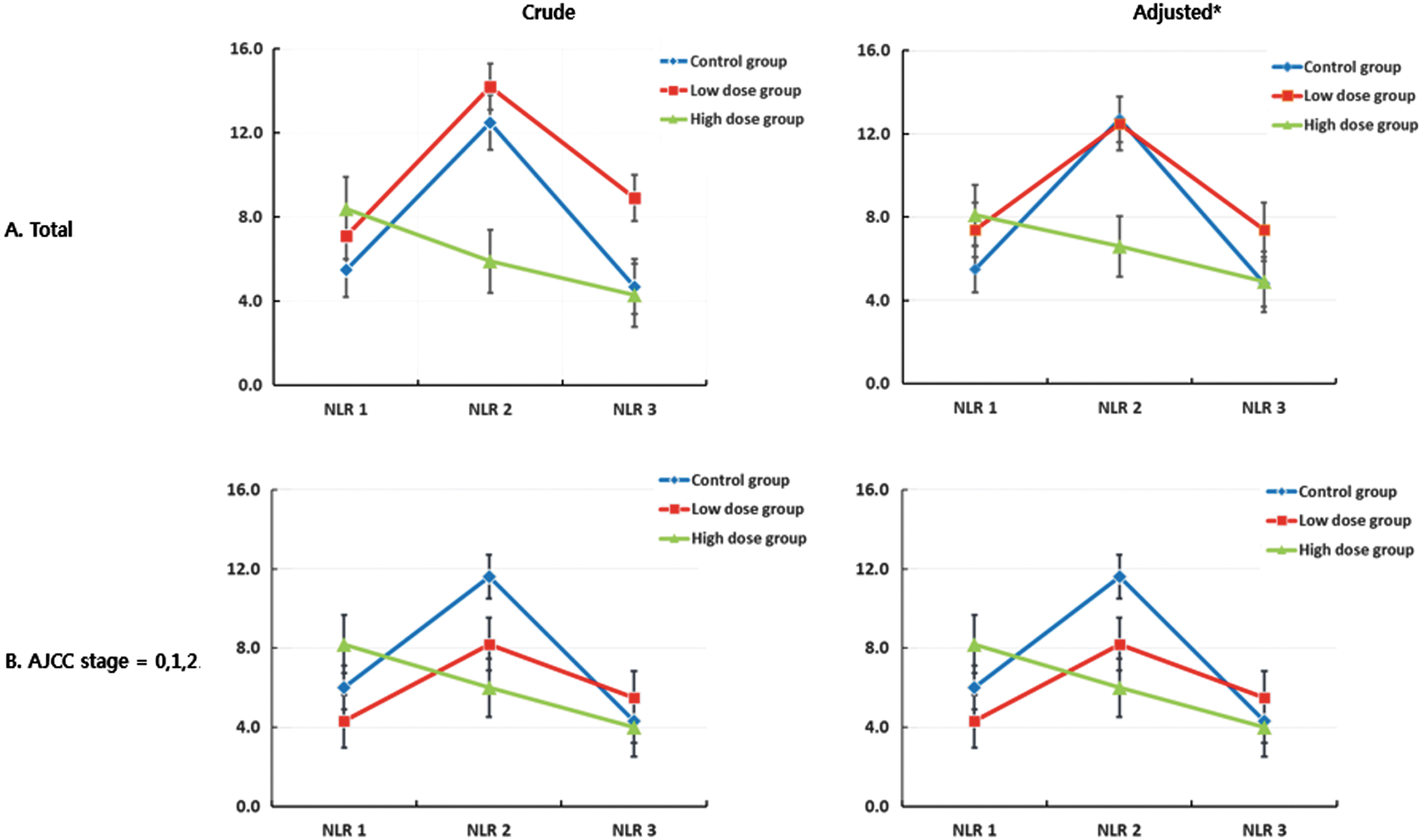
NLR changes over time and interactions between time and vitamin C group. *Adjusted with age and stage. AJCC, American Joint Committee on Cancer; NLR, neutrophil–lymphocyte ratio; VitC, vitamin C. Color images are available online.
Neutrophil–Lymphocyte Ratio Changes Over Time and Interactions Between Time and Vitamin C Group
All variables are presented in geometric means and standard error.
Analyzed by repeated measures ANOVA.
Adjusted with age and stage.
AJCC, American Joint Committee on Cancer; NLR, neutrophil–lymphocyte ratio; VitC, vitamin C.
The NLR values before, after, and at 3 months were 5.5 ± 1.1, 12.5 ± 1.1, and 4.7 ± 1.1 in the control group and 7.1 ± 1.4, 14.2 ± 1.2, and 8.9 ± 1.3 in the low-dose vitamin C group, respectively. NLR values tended to increase after radiation treatment and then decline 3 months after termination of radiation treatment. However, NLR values in the high-dose vitamin C group were 8.4 ± 1.7, 5.9 ± 1.3, and 4.3 ± 1.5, showing a continuous decrease (p interaction = 0.033). These results were similarly observed in the model adjusted for age and staging of the patient, and the statistical significance was close to the borderline (p interaction = 0.065).
The above analysis was repeated for patients with AJCC stage 0, 1, and 2 only. Similar to the overall participants, NLR values of the high-dose vitamin C group showed a continuous decrease before, after, and at 3 months after radiation treatment. This was also significant in models with additional adjustment for age and AJCC stage (p interaction = 0.030).
Comparison of neutrophils and lymphocytes between groups
In addition, the differentiation of the effect of intravenous vitamin C on lymphocytes and neutrophils was analyzed. When the association of vitamin C with changes of lymphocyte levels was evaluated, the continuous increase of lymphocytes was observed only in high-dose vitamin C group, not control group or low-dose vitamin C group, (p interaction = 0.017) (Table 4).
Lymphocyte Changes Over Time and Interactions Between Time and Vitamin C Group
All variables are presented in geometric means and standard error.
Analyzed by repeated measures ANOVA.
Adjusted with age and stage.
AJCC, American Joint Committee on Cancer; VitC, vitamin C.
This pattern was similarly observed among patients with AJCC stage 0, 1, and 2 (p interaction = 0.025). The adjustment for age and stage did not materially change the results. However, there was no difference in changes of neutrophils among the three groups (Table 5).
Neutrophil Changes Over Time and Interactions Between Time and Vitamin C Group
All variables are presented in geometric means and standard error.
Analyzed by repeated measures ANOVA.
Adjusted with age and stage.
AJCC, American Joint Committee on Cancer; VitC, vitamin C.
Discussion
As shown in Figure 1, changes in the NLR values over time between patients who were administered vitamin C showed that compared with NLR values before radiation therapy, the NLR values measured after radiation therapy had more than doubled in the control and low-dose vitamin C groups, from 5.5 ± 1.1 to 12.5 ± 1.1 and from 7.1 ± 1.4 to 14.2 ± 1.2, respectively; however, the NLR values after radiotherapy had significantly decreased in the high-dose vitamin C group, from 8.4 ± 1.7 to 5.9 ± 1.3 (p interaction = 0.033). This finding can be interpreted as indicating that administration of vitamin C has an inhibitory effect on inflammation at high doses (above 1 g/kg).
Similarly, the model adjusted according to age and stage showed a sharp increase in the NLR values after radiotherapy in the control group and the low-dose vitamin C group and a decrease from 8.1 ± 1.7 to 6.6 ± 1.3 in the high-dose vitamin C group. However, after adjustment, this decrease was somewhat reduced, showing a similar inflammation inhibitory effect, but the statistical significance was close to the borderline (p interaction = 0.065). This is considered to be because the comparison of NLR values before and after radiation treatment showed a significant decrease, but the NLR values measured after 3 months of treatment decreased to the level before radiation treatment in both the control and high-dose treatment groups.
Even in targeted groups with AJCC stages 0, 1, and 2, the NLR values after radiotherapy were nearly double the NLR values before radiotherapy due to inflammation levels increased by radiation therapy in the control and low-dose treatment groups; however, in the high-dose group, the NLR values after radiotherapy were significantly reduced from 8.2 ± 1.7 to 6.0 ± 1.3 (p interaction = 0.042). The adjusted model also showed significant suppression of inflammation with a reduction in NLR values after radiotherapy in the high-dose vitamin C group (p interaction = 0.030). This suggests that with less metastasis, high-dose vitamin C treatment during radiation therapy is more effective in reducing NLR.
In addition, analysis of the effect of intravenous vitamin C on neutrophils and lymphocytes was performed, and it was confirmed that the continuous increase of lymphocytes was observed only in the high-dose vitamin C group. In contrast, there was no significant difference between the three groups in the change of neutrophils. Therefore, the authors interpreted that the continuous decrease of NLR was the result of the effect on lymphocytes, rather than the effect on neutrophil.
An important limitation of this study is that this was a retrospective study conducted at a hospital. Second is the small sample size, with a small number of study participants (424 participants) and a small number of participants included in the high-dose group (18 participants); therefore, their study population is not representative of all patients with breast cancer. Third, participants were not excluded from the investigation based on whether they took antioxidants or alternative treatments before radiation treatment. In Korea, radiation therapy is intensively performed five times a week. During the radiation therapy period, drugs and other alternative treatments are strictly controlled; nevertheless prior treatment was not confirmed. Fourth, CRP and erythrocyte sedimentation rate were not used as markers for inflammation; the authors only used the NLR. Despite the above limitations, this is the first study to evaluate the effect of high-dose vitamin C during radiation therapy in patients with breast cancer, using the NLR.
Conclusions
The purpose of their study was to evaluate hematologic changes using the combination of radiation therapy and megadose vitamin C therapy. The authors used the NLR, a known prognostic indicator of mortality in patients with breast cancer. Elevated NLR, a measure of systemic inflammation, has been associated with higher mortality cancer patients, including breast cancer patients. In this observational study, NLR was significantly decreased during radiation therapy in patients administered high-dose vitamin C. However, several limitations remain in their study, including a small number of participants; therefore, further studies in patients with breast cancer are needed.
Footnotes
Authors' Contributions
This study was designed by J.C., and J.K. as principal investigator provided conceptual and technical guidance for all aspects of the project. H.P. and J.C. collected, analyzed, and interpreted the data. S.H. and D.L. also participated in data analysis and interpretation. The article was drafted by H.P. and commented on by all authors. All authors read and approved the final article.
Acknowledgment
The authors wish to thank Professor Duk-Hee Lee for helping us with the statistical analysis.
Author Disclosure Statement
No competing financial interests exist.
Funding Information
No funding was received for this article.