




Abstract
Objective:
Strenuous muscular workouts can increase markers of inflammation that can potentially damage components of skeletal muscles. Blueberries contain a variety of nutrients and phytochemicals that have individually been related to reduction in oxidative stress and inflammation. The objective was to conduct a systematic overview using evidence mapping to identify research-dense and evidence gap areas that examine the impact of blueberry consumption on exercise performance and inflammatory markers in adults.
Design:
The authors searched Medline, Cochrane Central, and Commonwealth Agricultural Bureau for literature published between 1946 and September 2019. Abstracts and full-text publications were screened in duplicate for studies that evaluated outcomes related to metabolism, lipoprotein, muscle damage, markers of oxidative stress, inflammatory markers, or gait after participants consumed blueberries and were subjected to some form of exercise.
Results:
The authors found nine randomized controlled trials, one single-arm study, and one observational study that met the eligibility criteria. Inflammatory markers, F2-isoprostanes, and gait speed were the most frequently reported outcomes, with each one reported by at least three studies. Outcomes related to metabolism, lipoproteins, muscle damage, and most markers of oxidative stress and most gait-related outcomes were each reported by one study. Intervention trials were generally conducted with a small number of participants and the majority included mostly younger individuals. Using multivariate analysis, the sole observational study examined physical ability among participants who consumed higher doses of blueberries compared with participants who consumed a half cup of blueberries less than once a month.
Conclusions:
Evidence mapping found that further research in both randomized controlled trials and cohort studies examining the impact of blueberry consumption on exercise performance and inflammatory markers is needed to establish an association.
Introduction
Regular physical exercise is an important lifestyle component for healthy living, and exercising several times a week helps to prevent cardiometabolic diseases by improving blood lipid levels, reducing blood pressure, and lowering blood glucose levels. 1,2 However, strenuous muscular workout, including long-distance running, can increase markers of inflammation and potentially damage the contractile and connective tissue components of skeletal muscles. 3 A number of mechanisms that contribute to exercise-induced muscle damage have been proposed. 4 –6 Blueberries contain a variety of nutrients and phytochemicals that have individually been related to reduction in oxidative stress and inflammation. 7
The antioxidant component of blueberries can reduce exercise-induced muscle damage and upregulate adaptive processes in muscle recovery. 3 While data are accumulating on the effects of blueberries on exercise-induced muscle damage and markers of inflammation, to the best of the authors' knowledge, a systematic overview of this role using evidence mapping has not been conducted. The overall objective of this evidence mapping is to identify if there is sufficient evidence to date to initiate a full systematic review in the near term evaluating the impact of blueberry consumption on exercise-induced muscle damage and markers of inflammation and also to identify gaps in the literature where future research may expand into. Results from this research are expected to identify the areas of evidence supporting the impact of blueberry consumption on exercise, including faster muscle recovery after exercise.
The goal of this evidence map is to determine the extent and distribution of available evidence examining the impact of blueberry consumption on exercise performance and inflammatory markers.
Methods
Evidence mapping is a research synthesis method used to identify, organize, and descriptively summarize well-researched areas (evidence-dense) as well as areas with gaps (evidence gaps). An evidence map is constructed on a broad question or topic to evaluate the extent of evidence before embarking on a full systematic review that evaluates well-defined key questions. 8
In general, evidence mapping has been used as a tool to systematically summarize the available scientific evidence on a topic and to plan for future research where additional research is needed. 9 This evidence map identifies, organizes, graphs, and qualitatively summarizes the published evidence that examines the impact of blueberry intake on exercise performance and inflammatory markers. It identifies research areas where there is sufficient evidence for a future systematic review and meta-analysis, as well as scientific gaps where future research on blueberry consumption and exercise would be beneficial.
Key informants
To gain a better understanding of the topic and to ensure that all available publications were captured, the authors recruited and interviewed a select number of key informants (KIs) with experience in the topic of blueberry consumption and exercise. At the onset, KIs helped refine the key questions. KIs suggested additional terms to expand the authors' initial literature search, such as physical function, gait, walk, and swimming, which would garner additional studies of interest. These terms expanded the population to include not very active adults and geriatric participants, in addition to normal healthy and athletically able adults. In addition to including studies with blueberries in any form (e.g., fresh fruit and juice), KIs suggested including studies where blueberries had been mixed with other polyphenols, such as green tea extract. KIs also helped prioritize the list of outcomes that would be meaningful for end users of this study.
Scope of the evidence map
The initial steps of systematic search and selection of studies taken for this evidence map were developed according to the methodology outlined in the standard systematic review methods, 10 –12 and further steps in evidence mapping were followed as previously described by the authors' team. 13,14 They included developing and executing a comprehensive search of various literature databases, establishing a study inclusion/exclusion criterion, screening of potential eligible citations and full-text publications using a systematic study selection process, developing an extraction form, collecting relevant data from each publication that met the inclusion criteria, and summarizing data using descriptive analyses.
Search strategy and study selection
The authors conducted an electronic literature search in Medline, Commonwealth Agricultural Bureau or CAB, and Cochrane Central Register of Controlled Trials for English-language literature published between 1946 and September 2019, which examined the impact of blueberry consumption on exercise performance and inflammatory markers in adults (≥18 years). The authors included both interventional studies and observational studies where participants consumed blueberries in any form. Outcomes of interest included inflammatory markers (e.g., interleukin [IL]-6 and IL-8), lipid markers (e.g., serum high-density lipoprotein cholesterol [HDL-C] and serum low-density lipoprotein cholesterol [LDL-C]), tests for muscle damage (e.g., creatine kinase and blood lactate), physical function outcomes (e.g., gait speed), and other relevant outcomes. The authors excluded studies in which participants had not been subjected to some form of exercise. They also excluded studies that only reported in vitro results.
The titles and abstracts for citations identified by literature searches were screened independently by two reviewers, and full-text publications of citations that met the inclusion criteria were retrieved and also screened in duplicate.
Data extraction and data synthesis
Two team members independently extracted pertinent data from qualifying studies, including variables related to study characteristics (e.g., country and funding), study design (e.g., randomized parallel and crossover), population characteristics (e.g., age and % male), intervention, comparator, exercise type and duration, outcomes, and result summary.
Data extracted from all included studies were summarized in narrative form, tables, and figures. All analyses and charting were performed using SAS, version 9.4 (SAS Institute, Inc., Cary, NC), and Microsoft Excel 2013.
Results
The electronic literature searches identified 268 citations, of which 10 intervention studies (nine randomized controlled studies 3,7,15 –21 and one single-arm study 22 ) and one observational study 23 met the inclusion criteria (Fig. 1 and Supplementary Table S1).
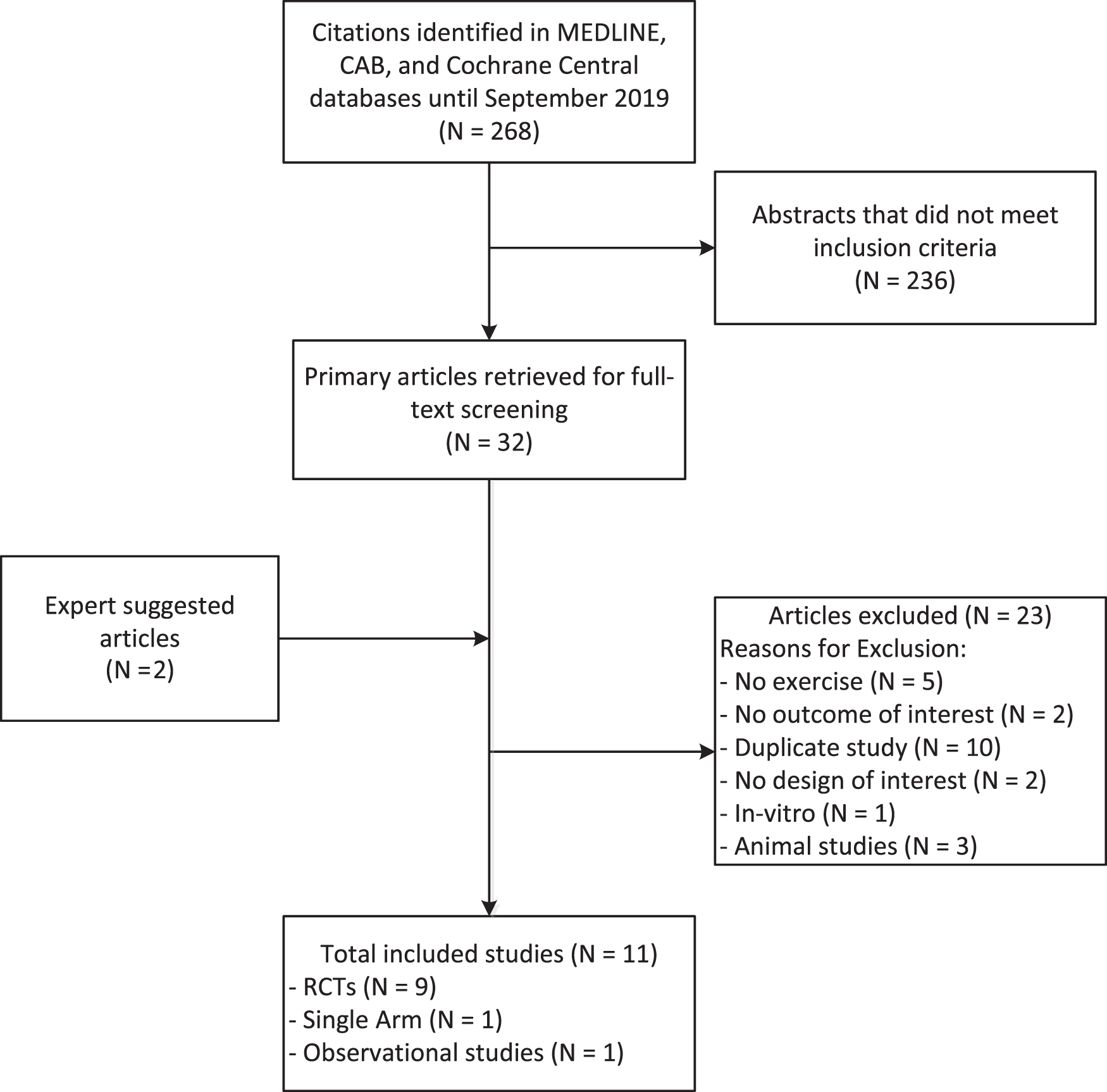
Study flow diagram. Study flow diagram that summarizes the flow of included and excluded studies. Citations identified in database searches were 268, of which 32 citations met the inclusion criteria. Two articles suggested by experts were also reviewed. A total of 23 articles were excluded for reasons including no exercise requirements (n = 5), not reporting an outcome of interest (n = 2), duplicate studies (n = 10), not a design of interest (n = 2), in vitro results (n = 1), and animal-only studies (n = 3). After exclusion, nine randomized controlled trials, one single-arm study, and one observational study were included. CAB, Commonwealth Agricultural Bureau; RCT, randomized controlled trial.
Blueberry intake in intervention studies
Ten intervention studies met the inclusion criteria, including five randomized, controlled parallel studies, four randomized crossover studies, and one single-arm study. 3,7,15 –22 Blueberry consumption ranged between 1 day and 17 weeks (Table 1). Seven studies were conducted in the United States, one in Canada, one in Sweden, and one in New Zealand, and the number of included participants ranged between 9 and 63 (Supplementary Table S2). Four 15 –18 studies were funded only by industry, five 3,7,19,20,22 were funded by a variety of sources, and one 21 did not report its funding source. Two 7,22 studies included only men, one 3 included only women, five 16,18 –21 included both men and women, and two 15,17 did not report participants' sex. The average age of participants across studies ranged from 22 to 69 years, and three 16,19,21 of the studies included elderly participants. Recruited participants were described as well-trained athletes in two studies, 17,18 moderately trained or individuals who regularly exercised in two studies, 3,7 with some running or exercise experience in two studies, 15,20 untrained in one study, 22 and elderly with the ability to walk unassisted in three studies. 16,18,21 Except for two studies that did not report on participants' baseline health, 7,17 all other studies included either healthy participants 3,15,18,20 or excluded participants with chronic diseases such as heart disease or glucose metabolism disorders. 16,17,21,22 Six studies 7,15,17,18,20,22 required participants to run on a treadmill, three studies 16,19,21 required participants to walk, and one study 3 required participants to complete sets of 100 eccentric repetitions of the quadriceps muscle before measuring final outcomes.
Intervention Characteristics of Control Studies
CRP, C-reactive protein; HDL-C, high-density lipoprotein cholesterol; hs-CRP, high-sensitivity C-reactive protein; IL, interleukin; LDL-C, low-density lipoprotein cholesterol; NK, natural killer; RCT-C, randomized controlled crossover; RCT-P, randomized controlled parallel; TNF-alpha, tumor necrosis factor-alpha.
Outcomes of interest
The most frequently reported outcomes in intervention studies were inflammatory markers (Figs. 2 and 3). Two randomized, controlled parallel studies 16,18 and one single-arm study 22 reported change in tumor necrosis factor-alpha (TNF-alpha), five randomized controlled studies 3,7,16 –18 and one single-arm study 22 reported results for change in IL-6, three randomized controlled studies 7,17,18 examined change in IL-8, four randomized controlled studies 7,16 –18 examined change in IL-10, and three randomized controlled studies 15,17,18 reported change in cortisol.
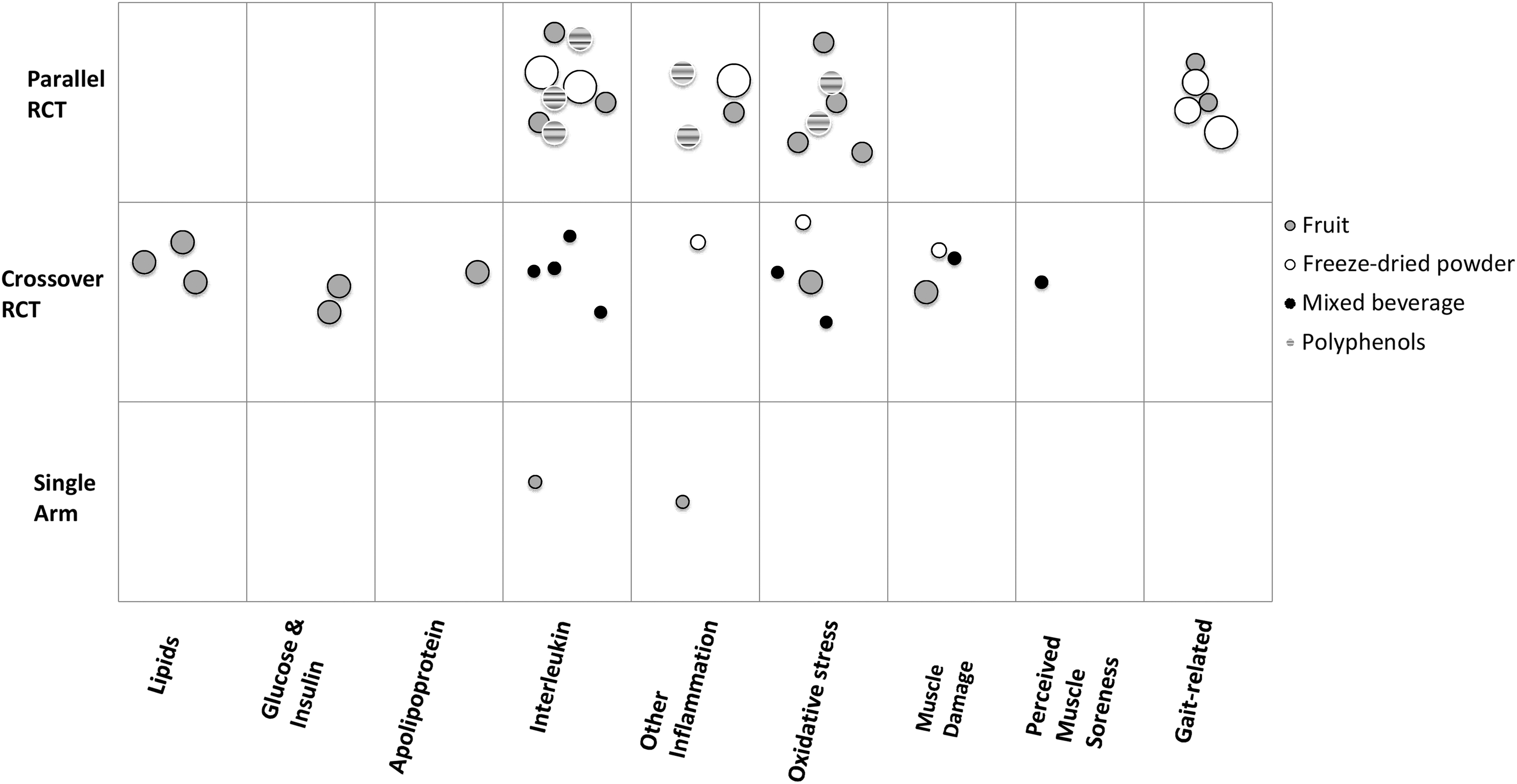
Bubble plot. Bubble plot presenting the number of outcomes reported by blueberry form, study design, and outcome type. The size of each bubble is proportionate to the number of participants in that trial. The different colors of the bubble represent the form in which the blueberries were consumed (e.g., fresh or powder). Studies that reported more than one outcome per outcome type are represented with one bubble for each reported outcome.

Total studies per outcome. Bar graph presenting the number of intervention studies reported for each outcome. Outcomes are grouped by outcome type.
Three randomized controlled studies 7,17,18 examined change in F2-isoprostanes, one crossover study 20 reported change in serum high-sensitivity C-reactive protein (hs-CRP), one 15 examined salivary hs-CRP, and one study 18 reported change in C-reactive protein. Changes in HDL-C, LDL-C, triglycerides, fasting glucose levels, fasting insulin, ApoA1, and ApoB were reported by only one study. 20 Muscle damage outcomes, including creatine kinase, 3 troponin T, 20 blood lactate, 15 and perceived muscle soreness, 3 and most oxidative stress markers, including homocysteine, 17 blood natural killer (NK) cell count, 17 and lipid hydroperoxides (ROOH), 7 were also each only reported in one study.
Three studies 16,19,21 reported results for gait-related outcomes. All three studies reported results for gait speed or velocity. Two studies 16,19 reported results for stride length, and one study 19 compared changes in step time, step width, stride time, and stride length between blueberry and placebo groups during a 2-min treadmill walk at the participant's preferred walking speed. Another study 21 tested balance by having participants walk within a narrow roped path created by two bright yellow ropes on the floor.
Study results
The 10 intervention studies examined more than 20 outcomes related to metabolic markers, lipoprotein, muscle damage, markers of oxidative stress, inflammatory markers, and gait. Of the metabolic and lipoprotein outcomes, only fasting glucose reported a significant decrease in the blueberry arm compared with the no-blueberry arm. 20 For muscle damage-related outcomes, blood lactate was the only outcome that reported a significant decrease compared with the placebo arm, 15 while for oxidative stress outcomes, both blood NK cell count 17 and ROOH 7 reported a significant change compared with the no-blueberry arm. Among inflammatory marker outcomes, only one of the four studies that reported a change for IL-10 reported a significant change in the blueberry arm compared with placebo. 17 All the remaining outcomes showed no significant difference after exercise between blueberry intake and comparators.
Study limitations
Even though the authors included studies that evaluated adults of all ages, 70% of the trials included participants with an average age less than 35 years. Most studies included only a small number of participants, with the largest study including 63 participants randomized to two arms. Adherence to intervention was self-reported in most studies, which could be susceptible to ascertainment bias. Although most studies instructed participants to stop taking certain vitamins or to stop consuming certain foods during the intervention phase, participants in general had different diets, which could potentially impact the results. Some studies, in which participants consumed blueberry powder, allowed participants to mix the powder with beverages (e.g., milk) or foods that could potentially impact the absorption and bioavailability of the blueberry's nutrients. 16 Included studies were heterogeneous with regard to the daily amount of blueberries consumed (40–250 mg), forms of blueberry intake (e.g., fresh or freeze-dried powder), and duration of blueberry intake (1 day–4 weeks). There was also a large variation in participants' baseline health and physical status, with some studies only recruiting participants who regularly ran marathons and other studies only recruiting participants with physical limitations.
Description of cohort study
One cohort study, The Health Professionals Follow-Up Study, 23 examined the association between blueberry consumption and physical function impairment in 12,658 men. The study, which was conducted in the United States, assessed average annual blueberry intake using a food frequency questionnaire. Physical functioning was assessed using the Medical Outcomes Study Questionnaire Short Form-36, which included 10 questions regarding physical limitations, including bathing, walking, climbing stairs, lifting groceries, moderate activities, and vigorous activities. Multivariate models were adjusted for potential confounders and analyzed the association of improvement in physical impairment and blueberry intake at various doses. This study found that blueberries taken at least twice a week significantly improved physical impairment compared with intake of blueberries less than once a month. However, a half cup of blueberries once a week and a half cup of blueberries one to three times a month did not improve physical impairment compared with intake of blueberries less than once a month.
Discussion
This evidence map identified 10 intervention studies (nine randomized controlled studies and one single-arm study) and one observational study published between 1946 and September 2019, which examined the association between blueberry consumption among adults who exercised and a variety of outcomes, including lipid and metabolic markers, inflammatory markers, muscle-related damage, and gait performance. Inflammatory markers were the most commonly reported outcomes with changes in TNF-alpha, IL-6, IL-8, IL-10, and cortisol, each reported by at least three studies. Metabolism (e.g., lipids and glucose), lipoprotein (e.g., apolipoprotein), muscle damage, most markers of oxidative stress, and most gait-related outcomes were each reported by one study. Studies generally included a small number of participants comprising mostly healthy, young athletic participants.
Evidence mapping serves as a cost-effective first step before embarking on a full systematic review and meta-analysis. Evidence mapping usually involves the following steps: identifying a research area that can be broad in one or more areas of PICO (population, intervention, comparator, and outcomes), defining key questions and variables and formulating a framework, engaging key stakeholders, conducting a systematic literature search and systematic selection of studies for inclusion according to a priori PICO, and synthesizing descriptive data. Presentation of evidence map findings includes visualization of data that describe the characteristics of eligible literature typically in bubble plots, heat maps, or bar graphs. Using a descriptive review and visualization of data, this evidence map found that most studies that reported on blueberry consumption and exercise focused on inflammatory markers. In contrast to conducting a systematic review, evidence mapping does not necessitate detailed extraction, assessment of risk of bias, quantitative synthesis of results from eligible studies, and assessment of the overall strength of evidence.
To the best of the authors' knowledge, this is the first evidence map to review and synthesize literature that solely examines the association of blueberry intake with improved exercise performance and includes a comprehensive list of outcomes. One previous review 24 examined the effects of certain fruits, including blueberries, and their respective fruit extracts on exercise performance and recovery. This review found three studies, which are also included in the authors' review. In addition, one animal study 25 also examined the association between blueberry intake and exercise performance. The study exposed mice to a normal diet and vehicle, a normal diet and blueberries, a highly palatable diet group (HPD) and vehicle, or an HPD and blueberries for 150 days. After the 150 days, mice were subjected to a forced swim test that consisted of mice individually swimming in an open cylinder container for 6 min. The duration of immobility was measured during a 6-min period. In addition, mice were subjected to ambulatory behavior in an open-field test where they were placed in a box that was divided into 12 squares and the number of squares crossed with all paws during an 8-min period was counted. The study found that treatment with blueberry extract prevented an increase in immobility time, but did not significantly change the ambulatory behavior during the open-field test, implying that the effect of blueberry consumption may not be related to changes in the locomotor activity in mice.
The strength of the evidence map includes the comprehensive examination of outcomes from a handful of eligible studies. The authors examined a comprehensive set of outcomes that ranged from lipid and metabolic markers, muscle damage-related outcomes, and inflammatory markers to gait-related performance. The authors did not limit their eligibility criteria by study design, blueberry intake type, exercise type, or subject's baseline health. The review identified studies that assessed the impact of blueberry consumption on exercise in not only healthy athletic participants but that also examined improvement in physical mobility among elderly subjects who can greatly benefit from improved physical performance.
Although the authors found studies frequently reporting results for inflammatory markers, outcomes related to metabolism, lipoprotein, muscle damage, markers of oxidative stress, and gait were each reported by only one study. This evidence map shows that further research is needed to examine the impact of blueberry consumption on exercise performance and that future studies need to employ more homogeneous interventions. Most studies included younger participants. Additional research is needed not only in the healthy, young, and physically active population but also in the physically impaired and geriatric population that could greatly benefit from increased mobility. Studies that include a greater number of participants, a broader age group of participants, irrespective of their physical ability, and a longer duration of the intervention would be useful in determining the effect of blueberry intake on exercise performance.
Conclusions
The antioxidant component of blueberries can help improve exercise performance and muscle damage and stimulate muscle recovery. 3 However, the authors did not identify a similar pattern of outcome evaluation across studies and across different populations. The evidence mapping systematically identified 10 intervention studies and one observational study in which participants consumed blueberries for a predefined period and completed some type of exercise before obtaining outcome measurements. Evidence mapping is helpful in identifying areas where further research is needed. The evidence map shows that further research on the association between blueberry intake and metabolism, lipoprotein, and exercise performance is needed in both healthy and physically impaired individuals.
Availability of Data and Material
The dataset supporting the conclusions of this article is included within the article and in its additional tables and figures.
Footnotes
Authors' Contributions
G.R. conceived and designed the research; E.E.A. and G.R. conducted the research; E.E.A. analyzed data; E.E.A. and G.R. wrote the article; and E.E.A. and G.R. had primary responsibility for the final content. Both authors read and approved the final manuscript.
Author Disclosure Statement
No competing financial interests exist.
Funding Information
This study was funded by the U.S. Highbush Blueberry Council.
Supplementary Material
Supplementary Table S1
Supplementary Table S2
References
Supplementary Material
Please find the following supplemental material available below.
For Open Access articles published under a Creative Commons License, all supplemental material carries the same license as the article it is associated with.
For non-Open Access articles published, all supplemental material carries a non-exclusive license, and permission requests for re-use of supplemental material or any part of supplemental material shall be sent directly to the copyright owner as specified in the copyright notice associated with the article.
