




Abstract
Background:
Medical Intuition is a system of expanded perception gained through the human sense of intuition. Medical Intuition focuses on visualization skills and intuitive and innovative scanning to obtain information from the physical body and its energy systems. Medical Intuition is designed to assist health care providers in a cost-effective, targeted approach to a patient's presenting concerns, and is not meant to serve as a diagnosis of illness or disease.
Objectives:
This exploratory study examined subjective accuracy and rates of acceptance of trained Medical Intuitives.
Settings:
Sixty-seven adult women and men served as study participants.
Procedure:
The procedure for each medical intuition session was standardized. Thirty or 60-min sessions were conducted by phone or video. The participant verbally provided their name at the beginning of the session. The Medical Intuitives were instructed not to engage in any conversation with the participant other than telling them the information they were “seeing” during the scanning process. Following the session, each participant completed an anonymous online standardized case report form documenting their assessment of the reading.
Results:
Findings included a 94% accuracy rate of the Medical Intuitive's ability to locate and evaluate the participant's primary physical issue; 100% accuracy to locate a secondary physical issue (86% of participants responding); 98% accuracy in describing the participant's life events, and 93% accuracy in describing a connection between the life events and health issues.
Conclusions:
These initial findings suggest that trained Medical Intuitives have strong subjectively reported accuracy rates identifying primary and secondary health issues and that their services are positively evaluated in the context of an individual's concerns regarding their health.
Introduction
There is a long history of the use of intuition in the medical setting, 1 with more recent efforts seeking to reconcile its use in the context of biomedicine. 2 “Medical Intuition” is a relatively new field within the medical setting that seeks to identify and evaluate structures and patterns of both the physical and the energetic systems of the body that may correspond to illnesses, imbalances, and disease. 2 Although Medical Intuition uses the word “medical,” the use of Medical Intuition is not to be construed as the practice of biomedicine, psychotherapy, or any other licensed health care practice, and is not to be considered a replacement for medical care, diagnosis, therapy, counseling, or treatment of any kind.
According to Colter, Medical Intuition is “a system of expanded perception gained through the development of the human sense of intuition and focuses on pinpoint visualization skills and in-depth intuitive scanning to obtain information from the physical body and biofield (energy) systems.” 3 The term biofield describes “the electromagnetic, biophotonic, and other types of spatially distributed fields that living systems generate and respond to as integral aspects of cellular, tissue, and whole organism self-regulation and organization.” 4
Medical Intuition is consistent with Complementary and Alternative Medicine as its ultimate aim is to promote holistic health, which includes physical, emotional, mental, and spiritual wellbeing. Medical Intuitives, practitioners of Medical Intuition, examine and provide reports on the functioning of the physical body and biofield and their relationship to overall health and wellbeing. 5 Medical Intuitives are individuals with enhanced intuition and perception who operate outside the normal range of the senses and awareness, such as Intuitives and Clairvoyants. 6 In the United States and Europe, intuitives are often consulted by individuals to gain further insight into the possible cause of specific bodily complaints and potential avenues for restoring health and wellbeing.
While there is increasing research on the energetic structures of the human biofield 4,5 that Medical Intuitives “read,” research on Medical Intuition is extremely limited. This is despite a fairly longstanding scientific interest in conducting research in the area. There have been few experimental studies, 7 –9 yet most of these have been in the form of case reports or qualitative studies. 10,11 Young and Aung, for example, had untrained “psychics” provide medical assessments to five volunteers who were medical patients. 10 The psychic's results were then compared with the patient's medical records. Results indicated some correspondence between the psychic's assessments and the medical records, however, not sufficiently impressive to warrant considering psychic assessment as a useful alternative method for identifying disease. 10
This exploratory and subjective evaluation study represents an attempt to gather evaluation data in this nascent field using trained Medical Intuitives. It also sought to obtain information on potential acceptance of this approach to wellbeing. The intention was that the findings could form the foundation of a larger experimental trial to determine accuracy within the context of a patient's medical history and records.
Methodology
The study took place over a period of 8 months, from August 2018 through March 2019. It was advertised through posted flyers, social media, and the use of existing e-mail lists. Participants (n = 67: 58 women; 9 men) were self-selected and included a cohort of 10 patients from UC San Diego Health and the Prebys Cardiovascular Institute's Cardiac Treatment Center at Scripps Health, San Diego, as well as people from the Medical Intuitive (MI) student's communities who were willing to participate and people who contacted The Practical Path through social media to participate in the study. There were no inclusion/exclusion criteria. All participants provided written informed consent. Outcome data was gathered anonymously online. Per UC San Diego's Human Research Protection Program CFR 46.101(b) Exempt Category #4, research involving information recorded in a manner that participants cannot be identified, directly or through linked identifiers, qualifies for exemption. Participants responded to a question to provide their age in blocks of 10-year intervals: 13 were in the range of 18–34 years; 18 were in the range of 35–44 years; 10 in the range of 45–54 years; 14 in the range of 55–64 years; and 12 in the range of 65–74 years.
The Medical Intuitives (n = 5) met with individual participants either by phone or video in independent 30- or 60-min sessions, where the Intuitives were blinded to the participants' complaints and medical history (see Appendix A for description of the reading process). The Medical Intuitives were trained and certified and selected for the study by Wendie Colter, CMIP, Program Director of The Practical Path, Inc. The procedure for each session was standardized. The MIs were instructed not to engage in any conversation with the participant other than telling them the information they were “seeing” during the scanning process. No medical or health information was provided by the participants. Following the reading, each participant completed an online anonymous standardized case report form documenting their assessment of the reading (Appendix B).
Results
Postsession assessment of accuracy
Participant responses to the questions in Appendix B yielded the following (presented are the combined percentages of participants responding “agree” and “strongly agree”) (Fig. 1):
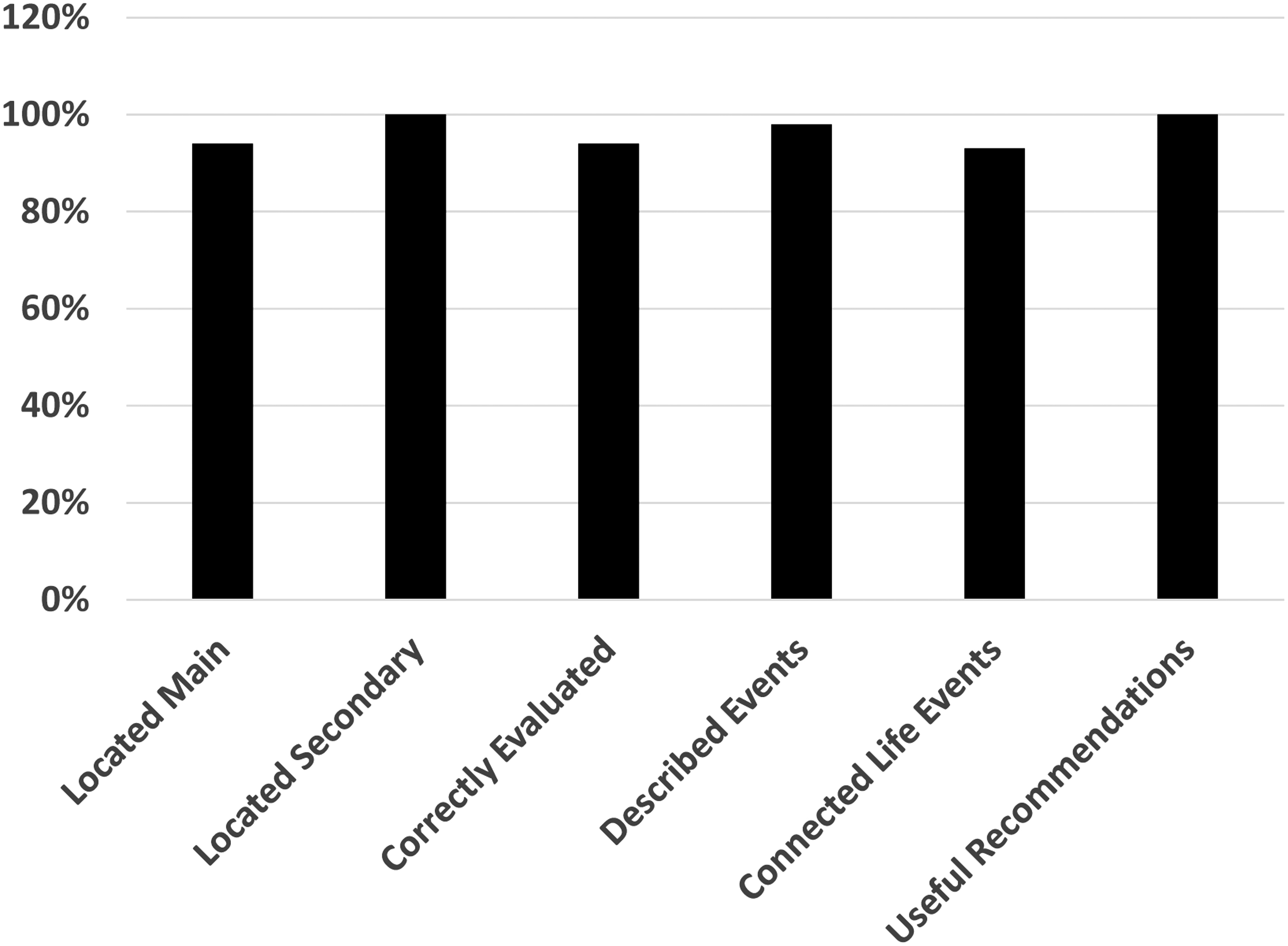
Postreading assessments of the medical intuition readings obtained from the rating scale questions 3–8, respectively, in Appendix B. Shown are the combined percentages of participants responding “agree” and “strongly agree.” Ratings were high across all of the domains examined, including whether the Medical Intuitive accurately located their main physical issue or concern (94%); accurately located their secondary physical issue (100%); correctly evaluated their health issue(s) (94%); accurately described their life events as related to the health issue (98%); accurately made a clear connection between the life events and the health issues (93%); and found the Medical Intuitive offered useful recommendations for their health issues or concerns (100%).
94% “Agree/Strongly Agree” the Medical Intuitive accurately located their main physical issue.
100% (of the 86% of study participants who completed this question) “Agree/Strongly Agree” the Medical Intuitive accurately located their secondary physical issue.
98% “Agree/Strongly Agree” the Medical Intuitive accurately described their life events.
94% “Agree/Strongly Agree” the Medical Intuitive accurately evaluated their health issue(s).
93% “Agree/Strongly Agree” the Medical Intuitive accurately made a clear connection between the life events and the health issues.
100% “Agree/Strongly Agree” that the Medical Intuitive offered useful recommendations for their health issues or concerns.
Additionally, 94% (of the 49% of the participants who responded to this question) indicated “Agree/Strongly Agree” that the Medical Intuitive was consistent with a known medical diagnosis.
Satisfaction with the session and participant comments
Overall, 99% of participants were “Satisfied/Extremely Satisfied” with their session, 97% would recommend Medical Intuition to others, and 96% stated they would have another Medical Intuitive session if given the opportunity.
In the postsession assessment, participants had the opportunity to also provide more qualitative descriptions of their experience. Comments included: “Very thorough”; “Excellent experience.” “Professional and informative, a very positive experience.” “The Medical Intuitive was very clear with her assessments. I felt comfortable and relaxed.” “She was able to see my problem areas. After she was done I felt a great sense of relief and confidence. She made a positive impact on my life.” “Very interesting session. Her comments affirmed what my surgeons, MD, and physical therapist have said to me.” “Spot on. Interestingly I had just discussed some of the items she brought up earlier today with my doctor. The session validated some of the avenues I have been exploring.” “An image that was brought up in the session gave me a very helpful picture of where my issues began.” “I found the session helpful for providing visual metaphors for emotional issues I was experiencing and those visualizations helped me to feel less overwhelmed.” “Insightful, enlightening, empowering and a lot of fun to see all the levels of mind, body and soul's influence on health.” “The Medical Intuitive hit right on certain things that I did not even know were effecting me still. Once they were brought forward things starting making so much sense. I can already tell a huge difference in my body. I am so thankful, grateful and excited!”
Discussion
This exploratory and subjective evaluation study helps address the need for scientific research on Medical Intuition. The findings suggest that trained Medical Intuitives have strong subjectively reported accuracy to identify primary and secondary physical complaints and/or illnesses as understood by the study participant, as well as to identify life events that led to the complaints and/or illness.
The findings also indicate that Medical Intuition is acceptable to individuals. Overall, patients expressed satisfaction with the medical intuition experience and would recommend it to others. Some of the study participants reported that the session was empowering for them.
There are limitations that must be noted. There were differences in the length of time of the readings, either 30 or 60 min in duration. We did not assess expectancy bias, nor did we have access to the participant's medical records to objectively assess the accuracy of the readings. In addition, we did not formally ask the participants if they had prior experience with Medical Intuition, although anecdotally we find that few people have ever heard of Medical Intuition. For these reasons, this is acknowledged to be an exploratory study.
While there is increasing scientific interest in the use of intuition in the medical setting, it is unfortunate that there are few well-designed experimental studies, 7 –11 in part, due to very limited funding in the area. Within this context, there is increasing interest in research on the human biofield which Medical Intuitives “read.” 4,5 With increasing funding in biofield research, it could provide a foundation for further experimental studies on medical intuition.
Findings from this exploratory study suggest that trained Medical Intuitives have strong subjectively reported accuracy rates to identify health issues and provide encouragement for further research in this area.
Footnotes
Acknowledgments
The authors acknowledge Tiffany Barsotti, MTh, Lori Johnson, RN, OCN, AHN-BC, Leonard A. Wisneski, MD, and the support of the University of California, San Diego Center of Excellence for Research and Training in Integrative Health.
Author Disclosure Statement
W.C. is the Program Director and Founder of the Practical Path, Inc., a Medical Intuition educational company. P.J.M. has no conflicts of interest to disclose.
Funding Information
No funding was received for this study.