




Abstract

—John Weeks, Editor-in-Chief (

I
The goal of palliative care is to relieve the suffering of adult and pediatric patients with serious illness, and that of the members of their families, by the comprehensive assessment and treatment of physical, psychosocial, and spiritual distress. Before the global pandemic, the World Health Organization estimated that 40 million people need palliative care each year, but only ∼14% receive it. 1 With unequal access to health care and an aging population, the necessity of palliative care is only increasing.
But why address palliative care in a special issue of a journal dedicated to integrative health? How does a field that emphasizes wellness and well-being relate to one that focuses on quality of life in serious illness? We assert that integrative health and palliative care share core values and goals, and that not building on their natural synergy misses an important opportunity to provide truly transformative care for people with serious illness (Table 1).
Core Principles of Integrative Health and Palliative Care
Although many people associate the use of palliative care with terminal disease, hospice care is only one subset of the field. Palliative care is best provided early in the trajectory of serious or chronic illness, increasing as illness progresses toward end of life.
Both integrative health and palliative care highlight quality of life, optimize well-being, reduce physical and emotional suffering, emphasize interprofessional and team-based collaboration, provide personalized individualized care, and strive for contextualized health care. Building on a few existing discrete efforts, an amplification of integrative palliative care—a hybrid of integrative health and palliative care—is proposed to enhance healing and reduce suffering in people facing serious illness, their families, and—significantly—health care professionals. We are advocating for a new formal field of integrative palliative care that takes a holistic hybrid approach to living well across the life course for people with serious illness and that builds on the strengths and shared philosophies of integrative health and palliative care 2 (Fig. 1).
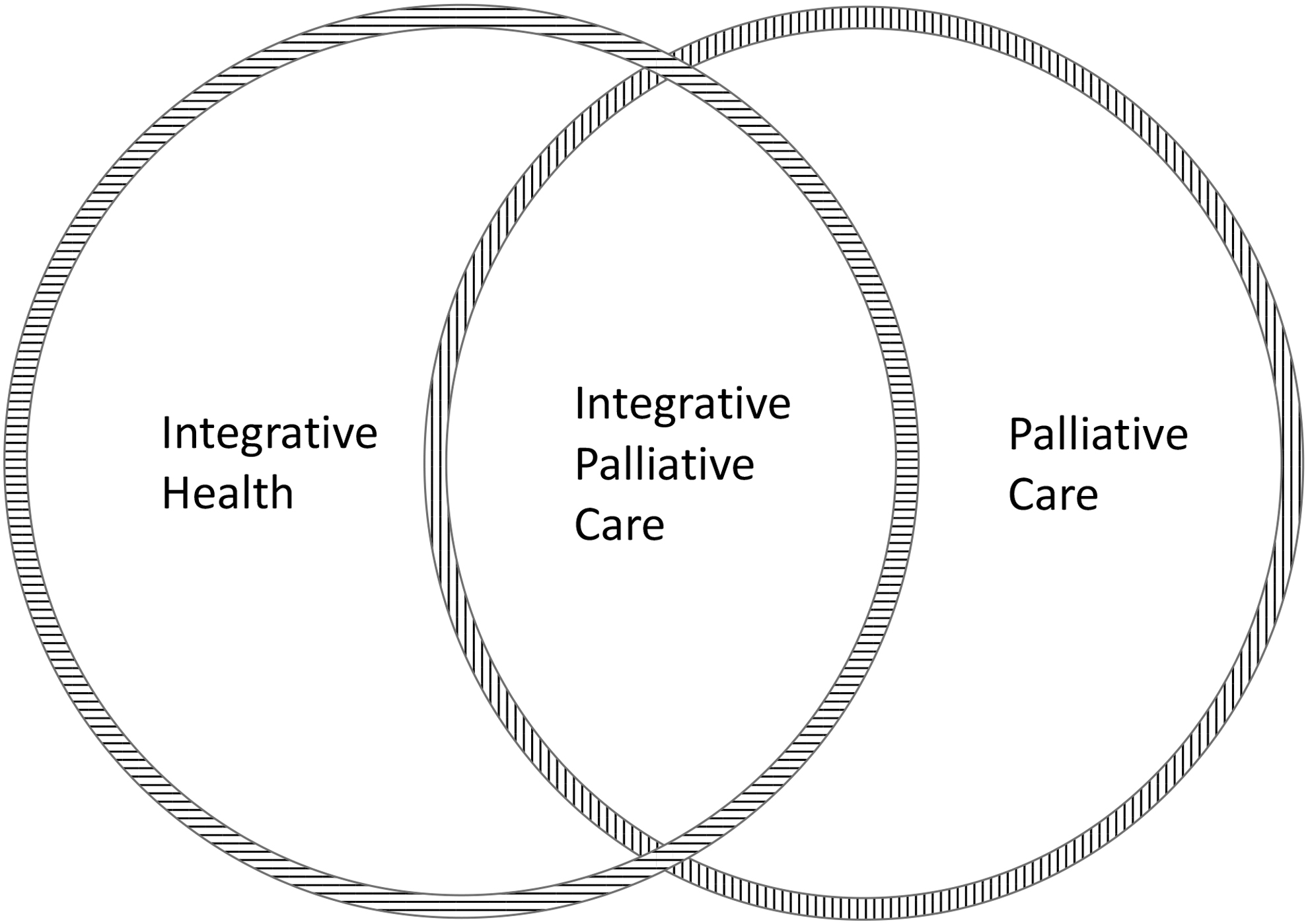
Integrative health and palliative care have substantial overlap in philosophy and scope. The combined field, integrative palliative care, expands the conventional palliative care toolbox and extends the impact of integrative health approaches across the life course.
Special Issue Advisory Team
Given the synergy between the fields of integrative health and palliative care, it may be surprising to learn that integrative palliative care has not already evolved as a robust widespread health care strategy. We believe that the reason for this delay lies in the historical and societal context in which the fields individually developed. In addition to conventional sources of paradigmatic inertia (e.g., disciplinary territoriality and boundaries, constrained resources, and dearth of leaders with expertise in all relevant fields), both integrative health and palliative care have actively fought to formalize their unique identities within a biomedical system that has not traditionally prioritized whole-person care. Palliative care is still poorly understood by many integrative health practitioners (who think of it as exclusively end-of-life or hospice care) and many palliative care providers are concerned about losing hard-won professional recognition through association with a field—integrative health and medicine—that is not universally respected. Despite the challenges inherent in amplifying integrative palliative care, we remain convinced that energizing the synergy of the two fields is critically necessary.
Care of the Health Care Provider
Attending fully to the needs of a patient's mind, body, and spirit requires that the clinician have positive energy, empathy, compassion, and professional engagement. An emotionally depleted integrative palliative care clinician is unable to fulfill the promise of this patient-centered specialty. The field must commit to the well-being of the patient, family, and the clinician. Burnout in the palliative care workforce is of significant concern and must be addressed as integrative palliative care programs grow. 3,4 Physicians experiencing burnout provide care that is of lower quality, 5 less satisfying to patients, 6 and more likely to result in medical errors. 7 The World Health Organization recently added burnout to its International Classification of Diseases (ICD-11), defining it as a “syndrome conceptualized as resulting from chronic workplace stress that has not been successfully managed.” 1 Specific symptoms include exhaustion, feelings of negativity toward or mental distance from one's job, and reduced professional efficacy. Burnout is classified as an occupational phenomenon, not a medical condition. It is crucial for us to identify, treat, and, ideally, prevent burnout in integrative palliative care physicians, nurse practitioners, nurses, social workers, chaplains, and other providers of integrative palliative care, such as acupuncturists, mind–body specialists, and massage therapists.
Since the arrival of COVID-19, it has become harder to provide high-quality integrative palliative care. The way in which care is delivered has changed: volunteer providers have been sent home; personal protective equipment (PPE) impairs rapport; and patients, families, and clinicians all bring their stress and fear into the clinical encounter. Integrative palliative care is a “high touch” field wherein rapport and connection between the patient and clinician are important components of clinical care. Telehealth visits, and even in-person interactions mediated by a mask and face shield, clearly make it more difficult to establish a strong clinician–patient bond. Integrative palliative care clinicians, who tend to sit close to the patient and use appropriate compassionate touch, now fear for their own health and safety. Anxiety, distress, and sometimes even reactivation of post-traumatic stress are impacting almost all participants in the health care system. From front desk staff to nurses to patients to physicians to technicians, there is a new unease and apprehension about clinical visits. More patients are reporting insomnia, uncontrolled anxiety, and depression; tempers are shorter and both patients and clinicians are on edge. Conversations with families of seriously ill patients that were typically held in-person, in cozy conference rooms, must now take place through videoconference. In addition, concerns about exposure to the virus and rationing of care have diminished patient trust in the health care system and made goals-of-care conversations and discussions of code status even more challenging.
Stress and burnout in all types of integrative health and palliative care providers, therefore, are becoming increasingly problematic during the COVID-19 pandemic. 8 A considerable proportion of health care workers, for example, are experiencing mood and sleep disturbances during the COVID-19 outbreak, including high prevalence rates of depression, anxiety, and insomnia. 9 As Rachel Naomi Remen noted ∼20 years before the onset of COVID-19, “The expectation that we can be immersed in suffering and loss daily, and not be touched by it, is as unrealistic as expecting to be able to walk through water without getting wet.” 10 The health and well-being of health care workers are no less important than that of the patients and families for whom they provide care. 11 Clearly, prioritizing the mind–body well-being of the health care workforce is necessary for sustained high-quality health care of any type. Researchers are reporting increasingly compelling evidence for the effectiveness of mindfulness-based approaches, for example, to address clinician burnout and other forms of distress. 12,13 The same integrative methods for providing optimal integrative patient care are invaluable for clinicians themselves, of course, since all people are potential patients.
Health Equity in Integrative Palliative Care
Standard (nonintegrative) palliative care has made significant advances and has proliferated in hospitals across the United States, 14 but there remain significant gaps in access and utilization that reflect longstanding systemic inequities in health and health care. Disparities in palliative and end-of-life care are consistently experienced by communities of color, people who are economically disadvantaged, and sexual and gender minorities. African American and other minority ethnic populations receive delayed and suboptimal palliative and end-of-life care because of lower access to services, lack of cultural sensitivity among health care providers, language barriers, previous negative experiences, and conflicting values between family/religion and perceptions of palliative care. 15 These health care disparities deny a growing population of adults living with chronic and advanced illnesses access to timely evidence-informed care and represent a significant public health concern. Patients with COVID-19 have higher prevalence of symptoms, lower performance status, and deteriorate and die more quickly. Early referral to palliative care during this pandemic is particularly important. Black, Latinx, Asian American, and other minority ethnic patients tend to be referred later to palliative care than white patients, especially during COVID-19. 16 We must develop comprehensive holistic strategies to set up integrative palliative care services that are responsive, flexible, inclusive, and equitable.
Full-spectrum integrative palliative care clearly is not equally available to all patients. Those who rely on insurance coverage have a smaller pool of modalities from which to choose. Although health insurance usually covers chiropractic care, other modalities and the providers who offer them, such as massage, craniosacral therapy, and reiki, are typically available only to patients with the ability to pay privately. Some, but not all, insurance companies cover acupuncture; recent changes to Medicare coverage now allow beneficiaries to receive acupuncture for back pain, but not for many other evidence-supported conditions. Patients covered by medical assistance do not have access to covered acupuncture at all. Modalities that patients can perform themselves, such as meditation, relaxation breathing, and self-hypnosis, are more widely available, and some instructor-led group activities, such as qigong, Tai Chi, yoga, and guided imagery, are available online at no cost. For optimal integrative palliative care, coverage clearly needs to expand.
It should not be surprising that neither integrative medicine nor palliative care addresses or meets equally the needs of all members of society. The development of a formal field of integrative palliative care offers yet another opportunity to build in health justice, the imperative that all people have the right to the highest attainable health, that social factors are fundamental determinants of health, and that systems and institutions should support the right to health by providing equal access to compassionate affordable health care. 17 As we advocate for the formal establishment of integrative palliative care, we recognize the unique opportunity to develop a field that does not merely consider health equity to be within its scope, but deliberately incorporates it into its center.
Integrative Palliative Care in Action
One of us (D.R.C.) leads an integrative and palliative medicine program at a community hospital. Although some centers have separate integrative medicine and palliative care departments that collaborate with each other, the Greater Baltimore Medical Center (GBMC)/Gilchrist in Maryland has a combined Integrative and Palliative Medicine Division. The integrative and palliative medicine service provides care in both inpatient and outpatient settings. The interprofessional team consists of integrative palliative care physicians; integrative palliative care nurse practitioners; a mind–body specialist; an integrative palliative care social worker; and volunteers who provide massage, craniosacral therapy, reiki, guided imagery, relaxation breathing techniques, and more. During the pandemic, the mind–body specialist has been providing services to inpatients using PPE and outpatients using telehealth. Acupuncture will soon be provided to hospital patients on the integrative and palliative medicine consultation service. Program assessment has shown that the outpatient services provided by the volunteer wellness team resulted in significant improvements in patients' pain, anxiety, and stress.
Integrative palliative care is evolving, along with health care in general. The use of telehealth, which increased exponentially around the world as a result of COVID-19, will be a helpful addition to the field. Seriously ill patients who do not feel well enough to come into the clinic will still be able to benefit from integrative palliative care services, including the pharmacologic and nonpharmacologic management of pain, anxiety, depression, and sleep dysfunction. Practitioners such as mind–body specialists, yoga therapists, music therapists, and qigong masters can provide services through telehealth. At GBMC, both the patients and the mind–body specialist have noted benefits to telehealth, including convenience, ease of achieving relaxation from home rather than in an office, picking up important therapeutic cues from seeing the patients in their home environment, and even including beloved pets in the sessions.
If integrative palliative care is to thrive as a field, training of both integrative medicine clinicians and palliative care clinicians must continue to evolve. Clinical fellowships will add to their curricula, board examinations should include integrative palliative care questions, and national support organizations such as the Center to Advance Palliative Care must add educational modules on integrative palliative care. As the field matures, we anticipate more integrative palliative care research, training opportunities, focused national conferences, and eventually a dedicated journal.
With such a strong base of shared values and complementary strengths, clinicians, educators, and researchers in the fields of integrative medicine and palliative care are poised to make significant contributions in the emerging realm of integrative palliative care. With serious and chronic illness, cure is often not possible, but integrative palliative care can reduce suffering, enhance well-being, and support the making of meaning for patients and families, as well as practitioners.
A Roadmap to the Integrative Palliative Care Special Issue
The articles we have included in this JACM special focus issue reflect the quality and breadth of research in integrative health in the context of palliative care. The accepted articles were selected from a large pool, >40 submissions, attesting to the relevance of this topic for researchers. The call for articles drew responses from scientists around the world, including successful submissions from researchers from Brazil, Canada, Chile, China, Greece, Iran, Italy, Norway, South Korea, the United Kingdom, and the United States. The issue contains eight original research articles, two reviews, four commentaries, and three editorials.
Four articles provide suggestions for advancing the field of integrative palliative care. Frenkel et al. provide a narrative article suggesting integration of complementary approaches at various stages of the cancer trajectory. Zeng et al. explore the role that Traditional Chinese Medicine can have in the development of the field of integrative palliative care in China. Marchand et al. note the shortage of palliative care providers in the United States and advocate for including yoga therapists in the palliative care workforce to enhance patient care and access, both in-person and through telehealth. Gentile et al. present a business plan, including structural features and practical solutions for combining integrative oncology and palliative medicine in a cancer center.
Seven articles address the core goal of integrative palliative care—relief of suffering. The authors address various aspects of physical and emotional suffering, related forms of distress that are tightly intertwined. Mantoudi et al. compare relaxation techniques and reflexology for patients with cancer, showing that although both interventions improved patients' anxiety and depression, reflexology was more effective in improving pain and the physical component of quality of life. Aitken-Saavedra et al. present a homemade salivary substitute made from chamomile and flax seed to ameliorate burning mouth syndrome (BMS). The treatment not only safely decreased BMS symptoms but also decreased salivary viscosity and increased flow. Heydarirad et al. report on a pilot randomized placebo-controlled trial that found benefit from a topical costus preparation in the treatment of chemotherapy-induced peripheral neuropathy. Kogan and Sexton discuss the use of medical cannabis for a variety of troublesome symptoms, including chemotherapy-induced nausea and vomiting, pain, anxiety, and anorexia. Amsterdam et al. describe that chamomile was beneficial for limiting anxiety and depression when they coexist. Fink et al. report different benefits of acupuncture and massage in the management of cancer-related pain, stress, and nausea. Although both modalities showed some benefit, massage decreased pain and stress more effectively than acupuncture. Birch et al. provide a narrative review of acupuncture that reveals emerging evidence for no less than 17 indications in palliative care.
In addition to symptom management, integrative palliative care aims to facilitate coping in patients with serious illness and their families. Osypiuk et al. explore the use of qigong to facilitate coping in breast cancer survivors. Participants share that a feeling of disconnection between mind and body emerged during breast cancer treatment and contributed to postsurgical pain. The authors found that 12 weeks of qigong practice resulted in not only improved pain control but also helped women to “reconnect” their mind and body and assess their body with more acceptance, confidence, and positive appraisal. Scagnetto et al. report on a study of animal-assisted intervention (AAI), a technique to facilitate coping in people experiencing stress and distress. The authors found that AAI decreased anxiety in end-of-life patients who had been pet owners but increased the anxiety of patients who had not lived with pets. This distinction is critical for services offered to very ill patients who might be unable to remove themselves from the experience. Lee et al. report on a study that showed a survival advantage of ∼3 months when Traditional Chinese Medicine was combined with biomedicine. The focus on balancing the body's immunity offers a more gentle and holistic approach that complements oncologic treatments, thus offering patients the option to pursue an alternative whole system approach together with their physician's recommendations.
We thank our special issue advisory team for their suggestions as we planned the issue and for their insightful reviews. We also note our appreciation for the support of our partners, the Society for Integrative Oncology (SIO), and the California State University Shiley Institute for Palliative Care (SIPC). SIO is a leader in the quest for integration of evidence-informed complementary therapies into standard cancer care to alleviate the physical and emotional suffering of cancer patients. The clinical practice guidelines that include rigorously studied complementary therapies developed by SIO are important additions to the field of integrative palliative care. SIPC shares an insightful commentary that outlines its commitment to integrative palliative care education and programming, including robust science-based course offerings for professional adult learners. Collaborations such as ours with these two organizations demonstrate the value of partnerships between integrative health and palliative care and represent the foundation on which an emerging field of integrative palliative care can successfully be built.
This collection of diverse articles, including our partners' commentaries, is united by the overarching goal of integrative palliative care—to reduce the suffering of people with serious illness and their families. The articles cover topics that are imperfectly addressed by conventional palliative care approaches and provide palliative indications for complementary modalities that are used in varied populations. Assessed together, they strengthen our assertion that formal attention to the amplification of integrative palliative care can alleviate suffering and optimize the health and well-being of people with serious illness across the life course through high-quality whole-person integrative health care.
Footnotes
Author Disclosure Statement
No competing financial interests exist.
Funding Information
No funding was received for this article.