




Abstract
Seborrheic keratosis (SK) is a common skin tumor that is typically benign but can be indistinguishable from malignant tumors. Current treatment methods carry risk of scarring and discoloration and are not always effective. We present the case of a 68-year-old woman with an SK lesion on her right cheek that had been growing for the previous 10 years. During an in-patient water-only fasting and exclusively whole-plant-food dietary intervention, the SK lesion began regressing until complete resolution was observed two weeks after her departure.
Introduction
Seborrheic keratosis (SK) is a benign skin tumor that is especially common in adults >50 years old with an estimated 83 million cases in the United States. SK lesions vary in location, number, size, color, and morphology, and can be indistinguishable from malignant conditions. The etiology and pathophysiology of SK are largely unknown. SK lesions are typically benign, but may be removed due to possible malignancy and/or aesthetic concerns. Common treatment methods, including cryotherapy, electrocautery, and 40% hydrogen peroxide, which was FDA approved in 2018, carry risk of scarring and discoloration and are not always effective. 1 In this study, we present the case of a woman with a 10-year history of facial SK that completely resolved after water-only fasting and exclusively whole-plant-food dietary interventions.
Case Presentation
In April 2018, a 68-year-old woman presented to our health center with the intention of improving obesity, hypertension, and diabetes. The patient also had an elevated brownish-black lesion measuring ∼1 × 1 cm with a fissured and rough surface on the right side of her face, which was diagnosed as SK in 2008. She reported that the lesion was asymptomatic but had continued to grow as well as change shape and color (from brown to black) since her original diagnosis. In 2015, she had the lesion re-examined but was denied treatment because it was benign.
The patient was approved to undergo an elective water-only fast based on her having sufficient nutrient and electrolyte reserves, normal creatinine and hemoglobin levels, normal kidney function, and a lack of any contraindicating conditions. 2 Before fasting, the patient prefed on an exclusively whole-plant-food diet without any added salt, oil, and sugar for nine days, followed by steamed vegetable purees for seven days, and fresh fruit and vegetable juices for seven days. She then fasted for 11 days by consuming only distilled water (minimum 40 ounces per day) and terminated the fast by refeeding for 10 days on plant foods of increasing complexity, beginning with fresh fruit and vegetable juices and ending with an exclusively whole-plant-food diet without any added salt, oil, and sugar. 2 At the end of treatment, her weight had reduced from 108.4 to 97.1 kg, corresponding to a body mass index change of 36.3 to 32.5 kg/m2, blood pressure changed from 127/68 to 111/75 mm Hg, and fasting blood glucose reduced from 157 to 91 mg/dL. On prefeed day 7, the patient reported that the SK lesion on her right check started “crumbling off” while washing her face and this continued throughout her treatment (Fig. 1A). The patient returned for a follow-up stay in December 2018 and reported that the SK lesion had completely fallen off approximately two weeks after her departure in May 2018 (Fig. 1B). The patient has provided written informed consent for the publication of this article and the use of images.
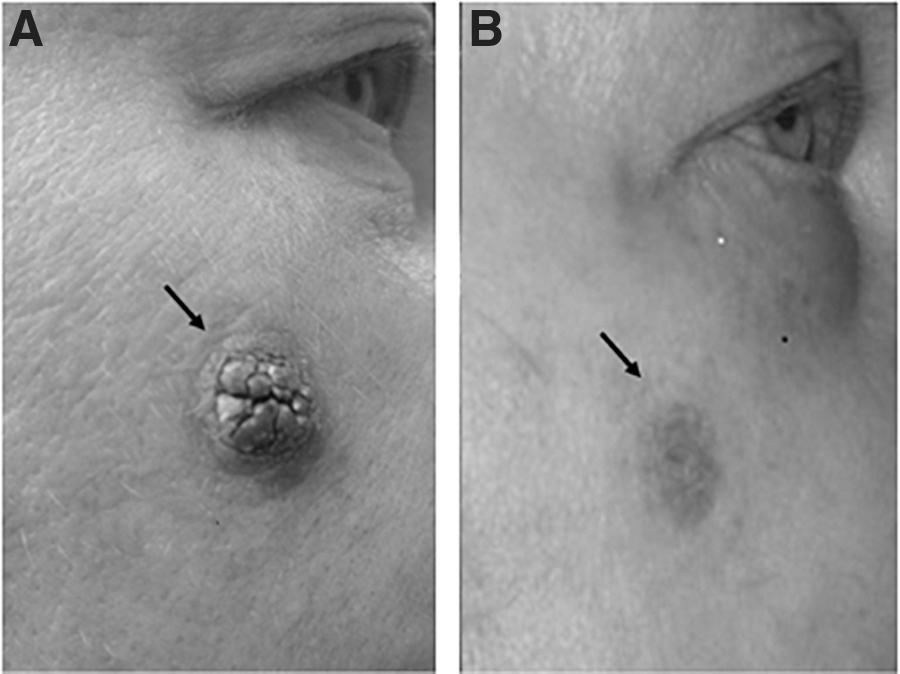
Seborrheic keratosis on right cheek
Discussion
This report describes the total resolution of a large facial SK lesion coinciding with water-only fasting and exclusively whole-plant-food dietary interventions—the timing of which suggests a causal relationship. These interventions may result in whole-body physiological changes (e.g., decreased inflammation) 3 –5 that make it difficult to differentiate between a treatment-associated response and spontaneous regression. There are a few published reports on spontaneous regression of SK lesions. In these cases, it was hypothesized that the regression was induced by mononuclear cell infiltration associated with concomitant malignancies. 6 –8 The mechanism(s) regulating spontaneous regression of tumors in malignant cancers and benign tumors may involve immune system activation or reactivation. 9 Fasting, and potentially an exclusively whole-plant-food diet, appears to stimulate immune responses (e.g., decreased levels of insulin-like growth factor) 10 that may also potentiate tumor regression in humans. 11 Thus, it is at least theoretically possible that the observed regression was the result of an immune response stimulated by fasting and/or diet. Research into SK pathophysiology and the effects of fasting and diet on immune responses are necessary to understand the mechanism(s) of action and support this notion. Nonetheless, this case as well as additional clinical observations of benign tumor regression after water-only fasting and an exclusively whole-plant-food diet provides a basis for further clinical research into these interventions as low-risk options for the treatment of SK.
Footnotes
Author Disclosure Statement
No competing financial interests exist.
Funding Information
No funding was received for this article. ■