




Abstract
Objective:
This review aims to assess the effectiveness of yoga for neck pain.
Methods:
Three electronic databases (PubMed/Medline, Scopus, and Web of Science) were searched to identify studies on all types of neck pain. Eligible trials were published in the English language between 2010 and 2019. Eleven studies were included in the review. Primary outcome measures were neck pain intensity and neck disability. Secondary outcome measures were quality of life (QOL), neck range of motion (ROM), and anxiety.
Results:
Eleven studies (eight randomized controlled trials, one qualitative study, one 12-month follow-up, and one pilot study) on 544 patients with neck pain (chronic neck pain, common neck pain, myofascial pain syndrome of the neck, and chronic nonspecific neck pain) comparing yoga with home-based exercise or physiotherapy were included. Almost all studies reported a significant improvement in the yoga group compared with the control group. The results showed that yoga had a positive effect on neck pain intensity, neck disability, QOL, cervical ROM, and anxiety, renewed body awareness, and increased acceptance of pain and disability. The yoga intervention alone or with an integration of physiotherapy has been found to improve neck pain intensity.
Conclusion:
Yoga was found to have a significant effect on neck pain intensity and functional disability, improve pain tolerance, increase ROM, and reduce anxiety and may be a useful intervention for neck pain. However, studies of yoga on neck pain were with different forms of yoga and with varied duration of interventions. More research is needed to draw firm conclusions.
Introduction
Neck pain is a major musculoskeletal disorder in adults globally. The etiology may be complex and may involve ergonomic (such as the use of strong physical activity, force, and vibration, inadequate posture, and repetitive movement), personal (such as age, body mass index, genome, and history of musculoskeletal pain), behavioral (such as smoking and level of physical activity), and psychosomatic (such as job satisfaction, level of stress, anxiety, and depression) factors. 1 Previous studies have suggested that many patients with chronic neck pain use alternative or complementary methods to relieve their pain. 2 –4
Yoga comprises breathing postures (prānāyāma), meditation (dhyana), physical postures (āsana), and relaxation, which are used to enhance physical, emotional, and mental well-being. 5,6 The ultimate goal of yoga is to achieve the union of mind, body, and spirit. It has been shown to have a beneficial effect for reducing pain. It may help to relieve pain by downregulating the hypothalamic–pituitary adrenal axis and the sympathetic nervous system. 7
Yoga has been used to improve neck posture and relieve neck pain. 8 –18 There are many studies that have assessed the efficacy of yoga for neck pain; however, results are inconsistent. Many studies assessed yoga specifically for chronic neck pain or chronic nonspecific neck pain. The aim of this study was to review published trials on the effectiveness of yoga for all types of neck pain.
Methods
Three electronic databases (PubMed/Medline, Scopus, and Web of Science) were searched to identify studies on yoga for the management of neck pain. Eligible studies were published in the English language between 2010 and 2019. Full articles were reviewed to determine whether they met the selection criteria. Search terms were “neck pain,” “neck syndrome,” “myofascial pain of neck,” “chronic neck pain,” “yoga,” “yog,” and “mind sound resonance technique.” The retrieval process of the literature and key characteristics of eligible studies are depicted in Figure 1.
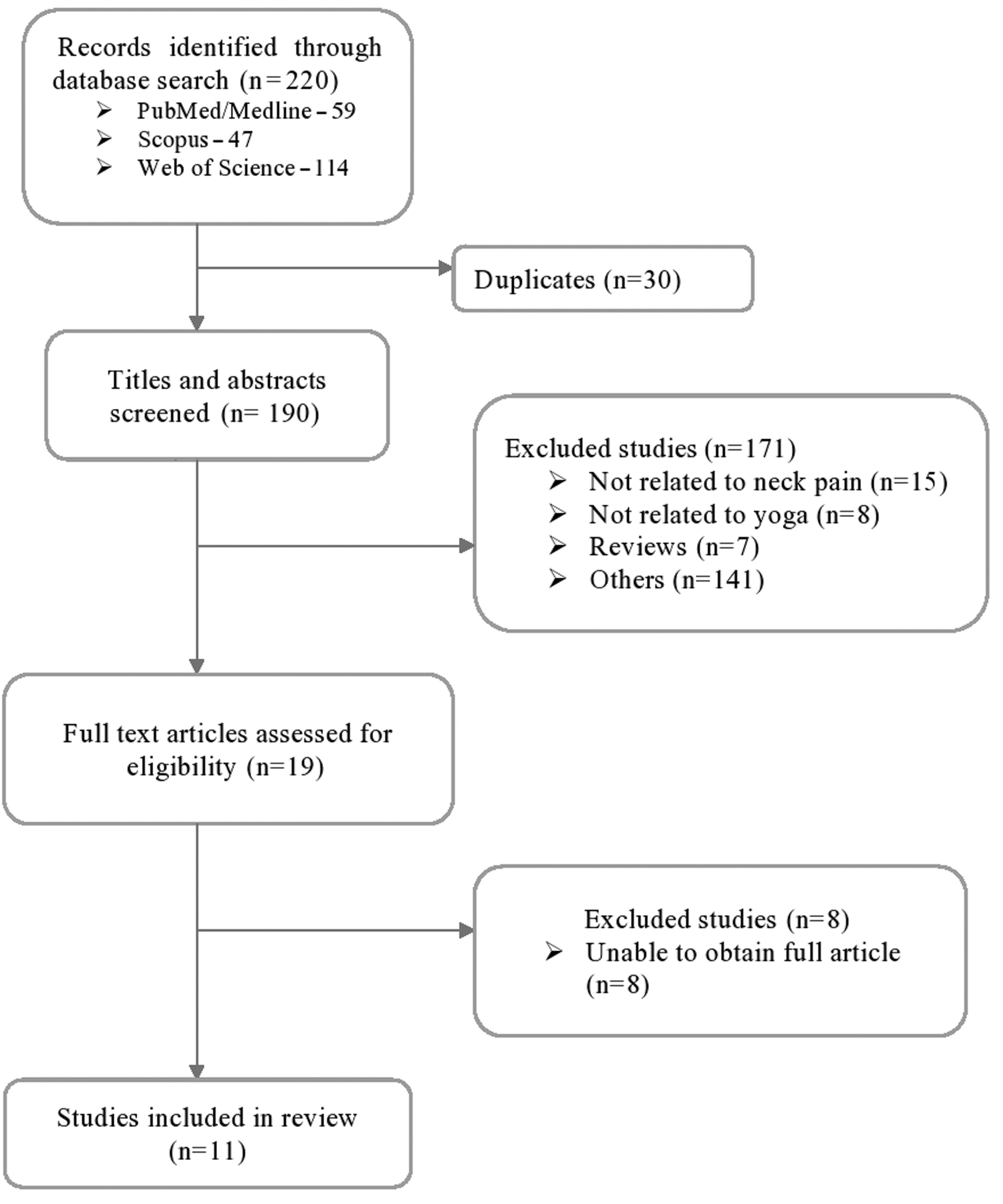
Flow diagram of eligible studies.
Eligible studies included randomized controlled trials (RCTs), quasi-randomized controlled trials, randomized cross-over studies, case reports or follow-ups, and pilot studies, on any form or type of yoga intervention for neck pain. Studies excluded from this review were publications before the year 2010, RCTs with healthy participants, and review articles.
No restrictions were made on length, duration, type of yoga, and frequency of yoga programs. Eligible intervention studies included those evaluating yoga postures, breathing, meditation, and mind sound resonance techniques for neck pain. Neck pain conditions included common neck pain, chronic nonspecific neck pain, chronic neck pain, chronic mechanical neck pain, and myofascial pain syndrome of the neck. Studies on other health conditions were excluded.
Primary outcome measures were neck pain intensity and neck disability, as these two parameters are important predictors of clinical outcomes in neck pain. Secondary outcome measures were quality of life (QOL), neck range of motion (ROM), and anxiety, as these parameters were considered important in assessing all types of neck pain.
Results
Two hundred twenty studies were identified related to the search terms: 59 were identified from Pubmed/Medline, 47 from Scopus, and 114 from Web of Science. Of the 220 studies screened, 30 were removed due to being duplicates and 190 titles and abstracts were screened. After title retrieval, 171 studies were excluded either because they were not related to yoga or neck pain or were review articles. The remaining eligible 11 studies, with 544 patients, were included in this review. Key characteristics of eligible studies are depicted in Table 1.
Characteristics of Included Studies
BP, blood pressure; CES-D, Centre for Epidemiologic Studies Depression Scale; CPSS, Cohen Perceived Stress Scale; CROM, cervical range of motion; DASH, disabilities of the arm, shoulder and hand; MSRT, mind sound resonance technique; NDI, Neck Disability Index; NPDQ, Neck Pain and Disability Questionnaire; PAS, Pain Analog Scale; RCT, randomized controlled trial; ROM, range of motion; SF-36, Short Form 36; qRCT, quasi randomized controlled trial; QOL, quality of life; VAS, Visual Analog Scale.
Yoga therapy had a median length of nine weeks with a median frequency of one weekly session. Yoga interventions were under the guidance of experienced yoga instructors. Yoga interventions included exercises, postures, and meditation. Various types of neck pain were included: chronic neck pain, chronic mechanical neck pain, myofascial pain syndrome of the neck, and chronic nonspecific neck pain. Most studies assessed neck pain intensity and disability. The control group in almost all studies included isometric exercises, Pilates, self-exercise, or t'ai chi. Iyengar yoga was the main style of yoga used in the included studies. This style of yoga focuses more on physical postures than breathing or meditation.
Almost all studies showed a significant improvement with yoga on neck pain intensity, neck disability, cervical ROM, anxiety, and QOL. The present study results are consistent with previous reviews and meta-analyses on the effect of yoga on neck pain.
Conclusion
This review was performed to evaluate the effectiveness of yoga on various types of neck pain. To the best of our knowledge, this study is the first review to assess yoga for all types of neck pain. Previous reviews included only chronic nonspecific neck pain or chronic neck pain. Yoga was found to have a significant effect on neck pain intensity and functional disability, improve pain tolerance, increase ROM, and reduce anxiety. Yoga may be a useful intervention for neck pain; however, more research is needed to draw firm conclusions.
Included studies of yoga for neck pain had small samples, different forms of yoga, and varied duration of interventions. There was also a high risk of bias due to nonblinded trials. Also, self-exercises in the control group were not under proper guidance, which may affect results. In addition, most outcome measures were subjective and follow-up data for almost all studies were not provided. Possibilities for future clinical trials include an integrated approach of both physiotherapy and yoga for neck pain.
Footnotes
Author Disclosure Statement
No competing financial interests exist.
Funding Information
No funding was received for this study. ■