




Abstract
Abstract
Muscle Channel Technique (MCT), a proprietary acupuncture technique, is a useful tool for pain management and injury healing. MCT is effective, easily accessible to both the patient and clinician, and safe. In its application, needles are inserted subcutaneously toward the pain or injury along the affected muscle channels at classically defined access points around the ankles or wrists. MCT's therapeutic effect can be enhanced by longer needle retention at the access points or the use of electrical stimulation between access and anchor points, which include He-Sea or Yuan-Source points.
Introduction
I have been practicing and teaching acupuncture in the United States since 1997. After finding that most visits to my office were for pain or related to injury, I conducted extensive research on Muscle Channel Theory (MCT) to find a better technique for longer pain relief through acupuncture. Inspired by Dr Dou Han Qing, 1 writer of Biāo Yōu Fù (Ode to Elucidate Mysterie), I experimented with longer retention of needles for chronic pain cases and found satisfying results. I have been practicing and teaching Muscle Channel Technique (MCT) since 1998. Thousands of patients with pain and injuries have benefited from MCT.
The channel system of Traditional Chinese Medicine can be subdivided into primary channels, Luo connecting channels, divergent channels, muscle channels, and cutaneous regions. Primary channels are the ones along which most of the regular points are located. Luo connecting channels serve as collateral conduits between the paired primary channels. Divergent channels have no points and run deep in the body to strengthen the internal linkage of paired Zang Fu organs. Muscle channels are superficial and run directionally from the extremities toward the trunk or head. Cutaneous regions cover wider swaths of the body surface and roughly correspond to the area served by the 12 muscle channels.
Anatomically, the muscle channels include muscles, tendons, ligaments, cartilage, and other connective tissues. Collectively, they bind bones together to form joints and hold the Zang Fu organs in their respective locations. The muscle channels also supply Qi and Blood to nourish and lubricate the joints and Zang Fu organs. Muscle channels are superficial and cover wide areas of the body. 2
Muscle channels do not have their own points, but they are accessible through 12 specific points called access points, located proximal to the wrists and ankles.
Access Points
Access points are located from 1.5 to 7.0 inches proximal to the wrist or ankle. These are specific points, such as Xi-Cleft or Luo-Connecting points. In addition to their traditional functions and indications, these points are the best sites to both access the muscle channels and correct muscle channel pathologies such as pain, inflammation, swelling, and scarring.
Anatomically, access points are frequently located along connective tissue planes between one muscle group and another, or between muscle and tendon or bone. Needle grasp is greater at access points because more connective tissue is available to wind around the needle, thus more De Qi is achieved. Neurovascular bundles are located along connective tissue planes as well and therefore, the same amount of needle grasp may have more powerful downstream effects. 3
Anchor Points
Anchor points for the upper extremities are located around the wrists and elbows; for lower extremities, the anchor points are located around the ankles or knees. They are most commonly He-Sea, Shu-Stream, Yuan-Source points, local Ah Shi points, or trigger points. Anchor points guide the Qi and Blood toward the injured joints or tissues.
The anchor and access points for both the upper and lower extremities are provided in Table 1.
Methods
Tools
Needles
One-inch needles, 34 to 36 gauge, with spiral coil handles are preferred. The needle handle needs to be flexible enough to bend with body structure contours and to accommodate natural tissue movement when the body moves. In pediatric cases, ½-inch needles are recommended. Needles with rigid plastic or metal handles should not be used in MCT.
Tapes
Numerous manufacturers make good-quality surgical paper tapes. I have found through years of practice that ½-inch or 1-inch 3M Micropore (3M; St Paul, MN) tape works best. These tapes are stretchy, durable, and stick well to the skin. Patients may shower and the tape will remain affixed to the skin. Patients may even take baths without wetting the needles. Waterproof bandages on top of the tape will help to keep water out.
Technique of MCT
Insert access point needles at a 15° to 30° angle. After insertion about ⅛-inch deep, lay the handle on the skin. Gently and slowly slide the needle into the skin, further toward the location of the injury or pain. Avoid bending the needle abruptly. Needles should be placed outside the body of the muscles and between the dermis and the underlying fascia (Figure 1).

Correct needle insertion angle about 15° to 30°.
An insertion angle that is too steep will result in deeper insertion into muscle tissue layer, which often causes pain or discomfort during needle retention. If the insertion angle is too shallow, more pain and discomfort will be caused due to the higher concentrations of sensory nerve endings in the dermis.
Insert needles at anchor points perpendicularly to the skin surface, and deeply to boost and relay the Qi and blood flow produced by the access points.
Access needles are often inserted ½ to ¾ of the needle length along the channels. If the needle is inserted all the way in, the bottom part of the handle may spin further into skin and deeper tissue, creating a possible opportunity for infection. If needle insertion is too shallow, the needle may dislodge when the body part moves.
The direction of needle insertion at access points is toward the injured tissues, joints, or organs that are being treated. The direction of insertion at anchor points is perpendicular to the body surface.
For prolonged pain relief, needles are often retained at access points for hours, days, or even weeks to provide constant Qi arrival and maximize the therapeutic effects of the treatment. If needle retention is desired, the access point needles may be taped to the skin, using the adhesive tape suggested above (Figure 2).
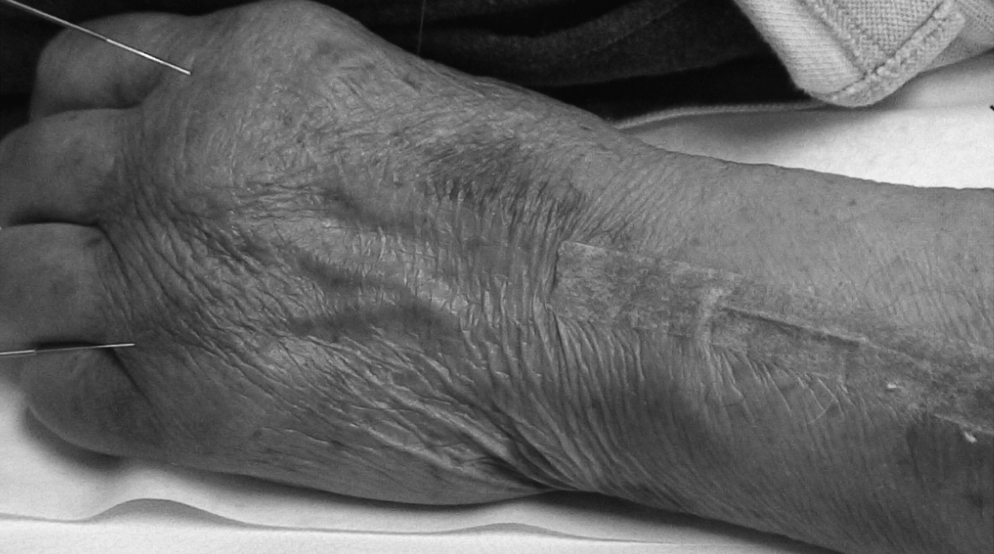
SJ-6 needle retention toward elbow taped for humeral fracture.
Precautions of MCT
MCT is generally a safe practice. However, retained needles may cause discomfort on occasion if not well-placed. Patients should be given a consent form with instructions on how to handle retained needles in the event of a needle becoming bent or stuck. Practitioners should provide emergency contact telephone numbers.
Muscle Channels and Their Indications
The indications of individual muscle channels were adapted from Chapter 13 of Neijing Ling Shu with reference to regional human anatomy. 4 However, many more conditions such as chronic internal diseases and even dermatological ones may also benefit from MCT. As more practitioners start to use MCT, the indication list will certainly expand.
Muscle Channel of the Lung
Lung muscle channel indications include arthritis or tenosynovitis of the thumb, tendonitis of the abductor or flexor pollicis brevis, lateral epicondylitis, bicepital tenosynovitis or tendonitis, and stiff neck.
Muscle Channel of the Pericardium
The flagship indication for the pericardium muscle channel is carpal tunnel syndrome. Other indications that respond to treatment using the pericardium channel include tenosynovitis or arthritis of the middle and ring fingers (trigger fingers), bicepital tenosynovitis or tendonitis, Dupuytren's contracture, chest pain (cardiac or noncardiac), arrhythmias, anxiety attacks, nausea or vomiting, and gastroesophageal reflux.
Muscle Channel of the Heart
Heart muscle channel indications include tendonitis of the flexor palmaris, medial epicondylitis, ulnar nerve dysfunction, central nervous system disorders such as cerebral palsy and seizures, insomnia, palpitations, and attention-deficit/hyperactivity disorder.
Muscle Channel of the Large Intestine
Large intestine muscle channel treats a number of inflammatory conditions of the arm and hand, including tenosynovitis or arthritis of the index finger, tendonitis of the abductor pollicis brevis, bicepital tenosynovitis or tendonitis, supraspinatus tendonitis or tear, lateral epicondylitis, acromio-clavicular separation, Bell palsy, otitis media, and skin diseases such as psoriasis or hives.
Muscle Channel of the San Jiao or Triple Burner
San Jiao muscle channel indications include tendonitis of the extensor digitorum, tricepital tendonitis, tear or tendonitis of teres minor and infraspinatus, lateral epicondylitis, elbow dislocation, olecranon bursitis, migraines, tinnitus, and otitis media.
Muscle Channel of the Small Intestine
Small intestine muscle channel indications include tendonitis of the flexor palmaris, medial epicondylitis, ulnar nerve dysfunction, tendonitis of teres minor, infraspinatus and subscapularis, temporomandibular joint disease, concussion, and vertigo.
Muscle Channel of the Spleen
This foot channel treats the following indications: medial ankle sprain, medial collateral ligament sprain, medial meniscal tear, shin splints, bunions, gout of the great toe and medial knee, prolapsed uterus, hemorrhoids, premenstrual syndrome, and dysmenorrhea.
Muscle Channel of the Kidney
Indications for the kidney muscle channel include Morton neuroma, plantar fasciitis, Achilles tendonitis, medial ankle sprain, calf tear, compartment syndrome, cruciate ligament tear, hamstring tear, spinal disk diseases, and central nervous system diseases such as Parkinson disease and multiple sclerosis.
Muscle Channel of the Liver
Similar to the spleen muscle channel, the liver muscle channel may be used to treat gout, bunions, medial ankle sprains, and medial collateral ligament sprain. Other indications include prolapsed uterus, inguinal hernia, erectile dysfunction, dysmenorrhea, and genital herpes.
Muscle Channel of the Stomach
Stomach muscle channel indications include Morton neuroma, lateral ankle sprain, high ankle sprain, medial collateral ligament sprain, meniscal tear, shin splint, iliopsoas strain, sciatica, prolapsed uterus, inguinal hernia, umbilical hernia, and gastroesophageal reflux.
Muscle Channel of the Gallbladder
Gallbladder muscle channel indications include 4th and 5th metatarsal fracture, lateral ankle sprain, lateral collateral ligament sprain, lateral meniscus tear, sciatica, gallstones, and migraines.
Muscle Channel of the Urinary Bladder
Urinary bladder muscle channel indications include plantar fasciitis, Achilles tendonitis, lateral ankle sprain, calf tear, chronic posterior compartment syndrome, cruciate ligament tear, hamstring tear, sciatica, spinal disk diseases, and central nervous system diseases such as Parkinson disease and multiple sclerosis.
Discussion
MCT provides the practitioner with another acupuncture method to help patients. MCT may be combined with traditional acupuncture points, Tong points, 5 and various movement therapies. Additionally, MCT can be easily integrated with many other physical medicine modalities. Physical and occupational therapists, chiropractors, nurses, dentists, podiatrists, and medical specialists may find MCT to be a beneficial adjunct to their patients' treatments.
Patients with chronic pain conditions may better tolerate therapeutic exercises such as yoga, pilates, Tai Chi, and Qi Gong if MCT is used prior to these activities. Athletic trainers can also collaborate with MCT practitioners to enhance athletes' pain tolerance and performance. In addition, some chiropractors do spinal manipulations under anesthesia. If MCT is combined with such procedures, the need for anesthesia may be decreased or avoided.
Until now, there has not been a universal standard for the frequency and length of needle retention in acupuncture. Furthermore, current research still finds difficulty in differentiating real acupuncture from sham acupuncture.6,7 As a way of resolving these 2 issues, MCT may afford a tentative step toward a standardized acupuncture and sham acupuncture model. Additionally, although MCT is still in its neonatal stage, preliminary clinical observation from this author and other practitioners indicates that it is a relatively effective and safe practice. There is no doubt that MCT will be adopted by more practitioners who focus on pain management and injuries. However, more controlled clinical studies should be done to validate the improved efficacy that may result from longer needle retention.
Conclusions
Traditional Chinese Medicine has always evolved to better serve the changing world. Practitioners today realize that acupuncture has been used to treat many more challenging medical conditions than those listed in Bâi Zhèng Fù (One Hundred Symptoms), and that the places of service such as hospitals and even battlefields are quite different from those in ancient times.1,8 In addition, both practitioners and patients expect acupuncture to work faster and last longer. MCT may help this ancient medicine continue to meet the challenges ahead.
Footnotes
Disclosure Statement
MCT is a service mark registered with the United States Patent and Trademark Office and belongs to Mr Frank He, Sunnyvale, CA. Acupuncture Services, In Class 44 (U.S. CLS. 100 AND 101). First Use 11-15-1998; In Commerce 11-15-1998. Int. Cl.: 44. Prior U.S. Cls: 100 and 101. Registered October 21, 2008. Reg. No. 3,522,348.