




Abstract
Abstract
Background:
Various methods, including those used in nuclear medicine, have been used in attempts to obtain scientific evidence about TCM techniques, including acupuncture and moxibustion. Evaluating the bioavailability of radiopharmaceuticals in rats is one way to determine the effects of stimulating acupuncture points.
Objective:
The aim of this work was to investigate the effects of the stimulation of acupuncture point Taixi (KI 3) on the bioavailability of the radiopharmaceutical technetium-99m methylenediphosphonate (99mTc-MDP) in male Wistar rats.
Subjects:
Ten healthy male Wistar rats were used in this study.
Intervention:
Therats were allocated into two groups, a control group (CG) and a treated group (TG). The TG group of rats was bilaterally stimulated at acupuncture point KI 3 with stainless steel needles. Ocular plexus administration of 99mTc-MDP (7.4 MBq) was carried out 10 minutes after every needle insertionin the rats. After 180 minutes, the animals were rapidly sacrificed, the organs isolated, the radioactivity determined in a well γ counter, and the percentage per gram of tissue of injected dose (%ID/g) was determined.
Results:
According to anunpaired t-test, the %ID/g was significantly decreased (p < 0.05) in the Large Intestine of the rats in the TG (0.167 ± 0.056), compared to the Large Intestine in the CG (0.370 ± 0.142) and in Bones of the TG (0.562 ± 0.054), compared to the CG (0.873 ± 0.282).
Conclusions:
These results may suggest that acupuncture stimulation in the acupoint KI 3 might induce physiological responses capable of altering the bioavailability of the radiopharmaceutical 99mTc-MDP. However, further rigorous experimental studies to examine the effectiveness in either acupuncture points need to be carried out.
Introduction
In Traditional Chinese Medicine (TCM), internal organs (Zang-Fu organs) are divided into three groups: (1) five Zang organs; (2) six Fu organs; and (3) Extraordinary organs. The five Zang organs comprise the Heart (including the Pericardium), Lungs, Spleen, Liver, and Kidneys; their functions are stated mainly to produce and store essence, Qi, Blood, and body fluid. The six Fu organs refer to the Gallbladder, Stomach, Large Intestine, Small Intestine, urinary Bladder and San-Jiao (Tri-Heater or Triple Energizer); their functions are anecdotally cited to receive and digest food, to absorb nutritive substances, and to transmit and excrete waste. The Extraordinary organs are regarded as Extra Fu-organs, including the Brain, Marrow, Bone, Vessels, and Uterus. Testis are considered as Extraordinary organs in male rats instead of the Uterus. However, their functions are similar to those of the Zang organs. 3
The development of experimental models to understand the effect of the acupoints stimulation upon Zang-Fu organs better is worthwhile. Various methods, such as those used in nuclear medicine with clinical or basic approaches, have been utilized to try to obtain scientific evidences about TCM techniques.4–6
Radionuclides, such as technetium-99m (99mTc), are widely used to label molecular and cellular structures (radiopharmaceuticals). 99mTc methylenediphosphonate (99mTc-MDP) has been used in a variety of clinical situations to identify Bone areas, because of the strong affinity this agent's hydroxyapatite crystals present in the mineral phase of the Bone with diphosphonate compounds.7,8 Protocols that evaluate the bioavailability of radiopharmaceuticals in rats have provided a way to investigate the influence of certain synthetic drugs,9,10 natural products, 11 physical exercises,12,13 and stimulation of acupuncture points.14–16
In clinical acupuncture, when acupuncture points are stimulated, several types of reflex responses seem to be evoked, inducing different categories of physiological mechanisms, which include changes in internal organs and tissue activities.17,18 Therefore, it is suggested that acupuncture stimulation would induce responses in organs and tissues.
In an attempt to add to scientific information about acupoint stimulation, an investigation was conducted to determine physiological responses associated with the bioavailability of 99mTc-MDP in Wistar rats, in which the KI 3 (Taixi) point was stimulated.
Materials and Methods
Animals
The experimental design was approved by the ethical committee of the Instituto de Biologia Roberto Alcantara Gomes, Universidade do Estado do Rio de Janeiro, in Brazil, under the guidelines on the use of living animals in scientific investigations. In the project that was approved by this committee, it was determined that that 10 animals would be used in the experiments. In this experimental model, male Wistar rats (N = 10, 3 months old, 389 g ± 18 g), obtained from the Laboratório de Cirurgia Experimental, Universidade do Estado do Rio de Janeiro, Brazil, were used. The animals were maintained under environmental conditions (22 ± 5°C, in12 hours of a light/dark cycle), receiving water and normal diet. Healthy animals were randomly divided into a control group (CG; n = 5) and a treated group (TG; n = 5).
Location of Taixi Acupuncture Point
The description of the location of the Taixi is reported in Zeredo et al, 2007. 19 Taixi is the third point in the Kidney Channel. It is a relatively shallow acupuncture point, located on the medial aspect of the foot. Its innervation is attributed to the medial crural cutaneous nerve, on the course of the tibial nerve.
Experimental Design
All rats were anesthetized by intraperitoneal injection of sodium thiopental 6.7% (Thiopentax,® 60mg/kg), without immobilization to avoid animal stress. Rats in the TG were treated with acupuncture by bilaterally insertion of stainless steel needles (0.25 mm × 20 mm) with guide-tubes (Sterile Acupuncture Needles, Wujiang Shenli Medical & Health Material Co., Ltd., China) into the KI 3 point. The acupuncture point Taixi was transferred to the rat's anatomy, and located according to anatomical landmarks, in the depression between the medial malleolus and the tendon calcaneus (Achilles' tendon). 19 Rats from the CG were not treated.
The radiopharmaceutical 99mTc-MDP (0.3 mL, 7.4 MBq, with a labeling efficiency of 96%) was administered via the ocular plexus, as has been previously reported. 12 Needles were inserted, and 10 minutes later, the needles were withdrawn. After 170 minutes, 8 the animals were sacrificed by exsanguination, as previously published works have delineated, 12 following ethical procedures. Organs and tissues (Pancreas, Spleen, Liver, Lungs, Heart, Stomach, Small Intestine, Large Intestine, Kidneys, Bone, Brain, Testis, Thyroid, and Muscle) of each animal were identified, removed, and isolated. The mass of these organs was determined in an analytic balance (Analytical Electronic Balance-BioPrecisa, model FA2104N) and the 99mTc radioactivity in each organ was determined in a well γ counter (Packard Instrument Company, model C5002). The percentage per gram of tissue of injected dose (%ID/g) of the radiopharmaceutical was determined for each organ. 12
Data analysis
All data were presented as mean ± standard deviation of the ID%/g and an unpaired t-test was performed to compare the CG and and TG. The level of statistical significance was set at p < 0.05. InStat Graphpad software was used to perform statistical analysis (GraphPad InStat version 3.00 for Windows 95, GraphPad Software, San Diego CA).
Results
Figure 1 shows a photograph of a rat with needle insertion in the KI 3 point.
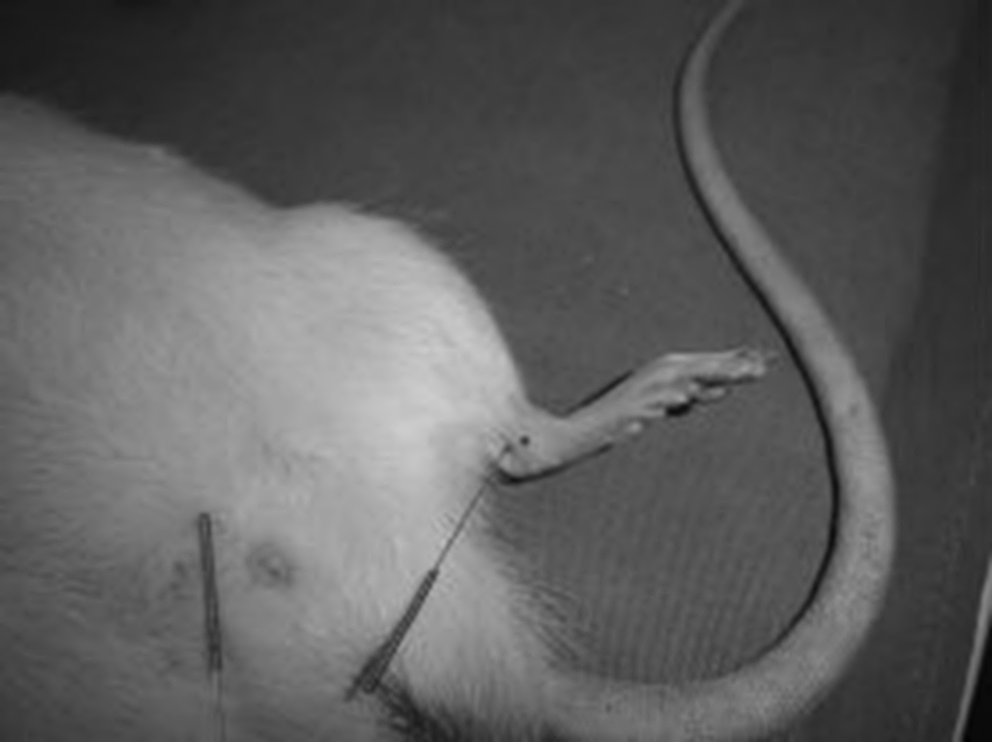
Acupuncture point Taixi (KI 3) with needle inserted in the hind limb of a rat. A detailed anatomical description explaining the exact location of the point is given in the Materials and Methods section of this article.
The 99mTc-MDP bioavailability in all groups of animals was assessed during the study as shown in the flow chart in Figure 2.
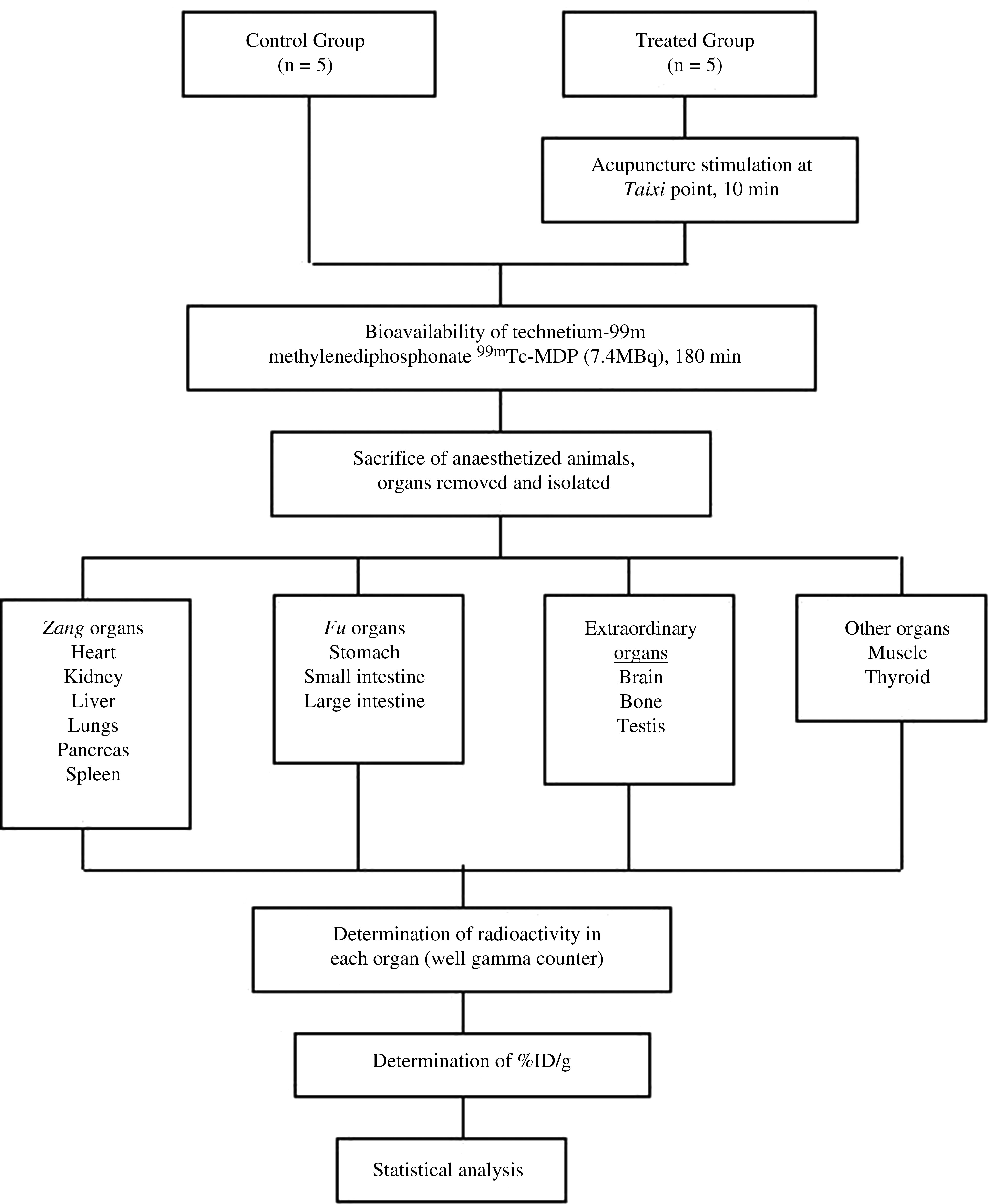
Flow chart showing progression of the study. %ID/g, percentage per gram of tissue of injected dose.
Table 1 shows the %ID/g in the organs considered as Zang in TCM. The stimulation of KI 3 did not significantly (p > 0.05) alter the radioactivity uptake in the Heart, Kidneys, Liver, Lungs, Pancreas, and Spleen.
The %ID/g was compared between control and treated (stimulating KI 3) groups. Statistical analysis was performed (an unpaired t-test, p < 0.05). The values are presented as means ± standard deviation. 99mTc-MDP, technetium-99m-methylenediphosphonate; %ID/g, percentage per gram of tissue of injected dose.
Table 2 shows the %ID/g in some organs considered as Fu in TCM. The stimulation of KI 3 significantly decreased (p < 0.05) the radioactivity uptake in the Large Intestine.
The %ID/g was compared between control and treated (stimulating KI 3) groups. Statistical analysis was performed (an unpaired t-test, p < 0.05). The values are presented as means ± standard deviation. *The difference between the treated and control animals was significant (p < 0.05). The other Fu organs (urinary Bladder, Gallbladder, and Triple Energizer) were not considered in this work. 99mTc-MDP, technetium-99m-methylenediphosphonate; %ID/g, percentage per gram of tissue of injected dose.
Table 3 shows the %ID/g in some organs considered as Extraordinary organs in TCM. The stimulation of KI 3 significantly decreased (p < 0.05) the radioactivity uptake in the Bone.
The %ID/g was compared between control and treated (stimulating KI 3) groups. Statistical analysis was performed (N unpaired t-test, p < 0.05). The values are presented as means ± standard deviation. *The difference between the treated and control animals was significant (p < 0.05). 99mTc-MDP, technetium-99m-methylenediphosphonate; %ID/g, percentage per gram of tissue of injected dose.
Table 4 shows the %ID/g in other organs and tissues. The stimulation of KI 3 did not significantly (p > 0.05) alter the radioactivity uptake in the Thyroid and Muscle.
The %ID/g was compared between control and treated (stimulating KI 3) groups. Statistical analysis was performed (an unpaired t-test, p < 0.05). The values are presented as means ± standard deviation. 99mTc-MDP, technetium-99m-methylenediphosphonate; %ID/g, percentage per gram of tissue of injected dose.
Discussion
The use of experimental models with radionuclide is useful to assess various quantitative scientific information.4,15 Moreover, it is expected that a radiopharmaceutical has specific distribution in organs and tissues. 8 99mTc-MDP is radiopharmaceutical that has been used in nuclear medicine examinations to identify bone areas, due to the strong affinity of the hydroxyapatite crystals present in the mineral phase of the bone with the diphosphonate compounds 8,9, allowing quantitative measurements in bone that reflect blood flow and osteoblastic activity. 20 The differential accumulation of the radiopharmaceutical is related to diseased tissue on the basis of perfusion.21,22 Furthermore, bone scintigraphy with 99mTc-MDP is a proven method in evaluating patients with chronic low back pain, and is useful to identify a broad range of pathologies, including skeletal metastases, fractures, spondylolysis, osteoid osteomas and sacroilitis. 23
Acupuncture stimulation is recommended for treating pain conditions and myofascial pain data, and research may help elucidate the mechanisms of acupuncture's effects. 24 TCM postulates an interaction between the Kidney and the Bone tissue 25 ; and the stimulation of Taixi (KI 3) is used for the treatment of lower back pain.19,26,27 bronchial asthma,28,29 male immune infertility, 30 Sjögren's syndrome, 31 , and the clinical manifestation of darkness under the eyes and facial edema. 32 In animal research, stimulation at the KI 3 point is used to study acupuncture effects on various physiological regulatory mechanisms and on the control of systems changes, including those in Alzheimer's disease 33 and renal blood flow. 34 Moreover, the diagnostic of menopausal bone loss is very commonly attributed to Kidney Qi and a Yin deficiency pattern.30,35 In this study, the KI 3 point was selected to evaluate a possible action on the Bone tissue through the bioavailability of the radiopharmaceutical 99mTc-MDP.
The use of localization and clearance of skeletal-imaging agents, such as 99mTc labeled diphosphonates, 67Ga citrate, and 111In leukocytes, offers sensitive and accurate means to detect occult diseases and investigate skeletal blood flow, metabolism, and pathology.8,9 Kuno and Cerqueira 36 reported a case in which a patient with back pain was given a bone scintigraphy, and the images of the patient's skull showed increased uptake in several regions. Upon questioning, the patient stated that he had received acupuncture treatment for his back pain several times before, in the regions of the increased uptake. They researchers then suggested that acupuncture can cause enhanced bone metabolism, demonstrated by increased activity on bone scintigraphy.
The experimental data in the current study showed that the bioavailability of 99mTc-MDP in the control group (Table 3) is in accordance with data previously published, 10 and analysis of the data suggests that stimulation of the KI 3 point could alter the bioavailability of 99mTc-MDP in the Bone.
Assessment of the bone tissue physiology is provided by studies using 99mTc-MDP. The variety of quantitative indices devised to express skeletal function, reflects a number of factors, which, acting together, may determine the uptake of a bone-seeking radiopharmaceutical in the bound bone compartment. These factors include bone blood flow; surface area of capillaries and their permeability to the diffusion of tracer molecules from plasma into the bone extravascular fluid; the transfer of tracer through the bone extravascular fluid to the sites of mineralization; and the rate of release of the bound tracer from the bone; and its diffusion back into the plasmatic compartment. 20
Moreover, the acupuncture point KI 3 is also used for the treatment of bronchial asthma, 29 which could suggest a possible action of this acupuncture point in the Lungs. TCM postulates an interaction between the Lung as a Yin organ and the Large Intestine as a Yang organ.30,37 According to the principles of TCM and the theory of the Five Elements, any treatment aimed at the Lung, as a Yin organ, also implicates treatment and regulation of the Large Intestine, as the linked Yang organ. 30 In the current bioavailability study, analysis of the experimental data (Table 2) suggests that the stimulation of the KI 3 point was able to alter the bioavailability of 99mTc-MDP in the Large Intestine. Stockert et al. 28 suggested that the interactive treatment of Lung and Large Intestine, according to TCM, by laser acupuncture and probiotics, has a beneficial clinical effect on bronchial hyperreactivity in school-age children with intermittent or mild persistent asthma and might be helpful in the prevention of acute respiratory exacerbations.
Following the concepts of TCM, the current study's findings seem to support some potential therapeutic effects of stimulation of the KI 3 acupoint. These results are strongly relevant, and they are in accordance with previous TCM data.19,28,29 Moreover, the data presented in this work could be also important for avoiding inadequate interpretations of nuclear medicine images of the bone that could lead to misdiagnosis or the necessity to repeat the examination,38,39 increasing the radiation dose to a patient who also undergoes acupuncture.
The mechanisms underlying the physiological consequences of acupuncture stimulation certainly involve a number of different systems. 40 In acupuncture, the absence of a complete and plausible mechanism through which it is possible to understand its clinical effects has sparked some studies.15,16,41–43
Conclusions
Following the concepts of TCM, the current study's results suggest that stimulation with acupuncture of the KI 3 point could induce physiological responses capable of altering the bioavailability of the radiopharmaceutical 99mTc-MDP. According to the current study's data, this experimental model would provide a better understanding of acupuncture and its effects in various organs and tissues.
Footnotes
Acknowledgments
This research was supported by Fundação de Amparo à Pesquisa do Estado do Rio de Janeiro (FAPERJ), Universidade do Estado do Rio de Janeiro, Conselho Nacional de Pesquisa e Desenvolvimento (CNPq).
Disclosure Statement
No competing financial conflicts exist.