




Abstract
Abstract
Background:
The use of acupuncture and other complementary and alternative medicine (CAM) modalities among patients with cancer is increasing. However, there are no recent Australian estimates of the numbers of patients using these therapies.
Objective:
The aim of this research was to explore the use of acupuncture and other CAMs in Australian women with breast cancer.
Design:
The study was a survey.
Setting:
The research took place at medical oncology clinic at the Royal Prince Alfred Hospital, Sydney, New South Wales, Australia.
Patients:
The respondents were 100 women with breast cancer.
Main Outcome Measure:
Prevalence of acupuncture use was examined.
Results:
The prevalence of overall CAM use was 73%, of which 30% was acupuncture use. Of acupuncture users (n=30), 43% had only used acupuncture after their diagnosis; 50% used acupuncture for cancer-related symptoms or treatment-related effects; and 50% for non–cancer related symptoms. The main reason for using acupuncture was to reduce symptoms (67%). The majority of women (77%) had not revealed their acupuncture use to their medical oncologists. Of all respondents (N=100), 71% indicated that they would consider using acupuncture if it was offered free of cost.
Conclusions:
A substantial proportion of patients with breast cancer use acupuncture and other CAMs. Discussion of CAM during medical consultations may contribute to substantial improvements in patient care.
Introduction
The use of acupuncture accounts for a significant proportion of CAM use among patients with cancer, and estimates range from 1.7% to 36.0%.15–17 Emerging evidence from randomized controlled trials has shown that acupuncture can alleviate symptoms and reduce side-effects commonly experienced by patients with cancer during treatment. These results include: effective management of depression, 18 reductions in chemotherapy-induced nausea and vomiting, 19 chemotherapy-related neutropenia, 20 chemotherapy-related hot flushes,21,22 cancer fatigue, 23 pain related to cancer treatment (including joint pain,24,25 and radiation-induced xerostomia), 20 and improvements in overall well-being. 26 It is perhaps not surprising that acupuncture is increasingly being introduced into standard care, as well as being included in a number of oncology clinics and hospices in the United Kingdom 27 and the United States.28–30 The use of acupuncture as part of cancer care is not yet fully recognized in Australia, although most Australian oncology departments now offer counseling and meditation as a part of supportive-care programs. 31
With interest in the role of acupuncture among patients with cancer increasing, information on patient perspectives and characteristics associated with acupuncture use will assist in developing a more comprehensive understanding of the treatment context. Considering the high prevalence of breast cancer among Australian women,1,2 such information is especially necessary for treating patients in this demographic category. However, data on the prevalence of acupuncture use by patients with breast cancer are Australia is minimal, and data concerning patient characteristics associated with the likelihood of its use are virtually absent. The current study was designed to address this paucity of statistics, with emphasis on acupuncture use, prior to conducting an acupuncture clinical trial at a university teaching hospital.
Patients and Methods
Patients and Setting
The survey was conducted in the medical oncology department of the Royal Prince Alfred Hospital, a university teaching hospital in Sydney, New South Wales, Australia, between October 2007 and March 2008. Inclusion criteria were: diagnosis of cancer (at any stage); age of 18 years or older; ability to complete the survey questionnaire; and ability to understand, and willingness to sign, a written consent form.
Procedure
Women with breast cancer attending the medical oncology clinic were invited to participate in the survey. Patients were asked to complete the consent form prior to the questionnaire. Those who chose to respond completed the form in the clinic waiting room and returned it to the clinical nurse, who checked it for missing data and asked for full completion before the patients saw their oncologists.
Ethics approval was obtained from the Human Research Ethics Committees of the Royal Prince Alfred Hospital before commencement of the study. All participants were assured that their participation or nonparticipation would not affect their treatment at the hospital in any way.
Measurement Instruments
To meet the objective of this study, namely, to obtain information about acupuncture and other CAM use in patients with breast cancer, the research team (J.M.B. and R.V.) developed a purpose-designed questionnaire containing questions on 29 items. The first part of the questionnaire elicited demographic information, including age group, education level, primary diagnosis of cancer, extent of the disease, time-lapse since first diagnosis, and what specific cancer treatments had been administered. The questionnaire also included the Eastern Cooperative Oncology Group (ECOG) scale in to assess how the disease affected the patients' daily living. 32 Patients selected from 4 items ranging from 0 (“Fully active, able to carry on all pre-disease performance without restriction”) to 3 (“Capable of only limited selfcare, confined to bed or chair more than 50% of waking hours”).
The next section of the questionnaire required patients to indicate their usage of CAM by selecting from a list of twenty-three CAM therapies. These therapies have been previously indicated as the most common among cancer patients in Australia. 33 If CAM use was indicated, elaboration of specific use in the past 12 months was required. In the case of acupuncture, participants were asked to complete additional items. These related to five broad categories: (1) reason(s) for use; (2) personal experience of use; (3) patients' perception of the safety and value of acupuncture in general; (4) whether patients discussed their use of acupuncture with their medical professionals; and (5) whether patients would be more willing to accept acupuncture should it be offered in conjunction with standard cancer treatment.
Data Analysis
The sample size of 100 participants was chosen for convenience. Categorical variables were summarized in frequencies and percentages. Chi-square statistics were used to explore the differences in demographic and clinical characteristics between users and nonusers of acupuncture. A two-sided P-value of<0.05 was considered statistically significant. All analyses were carried out using the Statistical Package for Social Science program (version 15).
Results
One hundred women with breast cancer completed all questions in the survey. See Table 1 for a summary of patient characteristics. The majority (97%) had early stage breast cancer. Eighty-two percent of participants were 18–64 years old, with the greatest proportion of participants (44%) between ages 50 and 64. The majority of women reported achieving either secondary (42%) or tertiary (52%) education. All patients had received a primary diagnosis of breast cancer. The time-lapse since the diagnoses ranged from<12 months to>5 years, with 47% of participants being diagnosed between 12 months to 5 years previously. As indicated by results from the ECOG scale, more than half of participants (52%) reported that they were “very active” and not at all limited by their illness. Treatment of their breast cancer included surgery (96%), chemotherapy (86%), radiotherapy (68%), hormonal therapy (50%), palliative care (3%), and other treatment (4%).
Eastern Cooperative Oncology Group (ECOG) scales:
0—Very active, not limited at all.
1—Somewhat limited with slight symptoms.
2—Significantly limited, but bed rest less than half the day.
Seventy-three percent of respondents reported use of CAM. The most commonly used therapies were vitamins (n=38, 52%); massage (n=35, 48%); acupuncture (n=30, 41%); special exercises, such as yoga, t'ai chi, qigong, and martial arts (n=24, 33%); and herbal medicine (n=22, 30%).
After performing Chi-square analyses, it was noted that acupuncture users and nonacupuncture users did not differ significantly in terms of age, ethnicity, education level, time-lapse from inception of diagnosis, level of activity (ECOG scale), treatment received, whether it had met their needs, or whether the patients' outlook had changed since diagnosis (P>0.05).
A summary of the use and perspectives with respect to acupuncture among the participants is provided in Table 2. The main reason for commencing use was expressed as “I thought it would be interesting” (n=19, 63%). The frequency of acupuncture treatment sessions ranged from one to more than ten treatments, with nearly half of patients (n=14, 46%) receiving more than ten treatments.
Respondents were allowed to answer more than one item.
The most-frequent expectations of acupuncture use were reduction of symptoms (n=20, 67%) and complementing the effects of current medical treatment (n=12, 40%). See Figure 1.
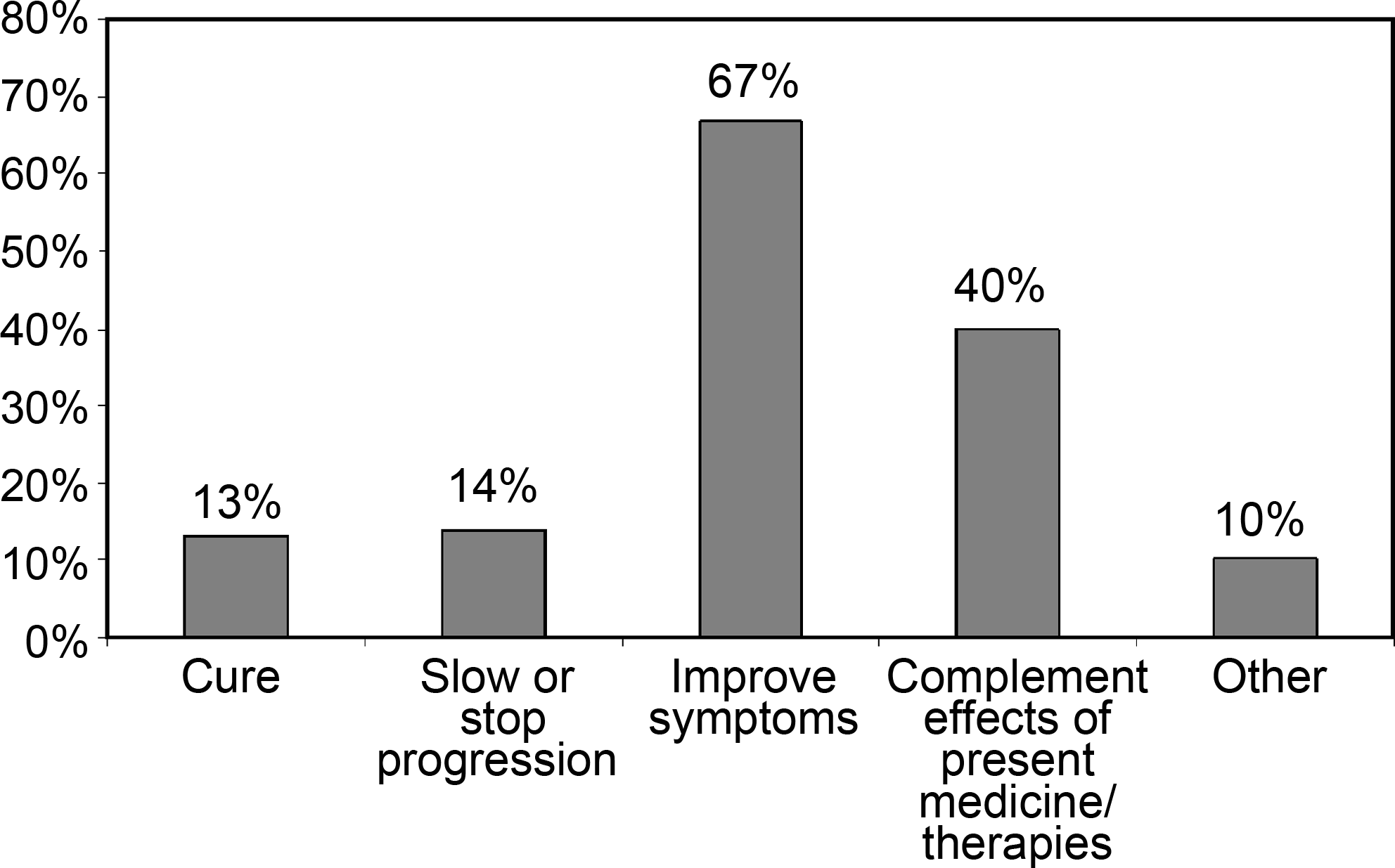
Expectations regarding use of acupuncture.
The majority of acupuncture users (n=21, 70%) believed that they had obtained enough information about the efficacy and safety of acupuncture before they started acupuncture treatment. Thirteen (43%) began receiving acupuncture following diagnosis of cancer, with 36% (n=5) indicating that they did so for cancer-related problems, 7% (n=1) for chemotherapy-related problems, 7% (n=1) for radiotherapy-related problems, and 50% (n=7) for other problems. Nineteen (63%) of the 30 patients who received acupuncture treatment responded that they believed the acupuncture to be effective, while 9 patients (30%) indicated that it was difficult to judge the efficacy of acupuncture and 2 patients (7%) responded that they believed that acupuncture was not effective. Most women had never received chemotherapy and acupuncture at the same time (n=26, 87%). The majority of users (n=28, 93%) did not experience side-effects; however, 1 patient reported experiencing side-effects and another patient reported that it was “difficult to judge the side-effects” of acupuncture.
Of all 100 participants, 71 indicated that they would consider having acupuncture in conjunction with their treatments for cancer if this treatment were offered to them free of cost (Table 2).
Table 3 presents information regarding disclosure of acupuncture use to medical professionals. The majority of acupuncture users did not reveal their usage to their medical oncologists (77%) or other medical professionals (nurses/pharmacists/paramedical staff members) (93%). The main reason given for nondisclosure was: “My doctor has never asked me about CAM use” (68%). The primary outcome resulting from disclosure was that the medical oncologist or other medical professional encouraged the patient to continue use (62%).
Respondents were allowed to answer more than one item.
Discussion
This study presents evidence to suggest that a substantial proportion of Australian patients with breast cancer use acupuncture and other CAM therapies. While this finding is generally consistent with what has been found in previous studies,5,17,34 the prevalence of acupuncture use was considerably higher compared to patients with cancer overall and the general Australian public.33,35,36 This is probably the result of a gender effect, because females have been shown to use CAM therapies more frequently, compared to males. 37
This study found no significant difference between acupuncture users and non–acupuncture users in terms of demographic, disease, and treatment characteristics, including age, ethnicity, education level, time-lapse following diagnosis, and treatment satisfaction. Contrary to these findings, previous CAM studies have reported that younger age and higher education level are significant predictors of CAM use.13,38 It is possible that the increasing body of evidence supporting the efficacy of acupuncture has reduced common doubts and hesitations regarding its efficacy, thereby leading to more widespread and indiscriminate use. Providing some support for this view, the current study found that the main reasons for acupuncture use included perceptions of the efficacy of acupuncture and that the most important expectation regarding use of acupuncture was symptom control.
A notable proportion of acupuncture users indicated that their expectation of using acupuncture was a hope for a cure. This finding is alarming in terms of indicating a considerable overestimation of the benefits of acupuncture, because there is no evidence of a cancer cure resulting from acupuncture treatment. It is possible that patients interpreted “cure” as “extension of survival period,” as found in the current authors' previous study. 33 That previous study's results revealed that incentive for the use of biological CAM and nonbiological CAM was different; the main reason for use of biological CAM was to extend the period of survival (45%), while the motivation for use of nonbiological CAM, like acupuncture, was to improve quality of life (53%). 33 Thus, the finding regarding acupuncture users' expectations may reflect a difference in the reasons for CAM use depending on the specific type of therapy. To clarify this issue, it would be of value to conduct a similar survey across a variety of CAM therapies and to examine the motivation for, and expectation of, the use of each independent CAM therapy.
Less than 25% of patients disclosed their acupuncture use to their oncologists. This is a considerably lower proportion, compared to previous studies, in which approximately half of the patients using CAM discussed their use with their conventional physicians.17,39,40 However, in accordance with other studies, in the current study, a common reason was given for nondisclosure was that these patients' doctors never asked about the patients' use of CAM.41,42 Patients using acupuncture may have thought it would not interact with their standard medical treatment, as acupuncture is generally not perceived to be a biologically active treatment.
Once usage of acupuncture was discussed, most patients perceived their oncologists as supportive of its use, and none were perceived as being unsupportive. This is surprising, considering that previous studies have found that doctors predominantly ignore disclosure of CAM use or attempt to dissuade patients from continuing use. 43 It may be that the patients held an erroneous perspective. A previous study reported that patients' interpretation about the “consent” or “recommendation” regarding the use of CAM was at times quite different from the doctors' intent. 44 Alternatively, the context in which the current study was situated may have biased the results. The hospital currently offers meditation, art therapy, and counseling as part of the cancer-supportive program. This undoubtedly would contribute to, and validate, patients' perspectives of mostly positive endorsements of CAM use by their oncologists.
Importantly, the majority of acupuncture users found the efficacy of acupuncture for symptom and side-effect management to be high, with only a small minority indicating “no benefits.” Furthermore, most acupuncture users indicated that they experienced no side-effects from acupuncture. These findings reflect those from previous studies, in which women with breast cancer reported high satisfaction levels with CAM use.5,45
Also of interest is that the majority of patients indicated that they would consider having acupuncture in conjunction with their cancer treatment if acupuncture were offered free of cost. This may be indicative of patients seeking an alternative to the standard medical options currently available for relieving treatment-related side effects. Indeed, a previous study revealed that a common reason for the use of CAM among patients with cancer was to satisfy needs unmet by conventional medicine and doctors. 36
Despite the significance of the findings, the current study had several limitations. Perhaps most obvious is the restriction of the sampling to a single institution. This is not only problematic because of the hospital's atypical endorsement of alternative therapies but also because there is evidence to suggest that use of acupuncture and other CAM varies, depending on geographical location (urban versus rural) and cultural background of the population.6,46 The sample for the current study was predominantly from the Sydney area and of Caucasian background. Therefore, to improve generalizability of results, it would be constructive to conduct a similar survey across a variety of geographic locations and cultural and ethnic groups.
In addition, given that a validated acupuncture and another CAM questionnaire were not available to assess CAM use and perceptions among patients with cancer, it was necessary to develop a questionnaire specifically for this study. Consequently, the questionnaire administered to patients may have limited the accuracy of the current study's findings in addition to limiting the depth of interpretation. For example, considering that the presence of anxiety, depression, greater severity of symptoms, and fear of cancer recurrence have been associated with higher rates of acupuncture and other CAM utilization,20,47,48 it may be worthwhile for future studies to collect data on the nature and severity of symptoms, fear of cancer recurrence, and presence of anxiety and depression.
Notwithstanding these limitations, the current study also had a number of strengths. To the authors' knowledge, this is the first study to evaluate the prevalence of acupuncture use by women with breast cancer in Australia. As such, the findings provide critical information on the current treatment context in which the use of CAM in addition to conventional treatment is becoming more apparent.
Conclusions
The current study's finding of a high prevalence of acupuncture and other CAM use among patients with breast cancer further emphasizes the need for health care providers to inquire about CAM use during consultations with patients. Consequently, it is vital for oncologists to be aware of the benefits of the various CAM modalities in order to provide appropriate support and management for maximum patient well-being. Further research investigating the safety and efficacy of CAM for patients with cancer would assist in formulating an evidence-based structure for discussion of CAM during the consultation.
Footnotes
Acknowlegments
This study was funded by the South West Area Health Services, in New South Wales, Australia.
Disclosure Statment
No competing financial interests exist.