




Abstract
Abstract
Background:
Physicians and scientists strive for evidence-based acupuncture study, but this is not a simple task. There are many issues that arise when integrating acupuncture into practice and research. This is because research often does not demonstrate well-defined concepts of the role of acupuncture. Many studies also have virtually no diagnostic and therapeutic methods based on standardized principles and theories. Therefore, many controversies regarding the efficacy of acupuncture have been raised in the literature, which has caused confusion.
Objective:
This review highlights the importance of well-interpreted principles and theories that could be possible solutions for these issues. The circulation of Blood should be at the core of acupuncture study.
Methods:
The definition and roles of acupuncture and its principles and theories were investigated. Korean Hand Acupuncture Therapy (Koryo Hand Therapy, KHT), using thermography, transcranial Doppler imaging, and functional magnetic resonance imaging were studied. Anterior and posterior blood circulation of the brain were explored to discover the mechanisms underlying KHT.
Conclusions:
It is essential to investigate acupuncture closely, using scientific methods, to learn how and where it has been used so that this discipline can be integrated into modern medical treatment.
Introduction
It is not easy to translate the meaning of acupuncture concepts into modern scientific concepts. The contents of original acupuncture texts were written in ancient Chinese. Therefore, it is not easy to define the meaning of concepts using modern scientific terms. It is also hard to find accurately translated literature to aid understanding of the concepts used in the Classics. Author, Park had an interest in this matter from 1968; however, Park found it extremely difficult to find solutions to these issues. Since 1982 Park has exchanged ideas with author Yoo and started to understand the concept of acupuncture related texts and acupuncture in general. Through these opportunities and accumulated knowledge Park began researching into how Korean Hand Acupuncture Therapy (Koryo Hand Therapy; KHT) can be applied to modern medicine. From 1978 to 2010, twenty Korean and Japanese KHT symposiums have been held. These provided opportunities for Park to meet many medical practitioners who were also researching KHT. Through this, and through research on KHT published by Western scholars, Park realized that KHT could be applied easily into clinical practice settings by Western medical practitioners and researchers.3–7 There are many medical practitioners who are hesitant to apply traditional acupuncture in a clinical setting even though they have undergone extensive acupuncture training, whereas KHT is easy to learn and apply in a clinical setting with minimal side-effects.
There is a lot of research that investigates acupuncture in practice; however, acupuncture's significance has been widely criticized. There is variation in efficacy shown in research on acupuncture for headaches and other conditions.8–12 This highlights many issues regarding theories, diagnosis, treatment, and practice methods that need solutions, which should be the foundation of acupuncture research (see Box 1).
Issues In Acupuncture Research
Much acupuncture research contains insufficiently detailed explanations of the principles of diagnosis and treatment. In a scenario where diagnosis and treatment based on acupuncture theories has not been established, determination of the effect of acupuncture is of little importance. Use of Western medical diagnostic methods can be an issue in a domain where acupuncture theories are different from those found in Western medicine.
Box 1. Issues for Acupuncture Application
Definition of acupuncture
Role of acupuncture
Principles and theories of acupuncture
Diagnosis and treatment
• Diagnostic problems: No standardized form • Therapeutic problems: No standardized methods
Evaluation problems
• No standardized protocol
The objective basis for the location of acupuncture points, methods of insertion, and insertion times is insufficient. In situations when these have not been established, problems arise concerning how to judge real, sham, and placebo acupuncture. A research article was published that shocked many people when the authors claimed that there was a correlation between acupuncture points and corresponding brain cortices; however this article was withdrawn after the hypothesis of this research was found to be incorrect. 13 Recently, a review article argued that some acupuncture–functional magnetic resonance (fMRI) studies have not adopted all methodological standards applied to most other fMRI studies. 14
Insertion of acupuncture needles by hand can cause pain for a patient. To avoid this, some institutes used electric and laser acupuncture in clinics and research. These institutes published research claiming that laser acupuncture was more effective than hand-inserted acupuncture. However, there is insufficient research into issues regarding the use of electric and laser acupuncture.15,16
Ideally, the participants in an acupuncture trial should not be exposed to side-effects or danger. However, research on the side-effects of acupuncture is currently insufficient.17,18 To begin with, the materials that comprise acupuncture needles mentioned in original texts and how these needles were made should be researched more extensively. Today, stainless steel is one of the materials used to make acupuncture needles. The potential existence of poisonous elements in these modern needles needs to be examined more fully. There are reports that rust-free lead, nickel, chrome, manganese, phosphorus, mercury, and cadmium are used to make acupuncture needles. Even acupuncture needles made of plastic are used, but there is no research into their side-effects. 19
Many Western practitioners use acupuncture mainly for pain management. It is questionable how to approach diagnosis and treatment for various conditions when pain management is not an issue. The uses for acupuncture that medical acupuncturists suggest are health promotion, disease prevention, and disease treatment. If medical acupuncturists only use this modality for pain management, it would be difficult to suggest practical acupuncture application guidelines relating to health promotion or disease prevention. In this respect, research up to the present time is insufficient for revealing the potential for expanded roles of acupuncture by Western practitioners. In scenarios where the theory of acupuncture has not been established, Western scholars have been researching the hypothesis that acupuncture and the nervous system are closely related. However, it is not easy to investigate objectively how acupuncture works. Recently, studies on how acupuncture affects the brain were published.20–24 Uchida et al. and Litscher mainly examined the change of cerebral vessels and peripheral vessels using various medical devices over a long period.25,26
Acupuncture Research Methods
Observing the change of blood flow based on the original texts of acupuncture and moxibustion should be the foundation of acupuncture research. To research acupuncture, clarification of what the roles and theories of acupuncture are and establishment of diagnostic and treatment methods are needed; based on this, it is very important to clarify underlying mechanisms. If these basic issues are not dealt with, it will be very difficult to incorporate acupuncture into evidence-based modern medicine. The basic content of literature published on acupuncture differs greatly, leading to more confusion.
In The Yellow Emperor's Inner Canon, the original text of acupuncture, the roles of acupuncture were recorded as follows:
Huangdi said to Qibo: “I, the emperor of the people, receive revenues of rents and taxes to nourish the hundred families, but I am grieved by not being able to provide for those afflicted with disease. I wish they did not have to endure the poison of medicines and the use of stone probes. I prefer to use those fine needles which penetrate the channels, harmonize (control) the blood and qi, manage the current and countercurrents, and assemble the exits and entrances. Please unravel this for future generations and enlighten them in the proper methods so this therapy will not be destroyed or severed for eons. See that it is easy to use, difficult to forget, a classical record. Delineate the process, clarify the extrinsic and the intrinsic, and define an end and a beginning. Please formalize the reality of each item. Begin with the fundamentals of classical acupuncture. I wish to hear of these essentials.” Qibo answered saying, “In accordance with your imperial request, I relate the following: You wish to have the principles and records. To begin with the first, there are a total of nine needles and principles of their way. The principles of using these fine needles are easy to say but difficult to master. Ordinary skills of acupuncture maintain the physical body; high skills maintain the spirit, use spirit to reveal the spirit and the guest at the door. Without careful observation of the disease how can there be an understanding of its origin?”
27
Described in simple terms, “inserting minute acupuncture needles in certain areas called meridians controls blood and qi.” Through this sentence, the authors understood that one could control changes of visible blood flow and invisible energy flow by inserting minute acupuncture needles at acupuncture points on the meridians. Undertaking a close examination of the meaning of the terms mentioned here is the essence of acupuncture research. Identifying such issues and explaining acupuncture research using KHT could help Western medicine practitioners understand the theoretical foundation of acupuncture more deeply.
Roles and Theories
The roles of acupuncture include controlling bodily physiology, visible changes of blood flow, invisible Qi flow, the balance of the five solid and six hollow organs, and normalizing imbalances. To do so, it is very important to understand the concept of Yin and Yang and the five solid and six hollow organs in acupuncture theory (see Box 2).
KHT is a new therapy researched and developed by Yoo, in 1971–1975, who established 14 micro-meridians and 403 acupoints on the hands. Just as there are 12 meridians on both sides of the body, there are micro-meridians on both sides of the hands. In KHT, the relationship of Yin and Yang suggests a phenomenon like a seesaw effect between two factors that are different in properties. KHT theory also argues that, of the internal organs, ones with shape are called solid organs, and ones shaped like a sack that can transform shape are called hollow organs. KHT also theorizes that solid organs correspond to Yin and hollow organs correspond to Yang.28–30
KHT argues that the theory that solid organs and hollow organs function together at the same time is wrong (as in the case of Liver and Gallbladder Excess or Liver and Gallbladder Deficiency in Traditional Chinese Medicine [TCM]). Because solid organs and hollow organs are considered to be in opposition, their functions cannot be either or both Excess or Deficient at the same time. In TCM, theorizing that both the Liver and Gallbladder are Excess means that the function of both the Liver and Gallbladder is Excess. If the Liver and Gallbladder are Deficient, then the function of both the of these organs is Deficient. This does not fit the KHT theory of Yin and Yang. It means that the twelve pairs of meridians circulate on the right and left sides of the body. However, the connection of the right and left meridians is not considered in TCM.
Box 2. Roles of Acupuncture: From Pain and Disease to Health
Balance Yin and Yang
Balance solid organs and hollow organs
Balance of five elements or five phases
Acupuncture and health
Acupuncture and pain and disease
Health and cerebral blood flow
Pain and disease and cerebral blood flow
Acupuncture and cerebral blood flow
Acupuncture and nervous system, immune system, and endocrine system
KHT theorizes that the functions of the left and right meridians are different. In a case when the function of the left and right meridians are mutually opposite—such as when the Liver and Gallbladder are Excess—this means that the function of one side of the Liver meridian is Excess and the function of the Gallbladder meridian on the same side is Deficient. Furthermore, the function of the Liver meridian on the other side is Deficient and the function of the Gallbladder on the other side is Excess. If the Liver and Gallbladder are Deficient, this means the function of one side of the Liver meridian is deficient and the function of the Gallbladder meridian on the same side is Excess. Still, furthermore, the function of the Liver meridian on the other side is Excess and the function of the Gallbladder on the other side is deficient. In this case, it is theorized that Excess or Deficiency of the left and right side should be identified; however, the absence of this concept leads to misdiagnosis. The current authors have noticed that cases of left and right organ functions being in opposition occur very frequently.
In a healthy state, the Liver and Gallbladder maintain a balance with each other, but if an abnormality in physiology arises, for example, if the Liver function is Excess, the Gallbladder function will be Deficient; conversely, if the Gallbladder function is Excess, the Liver function will be Deficient. If the function of both of these organs are Excess, the treatment method will be completely different. This causes issues in diagnosis and treatment.
The Yin and Yang in KHT theory is that, if the Liver function is Excess, the Gallbladder function cannot be Excess, and, conversely, if the Gallbladder function is Excess, the Liver function cannot be Excess. If Western medical practitioners also understood this, they could develop new treatment principles for liver diseases. If they treat liver diseases based on the diagnosis of Excess Liver function, these practitioners would not only reduce the Liver but also tonify the function of the Gallbladder, which is in a paired relationship with the Liver. Liver function would be normalized, resulting in a new breakthrough in treatment methods being developed.
The KHT theory of five solid and six hollow organs is even more profound. Currently, KHT does not use terms such as “generating” and “controlling cycle,” which are presently used in TCM. Instead of these, terms such as “five flowing,” “mutual generation,” and “mutual controlling” are used. The KHT theory is that, if physiological dysfunction in solid and hollow organs arises, this leads to disorder in the paired (Yin and Yang) organs, for example, Liver and Gallbladder, Heart and Small Intestine, Spleen and Stomach, Lung and Large Intestine, and Kidney and Bladder. Furthermore, according to certain rules, this affects all five solid and six hollow organs.
If there is disorder in the Liver and Gallbladder, two scenarios are possible: (1) the Liver function is Excess and the Gallbladder function is Deficient or (2) the Gallbladder function is Excess and the Liver function is Deficient. If the Liver function is Excess, the Gallbladder function will be Deficient; furthermore the neighboring Kidney function will be Excess, the Bladder function will be Deficient, the Heart function will be Excess, the Small Intestine function will be Deficient (this is different from existing inter-generating relationships). An Excess Liver controls the function of the Spleen and Lung, according to the Yin and Yang relationship. A Deficient Spleen and Lung, respectively, increases the function of the Stomach and Large intestine (this is different from existing inter-controlling relationships and counter-controlling relationships). In conclusion, when the roles and theories of acupuncture are established, accurate diagnosis is possible. Furthermore treatment based upon this diagnosis can be undertaken (Fig. 1).
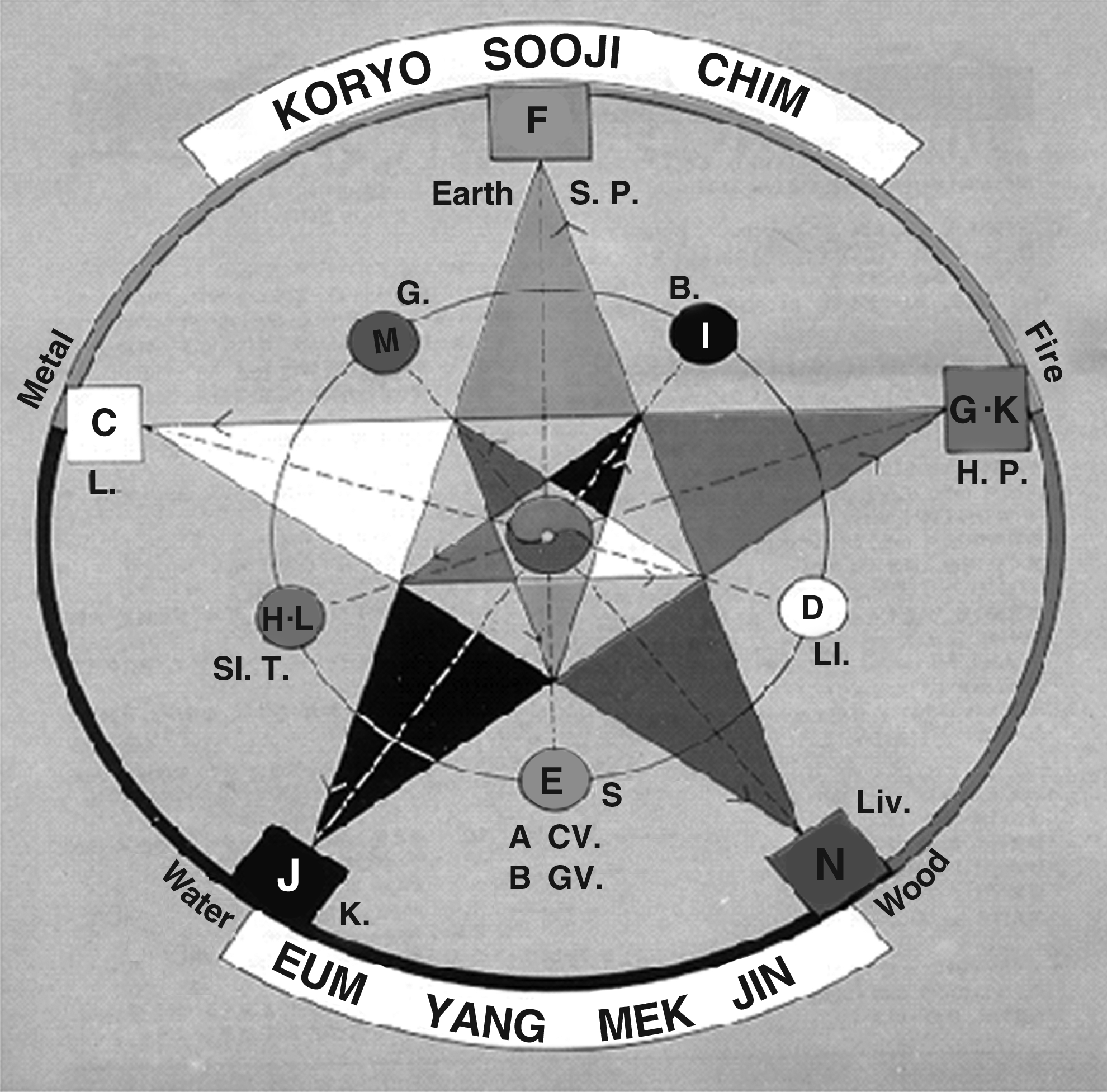
Relationships between Yin (Eum) and Yang; Liver and Gallbladder; Heart and Small Intestine (Pericardium and Triple Warmer; Spleen and Stomach; Lung and Large Intestine; and Kidney and Bladder, and correlation of five elements of Liver, Heart, Spleen, Lung and Kidney or Gallbladder, Small Intestine, Stomach, Large Intestine, and Bladder. 28
Issues In Diagnosis
There are various issues relating to diagnosis. Four diagnostic methods—observation, questioning, listening, and palpating the patient—are basic methods in both TCM and Western medicine. These methods are the key to successful TCM diagnosis, but the authors question the diagnostic accuracy of these methods. This is because the objectivity of these methods has not been established and each practitioner who puts them into practice makes a different diagnosis. It is difficult to expect a positive therapeutic effect to occur from an incorrect diagnosis. The presently used four diagnostic methods are not objectively standardized, especially in diagnosis prior to acupuncture treatment. In these circumstances this issue cannot be overcome. The use of medical devices developed in Western medicine cannot increase diagnostic accuracy in TCM. The various diagnostic methods in KHT are more objective, standardized and easier to apply in clinical practice than traditional acupuncture systems (see Box 3).
Pulse diagnosis is a very important diagnostic method for acupuncture. There are various kinds of pulse taking recorded in texts such as The Yellow Emperor's Inner Canon, 27 but they are not often easy to learn and apply in a clinical setting. The authors have failed to find any pulse taking that has been standardized objectively. However, in KHT, comparison between carotid and radial arteries (Yin–Yang Pulse Diagnosis) was systematized for use in a clinical setting. KHT pulse taking is based upon the theory that, through comparing the carotid artery on the neck and the radial artery on the wrist, the relationship of Yin and Yang and abnormalities of the five solid and six hollow organs can be diagnosed. Comparison pulse taking was mentioned in The Yellow Emperor's Inner Cannon 27 mainly in Lingshu chapter 9 Zhongshi, but the true meaning of this has not been understood correctly for a long time and therefore has not been widely used. In KHT, the theory of pulse taking was established and used as the foundation of all diagnosis. Pulse diagnosis is important for revealing the theories and roles of acupuncture and for highlighting the direction of scientific and objective acupuncture research. The authors failed to find any other practitioners that use systematic pulse diagnosis, such as KHT Yin–Yang Pulse Diagnosis, as a diagnostic method. The aim of acupuncture is to harmonize Yin and Yang and the five solid and six hollow organs, but disregarding the pulse is incorrect when one strives to understand acupuncture.26–29 Comparison pulse taking is the cardinal point in highlighting not only the relationship between Yin and Yang but also the relationships of the five solid and six hollow organs. If acupuncture can control Yin and Yang, the balance of the five solid and six hollow organs, restore health, and promote health, acupuncture can be the key to solving health problems. On the basis of this accurate diagnosis, one can decide a course of treatment. Because, when a disorder of the five solid and six hollow organs is identified, correcting this is the treatment goal. There are various ways to undertake treatment based on evidence-based diagnosis. If the diagnosis is accurate, various treatment methods can be used; however the authors have noticed that many medical practitioners diagnose their patients based on their complaints and treat these patients based on this. In fact, there are many issues in diagnosis. Furthermore, various issues in inadequate diagnosis have not been resolved yet.
Box 3. Diagnostic Methods in Korean Hand Acupuncture Therapy
Corresponding points
Abdominal diagnosis
Three Constitution (Sam III Che Jil)
Five Finger diagnosis
Yin–Yang Pulse diagnosis
Pendulum diagnosis
Acubeam diagnosis (electric beam)
Biorhythmic Diagnosis
In KHT, various kinds of equipment have been developed and used to increase the efficacy and convenience of acupuncture practice. Equipment other than needles is widely used during a KHT treatment. Although this variety of instruments is used, they are all based on the same underlying principles. The method of using this variety of instruments is called Seo Guem Therapy (SGT). If more practitioners knew how to obtain the same effect as needles without causing patients the pain associated with using needles, there is a high probability that these practitioners would do. SGT could replace use of needles and be very effective in a clinical setting.
Treatment
To give a standardized treatment, it is vital to confirm the diagnosis, decide the location of the patient's complaints, and differentiate the condition of the solid and hollow organs involved. Then, an appropriate treatment, such as a corresponding or micro-meridian treatment, depending on the condition can be given. If there is pain in a part of the body, the part should be located accurately. When the pain site is irregular and numerous, as occurs in many cases, it is not always easy to locate the accurate site. However, this can easily be confirmed through the use of KHT corresponding areas. According to KHT theories, abnormal body conditions and diseases stem from unbalanced Blood flow. Stimulation by acupuncture can control the balance of internal organs related to the pain site. Objective research based on this can be undertaken in KHT, because the diagnosis and treatment methods are standardized and various kinds of equipment are used.28–30 (See Box 4.)
For example it is often very difficult to specify the location of a headache site when taking of medical history. This can cause unsatisfactory results in diagnosis and treatment. Therefore, acupuncture treatment focusing on only the specific area where the patient complained of pain is often not accurate or effective. Thus, an accurate diagnosis is most important. After the pain site is located accurately and confirmed, the organs related to the pain should be identified. It is very important to examine how the symptoms of many patients are related to their solid and hollow organs, but it is difficult to examine that relationship in depth, so, often, this relationship is ignored. Thus, it can be said that Western medical treatment today often resides within the category of symptomatic treatment. Above all, it is important to identify the relationship between symptoms and solid and hollow organs through diagnostic methods such as pulse diagnosis.
Box 4. Therapeutic Strategies in Korean Hand Acupuncture Therapy
Depends on accurate diagnosis
Which location (side and site)
Which organs involved
Basic treatment
Corresponding therapy
Micromeridian therapy
Five Phase therapy
Combined therapy
Discussion
If acupuncture research is approached based on the theories discussed earlier, a more suitable direction for acupuncture research can be undertaken. It is the authors' opinion that, on the basis of this, investigating the harmony of Yin and Yang and the five solid and six hollow organs with visible changes in blood flow could be a possible foundation for acupuncture research.
The main theories of KHT are Correspondence Theory and 14 Micro-Meridians Theory. Correspondence Theory theorizes that the hands are a micro-reflex zone for the whole body. The 14 Micro-Meridians Theory theorizes that there are 14 micro-meridians of the five solid and six hollow organs, Conception Vessel and Governing Vessel, and 403 acupuncture points on each hand. In KHT both hands can be used for treatment based on the Correspondence Theory. This is one of the most important theories in KHT. It theorizes that an abnormal finding in a part of the body appears as an abnormal condition on a certain area of the hands. Based on this theory, Yoo developed and compiled KHT acupuncture points and micromeridians (Fig. 2).
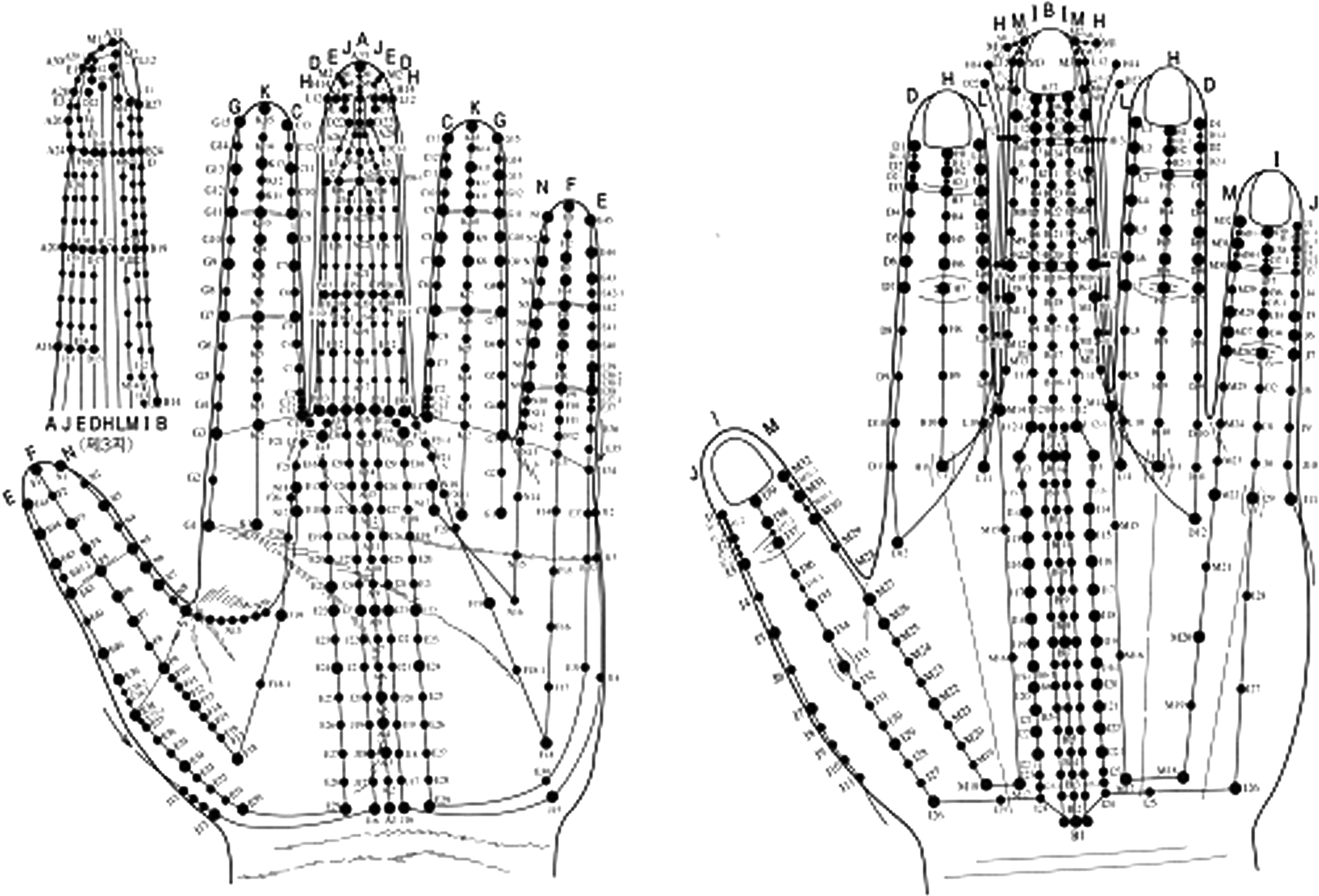
Korean Hand Acupuncture Therapy points and micromeridians. There are 14 micromeridians and 403 acupuncture points on the hand. 29
The authors confirmed through the use of a thermograph that A28 and A24 on the hands correspond to the nose (CV 25) and the neck (CV 22) and F19 on the hands corresponds to Sp 19. After placing dry ice on the right hand F19 right and left, corresponding part relationships were confirmed by observing temperature changes on the right Sp 19. Yasmiso's research also showed that stimulation of KHT acupuncture points causes temperature changes in the corresponding body part. Relieving pain using KHT Correspondence Theory is a new concept that medical practitioners could use effectively in a clinical setting.31,32 (See Box 5.)
Recently, transcranial sonography has started to be used in research into cerebral blood flow and acupuncture. Experimental animals have also been used in research on cerebral blood flow and acupuncture. Recent research on the changes of the body from acupuncture stimulation mainly reported changes in the middle cerebral, temporal, and ophthalmic arteries. According to this research, the velocity of blood flow in the middle cerebral artery increased, but there was no explanation of why such a change occurred.33,34
Box 5. Advantages of Korean Hand Acupuncture Therapy
Well-defined theories and principles
Newly developed method in Korea
Scientific evidence and study possible
Various methods in KHT a
Education and practice
Teaching, learning, and practice
KHT has the following benefits:
Effective Safe Simple Easy to use Easy to learn, teach, and practice Cost effective
Because many acupuncture theories are vague, issues arise in analyzing results from various methods of research. Because the link between acupuncture and cerebral blood flow has not been established, a thorough investigation into this cannot be undertaken; much research confirms only that acupuncture stimulation can cause changes in the velocity of the blood flow in of vessels.
The authors researched the relationship between KHT corresponding areas and micro-meridians. Experiments on corresponding areas were confirmed through thermography. The changes of carotid, vertebral. and radial arteries were confirmed through transcranial sonography. The changes in both sides in the carotid and vertebral arteries were investigated through the use of fMRI. It was revealed that KHT corresponding areas correlated to particular body parts. This research also highlighted how acupuncture stimulation affects the carotid, vertebral, and radial arteries. Use of cerebral blood flow measurements clarified the importance of pulse diagnosis. Checking the changes of anterior and posterior cerebral blood flow through the use of fMRI clarified a co-relationship between the anterior and posterior blood vessels.35–38 (See Fig. 3.)
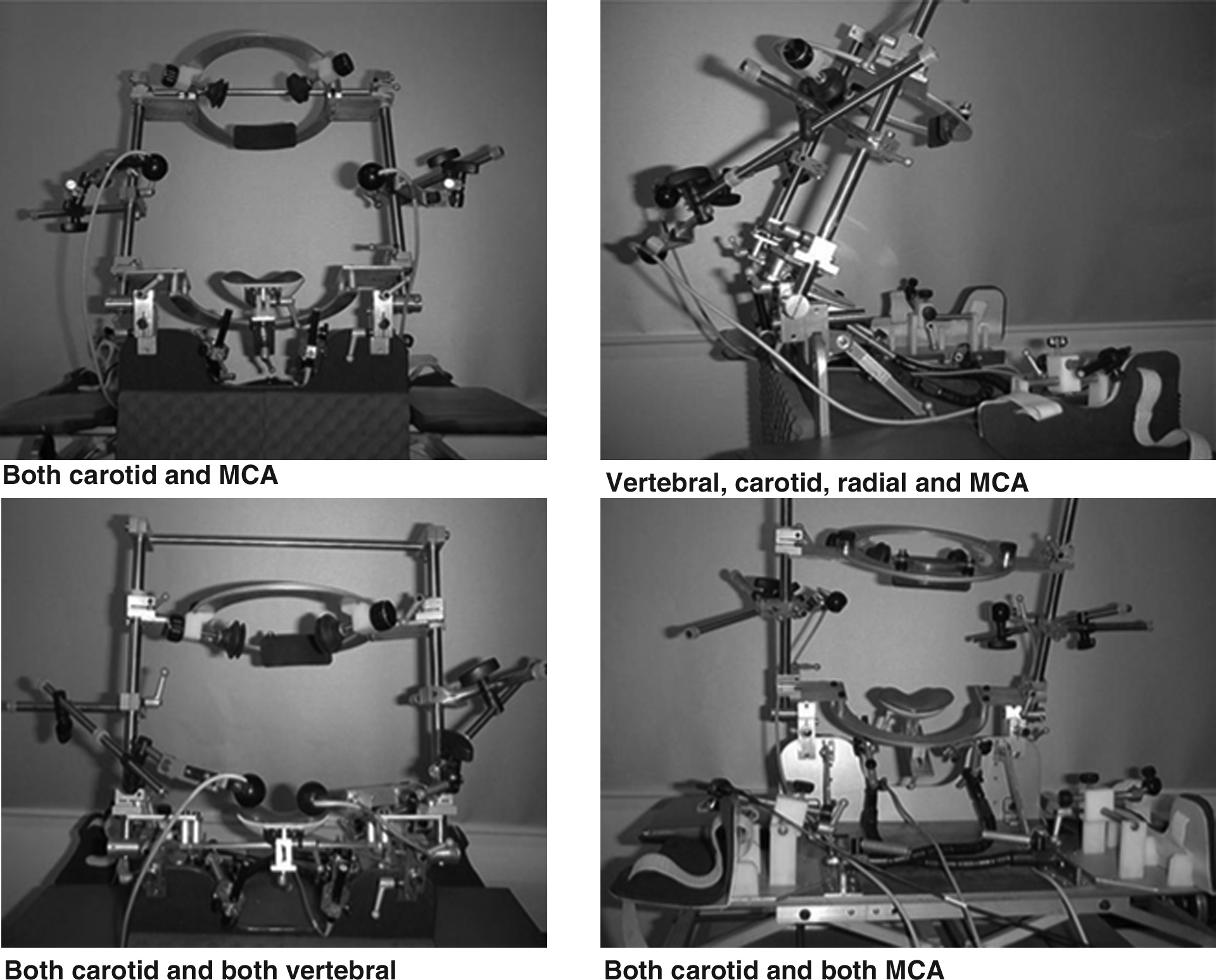
The new hold frame was designed to check the blood flow velocities in several arteries continuously and simultaneously. 37 (Handok Medical Company)
The author researched KHT based on comparison pulse diagnosis. The condition of harmony and disharmony of Yin and Yang and the five solid and six hollow organs was confirmed through transcranial Doppler (TCD) imaging and fMRI. A main theory of SGT classifies cerebral blood flow volume and disease in the solid and hollow organs. Applying this theory, a practitioner can stimulate corresponding areas and micro-meridians, control cerebral blood flow volume, and enable the brain to regulate disease within the body.
KHT can be used to differentiate cerebral blood flow volume and control it (Fig. 4). The corresponding KHT point of the carotid artery is E8, the corresponding KHT point of the vertebral artery is I2. E8 is located on the middle section of the palmar side of the middle finger (corresponding to the middle part of the neck where the carotid artery is divided into the internal and external branches). I2 corresponds to the place where the vertebral artery enters into the cerebrum and is located on the tip section of the dorsal side of the middle finger. Use of a multidirectional TCD developed by the authors can measure various arteries, such as the carotid, vertebral and radial arteries, concurrently and continually. The research conducted by the authors confirmed that the blood flow changes from KHT stimulation are not as simple as previously reported but are varied and complex. The research also revealed a correlation between the blood flow of the carotid and vertebral arteries in healthy and diseased states. 38 Revealing a correlation of the changes of carotid, vertebral, and radial arteries using a TCD also confirmed the importance of pulse diagnosis.

Axial magnetic resonance (MR) image of the neck at the level of cervical 4th spine with a fast low-angle shot sequence. Flow-compensated image is shown in
KHT has many advantages in acupuncture research (Box 5). It is very effective, easy to learn and practice, virtually free from side-effects, and almost painless during the 1–2-mm insertion of needles. The size of the acupressure discs used in the authors' research were only 1–2 mm; these discs were also very convenient to use and easily adhered to the skin with an adhesive. KHT not only includes advanced and modified theories but also objectifies the reproduction of research through use of the 14 Micro-meridians based on corresponding areas. Various stimulation methods used in KHT could be used as powerful alternatives to other traditional acupuncture stimulation methods. In KHT, changes in internal organs can be observed through various changes on the hands and fingers. KHT theorizes that stimulation of the hands and fingers affects the body parts and internal organs that correspond to the stimulated areas of the hands and fingers. This occurs through changes in cerebral blood flow. It has been theorized that a correlation between KHT stimulation and changes in cerebral blood flow suggests a scientific model of acupuncture research based on standardized acupuncture theories.
Recording the changes in cerebral blood flow in future acupuncture research would coincide with principles found in original acupuncture texts such as The Yellow Emperor's Inner Canon. 27 The foundation of acupuncture research should be based on the content described in such texts. If issues that result from research cannot be explained scientifically, it will be difficult for acupuncture to be a part of mainstream modern medicine. Therefore, research should be based on verified theories. It is the authors' opinion that acupuncture research based on cerebral blood flow will clarify the interrelations among neural activation, neurotransmitters, endorphins, neural immunity, and neural hormones. 39
In the future, it is believed that, if further research on various diseases is undertaken using advanced medical devices, subtle changes in intracranial blood vessels, fundamentally attributable to the carotid and vertebral arteries, will be observed. By undertaking further research on cerebral flow with the application of advanced medical technologies, the minute changes of cerebral flow from disease or pain may be observed. Furthermore, it is theorized that the relationship between the activation of nerve cells, and the changes of neurotransmitters and endocrine function could be revealed. It is the authors' opinion that the function of acupuncture is to stimulate and control these changes.
Conclusions
To incorporate acupuncture, with its long history, into modern medicine, close investigation needs to be made into how and where acupuncture has been used until now, and issues raised need to be resolved through use of scientific methods.
The principles and theories of acupuncture that have been neglected up to now should be clarified, and the correct research direction undertaken based on this should be established. Based on this, objective and standardized diagnosis is possible and standardized treatment principles and methods can be established.
The time may come when the mechanisms underlying acupuncture are understood through the use of scientific methods, advanced medical technology and equipment.
Footnotes
Acknowledgments
This study was supported by a Pusan National University Research Grant and the Pusan National University Hospital 2010/11.
The authors would also like to express their appreciation to Nataly Baik, BSc (Hons), for her help in translating this article into English.
Disclosure Statement
No competing financial interests exist.
a
Korean Hand Acupuncture Therapy is also known as Koryo Hand Therapy (KHT).