




Abstract
Abstract
Background:
In recent years, both the Department of Defense (DoD) and Department of Veterans Affairs (VA) have begun to turn to complementary and integrative medicine (CIM) therapies to help address chronic physical (pain) and psychological (post-traumatic stress disorder, anxiety, depression) conditions. One of the most prominent CIM therapies for these conditions is acupuncture. While there has been considerable acupuncture research performed in civilian populations, the level of research conducted within military and veteran populations is unclear.
Objective:
The main objectives of this review were to survey the number of published acupuncture studies in military and veteran populations and to assess and summarize the quality of the included studies.
Design:
A Rapid Evidence Assessment of the Literature (REAL©) was conducted to identify, assess, and characterize published studies of acupuncture among military and veteran populations (from inception until March 2011).
Results:
A total of 340 citations were reviewed. Studies that met the criteria for inclusion were evaluated for study quality and bias using the Scottish Intercollegiate Guidelines Network 50 (SIGN 50) checklist for randomized controlled trials (RCTs). Only 2 RCTs that fit the inclusion criteria were found and were able to be assessed using the SIGN quality scoring tool.
Conclusions:
This review shows that, although there have been several studies examining acupuncture efficacy and effectiveness in a military and/or veteran population, only one of the published studies had a sound methodological design. At present, there is a paucity of acupuncture research in military and veteran populations.
Introduction
Acupuncture research in the civilian population is considerable. The research has evaluated the safety, efficacy, and effectiveness of acupuncture for a broad spectrum of both physiological and psychological ailments. Acupuncture has demonstrated effectiveness for a number of pain conditions2–8 and has begun to show potential for addressing psychological conditions.9–11
Within the military and veteran medical systems, acupuncture use is on the rise. There have also been numerous articles in military and civilian publications detailing increased acupuncture use in military medicine.12–16 While this information highlights an increase in acupuncture use, it is unclear if these increases are appropriately supported by the current level of evidence for acupuncture use in these populations.
To date, there have been no systematic reviews examining the quantity and quality of acupuncture research available in military and veteran populations. The purposes of this Rapid Evidence Assessment of the Literature (REAL©) were to: (1) survey the number of published acupuncture studies in military and veteran populations available in the literature; (2) assess and summarize the quality of the included studies according to strict methodological criteria; (3) evaluate the evidence for effectiveness of acupuncture in military and veteran populations based on published studies; and (4) highlight the unique medical challenges associated with these populations.
Methods
A REAL was conducted to identify, assess, and characterize published studies of acupuncture among military populations. The REAL approach differs from a conventional systematic literature review in that a REAL provides an evidence-based, systematic “snapshot” of the available literature; this method is not intended to be as comprehensive or exhaustive as a systematic review; however, the conclusions of a REAL are comparable to that of a systematic review. The REAL, developed by the Samueli Institute, Alexandria, VA, requires expertise in literature searching, as well as in grading and synthesis of scientific evidence. REAL literature reviews can be performed within a short timeframe and in a specialty area of medicine/wellness/health promotion or human performance.
The following databases were searched from inception until March 2011: PubMed, EMBASE, CINAHL, PsychINFO, all of the Cochrane evidence-based medicine databases, U.S. Department of Defense (DoD) databases, and the DoD BioMedical Research Database. In addition clinicaltrials.gov was searched to identify ongoing trials, and a hand search of this journal, which is not indexed in MEDLINE,® was performed. Medical Acupuncture has published studies of acupuncture conducted by military medicine clinicians and researchers.
The initial search terms used were
Inclusion/Exclusion Criteria
Articles were included if they met the following criteria: (1) population involving military and veteran personnel; (2) the intervention being acupuncture; (3) a control intervention being assessed in comparison to acupuncture (for the RCTs captured); and (4) the study design being a formal scientific study design (RCT, controlled clinical trial [CCT], descriptive study [Des], observational study [Obs], or mixed methods approach). There were no systematic reviews or meta-analyses that met the inclusion criteria for this study.
Articles were excluded from this REAL if: (1) the population was not military-specific; (2) none of the interventions met the current authors' definition of acupuncture; or (3) the report was an editorial opinion, narrative review, or thought piece not considered to be in a formal scientific study design.
Three investigators (Cindy Crawford, Alexandra York, and Avi Walter) independently screened titles and abstracts for relevance based on the inclusion criteria for this REAL. All articles deemed relevant were pulled and screened further for eligibility, and the RCTs were assessed for quality. Any disagreements about including a study were resolved through discussion and consensus or by a fourth subject matter expert (Remy Coeytaux).
Quality Rating of Included RCT Studies
Methodological quality of the included studies that met the criteria for RCTs was assessed independently by 3 reviewers (Cindy Crawford, Alexandra York, and Avi Walter) for the individual studies. These individual studies were evaluated for study quality and bias using the Scottish Intercollegiate Guidelines Network 50 (SIGN 50) checklist for RCTs. 17 SIGN 50 is an internationally developed, validated, reliable, and accepted assessment approach widely used for both conventional and complementary medicine research. Once the quality assessment of the individual studies is completed, it is customary in a REAL for 2 subject matter experts to conduct a quality assessment of the overall literature pool for each condition using the Grading of Recommendations Assessment, Development and Evaluation (GRADE) looking at: the (1) confidence in the estimate of the effect size; the (2) magnitude of the effect; (3) safety grade; and (4) strength of the recommendation. 18 GRADE is also an internationally accepted approach for quality assessment of literature sets. All screeners and reviewers were trained in the methodology and were able to attain a consistent Kappa above 90%.
Data extraction was also conducted on population, condition being studied, type of acupuncture, sample entered, sample completed, power calculation, dropout percentages in each group, description of the intervention, what the control was, what the relevant outcomes were, what the p-values associated with those outcomes were, whether there was an effect size reported, what that was, what were the authors' main conclusions, if there were any adverse effects reported, and a description of those if mentioned for all RCTs. For studies that met other formal study designs, the studies were described in a narrative by the authors.
Results
The search yielded a total of 340 citations from database inception to March 2011. Of these, only 2 were RCTs that fit the inclusion criteria and were able to be assessed using the SIGN quality scoring tool.19,20 There were 2 observational studies21,22 specifically conducted in a military or Veteran's Affairs (VA) population and 4 descriptive studies23–26 that fit the inclusion criteria—the results of which are described (Fig. 1).
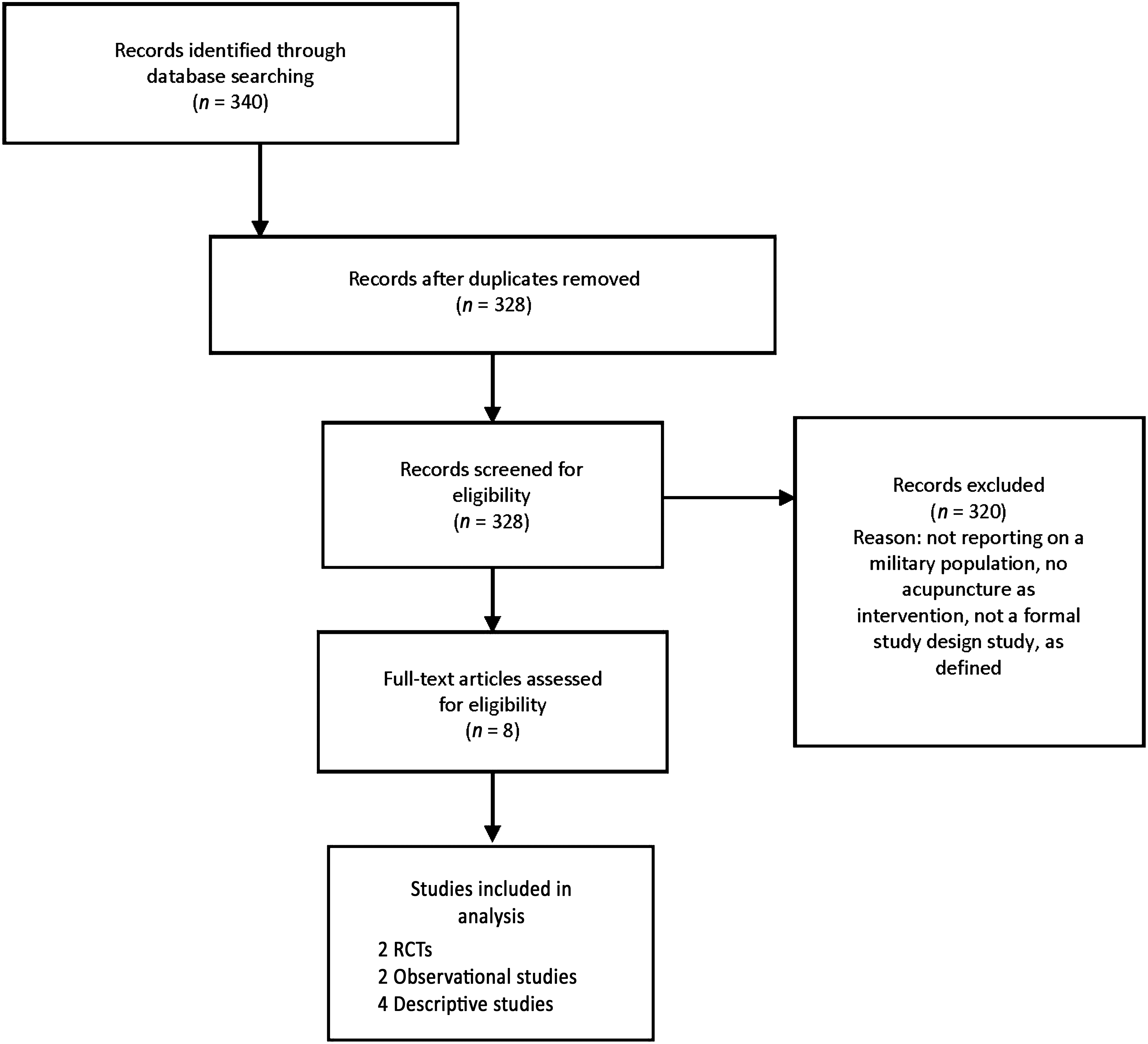
Flow of studies diagram.
RCTs
The first RCT was a pilot study conducted by Goertz et al. 19 that took place in the emergency room of a Military Treatment Facility (MTF). Eighty-seven active duty military personnel and dependents with acute pain were randomized to either a standard emergency medical care group or an auricular acupuncture plus standard emergency medical care group. Only the research coordinator (assessor of outcomes) and emergency room personnel were blinded to which treatment groups the participants were placed in. This was accomplished by placing an adhesive bandage over the auricular acupuncture points on the ears of both participants randomized to standard care alone (and those in the auricular acupuncture plus standard care group). Those randomized to receive auricular acupuncture in addition to standard care experienced a 23% reduction in pain prior to leaving the emergency room whereas reported pain in the standard care group remained unchanged. Within 24 hours, both groups experienced similar reductions in pain.
The second RCT was a single-blinded study to determine if auricular acupuncture could help reduce cravings, increase treatment retention, and prevent relapse in 36 cocaine-dependent inpatient veterans. No significant difference between the treatment and control groups was observed. Otto et al. 20 did, however, note that patients randomized to the acupuncture group tended to remain in treatment longer than a retrospectively analyzed group who did not receive acupuncture.
The two RCTs assessed using SIGN individual quality criteria are shown in Table 1. The descriptive data captured on these studies are shown in Table 2. According to the SIGN criteria, Goertz et al. 19 received a “+” indicating that some of the criteria had been fulfilled and that those criteria that were not fulfilled or were not adequately described were thought unlikely to alter the conclusions. Otto et al. 20 received a “–” indicating that few or no criteria were fulfilled and that the conclusions of the study were thought likely or very likely not to stand if those criteria were met. Given that the included RCT's involved only two conditions in the two studies, it was decided not to conduct a GRADE assessment of the overall literature pool, but this article describes briefly what it would have looked like. If the two studies had been grouped together, the current authors would not have been truly able to comment on the confidence in the estimate of the effect, because the Goertz et al. study 19 showed a short-term effect, but the Otto et al. study 20 failed to show any effect. The magnitude of the effect for the Goertz et al. study 19 was large for the short-term effect but small for long-term effect. The Otto et al. study 20 did not report on any effects. Neither study reported on adverse effects at all.
A=Adequately Addressed; W=Well Covered; P=Poorly Addressed; NA=Not Applicable.
SIGN 50, Scottish Intercollegiate Guidelines Network 50; RCT, randomized controlled trial.
Power calculation NOT done and achieved.
RCT, randamized controlled trial; ER, emergency room; VA, Veterans Affairs; T, treatment; C, control; SCL-90, symptom checklist 90; d, Cohen's d (effect size estimate).
Non-RCTs
There were two Obs studies21,22 and four Des studies23–26 that did not meet the criteria for inclusion into the REAL analysis (i.e., the studies were non-RCTs), but are worth noting as these studies did examine acupuncture in a military or veteran population. An outcomes study evaluating the effectiveness of a standardized acupuncture treatment to reduce chronic daily headache observed a reduction in the frequency and intensity of participants' headaches. The beneficial therapeutic effects were sustained at 12 weeks after the last treatment. 22 A retrospective analysis of a previous study was conducted to determine CIM use among members of the US military. There were approximately 90,000 participants, of whom 1.4% reported utilizing acupuncture within the last 12 months. 21
A survey to determine the use of six common complementary and integrative medicine (CIM) treatments (dietary supplements, massage therapy, chiropractic care, herbs, acupuncture and homeopathy) was administered to Boston area veterans receiving care at oncology and pain clinics. Five hundred veterans were surveyed, and 264 responded with no significant difference in responses between oncology and pain patients. Of these respondents, 27.3% utilized one of the six CIM modalities listed in the survey, and the majority had been using CIM for 2 years, with 35% reporting satisfaction with their treatments. Approximately 10% used acupuncture. 24
In a case report chronicling the care of a 50-year-old naval veteran of the Canadian Forces experiencing chronic knee and back pain, acupuncture is only mentioned as part of the care the veteran was receiving prior to seeing a new physician and is not discussed further. 26 In another case report, a British general practice physician in the Royal Army Medical Corps describes the first hundred cases that he managed since receiving medical acupuncture training. The overall observation was quantified via qualitative post-treatment questions after each treatment, and duration and extent data were collected prior to the subsequent treatments. One hundred patients were treated and the overall conclusion was that acupuncture showed benefit for a number of chronic conditions that seemed resistant to more conventional approaches.
Finally, Japan Air Self Defense Force F-15 pilots were surveyed regarding their musculoskeletal problems, how symptoms affect flight duty performance, and how effective they deemed muscle training as a preventive measure against the high-gravity forces they experience. Acupuncture was mentioned as one of the methods pilots preferred for managing their pain. 23
Discussion
The goal of this review was to survey, assess, summarize, and evaluate the effectiveness of acupuncture research within military populations. This review shows that, although there have been several studies examining acupuncture efficacy and effectiveness in a military and/or veteran population, only 1 of the published studies had a sound methodological design. 19 The remaining studies were not rigorous investigations of acupuncture and tended only to capture descriptive and anecdotal evidence for acupuncture use in these populations.
Even though the current evidence base for acupuncture use in these populations is sparse, there are indications that research is mounting. A quick search of the clinicaltrails.gov database returns a dozen open/active trials examining acupuncture in a military or veteran population. The studies vary in scale and examine acupuncture for treating a wide range of conditions—sleep, quality of life (QoL), sore throat, gastroesophageal reflux disease (GERD), Gulf War Illness, and acute pain. Also, while this review was limited to indexed studies, the authors are familiar with a number of other studies (either not published in an indexed journal or yet to be published) in which acupuncture was evaluated in active duty populations.
In 2005, an Obs study evaluated the only acupuncture clinic in the military located in Malcolm Grow Medical Center on Andrews Air Force Base, Maryland. 27 The study evaluated the benefits of acupuncture for acute and chronic pain in active duty military members, dependents, and retirees. One hundred and eight patients participated, and pain, QoL, and patient satisfaction were assessed. At the end of 4 weeks, patients reported significant reduction of their pain and their QoL scores were improved. One item to note is that this study did not use one particular acupuncture method. Instead, the study used a variety of acupuncture methods administered for various acute and chronic pain conditions. This research, paired with Goertz et al., 19 has led to the development of a study to evaluate the feasibility of integrating a simple ear acupuncture procedure into the aeromedical evacuation system from Ramstein Air Base in Germany to Andrews Air Force Base. This study began recruitment in early 2011.
There has also been significant acupuncture research activity at Walter Reed Army Medical Center (WRAMC). In 2006 a pilot study by Penhollow et al. (and subsequently presented at a conference in 2007) showed the feasibility of treating phantom-limb pain (PLP) with acupuncture, and yielded promising preliminary data. 28 Nineteen patients with 24 major limb amputations were randomized into one of three acupuncture treatments: Chinese Scalp Acupuncture; French Auricular Acupuncture; or a combination of Chinese Scalp and Auricular Acupuncture. Treatments were administered twice a week for 5 weeks, and all patients reported a significant reduction in PLP (p<0.005) at 2 weeks post-treatment. It should be noted that there was no control group in this study. More recently, a case report detailed the use of both laser and traditional metal needles at ear acupuncture points for the alleviation of PLP. The 25-year-old male military amputee reported immediate pain relief with both the laser and needle ear acupuncture. His pain relief lasted approximately 4 hours after the administration of laser ear acupuncture and, with the needle ear acupuncture, his pain relief was sustained into the following day. 29
In addition to PLP, an RCT evaluated acupuncture for post-traumatic stress disorder (PTSD) in service members in 2006, the results of which were presented at a symposium in 2008. 30 Service members were randomized to either acupuncture plus usual care or usual care alone. Assessments took place at baseline, 1 month post-treatment, and at 2 and 3 months postrandomization. This is the first study to examine acupuncture for PTSD in an active duty military population.
At the beginning of 2011, an exploratory, randomized study to examine the effectiveness of acupuncture for traumatic brain injury (TBI) related headache in an active duty population began at WRAMC. The study design is unique in that it will compare a standardized ear acupuncture technique (developed by a medical acupuncturist) to an individualized semi-standardized acupuncture protocol (developed by a licensed acupuncturist and psychiatrist), to usual care. While the primary outcome measure of the study is headache, other secondary outcome measures will be evaluated. The potency for this study is reported elsewhere in this issue of the journal. All of these recently completed and ongoing studies indicate that the evaluation of acupuncture in military and veteran settings is growing.
Even with the recent and ongoing research, a significant gap between how acupuncture is currently being utilized in both military and veteran populations and the amount of acupuncture research that has actually taken place still exists. As with any approach to health and acupuncture, for it to be maximally effective, it should be evaluated not only for the condition it seeks to correct, but also in the population in which the condition exists. How a condition manifests, which approaches are maximally effective, and which approaches are deemed acceptable are all affected by the characteristics of the population in question.
The focus of future acupuncture research efforts in military and veteran populations should follow guidance from the policymakers and clinicians serving these populations. Recent findings from both the U.S. Army Surgeon General's Pain Task Force (PTF) and the joint workshop between the Department of Defense (DoD) and National Institutes of Health (NIH) regarding acupuncture for pain, provide a way forward.
Both the PTF report and information from the NIH/DoD conference highlight not only the need for more research but a need for research that is pragmatic. The magnitude of injuries, both physical and psychological, is significant, and the subsequent chronic conditions on the horizon for these populations is formidable. Currently, pain and PTSD are two of the most prevalent conditions facing military and veteran populations. 31 Both conditions are particularly challenging to conventional medical methods and could benefit from pragmatic effectiveness data on acupuncture. These conditions are no longer viewed as stand-alone conditions to be treated separately and apart from other physical and psychological ailments.
Acupuncture could potentially be a tool that weaves conventional and healing models together. However, there has not been enough acupuncture research within the military and veteran populations to discern the extent to which acupuncture can be used for these populations. Acupuncture research in the civilian realm has provided the justification for the integration of acupuncture into medical treatment, particularly for pain, but before acupuncture use can be expanded more research needs to occur in those settings.
This review is limited by the possibility that relevant articles were not identified by our search strategy and the REAL approach. We did not search systematically the gray literature. Potentially informative research that was reported only at scientific meetings; or published only in abstract form or published in nonindexed journals were not identified, with the exception of the unpublished studies summarized above that the authors were aware of.
Conclusions
At present, there is a paucity of acupuncture research in military and veteran populations. While numerous studies have evaluated the effectiveness of acupuncture for a variety of conditions within civilian populations, very few have been done in the military and veteran settings. The extent to which acupuncture, as an integrative approach, can affect these conditions requires further investigation. Finally, in addition to utilizing the guidance provided by policy makers, more research on how acupuncture is currently being utilized in these populations should be conducted to also ensure that future research designs will actually answer the relevant questions the military medical community needs about acupuncture before widespread use.
Footnotes
Acknowledgments
The authors would like to thank Jarrad Davis, BA, for assistance in preparation of the manuscript.
Disclosure Statement
No financial conflicts exist.