




Abstract
Abstract
Used for more than 2000 years in China, acupuncture is a mature but still-advancing field. The Chinese military trains its doctors to use acupuncture to prevent and treat illness as well as to treat injuries. Non-medical soldiers are trained too, to use acupuncture and related techniques in the prevention and treatment of illness within their barracks. In addition, the Chinese have trained military personnel from other countries to use acupuncture. The Chinese military also is involved in acupuncture research and academic exchanges that advance the use of acupuncture. Chinese medicine generally and acupuncture specifically also are important components of illness prevention programs for Chinese military veterans.
Introduction
Because acupuncture is simple, effective, and easy to master for military doctors, it is very useful for treating the common conditions among officers and soldiers at the grassroots level. In military medicine in China, as a result, acupuncture is highly valued. In recent years, under the unified arrangements of the Health Branch of the People Liberation Army (PLA) General Logistics Department, and with the active involvement of acupuncture professionals, there has been established a mature training system, a large-scale clinical application, a stable acupuncture research system, and a complete system of preventive and health care by means of acupuncture.
Acupuncture Training in Military Medicine
Acupuncture training in military medicine is made up of national training programs and international training programs (Fig. 1). The inside training programs consist of popular courses for grassroots practitioners and the continuing education of professionals. Up to now, there has been a mature system of acupuncture training in military medicine in China. With the support of the Department of Traditional Chinese Medicine and use of acupuncture in large military hospitals, training bases of different sizes have been established to provide simple acupuncture-skill training programs for front-line acupuncture doctors (usually lieutenants) in each military region. These training programs are designed to enable attendees to master several basic skills for treating common conditions. For example, by means of such basic skills as cupping, moxibustion, scraping, massage, and simple acupuncture, such conditions as colds, low-back pain, and soft-tissue disorders will be effectively treated in a timely fashion. By intervening in the early stage of the conditions, acupuncture will prevent the progression of their development, and will promote recovery, thus helping reduce the evacuation and attrition of military personnel affected by such conditions.
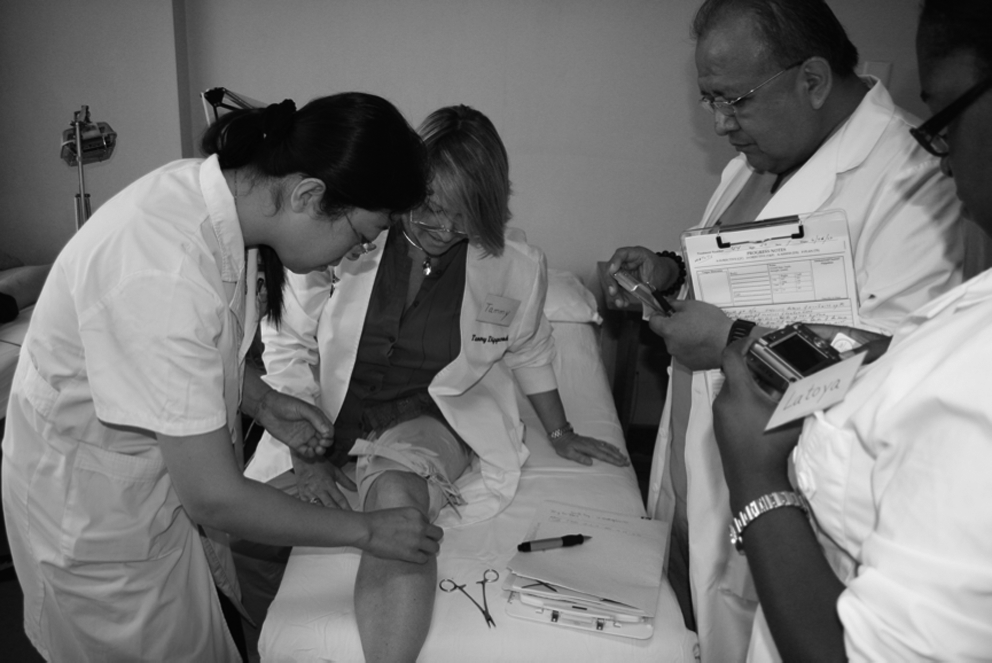
Foreign student training.
Organized by the Committee of Acupuncture under the Society of Traditional Chinese Medical Professionals in PLA, regular training programs for acupuncture doctors from the hospitals and clinics of every military region are mainly designed to teach the latest skills and practices. In recent years, for instance, there have been training programs on how to manage floating acupuncture pain, perform long round circular-needle therapy, eye acupuncture, and balance acupuncture treatment for exercise-induced fatigue. The purpose of these training programs is to improve the skill levels of clinical acupuncture physicians, teach these physicians how to treat some complicated conditions among military officers and soldiers, and enable acupuncture to serve as a complement to conventional medicine and play an alternative role in the treatment of some chronic refractory conditions. Having taught tens of thousands of trainees for quite a few years in the past, these programs have constituted the basis for the wide application of acupuncture at the grassroots level.
In the international training program, the Traditional Chinese Medicine Department of the Second Military Medical University (SMMU) is the basis of Chinese medicine education for foreign military students. Since its establishment in 2004, the Traditional Chinese Medicine Department has taken “building the first-class training base for foreign students, and promoting Traditional Chinese Medicine” as the overall objective of its international training program. Addressing the academic background and working environment of foreign students; and according to the principles of practicality, innovation, and attention to quality and functions, The Practical Course of Traditional Chinese Medicine for International Students has been edited to systematically and pertinently illustrate the elementary theories and clinical practice of TCM as well as clinical treatment using acupuncture and massage therapy in TCM. Besides establishing a training room and a specimen room for TCM, the SMMU has also founded two clinical training bases: Changhai Hospital and Changzheng Hospital.
Invited by the 31st International Military Medicine Conference, the SMMU hosted the first “International Training Course on Practical Techniques of Acupuncture” in September 1998, with the attendance of 19 senior military doctors from 13 countries such as Germany, France, and Japan. Thereafter, the SMMU held another 8 training classes for 102 foreign military students in Chinese acupuncture and massage from 41 countries. By spreading our traditional acupuncture and promoting our exchange with foreign military doctors, the SMMU has gained full recognition and is held in high regard by the heads of the PLA headquarters.
Clinical Applications of Acupuncture in Military Medicine
Acupuncture is widely used in the Chinese army. In addition to investigating common conditions, there is more research on training-related injuries and exercise-induced fatigue and other problems. Some main types of conditions and treatments are discussed in the sections that follow.
Acupuncture Treatment
Acupuncture treatment mainly includes ordinary needle therapy, wrist–ankle acupuncture (WAA) therapy, floating acupuncture, eye acupuncture therapy, and balance acupuncture treatment. All the above therapies are used to prevent and treat training injuries, mainly for acute and chronic osteoarthritis and soft-tissue damage. Among others, needle therapy is the most commonly chosen modality. Studies have shown that this method will reduce pain in acute and chronic soft-tissue injuries more significantly than conventional therapies will do.
Invented by Professor Zhang Xinshu in the 1970s, WAA therapy has a certain influence in domestic use of acupuncture, and has been included in textbooks for undergraduate students in acupuncture for many years. Applied to the subcutaneous site of the wrist and ankle, WAA does not cause acidity, numbness, swelling, or pain; thus, this method is easy for the soldiers to accept. In addition, because it is so simple and easy to master, it is also appropriate for military health workers to learn.
Floating needle therapy employs specific needles—floating needles—for conditions that cause limited pain (to loosen the myofascial trigger points [MTrPs]). It is mainly used to relieve acute and chronic soft-tissue injuries that cause pain.
Based on the principle of observing the eyes and selecting the acupoints, eye-acupuncture therapy is applied to the acupoints around the eyes and produces an obvious effect with respect to relieving pain immediately.
Floating needle and eye-acupuncture have an immediate effect on acute and chronic pain, and produce an even better effect on patients with severe pain. Only one treatment will produce an immediate analgesic effect on pain caused by soft-tissue injuries resulting from training, but there is also obvious long-term efficacy as well.
Invented by Professor Wang Wenyuan from the Beijing Military Region, balance acupuncture is applied more quickly to fewer points. For training-induced injuries, balance acupuncture treatment confers certain advantages to patients and also reduces military training–related fatigue syndrome.
Moxibustion Therapy
Warm moxibustion is applied to stimulate the acupuncture points to control the symptoms related to various conditions by producing direct thermal effects and the adjustment caused by stimulation of the relevant acupoints on the body.
Moxibustion therapy helps relieve swelling, Stasis, pain, and adhesions, and promotes wound healing; thus moxibustion is applicable in patients who are in the late stages of chronic and acute injuries sustained from blunt traumas. Because of moxibustion's simple operation and the body comfort achieved, patients are willing to accept this kind of therapy. Some military units have carried out independent and mutual moxibustion for treating chronic back myofascial pain (Fig. 2).

Independent and mutual moxibustion treatment.
In addition to soft-tissue injury caused by training, moxibustion is also mainly applied in patients with gastrointestinal, respiratory, and many other conditions, thus helping improve the overall health of service people.
In recent years, there have been some improved moxibustion instruments, such as a moxibustion masseur and frame, so it is easier and safer than ever to perform moxibustion in the army (Fig. 3).
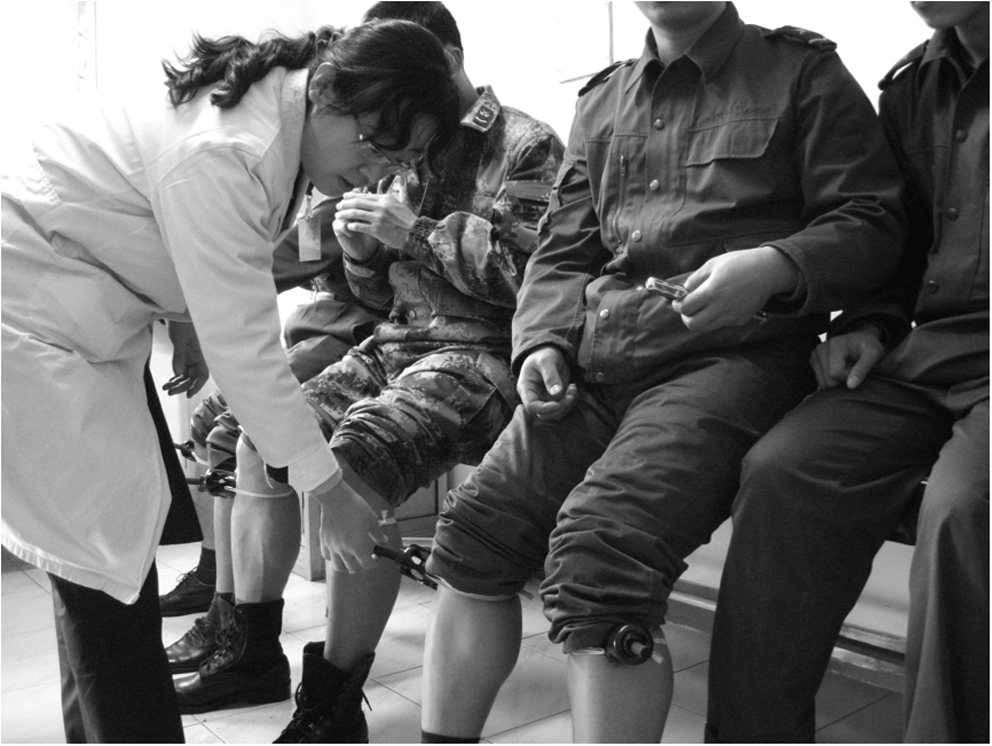
Moxibustion instruction for soldier.
Small Needle–Knife Therapy
Small needle-knife therapy combines the theories of Chinese and Western medicine. That is, this therapy integrates the scalpel used in Western medicine and the needle used in Chinese medicine. As a result, small needle–knife treatment produces two effects—those produced by needles and those produced by knives, thus effectively separating adherence and contracture of tissues, dredging meridians, and improving circulation.
In pathological studies of soft-tissue injury and with improvement of needle–knife tools and their potential use for treatments, the modality known as “acupotomology” has made great progress in recent years and has also achieved remarkable results. There are numerous clinical reports about its use for treating military-training injuries and for treating chronic intractable pain.
In addition, fire-needle therapy and combination therapy have also played an important role treating and rehabilitating patients who have sustained training related injuries.
What is more, thanks to the easy and practical nature of acupuncture, military doctors have put forward the idea of “independent and mutual treatment” among the grassroots soldiers. Based on this training, soldiers are taught to master the simple skills of acupuncture and massage, to independently or mutually treat each other's conditions. In this way, within the barracks, some small problems can be resolved. Currently, this program has already been started in the military.
Some PLA units have also designed acupuncture device–based “Chinese Medicine Boxes” containing acupuncture needles, moxa sticks, cupping equipment, materials needed for massage, etc., which have been allotted to the company-sized military units, all clinics for retired cadres, etc., for grassroots units to provide a guarantee that acupuncture will be used among these patients.
Acupuncture Research and Academic Events in Military Medicine
In recent years, the army has substantially increased the investment in acupuncture research. In the annual allocation of funds for military medical research, the projects of TCM and acupuncture are granted special financial support, at a rising rate every year.
Up to now, there has been plenty of basic and clinical research on acupuncture, moxibustion, and military training injury prevention and control. Among the scientific and technological achievements in the army in recent years, acupuncture also enjoys increasing advancements year by year.
In academic activities, in addition to the regular academic exchanges and training programs held by the Committee of Acupuncture under the Society of Traditional Chinese Medical Professionals in PLA, the PLA General Logistics Department has also organized a series of large-scale activities to promote academic exchanges. Take the 2007 PLA Contest of Traditional Chinese Medical Technology for example. It was initiated by the Minister of the PLA Logistics Department himself, and implemented by the Health Branch of the PLA Logistics Department. It was made up of the election of “Masters of Traditional Chinese Medicine” and “Technical Experts” in military TCM, the contest of traditional Chinese medical knowledge, and the presentation and contest of acupuncture skills and so on.
During more than 6 months, military medical and health institutions at all levels carried out multiple ways to provide the training programs on TCM and acupuncture skills. Thanks to the active participation of the majority of medical personnel, there immediately appeared a tide of studying TCM and acupuncture. Through the Contest, we have comprehensively promoted the construction of acupuncture teams and technology, and effectively ensured the service of acupuncture in the army.
In 2009, the PLA General Logistics Department organized “The Traditional Chinese Medicine entering camps” (Fig. 4). Selected from all Chinese military medical institutions, more than a hundred branches of Chinese medicine, including service teams of acupuncture physicians, went to grassroots units to practice Chinese medicine, perform acupuncture services, and promote science for almost a year. In addition, there were seminars and health counseling designed to promote acupuncture knowledge, popularize acupuncture and other nondrug therapies, and improve medical care of officers and soldiers.

Traditional Chinese Medicine entering camps.
Moreover, there are also technical support programs. That is, regular expert groups are sent to give advice in military units, as well as providing continuing education for health workers in military units. In the end, the goal is training tens of thousands of grassroots health workers to master the TCM and other treatment technologies during the “Eleventh Five-Year Program.” In fact, “The Traditional Chinese Medicine entering camps” is the first program to offer grassroots servicepeople TCM in the history of military medicine. Thus, this program has had an important role in, and meaning for, expanding the service of acupuncture in the army, cultivating a team of acupuncture professionals, and establishing a long-term institution of providing acupuncture services for the army.
Illness Prevention and Health Care for Acupuncture Among Veterans
As an important component of illness prevention in TCM, acupuncture has provided illness prevention and health care for more than 2000 years in China. Especially from the mid-twentieth century, Chinese acupuncture practitioners have widely applied acupuncture to prevent all types of conditions. For the last 3 decades, the application of acupuncture in health care has been fully recognized. For example, moxibustion has been widely used to prevent some geriatric and aging conditions, while ear massage has also been recognized as a health care approach.
Health care for retired officers has long been an important part of military medical work. Acupuncture is simple and inexpensive, and it has obvious effects with respect to illness prevention and health care. This is particularly true for such common conditions among veterans as hypertension, dementia, coronary heart disease, joint degeneration, and other health problems. In recent years, acupuncture practitioners have taught health care doctors in the cadre sanitarium, and also held seminars to guide veterans in using acupuncture for self-care and preventing of geriatric conditions. Just as the data have proven, applications of moxibustion, self-massage, meridian exercises, and other methods will enhance veterans' physical health, reduce their drug usage, and save medical care costs for the government.
Conclusions
In short, compared with conventional therapy, medical acupuncture confers unique advantages to military medicine with respect to effects, price, popularity, and other factors. Having won acceptance from the government and the army, acupuncture is undergoing a new period of development. In the future, the Chinese military should continue to organize and promote the simple and practical techniques of acupuncture, integrate a variety of therapies effectively, perform vigorous training for grassroots health workers, and improve technology and service involved in TCM steadily. In this way, the Chinese military will turn acupuncture into the most-used medical and health care application among service personnel.
Disclosure Statement
No potential financial conflicts exist.