




Abstract
Abstract
Anxiety is a common clinical presentation that is important for practitioners to recognize and address in their patients. Modern psychological research understands anxiety to be a state of apprehensive fear in the face of uncertain or uncontrollable challenges. Traditionally, Chinese medicine has several approaches to the treatment of anxiety, including treatments focused on the Liver, Heart, and Mind. Utilizing the relationships of organs to emotions in Traditional Chinese Medicine, and an interpretation of Chinese characters used in naming acupuncture points and describing anxiety, the author discusses a new strategy for the treatment of anxiety, utilizing the acupuncture point KI 26 (Yu Zhong). This is a promising acupuncture point to research in the treatment of clinical anxiety.
Introduction
The Problem of Anxiety
Anxiety disorders are commonly encountered in clinical practice, although it is often underdiagnosed and treated. According to the National Institute of Mental Health, 18.1% of U.S. adults and 25.1% of U.S. children from 13 to 18 years of age suffer from an anxiety disorder. 5 Anxiety disorders represent a group of disorders characterized by prolonged or abnormal fear that may be episodic or continuous, and lead to mental fear and apprehension, physical tension, and physical symptomology. Patients with anxiety are more likely to present to their general practitioners with somatic symptoms, such as heart palpitations, gastrointestinal distress, breathing difficulty, and physical pain, and have a greater likelihood of comorbidity with other psychological disorders such as depression and substance abuse. 6
Anxiety disorders are characterized into five main types: Generalized Anxiety Disorder, which is persistent and excessive anxiety and worry over daily life issues for at least six months; Obsessive-Compulsive Disorder, which is characterized by obsessive thought patterns or compulsive actions that alleviate anxiety; Panic Disorder, which is characterized by acute episodes intense fear and may be accompanied by chest or abdominal pain, heart palpitations, shortness of breath, and/or dizziness; Post-Traumatic Stress Disorder (PTSD), which is characterized by the re-experiencing of a very traumatic event and avoidance of stimuli that may trigger that trauma; and Social Anxiety or Phobia, which is characterized by anxiety or excessive self-consciousness in social situations. 7
Neurobiologically, anxiety and fear are in part linked to increased activity of the amygdala, which stores memories of emotional stimuli and is involved with processing and responding to fear, as well as increased activity of the hypothalamic-pituitary-adrenal (HPA) axis and cortisol levels, which controls reactions to stress and regulates emotions and moods. In addition, anxiety is correlated with low levels of gamma-aminobutyric acid (GABA), which functions to inhibit activity in the central nervous system, and serotonin, which moderates several functions including mood as well as appetite and sleep. 1 Conventional treatments for anxiety disorders include psychotherapy and cognitive behavioral therapy and selective serotonin reuptake inhibitors (SSRIs) as first-line therapy, with tricyclic antidepressants and monoamine oxidase inhibitors (MAOIs) as second-line treatment due to an increase in the severity of side effects. SSRIs, however, have potential side effects such as sexual dysfunction, weight gain, nausea, headache, insomnia, and even an increase in nervousness and restlessness. Benzodiazepines as sedative hypnotics are also used for short amounts of time to control anxiety and panic, although they do have an increased risk of tolerance and dependence, along with memory impairment and psychomotor function and withdrawal symptoms when the drug is discontinued. 8 Beta-blockers are also used to treat anxiety, especially social phobia, but also have weight gain and sexual dysfunction as potential side effects. 9 Acupuncture has been shown to be promising in treating anxiety and anxiety disorders in several clinical studies, 10 and has been shown to be as effective as cognitive behavioral therapy in the treatment of PTSD. 11
Modern Understanding of Anxiety
Anxiety is a reaction to stress that helps a person cope with challenges facing them, and can represent a normal reaction to a stressful stimuli. If experienced in excess, anxiety can interfere with normal daily life and function, and lead to debilitating psychological and physical symptoms. Psychologically, in people with abnormal levels of anxiety, it represents a maladaptive response to stress characterized by a subjective feeling of helplessness in the face of unpredictable or uncontrollable threats or challenges. 12 As a response to this perceived threat, a person may become hypervigilant, resulting in anxiety. A leading anxiety and anxiety disorder researcher, Dr. David H. Barlow, PhD, has suggested that anxiety represents a state of apprehension and anticipation over perceived future danger, where fear represents a response to present danger that demands immediate action. 5 It has also been suggested that anxiety results from hypervigilance due to overestimation of the potential for threat in ambiguous situations. 13 Anxiety and fear are interrelated but distinct psychological states.
Chinese Medicine Understanding of Anxiety
Understand the Chinese characters that describe energetic states and disease states can yield a tremendous insight into what is implied by that character. This is especially true in understanding emotional disorders that are harder to quantify and qualify than physical disease states. In Chinese Medicine, the emotional state of You (for Chinese characters, please refer to Fig. 1) has often been described as anxiety. The traditional character shows a description of a state in which someone walks slowly with a troubled head and heart. It connotes a depressive state of mind and is most often translated into English as anxiety, sadness, or worry, and is associated with the Lungs. In Traditional Chinese Medicine (TCM), however, patterns that include You (You Zheng) are most often described as a type of depression disorder. It best denotes someone who is aggrieved or melancholic, which is different from the modern psychological understanding of anxiety. The most common classification of depression in TCM is Yu Zheng, a state of Qi stagnation related to the Liver, and often the result of emotional stress and anger. Stagnation of the Qi dynamic of Liver leads to symptoms including hypochondriacal pain and distention, frequent sighing, and an emotional state that presents as an “anger-turned-inward” type of depression. The traditional character, Yu, can be translated as “lush” and denotes something that is difficult to move through. It refers to depressed movement and activity—whether physical or emotional. You, on the other hand, is most often characterized as a type of melancholy and despondency. You Yu refers to melancholia, dejection, and depression. You Ju, however, refers to apprehension, with the character Ju specifically describing a sense of fear or dread. You Ju can refer to a state of anticipatory fear, which relates to the energetics of the Kidneys in TCM. According to the Su Wen, chapter 5, fear relates to the Kidneys and can damage the Kidneys when in excess. This is an important distinction when considering the treatment of anxiety with acupuncture and Chinese medicine. To address what most patients will describe as anxiety, the energetics of the Kidney need to be addressed, specifically by treating the Kidney channel.
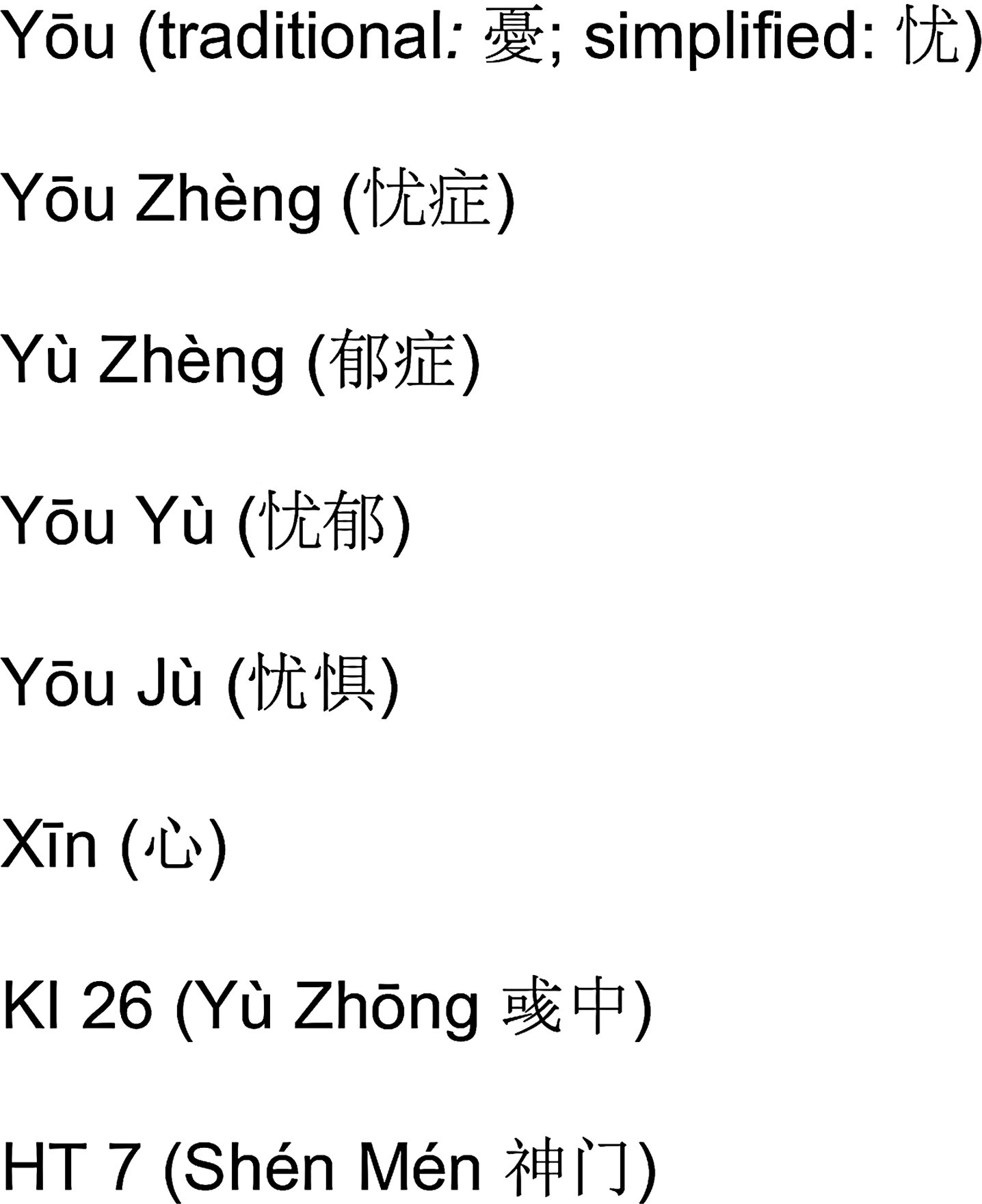
Chinese terms used in this article.
TCM Treatment of Anxiety
Current TCM treatment for anxiety most often focuses on soothing the Liver and calming the Heart and Mind. Psychological disorders are often addressed in TCM through the Liver and Heart. Treating the Liver—most often with a diagnosis of Liver Qi Stagnation—means to treat Yu and is a method to help someone move through the emotional state in which they are stagnated. It is, in a way, a strategy that helps someone persevere and move through whatever emotion they are having a difficult time processing—be it fear, anger, worry, or sadness. In this paradigm, a person's condition is characterized by an emotional state that is worsened by stress, and accompanied by a stagnated Qi dynamic, including distending hypochondriacal pain, chest oppression, digestive upset, irregular menses, depression, epigastric fullness, and a wiry pulse. Treatment for Liver Qi stagnation most often includes the “four gates,” LR 3 and LI 4, along with points to regulate Qi including LR14 ST 36, CV 17, and CV 12. 14
Another TCM strategy to treat emotional disorders and anxiety is to treat the energetics of the Heart. The Heart, as the emotional center of the body and the mind, is responsible for being present with and transforming emotional states. The character for Heart—Xin—is a part of each character that represents an emotion. The Heart is where a person feels, and responds to, emotional or mental stimulus. If the Heart is calm, a person can be present with current and future potential fear and not be overwhelmed by them. Acupuncture points that address this aspect of anxiety include HT 7 and PC 6, and BL 15. To treat the Heart can also mean to transform Phlegm that is misting the Heart, leading to confused thoughts and foggy headedness, and that obstruct a person's ability to emotionally and cognitively “see things for what they are.” Points such as ST 40 and PC 5 clear Phlegm that is misting the Heart, and can lead to improved consciousness and emotional clarity.
A third strategy involves a more modern approach of treating the mind to alleviate anxiety. This strategy involves points that specifically function to sedate and calm the mind and brain. A common strategy involves the use of points such as Sishencong, GV 20, and Yintang to calm and sedate the mind. The other involves the use of auricular acupuncture, based most often either on National Acupuncture Detoxification Association (NADA) protocol or the Nogier style (i.e., Shen Men, Tranquilizer, and Master Cerebral Point). 9 In one study, using both body points and auriculotherapy were found to be equally effective in alleviating preoperative anxiety. 15 All of the above methods—treating the Liver, Heart, and Mind—are commonly combined in the treatment of anxiety in clinical practice.
Another Approach to Treating Anxiety
As discussed, most patients that present in clinic with anxiety will describe their emotional state more as apprehension and fear around uncertainty about future events. Given that anxiety and fear are interrelated, though, it makes sense in Chinese medicine to look at what is described in clinical practice as anxiety through the function of the Kidneys. In looking at anxiety as more apprehensive fear (You Ju), there is one point that characterizes this state more than any other: KI 26—Yu Zhong. In TCM, it functions in TCM to unbind the chest and benefit the breasts, transform Phlegm, and lower rebellious Lung and Stomach Qi, and is most commonly used for dyspnea, cough, and asthma, along with vomiting and breast abscesses. 16 It is not described as having a strong function to affect the mind and mental status.
KI 26 in the Treatment of Anxiety
An important way to understand the functional dynamics of a point, however, is to understand the characters used in the name of the point. For example, HT 7 (Shen Men) is often translated as “Spirit Gate,” 10 which denotes its ability to regulate excess and deficient states of the Heart channel—both physically and emotionally. With KI 26 (Yu Zhong), there are many translations for “Yu Zhong.” Deadman in A Manual of Acupuncture translates this as “Comfortable Chest,” 17 J.R. Worsley in the 5 Element tradition translates it as “Amidst Elegance,” 18 and Wiseman in A Practical Dictionary of Chinese Medicine translates it as “Lively Center.” 10 Zhong refers to the center of something. It also refers to being in the midst of something, as well as to attain or hit a target. Yu commonly refers to something that is cultured or refined. The first character in the name of KI 26 can be transliterated as either Huo or Yu in Pinyin, and has an interesting meaning. In modern Chinese, it can be interpreted as the adverb “perhaps,” which connotes a degree of uncertainty. The classical meaning of the character, however, refers to a “primitive, boundary-less post, castle or town that a landlord defended with the weapons of his men.” 19 Yu Zhong, then, can be interpreted as a point that represents the center of a territory with no known boundaries, which is an interesting juxtaposition. How can one know the center of a territory with no known boundaries? How can one face the potential challenges and situations in life when one does not know exactly what will happen or what a given situation will look like? This fits exceedingly well into the current understanding of anxiety being a state of anticipatory apprehension and hypervigilance. It describes a person who tries to protect themselves in a state in which they cannot find the center of the situation or, perhaps, themselves. This point symbolizes finding the center of oneself when one does know what will exactly what will happen, and the ability of the Kidneys to turn the disordered emotions of fear and anxiety into the virtue of wisdom.
Case Study
The author has incorporated KI 26 into a number of patient treatments where anxiety has been a presenting issue or complaint, and empirically found it to be effective in reducing anxiety symptoms. A representative example of this is the case of a 33-year-old woman, who had recently moved from Oregon to New York City. She presented to the clinic with stress and anxiety. She was enrolled in an intensive business management program, and reported suffering from insomnia, irregular menses tension headaches, and feelings of generalized anxiety and being overwhelmed about family issues and school. Her TCM pattern diagnosis was Liver Qi Stagnation, and the focus was on coursing Liver Qi and calming the spirit. The author needled LR 3, LI 4, ST 36, HT 7, PC 6, and Yintang for the first treatment. Returning one week later, the patient reported somewhat decreased anxiety. For the second treatment, the previous protocol was kept but KI 26 was added. Upon follow-up, the patient reported significant alleviation of anxiety, increased coping ability to deal with stress, and specifically asked for the “point on the chest” again. Within two more treatments, the patient reported remission of her presenting complaints, and increased ability to cope with the challenges that she was facing. With the addition of KI 26, even though her underlying diagnosis related more to the Liver and Heart, the ability of the treatment to address the energetics of the Kidney and apprehensive anxiety and to calm fear in the patient yielded dramatically better clinical results.
Discussion
Anxiety is a common complaint in the modern acupuncture clinic. Patients often describe their anxiety more closely to how modern psychology describes it—anticipatory fear in the face of uncertainty—than how the term translates in TCM. You, which is most commonly described as anxiety, is ascribed to the Lungs and more closely refers to melancholia and depression than to anxiety. It is sometimes challenging to translate more modern understandings of psychological signs and symptomology into Chinese medical terms, but the ability to treat psychological conditions and to support emotional well-being is a tremendous area of opportunity for acupuncture and Chinese medicine. By interpreting the state of anxiety as one in which a person is unable to cope with anticipation and fear, we are able to reinterpret this concept through the frame of TCM.
In TCM, fear and the transformation of fear into wisdom is governed by the water elements and the Kidneys. This means that in addition to the normal physical and physiological functions of the Kidneys, such as supporting the low back, bones, and ears, promoting urination, and so on, the Qi of the Kidney channel also supports the emotional aspect of the Kidneys. It can be said that every point on the Kidney channel may have both a physical and emotional function. Often, in addition to traditional uses and indications for these points that can be found in textbooks and Chinese medical classics, the name and characters used to name each point can yield a tremendous insight into a point's function and nature. In China, point names are always used to refer to a given point rather than as a channel and number as in the West. It is possible that understand the names and characters of points can yield a deeper energetic understanding of their use in modern patients and conditions. Points that are commonly or even not commonly used for their physical function may be reassessed for their ability to impact the energetics of the mind, psyche, and emotions. This is an important area of research and interpretation that may yield new and important acupuncture treatment ideas in modern practice and emotional disorders.
An example of this is the point KI 26 (Yu Zhong). By interpreting its meaning through the energetics of the Kidney channel, and through the meaning of the characters used to name the point, we can understand this point in a new context. Given that it is a Kidney point, we interpret it as a point that can treat and transform fear to some degree, and given that the point refers to the center of a territory with no known boundary, we can understand that it can help to emotionally center someone who is facing a challenge or uncertainty in their life and is becoming hypervigilant or fearful about future events. KI 26 represents potentially an important point in the treatment of anxiety.
In the case study presented, this point did indeed provide a center through which the patient could find a sense of calm that enabled her to process the day-to-day stressors and help her transition into a new part of her life personally and professionally. The author has subsequently utilized this point in patients reporting anxiety, and has found it to be empirically effective in the treatment of anxiety.
Conclusion
Anxiety is an important, mulifaceted clinical problem, and can be understood as apprehensive fear in the face of uncertainty. Chinese medicine has methods that address the treatment of anxiety and anxiety disorders. Traditionally, acupuncturists have addressed anxiety by treating the energetics of the Liver, which helps someone to “move through” a stressful situation, or the Heart or Mind to calm the emotions and mental restlessness. An important component of addressing anxiety, however, has been lacking from some protocols and methods—the transformation of fear, which falls under the domain of the Kidneys. KI 26, as a point that represents finding a center in an uncertain situation, is potentially an important point on the Kidney meridian to help emotionally calm a person and help alleviate apprehension and uncertainty that is leading to anxiety. Future research into the acupuncture treatment of anxiety utilizing the acupuncture point KI 26 is warranted to help to create effective treatments for patients suffering with anxiety and anxiety disorders.
Footnotes
Acknowledgments
The author wishes to acknowledge and thank Thea Elijah, LAc, for previous discussions on emotional energetics and Chinese medicine, and Michael Jabbour, LAc, for reviewing the manuscript.
Disclosure Statement
No competing financial interests exist.