




Abstract
ABstract
Background:
Acupuncture has been found to be effective for reducing body weight (BW) with few adverse effects.
Objective:
The aim of this study was to evaluate the effect of auricular acupressure plus exercise in primary obese women in a randomized controlled clinical trial.
Design, Setting, and Patients:
Sixty Chinese women (ages 18–54) with primary obesity (body mass index [BMI] ≥25 and waist circumference [WC] ≥80 cm) were enrolled in this study.
Intervention:
The patients were randomly assigned to 2 groups: Group A and Group B. Patients in Group A (n=30) were instructed to do aerobics exercises such as jogging, rope skipping, walking, etc. Patients in Group B (n=30) were treated with auricular acupressure plus exercise.
Main Outcome Measure:
BW, BMI, and WC in primary obese women were measured at the beginning and end of the treatment.
Results:
BW, BMI, and WC decreased in both groups after 4 weeks of treatment. The participants' BW decreased more (p<0.05) in Group B than in Group A. Yet, there were no statistical differences in BMI and WC between the 2 groups.
Conclusions:
Both auricular acupressure and exercise play important roles in weight reduction. Auricular acupressure plus exercise is better than exercise alone for BW reduction. Auricular acupressure is an effective, convenient, and low-cost treatment for primary obese women, and can be self-administered by the patient when this is required.
Introduction
The increased prevalence of obesity highlights the necessity for effective treatment approaches. Managements for weight reduction include pharmacotherapy, 5 surgery, 6 and other medical treatment methods. The use of Western antiobesity drugs has been limited by side-effects, including mood changes, suicidal thoughts, and gastrointestinal or cardiovascular complications. Chinese herbal medicine (CHM) and acupuncture has been found to have a similar efficacy in reducing body weight as the Western antiobesity drugs but with fewer reported adverse effects. 7 A telephone survey by Sharpe et al. in the United States showed that acupuncture is one of the most often used therapies of complementary and alternative medicine for weight control. 8 Auricular acupressure is easily accepted by obese women, and can be self-administrated by patients.
The aim of the present study was to investigate the effect of auricular acupressure plus exercise on body weight (BW), body mass index (BMI), and waist circumference (WC) in primary obese women. Primary obesity can be defined as obesity resulting when caloric intake exceeds energy expenditure.
Methods
Participants
Participants were enrolled from the outpatient Department of Acupuncture and Moxibustion, in the Hubei Hospital of Traditional Chinese Medicine, which is affiliated with the Hubei University of Traditional Chinese Medicine. The criteria for inclusion were: (1) primary obesity; (2) female between ages 18 and 60; (3) BMI≥25; and (4) WC≥80 cm. The criteria for exclusion were: (1) secondary obesity diagnosed by history, and physical and laboratory examinations; (2) receiving or changing any medical treatment in 2 months before being enrolled in the present study; (3) being pregnant or lactating; (4) having tumors, progressive encephalopathy, progressive neurodegenerative disorders, and/or other serious illnesses. In total, 426 patients came forward to participate in the study. According to the inclusion and exclusion criteria, 60 Han Chinese women (between ages 18 and 54, mean age 34) were finally enrolled in the study and were considered to be suitable for randomization (Fig. 1). Of the excluded patients, ∼50% were excluded because they did not have primary obesity, ∼30% were older than 60 or younger than 18, and ∼20% had a BMI<25.
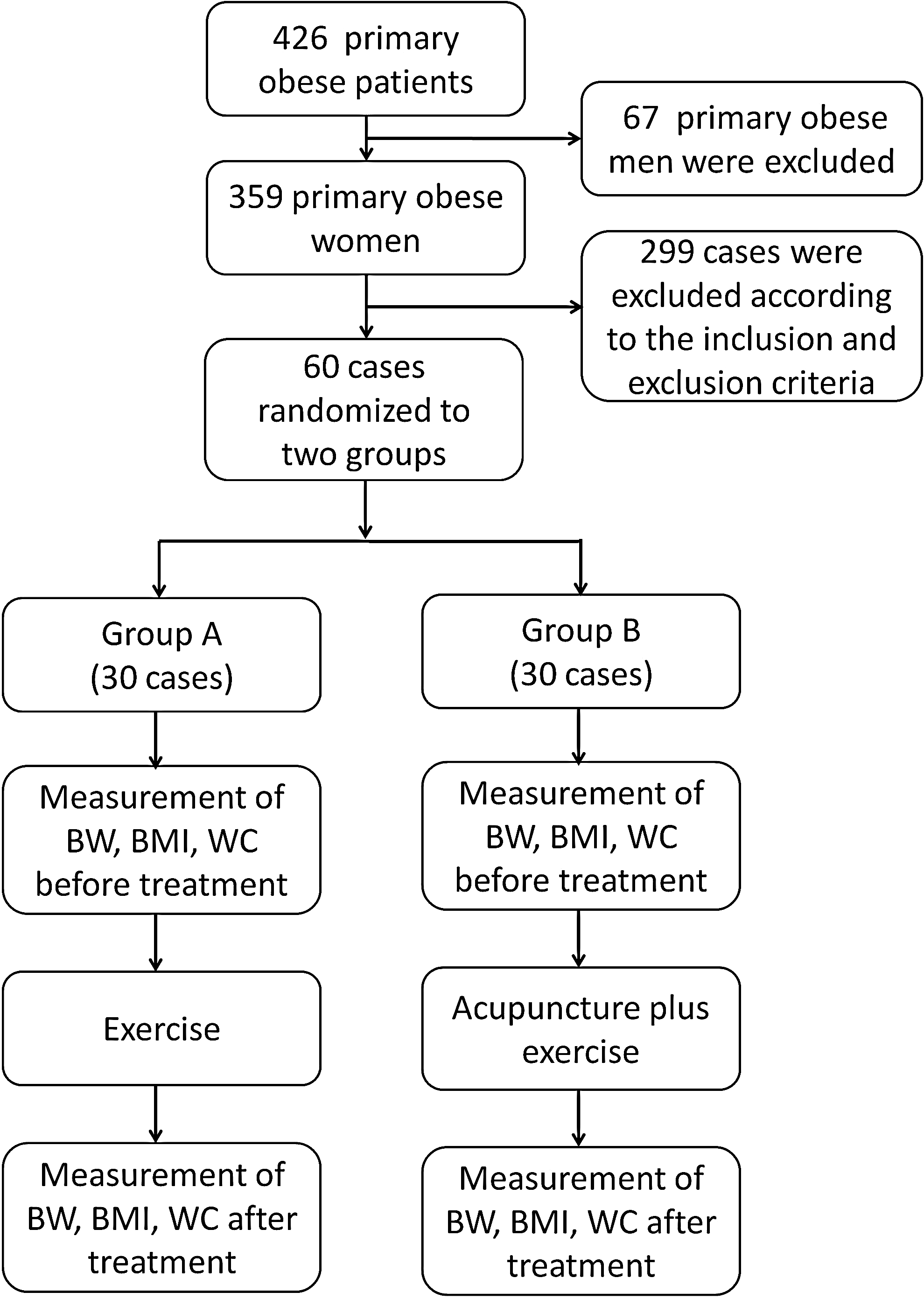
Flow chart of the study performed at the Hubei Hospital of Traditional Chinese Medicine affiliated with the Hubei University of Traditional Chinese Medicine. BW, body weight, BMI, body mass index, WC, waist circumference.
All enrolled participants were provided with informed consent forms following the Chinese law of human scientific studies and the principles of the Helsinki Declaration. Ethical permission for the study was obtained from the institutional review board of the Hubei Hospital of Traditional Chinese Medicine.
Study Procedures
The obesity patients were randomized into two groups: Group A and Group B. Patients in Group A were instructed to do exercise. Patients in Group B were treated with auricular acupressure plus exercise. Before and after treatment, the values of BW, BMI, and WC in primary obese women were analyzed and compared (see Fig. 1).
Treatment
Exercise
Patients were asked to do aerobics, such as jogging, rope skipping, walking, etc. The patients could choose any of the above aerobics exercises. When the patients were doing aerobics, their heart rates remained at 120–150 beats/min. The patients engaged in the exercise program for 1 hour per day for 4 weeks.
Auricular Acupressure
The auricular acupoints for treating obesity were Hunger, Stomach, Spleen, Large Intestine, Endocrine, and Shenmen (Fig. 2). For each patient, Semen vaccariae (Wang Bu Liu Xing, cowherb seed; globes of ∼1.5 mm in diameter, surface: black; Hebei, China) was applied unilaterally on the acupoints of one ear by adhesive plaster. The auricular acupressure was changed to the other ear after 3 days. The patients were asked to press each of the S. vaccariae seeds for 10 seconds, 3 times a day, for 4 weeks, for a total of 30 seconds/seed each day. Thus, each of the acupuncture points was stimulated for ∼30 seconds each day.

Model of the human ear at the Medical University of Graz. The acupuncture points used in this study are shown.
Both exercise and auricular acupressure were suspended when a patient had a menstrual period.
All patients were asked to avoid eating any food after 8:00
Measurements
BW, BMI, and WC in primary obese women were measured at the beginning and end of the treatment. All the measurements were performed on the patients with an empty stomach at 8:00
Statistical Analysis
Values were presented as mean±standard error. SPSS 16.0 software (IBM Corp., New York, USA) was used for statistical data analysis. An independent t-test was performed to compare mean values between the 2 groups. A paired t-test was performed to compare mean values between baseline measurements and after treatment in the same group. Significance was set at p<0.05.
Results
After 4 weeks of treatment, the participants' BW decreased in comparison with baseline measurements in both Group A and Group B (p<0.05, P<0.01, respectively); there was also a statistical difference (p<0.05) in weight loss between the 2 groups. See Table 1.
p<0.05, **p<0.01, compared with baseline measurements; #p<0.05, compared with Group A.
BW, body weight.
After 4 weeks of treatment, the participants' BMI decreased in comparison with baseline measurements in both Group A and Group B (p<0.05, p<0.01, respectively); there was no statistical difference in BMI changes between the 2 groups. See Table 2.
p<0.05, **p<0.01, compared with baseline measurements.
BMI, body mass index.
After 4 weeks of treatment, the participants' WC decreased in comparison with baseline measurements in both Group A and Group B (p<0.05, p<0.01, respectively); again, there was no statistical difference in changes in WC between the 2 groups. See Table 3.
p<0.05, **p<0.01, compared with baseline measurements.
WC, waist circumference.
Discussion
The present study investigated the effect of auricular acupressure for treating primary obese women. BW, BMI, and WC decreased in both groups after 4 weeks, which means that both auricular acupressure and exercise played important roles in weight reduction. BW decreased more in Group B than in Group A, which suggests that auricular acupressure plus exercise was more effective than exercise alone. Yet, there was no statistical difference in BMI and WC between the 2 groups. However, there was a clear trend, which warrants further studies in the future.
Weight reduction is an obvious aim of obesity treatment. BW and BMI are widely used indicators of weight status, and have been applied in both public health systems and clinical practice. The relation between BMI and percentage of body fat is influenced by age, gender, and ethnicity. In some Asian populations, a higher percentage of body fat was found for a given BMI than in Europeans. 10 Recently, WC and WC-related values have been widely used as representative indicators of abdominal adiposity, because they are correlated with abdominal fat mass and are more associated with cardiovascular risk factors than BMI.11,12 BMI and WC can also predict the presence of many metabolic risk factors in Chinese subjects. 13
The effectiveness and safety of CHM and acupuncture suggest that they are viable alternative established therapies for obesity. Acupuncture and acupuncturelike stimulation (acupressure) is widely used for weight reduction in China. Many acupuncture clinics specialize in weight reduction. Several studies have shown that auricular acupuncture is a reasonable for treating patients who are overweight.14–17
Auricular acupuncture points for treating obesity are: Shenmen, Spleen, Mouth, Stomach, Endocrine points, Small Intestine, Large Intestine, and Hunger.17–21 There are also other acupoints used to treat obesity; however, not all of them were used in the current study because of the practical procedures required in the hospital. The most commonly used acupoints are Shenmen and Stomach. Different kinds of methods—including auricular acupuncture, 21 auricular acupressure,14–16 auricular electroacupuncture, 19 and transcutaneous electrical nerve stimulation 20 —have been used to treat obesity. The vaccaria line seed 18 and magnetic pearls14,15 are used for auricular acupressure.
In clinical studies, BW, BMI, and WC decreased after auricular acupuncture was used for treating obesity. After 8 weeks of ear acupressure treatment, BMI decreased significantly by 0.7. 15 After being treated with electroacupuncture at auricular acupoints plus body acupoints for 20 days, there was a 4.7% weight reduction in patients with obesity, whereas patients in a diet restriction group had a 2.9% weight reduction. 19 A statistically significant drop in WC during a 9-week treatment using auricular acupuncture occurred in obese volunteers. 22 Decreases in leptin, 23 increases in serumβ-endorphin level, 24 an increase in basal metabolic rate, 25 and appetite suppression 20 were suggested as possible mechanisms involved in weight reduction by auricular acupuncture. In animal studies, auricular acupuncture stimulation clearly modulated feeding-related hypothalamic neuronal activity of experimental (both hypothalamic and dietary) obese rats, which suggests that auricular acupuncture stimulation is concerned with satiation formation and preservation. 26 If a surgical lesion was created at the hypothalamic ventromedial nucleus—the satiety center—auricular acupuncture had no effect on body weight and evoked no potentials in the lateral hypothalamus. 27
Yet, limitations and problems still exist in the treatment of weight reduction by auricular acupuncture. Sun 28 reported that the therapeutic effect of acupuncture on abdominal obesity was gradually lessened with the prolonging of treatment course. Shen et al. 25 proposed that sympathomimetic effects may account for the reduction in BW by temporarily increasing the basal metabolic rate and decreasing appetite, but the body may regain weight after termination of increasing basal metabolic rate and decreasing appetite. In addition, another study demonstrated that acupuncture had no influence on weight. However, acupuncture improves the psychological status of obese patients with significant improvement in anxiety and depression. 29
Compared with needling, auricular acupressure is completely noninvasive and can be self-administered by the recipient when necessary. 30 It can be easily accepted by obesity patients. The patients go to see the doctors only when they need to change to the other ear for auricular acupressure. Of course, lifestyle is important for maintaining a healthy weight. In the current authors' opinion, auricular acupressure plus exercise is a good integrative way to achieve weight reduction.
Conclusions
Both auricular acupressure and exercise play important roles in weight reduction. This study suggests that auricular acupressure plus exercise is significantly better than exercise alone for BW reduction. Auricular acupressure is an effective, convenient, low-cost treatment for primary obese women, and can be self-administered by the recipient when necessary. Further studies, using continuous, electrical, high-technology ear acupuncture stimulation are in progress.
Footnotes
Acknowledgments
This study was supported by the German Academy of Acupuncture (President: Frank Bahr, MD) and was performed within the research area entitled “Sustainable Health Research,” at the Medical University of Graz, in Graz, Austria.
The authors would also like to thank Ingrid Gaischek, MSc (Medical University of Graz), for her help with manuscript preparation.
Disclosure Statement
No competing financial interests exist.