




Abstract
Abstract
Background:
Pain is associated with autonomic imbalance, which mainly manifests as increased sympathetic activity. Up to now, there has been no scientific articles focusing on autonomic modulation of acupuncture for treating low-back pain (LBP) in women.
Objective:
The goal of this study was to investigate short- and long-term effects following acupuncture needle stimulation on parameters of the autonomic nervous system, such as heart rate (HR) and heart rate variability (HRV) in female patients who have LBP.
Design, Setting, and Patients:
Thirteen women (mean age 58.5±13.5 [standard deviation] years) with lumbosacral pain were enrolled in this study.
Intervention:
All patients received needle acupuncture treatment in different sessions. The main acupoints used were were Yaoyu (GV 2), Huantiao (GB 30), and Yanglingquan (GB 34).
Main Outcome Measures:
HR and HRV were measured by a Medilog® AR12 HRV (Huntleigh Healthcare, Cardiff, United Kingdom) recording and analysis system.
Results:
There were significant decreases of HR and significant increases in HRV during the acupuncture treatment sessions. No significant changes were found before and after each acupuncture treatment cycle.
Conclusions:
HR and HRV are useful parameters to quantify short-term changes in the autonomic nervous system in females with LBP. Further studies using the same standardized acupuncture scheme in all patients and involving at least ten acupuncture sessions are planned.
Introduction
Management of LBP includes pharmacological interventions, such as analgesic, nonsteroidal anti-inflammatory drugs and steroid injections. 7 Because of the limitations of pharmacological interventions, such as adverse drug effects, physical therapies, including laser and ultrasound therapy and/or manual therapy have been reported for the management of pain. 8 Acupuncture has also been to treat LBP. 8
Pain is associated with autonomic imbalance, which manifests mainly as increased sympathetic activity. 7 Up to now, to the best of the current authors' knowledge, there has been is no scientific articles focusing on autonomic modulation of acupuncture for treating LBP in women.
The goal of this study was to investigate short- and long-term effects following acupuncture needle stimulation on parameters of the autonomic nervous system, such as heart rate (HR) and heart rate variability (HRV) in female patients who have LBP. In addition, the same parameters were investigated at the start and at the end of each acupuncture treatment cycle.
Methods
Setting and Patient Population
The investigations were performed at the Privatclinic Lassnitzhoehe, in Lassnitzhoehe, Austria. Altogether, 13 women (mean age 58.5±13.5 [standard deviation] years, range 40–82 years; mean height 164.6±5.8 cm; mean weight 69.2±10.9 kg) were enrolled in the study. Patients for the study were included by an experienced neurologist. All participants gave oral informed consent, and the study was performed following the principles of the Declaration of Helsinki. Ethical permission for the study was obtained from the institutional review board of the Privatclinic Lassnitzhoehe.
Study Procedures
As the study was performed using routine acupuncture therapeutic interventions, there was no control group in which to take measurements. All patients were treated with acupuncture. Data for HR and HRV were analyzed during the 30-minute acupuncture sessions as well as before and after treatment (several sessions). On average, 3.1±0.8 sessions were performed.
Treatment
During each acupuncture session, each patient laid down on a bed (Fig. 1).

Acupuncture for low back pain and recording of HRV data. Photograph used with permission of the medical doctors and the patient.
The acupuncture points used in this study to treat LBP are listed in Table 1 for each patient.
All patients were treated with at least one of these main acupoints.
LBP, low-back pain.
Sterile single-use needles (0.30×30 mm and/or 0.30×40 mm; Huan Qiu, Suzhou, China) were used. Needling was performed according to Chinese standard procedures (with respect to depth [see Table. 1] and direction 9 ), and needle stimulation was performed clockwise and counterclockwise for 15 seconds each, with two rotations per second, resulting in 30 rotations per stimulation. Stimulation was done immediately after inserting the needle, 5 minutes later, and 10 minutes later (See Fig. 2).
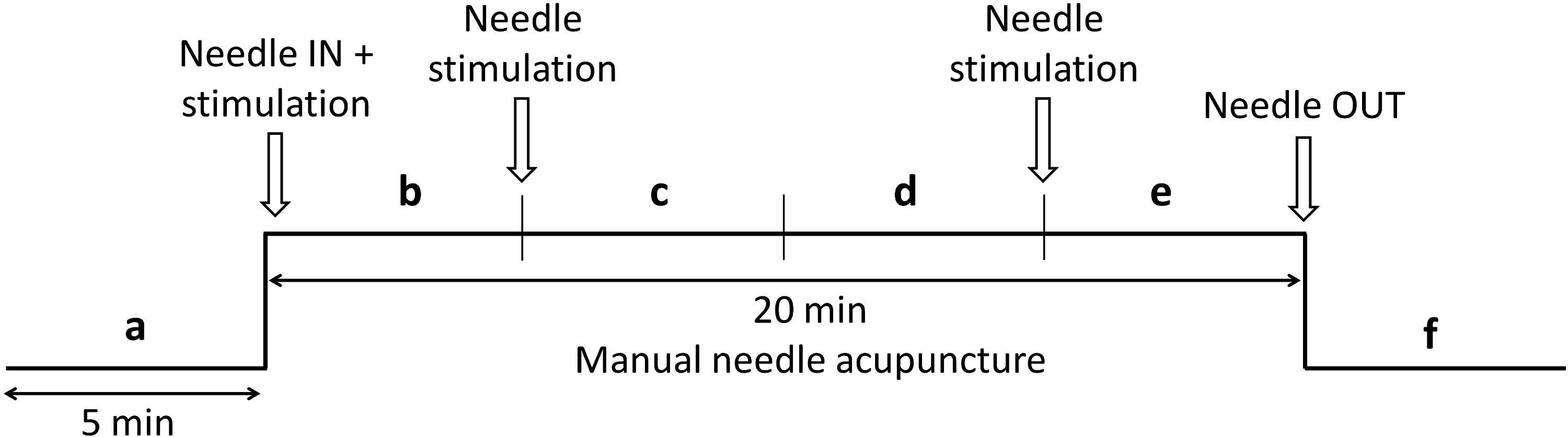
Measurement procedure.
HR and HRV Measurements
The basis for determining HRV is the duration of R–R-intervals measured during a special time period (5 minutes). Electrocardiograph (ECG) registration was performed with three adhesive electrodes (Skintact Premier F-55; Leonhard Lang GmbH, Innsbruck, Austria) applied to the chest of each subject. The electrodes were positioned using a standard recording scheme at three points on the thorax.
For the investigations, a Medilog® AR12 HRV (Huntleigh Healthcare, Cardiff, United Kingdom) system was used (see Fig. 1). By recording with 4096 samples per second, the new system can detect R-waves extremely accurately. The dimensions of the HRV recorder are 70×100×22 mm, and the weight is ∼ 95 g with batteries.
All raw data were stored digitally on a special memory card. After removing the card from the portable system, the data were read by a card reader connected with a standard computer and then transferred to the TCM Research Center Graz, in Graz, Austria, via the Internet. With new software,10–12 the biosignals were analyzed and HRV was displayed in a way to help to judge the function of the autonomic nervous system. For offline visual inspection, all ECG raw data can be displayed on a screen.
Mean HR, total HRV, and the low frequency (LF)/high frequency (HF) ratio of HRV served as evaluation parameters. These parameters are recommended by the Task Force of the European Society of Cardiology and the North American Society of Pacing and Electrophysiology, 13 and provide an understanding of the effects of sympathetic and parasympathetic systems on HRV.
Statistical Analysis
Data were analyzed using SigmaPlot 11.0 software (Systat Software Inc., Chicago, IL). Graphic presentation of results uses box plot illustrations. Testing was performed with a one-way repeated measures analysis of variance and the Holm-Sidak test. The criterion for significance was P<0.05.
Results
Results of mean HR from the ECG recordings before, during, and after acupuncture of the 13 patients are shown in Figure 3. There were significant alterations within the different conditions

Mean heart rate (HR). Box plot illustration for 13 patients with low-back pain before
Analysis of total HRV showed the following results: There was a significant increase in total HRV only after acupuncture within the last session. This effect appeared after removing the needles

Total heart rate variability (HRV). Box plot illustration for 13 patients with low-back pain before
Furthermore, the biosignal monitoring during acupuncture showed no significant reductions in the LF/HF ratio (see Fig. 5). During the last acupuncture session, the values decreased slightly.
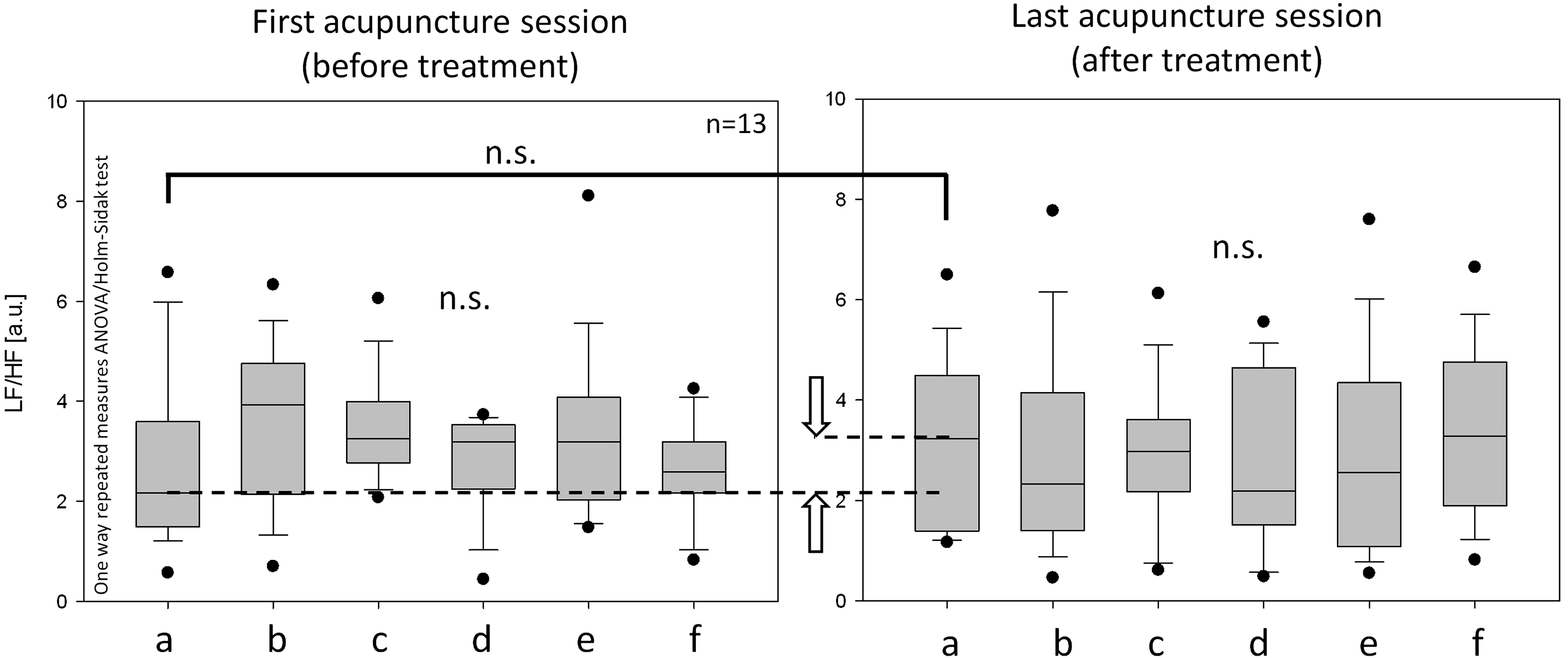
LF (low frequency)/HF (high frequency) ratio. Box plot illustration for 13 patients with low-back pain before
Discussion
The present study is the first to investigate the role of modulation of the autonomic nervous system in the treatment of LBP in women by acupuncture.
In general, patients who have pain have a significantly reduced vagal tone and increased sympathetic activity. 14 Nakamura et al. 15 suggested that the main afferent pathways of pain from the lower intervertebral discs go through the L2 spinal nerve root, presumably via sympathetic afferents from the sinuvertebral nerves. Discogenic LBP should be regarded as a visceral pain with respect to its neural pathways. 15 In an animal study in rats, sympathectomized rats increased their hot-plate latency time compared with that of sham-operated rats, and in each rat, the density of calcitonin gene-related peptide immunoreactive fibers in the sympathectomy side of the lumbar dura mater decreased to 45.5% compared with the contralateral side. 16 The result showed that sympathectomy at L2–L3 increased the pain threshold and made the sympathectomized rats hypesthetic. Therefore, sympathetic nerves may play an important role for LBP involving the lumbar dura mater. 16 In anesthetized cats, dorsal horn neurons receiving nociceptor input from lumbar paraspinal tissues were tested for activation by electrical stimulation of the lumbar sympathetic chain, which suggested that LBP may be exacerbated by activity in both efferent and afferent fibers located in the lumbar sympathetic chain, with the efferent actions being mediated indirectly through sympathetic–sensory interactions in somatic and/or visceral tissues. 17
The therapeutic strategy most commonly used by patients for addressing pain is a visit to the physician (66.3%); followed by self-medication (27.6%); and alternative medicines such as local heat, massage, and acupuncture (20.5%). 18
The collaborative treatment of acupuncture in addition to routine care as an approach for managing LBP is receiving increasing recognition in both lay and professional arenas. 19 Acupuncture has been used to treat LBP, and clinical trials have demonstrated acupuncture's efficacy. In a randomized controlled trial, 187 patients with chronic LBP were randomized to Hegu acupuncture, standard acupuncture, or usual-care groups. The authors of that study found that both Hegu acupuncture and standard acupuncture had beneficial and persistent effectiveness for relieving chronic LBP (cLBP), compared with what occurred in the usual-care group; in addition, Hegu acupuncture was significantly more effective than standardized acupuncture. 20 Another study showed that the number of physician visits for a 1-year post-acupuncture period decreased by 49% in an acupuncture group, compared to the 1-year pre-acupuncture period for the same group of patients. Physician services costs declined by 37% for the acupuncture group. 21 Acupuncture points commonly used to treat cLBP are Yaoyu (GV 2), Huantiao (GB 30), Yanglingquan (GB 34), Shenshu (BL 23), Dachangshu (BL 25), Yaoyangguan (GV 3), and Weizhong (BL 40).9,22
HRV results from the regulation of the heart by the autonomic nervous system. The ability of acupuncture to improve HRV could be used as a tool in acupuncture research and practice to monitor treatment effectiveness and the impact on QoL. 23 The method of using HRV as a short-term parameter is noninvasive and not expensive. In lumbosacral pain, acupuncture can relieve the pain effectively and improve a patient's autonomic status. 14 In a study comparing the effect of acupressure at local and distal acupoints on pain conditions and autonomic function in females with chronic neck pain, HR decreased and the power of the HF component of HRV increased after acupressure in only the local acupoints. 24
Conclusions
In the present study, there was a significant decrease in HR and a significant increase in HRV during the ongoing acupuncture sessions. However, there was no significant effect between the beginning and the end of each acupuncture treatment, although all patients subjectively reported ameliorations and reductions of pain. The current authors' hypothesis is that one of the main reasons why the evaluation parameters did not show significant changes between treatment onset and end was that there were not enough acupuncture sessions for this to become evident. As already mentioned in the Methods section, the measurements were integrated into routine treatments in a hospital, and it was not possible to perform further investigations in the patients. Further studies using the same standardized acupuncture scheme in all patients and involving at least 10 acupuncture sessions are planned.
Footnotes
Acknowledgments
This study was supported by Sino-Austrian cooperation projects. The first author, Dr. He, received a Eurasia-Pacific Uninet scholarship for a research stay at the TCM Research Center at the Medical University of Graz. The study was also supported by the German Academy of Acupuncture (president and professor, Frank Bahr, MD) and was performed within the research areas “Neuroscience” and “Sustainable Health Research” at the Medical University of Graz.
The authors would also like to thank Walter Kreuzig, MD, Head of Medical Affairs at the Privatclinic Lassnitzhoehe, for his support for this study.
Disclosure Statement
No financial conflicts exist.