




Abstract
Abstract
Background:
In some studies acupuncture seems to work better than placebo in irritable bowel syndrome; yet, in others, acupuncture seems to work no better than sham versions of acupuncture or placebo. In the experience of the current author, acupuncture has been effective—both for symptomatic relief and for prevention of recurrences, if points are carefully chosen according to the presenting symptoms and the patterns of Disharmony.
Objective:
The aim of this case study is to describe the development of a system of point selection, for both symptom reduction and correction of Disharmonies that originally lead to the development of IBS.
Cases:
Three cases are described. These were females (ages 49, 78, and 74). Each patient was examined individually to determine her pattern of Disharmony and the relevant points were treated. Chong Mai was used in all of these cases. This meridian was chosen because of its regulatory effects on all symptoms of IBS and related Disharmonies. Other points were then added as required.
Results:
Acupuncture provided significant relief in all three cases during the initial treatment period of 8 weeks; but it was necessary for the patients to have additional treatments periodically to maintain their relief from IBS symptoms. The third patient had a poor prognosis with respect to obtaining complete relief, because of the long duration of her constipation.
Conclusions:
While the available evidence for the beneficial effects of acupuncture in IBS is equivocal, in the author's experience, stimulating Chong Mai and points according to the presenting symptoms and Disharmony patterns, demonstrated empirically that acupuncture can be used with success in most cases.
Introduction
Diagnosis is made by symptoms alone in the absence of “red flags” such as age of onset being >50, rectal bleeding, weight loss, family history of inflammatory bowel disease or systemic signs of infection or colitis.6,7 Onset is most likely post infectious (IBS-PI) or after a stressful event. Examination findings are usually normal, except for possible tenderness in the left iliac fossa. Patients with IBS have an increased incidence of gastroesophageal reflux, chronic fatigue, fibromyalgia, headache, genitourinary symptoms, and psychiatric symptoms (such as depression or anxiety).
There are no specific tests for IBS. Diagnostic criteria for IBS include recurrent abdominal pain or discomfort for at least 3 days per month in the last 3 months associated with two or more of the following: (1) improvement with defecation; (2) onset associated with a change in frequency of stool; and/or (3) onset associated with a change in form of stool. 8
It is important to exclude colon cancer, giardiasis, thyroid disorders, carcinoid syndrome, microscopic colitis, bacterial overgrowth and eosinophilic gastroenteritis.
If a patient's history is typical, physical examination, colonoscopy, blood count, erythrocyte sedimentation rate, C-reactive serum proteins, thyroid functions, and three fecal occult blood examinations yield normal findings, a diagnosis of IBS can be made with confidence.
The cause is unknown; the risk of IBS increases after acute gastrointestinal infections. Psychological factors may play a part in derailing of the brain–gut axis. 9 Increased sensitivity to distension of the bowel and abnormalities of motility are found in some patients.
Treatment is usually not uniformly successful. Antispasmodics (e.g., hyoscine, 20 mg three times per day) before meals can be tried. Antidepressants (tricyclic and selective serotonin reuptake inhibitors) can ease abdominal pain, urgency, and stool frequency in patients who have IBS-D. Serotonin agonists and antagonists have been tried on patients with variable outcomes; these agents are associated with serious side-effects. Avoidance of specific foods, such as cereal, dairy, fructose, etc., may be useful in sensitive patients. Dietary fiber may help other patients. Ispaghula (Plantago psyllium) husk can help in constipation. Modulations of gut flora with antibiotics (such as neomycin) and probiotics have helped some patients. Chloride-channel activators such as lubiprostone have helped some patients who have IBS-C. The herbal extract Iberogast® has been found to be significantly better than placebo. 10 Cognitive–behavioral therapy 11 and relaxation therapy 12 have been found to be effective. 13 Physical exercises, at least 30 minutes per day, 5 days per week have been found to be beneficial, and so has yoga.
Acupuncture
Two Cochrane reviews showed that acupuncture was not more effective than placebo in IBS.14,15 This has not been the experience of the author. There is nothing called IBS in Chinese Medicine. When a diagnosis of Disharmony is made—such as Spleen Deficiency or Liver Stagnation—and treated accordingly, the response to acupuncture is very good. In a study of 29 patients who had IBS, acupuncture treatment produced significant reduction in almost all symptoms. 16 A similar result was shown in another study involving 10 patients. 17 The major drawback in these studies was the small number of patients.
Symptoms of IBS correlate well with disorders of the autonomic nervous system; and acupuncture is known to influence autonomic function. 18 Results, examined symptom-by-symptom, in a study involving 520 patients with constipation, showed that acupuncture was effective in 80% of the patients treated with it. 19 Acupuncture has been used successfully to treat infantile diarrhea 20 ; CV 12 has been found to inhibit colonic transit stimulating the sympathetic efferent pathways and, hence, this point is considered useful for treating diarrhea. 21 CV 12 also reduces abdominal pain. 22 It has been demonstrated that electrical stimulation at ST 36 and PC 6 increases the threshold of rectal sensations caused by rectal distension in patients with IBS. 23
These points can also reduce visceral perception in patients who have IBS. Stimulatory effects of acupuncture at ST 36 can be useful for patients with IBS-C, 24 while the inhibitory effects of acupuncture at CV 12 can be beneficial for patients with IBS-D.25,26 It is expected that acupuncture will play a prominent role in the treatment of IBS and other functional gastrointestinal disorders, and that will bring down the related health care costs significantly. 27
Causes of IBS
In Chinese medicine IBS symptoms can be produced by:
• Rebellious Qi of Chong Mai • Liver Qi Stagnation • Spleen Deficiency • Emotional factors • Retention of food.
Rebellious Qi of Chong Mai. While there appears to be five different causes for IBS, emotional factors are central to all these causes, especially anger, frustration, resentment, and worry. These negative emotions cause the Qi of Chong Mai to rebel and the Qi of the Liver to Stagnate. Stagnant Rebellious Liver Qi can invade the Spleen, producing Spleen Deficiency, and the Stomach, causing retention of food. Retention of food can also be caused by a Stagnant Liver producing a Spleen Deficiency, in turn, causing impediment to the descending flow of Stomach Qi.
Liver Qi Stagnation. When Stagnant Liver Qi predominates there is distension, pain and constipation; when Spleen Deficiency predominates, there is diarrhea. Stagnant Liver Qi produces constipation directly through its effect on the Large Intestine or indirectly through invading the Stomach, affecting the Yang–Ming axis (Stomach–Large Intestine axis).
Distension is the most important symptom of Qi Stagnation and often described as “bloating.” It may be accompanied by pain. In Liver Qi Stagnation, the distension is usually felt in the hypochondrium, chest, epigastrium, or abdomen in general. These may be associated with depression, moodiness, and a “lump in the throat” sensation. There can be premenstrual tension, distension of breasts, and irregular menses. Menstrual problems are very common in all Liver Disharmonies and result from Stagnation affecting the Ren Mai and Chong Mai vessels. The tongue has no special diagnostic feature; however, the tongue may be red on the sides. The patient's pulse is wiry (it feels like an electric wire), especially on the left side (the Liver is represented in the left middle position). A feeling of distension, as mentioned above, associated with wiry pulse is often sufficient to make a diagnosis of Liver Qi Stagnation.
Spleen Qi Deficiency. Tiredness and loose stools are the most important features of Spleen Qi Deficiency. There is usually a tendency to obesity. The tongue is pale, and the pulse is empty (an empty pulse is a big pulse, but it feels empty inside, as well as being hollow and soft).
Emotional factors. See above section entitled “Rebellious Qi of Chong Mai,” for the connection of emotional factors with IBS.
Retention of food. This symptom is manifested by epigastric or abdominal pain, that is worse when pressure is applied, abdominal distension, fullness, belching, vomiting of undigested food, regurgitation, and foul breath. This condition is caused by overeating, or irregular or hurried eating, and there is an accumulation of undigested food in the Stomach. This symptom can also be secondary to Liver Qi Stagnation. This prevents the Stomach Qi from descending, causing impaired movement of food through the Intestines, and, in turn, causing constipation. If there is an associated Spleen Deficiency, there will be diarrhea.
The tongue has a thick white or yellow coating in the center, where the Stomach is represented. The pulse is slippery (it slips under the fingers as if coated with oil).
The Role of Chong Mai in IBS
To understand The syndrome of Rebellious Qi of Chong Mai fully, a fundamental knowledge of this meridian is essential. Chong Mai is known as the Thoroughfare Vessel.
The points involved are as follows:
• Opening point—SP 4 • Coupled point—PC 6 • Entry point—ST 30 • Exit point—KI 21.
At the Entry point, the meridian enters the surface, at the Exit point the meridian leaves the surface of the body.
Pathway of the Chong Mai
Knowledge about the Chong Mai is incomplete. Figure 1 illustrates the pathway for this meridian, including its branches. To the best of the current author's knowledge, this meridian originates below the level of Kidneys, and flows through the Uterus to emerge at CV 1 (Internal Branch); from there, the meridian follows the Kidney channel, after going through ST 30, then ascends from KI 11 to KI 21, and then disperses in the chest (Abdominal Branch). From this area, another branch ascends across the chest, throat, and face; curves round the lips; and terminates in the nasal cavity and below the eyes (Head Branch). A branch arises from below the Kidneys, connects to ST 30, and descends along the medial aspect of the thigh and the posterior aspect of the medial malleolus to terminate at the bottom of the foot (Descending Branch). At the heel level, the vessel divides: one branch goes to the foot to connect with the Kidney channel and the other branch goes to the big toe and connects with the Liver channel. A Spinal Branch emerges from CV 1 and ascends inside the lumbar spine to the level of BL 23.
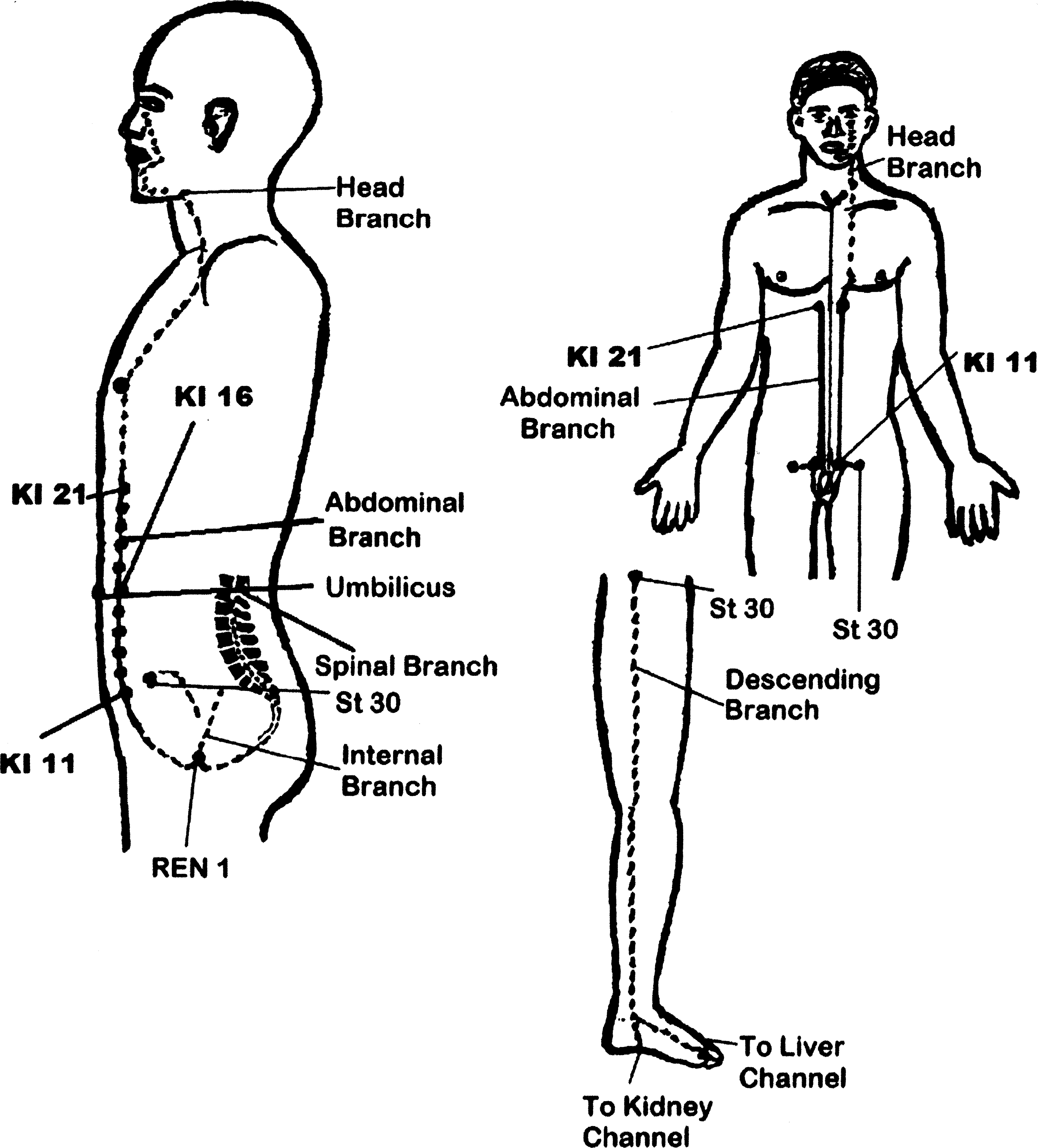
Chong Mai Extra Meridian.
Clinical Significance of the Branches
The Internal Branch is functionally related to the Kidneys and the Uterus/Prostate and, hence, is important in gynecological disorders, and disorders of the prostate and kidneys.
The Abdominal Branch is related to the syndrome of Rebellious Qi of Chong Mai. In this condition, the Qi of Chong Mai rebels upward, producing Heat in the upper part of the body and Coldness in the feet. This is characteristic and caused by a Deficiency of Qi in the feet and an Excess of Qi in the upper part of the body.There is a feeling of distension all along the path of this branch—in the pelvis, abdomen, and chest; this sensation is associated with pain, tightness in the chest, palpitations, sighing, breathlessness, a “lump” sensation in the throat, Heat in the face, headaches, and Internal Urgency (anxiety and restlessness).
The Head Branch produces a “lump in the throat” sensation that is associated with Rebellious Qi.
The Spinal Branch produces back pain in menstrual disorders.
The Descending Branch ends at LR 3. Many of the various actions of LR 3 could be the result of this connection; every time one stimulates LR 3, the Thoroughfare Vessel becomes stimulated.
Chong Mai is known as the Sea of Blood and the Sea of Twelve Channels.
Sea of Blood
Chong Mai controls the Blood Connecting channels. These are networks of channels, at a deeper level than the Principal meridians where Stasis of Blood is the pathology. There are two types of Connecting channels—superficial and deep. The superficial Connecting channels occupy the space between muscles and skin, and this is where Defensive Qi circulates. The deeper Connecting channels occupy the space between the Main meridians, and this is where Blood Stagnations occurs. The flow of Qi in the Main channels is in the vertical direction. The flow of Qi in the Connecting channels occurs in a horizontal direction, and these are the channels through which the Principal meridians control the areas that are not physically traversed by them.
In Chinese Medicine, Blood Stasis has deep significance. This is responsible for serious disorders, such as cancer, various tumours, endometriosis, ischemic heart disease and stroke. Clinically, Blood Stasis is associated with stabbing fixed pains, dark color, purple lips and nails, dark clots, a purple tongue, and a wiry or choppy pulse. Chong Mai has to be used in all cases of Blood Stasis in gynaecology and, in fact, in any area of the body. Whenever pain is fixed in one location, such as hemicrania continua or post-traumatic pain, there is usually Stasis of the Blood.
Sea of 12 Channels
Chong Mai affects all 12 channels and also all Connecting channels in all areas of the body, with the exception of the arms where this meridian has no branches.
Chong Mai has connections with all organs and, hence, it is also called the Sea of the Five Yin and Six Yang Organs. It influences female breasts, because it disperses in this area. This meridian also controls all Connecting channels in the breasts. Stagnation of Qi in Chong Mai causes distension and pain in the breasts, and, over the long-term, causes lumps. Being the Sea of Blood, this meridian is responsible for transforming blood to milk after childbirth. If there is Qi Stagnation in this vessel, there will be difficulty in expressing milk. If Blood is Deficient in this channel, there will be a reduced formation of milk, as there would not be enough Blood available to be transformed into milk.
Because this vessel disperses in the chest and is the Sea of Blood, it has a direct influence on the Heart and is used to address cardiac pain and arrhythmia. Because this vessel emerges from ST 30, it is useful for addressing many disorders of the Stomach, especially Excess conditions.
Kidney and Heart Relationship
The relationship between the Kidney and Heart is being recognized increasingly in modern medicine—a disorder of one has repercussions on the other. This is explained in Chinese Medicine in two ways:
(1) Qi circulation leaves the Heart channel and goes to the Small Intestine channel at the little finger (a Yin–Yang relationship), this then connects to the Bladder channel in the Head (an Axis relationship), then goes to the Kidney channel in the foot (a Yin–Yang relationship), and then returns back to the Heart channel (an Axis relationship), thus completing the second circulation of Qi. (2) Chong Mai originates in the space below the Kidneys and disperses in the chest, thus connecting the Kidney with the Heart.
The descending branch of the Chong Mai extends to the foot, taking Yin Qi to the foot and, hence, pathology here causes restless legs, poor circulation, and numbness and tingling in the legs. This branch also has a considerable role in maintaining the tone of abdominal muscles, health of the uterus/prostate, and erection of the penis.
Areas of the body influenced are the abdomen, chest, throat, face, head, uterus/prostate, lumbar spine, and medial aspect of legs and feet, as shown by this branch's pathway.
Stimulation Methods
Three stimulation methods are commonly used:
(1) Bilateral stimulation of Opening and Coupled points, in that order (2) Unilateral crossed over method in which the Opening point is stimulated on one side (right side in women, left side in men) and the Coupled point is stimulated on the opposite side; if the pathology is on one side, then the gender difference is ignored and the Opening point is stimulated on the affected side and the Coupled point is stimulated on the other side; a reducing or even method is used in both of the above stimulations (3) Bilateral stimulation of Opening points, Coupled points, Entry and Exit points, in that order; the Entry point is reinforced while the other points are stimulated by a reducing or even method; this is the author's preferred method.
When Opening and Coupled points are stimulated, the combination effects supersede the individual effects of the points.
Treatment
Table 1 shows the signs, symptoms, and point combinations for treating IBS.
Note: The following points can be used in all cases of irritable bowel syndrome irrespective of the Disharmony patterns for symptom relief:
1. All cases—KI 16
2. Acute abdominal pain—ST 34, ST 36, LI 4 & ST 25
3. Nausea and vomiting—PC 6 & ST 36
4. Diarrhea—ST 25, CV 6, CV 3, ST 36, ST 37, SP 4 & SP6
5. Constipation—ST 25, TE 6, ST 36 & CV 12
6. Abdominal distension—GB 25, LR 13, GB 26, CV 12, PC 6, ST 36, SP 6 & LR 3
All points are reduced.
Typical Points
(1) Liver Qi Stagnation—This is an Excess pattern and moxa should not be used. A reduction method is applied to the following points:
• PC 6—if there are emotional problems
• GB 34—if there is pain in the hypochondrium
• LR 3—if the symptoms are in the throat and head
• TE 6—if the symptoms are on the lateral aspect of the body
• LR 13—if there are Spleen-related symptoms (the Mu point of the Spleen)
• LR 14—if there are abdominal symptoms (the Mu point of Liver)
• CV 13—if Excess Liver invades the Stomach and produces vomiting, regurgitation of food, epigastric distensionm or hiccups, as this point facilitates the descending of Stomach Qi.
(2) Deficiency of Spleen Qi—This is the most common cause of tiredness seen in practice. Moxa heating at SP 6 and ST 36 provides almost immediate relief from chronic tiredness. Other points to be reinforced are SP 3 (the Source point of the Spleen), BL 20 (the Back Shu point of the Spleen), BL 21 (the Back Shu point of the Stomach), and CV 12 (the Mu point of the Stomach).
(3) Retention of Food—The most important step is to promote the descending of Stomach Qi. CV 13 is the most useful point for this purpose. Other useful points are ST 20, ST 21, and the distal points ST 44 and ST 45. ST 25 promotes bowel movements as this is the Mu point of the Large Intestine, and this helps Stomach Qi to descend. All points are reduced.
Auricular Points
The Principal Points are the Abdomen, Constipation, Shenmen, Stomach, Point Zero, Small Intestine, Large Intestine, Rectum, and Rectum E. Supplementary Points are the Pancreas, Occiput, San Jiao, and Sympathetic Autonomic point.
In 21 cases of IBS seen by the author recently, all of the patients had abdominal distension and discomfort. Nine patients had reduced a frequency of stools (IBS-C) and 12 patients had increased frequency of motion (IBS-D). After 8 weeks of acupuncture (twice weekly), bloating was totally relieved in 19 cases (90.5%). Of 2 two less-relieved cases, 1 had antimitochondrial antibodies with no evidence of biliary cirrhosis; the other patient had persistent elevation of serum amylase for which no cause was found after extensive investigations. Reduced stool frequency (IBS-C) was relieved in 7 of 9 cases (78%), and increased stool frequency was relieved in 10 of 12 cases (83%).These results were obtained after using Chong Mai and KI 16 in all cases, stimulating the specific symptom points and correcting the associated Disharmonies.
Addressing the Fundamental Problem
The fundamental problem is Liver Qi Stagnation. This causes distension, bloating and pain. When Rebellious Liver Qi invades the Stomach, the patient gets epigastric pain and belching; when this Qi invades the Spleen, there is loose motion, and when this Qi invades the Intestines there is constipation. The treatment has to be directed to reducing the Liver Qi Stagnation using GB 34, LR 3, LR 13, LR 14, TE 6, and PC 6. The effects of acupuncture without addressing the causative factors producing Liver Qi Stagnation will be temporary.
Emotional factors (anger, worry, and sadness) and dietary factors (hot energy foods [alcohol, red meat, and spices], greasy foods, dairy products and fried foods), have to be addressed to achieve better long-term results. Supplements to nourish the Liver—such as dandelion (Taraxacum officinale) tea, milk thistle (Silybum marianum), etc.—will potentiate the effects of acupuncture, and produce better long-term benefits and reduced recurrences.
Illustrative Cases
Informed written consent was obtained from all three patients to discuss and publish their case histories.
Case 1
A 49-year old woman had constipation alternating with diarrhea, abdominal distension, and pain; gastroesophageal reflux; and substernal pain for more than 10 years. Her tongue colour was normal, with redder sides; her pulse was firm and slightly wiry on the left side.
This patient's bloating and constipation were caused by Liver Qi Stagnation, which invading the Spleen, causing diarrhea. Her gastroesophageal reflux could have resulted from Liver Qi Stagnation invading the Stomach or from Rebellious Qi of Chong Mai. The latter diagnosis for this patient's reflux was preferrred because her pulse was firm in all positions (beating straight up and down) and was only slightly wiry. Her red tongue sides indicated Liver Excess.
She was treated using SP 4, PC 6, and KI 21 (all reduced), and KI 11 (reinforced) to stimulate Chong Mai. KI 16 was also reduced. This combination of points reduced most of her symptoms. Other points used were LR 13 to harmonize the Liver and Spleen, ST 25 and SP 15 to treat diarrhea and constipation, and GB 34 and LR 3 to promote a smooth flow of Qi and calm her abdominal pain, all by the reduction method. CV 12, ST 36 and SP 6 were reinforced to tonify the patient's Spleen.
After 8 weeks of treatment (twice weekly), this patient's symptom relief was near total. Acupuncture was then continued on a monthly basis. This is a problem period for recurrence when a patient is weaned from acupuncture; so focus on causative factors is necessary. The foremost is anger, which includes frustration, irritation, and resentment. It is not easy to address these factors, but if this is not done, symptoms will return. Worry and sadness also affect the Liver. Dietary advice regarding reduced consumption of red meat, spices, greasy foods and alcohol is essential. All these were addressed with this patient. Herbs, such as dandelion tea and milk thistle support the Liver and will help in reducing recurrence. The patient was advised about the effect of these herbs.
Case 2
A 78-year-old woman had abdominal bloating with pain and several loose motions per day for several years. She also had low-back pain, osteoarthritis of her knees, and bilateral ankle edema. Her tongue was generally moist, with sticky coating and reddish sides. Her pulse was weak in both rear positions, and was generally slippery and wiry in the left middle position.
This patient had combined Excess and Deficiency. The Excess was shown by Liver Qi Stagnation causing abdominal bloating and pain. The patient's tongue edges were red and raised, and her pulse was wiry in the left middle position. When this Excess Liver invades the Spleen, this causes diarrhea. Reduced Spleen function causes Stagnation in the transport of fluids, and this, in turn, causes internal Dampness as shown by this patients' slightly swollen and sticky tongue coating. Stagnated fluid surrounded her the pulse and caused it to slip under the fingers (a slippery pulse). Her Deficiency of Kidney Yang was shown by her LBP, OA of her knees and ankle, edema, her moist tongue, and her weak rear pulses. Mixed Excess and Deficiency patterns are fairly common.
She was treated, using SP 4 right and PC 6 left (to stimulate the Chong Mai), and KI 16. All points were reduced. This combination was immediately effective for reducing this patient's abdominal pain and bloating.
Other points used were LR 13, GB 34, and ST 39 to harmonize the Liver and Spleen, pacify the Liver, and reduce abdominal pains. All the above points were reduced; CV 12, BL 20, ST 36, and SP 6 were reinforced to tonify the Spleen. BL 23, KI 3 and GV 4 were reinforced to benefit the Kidney Yang.
This patient was almost symptom-free after 8 weeks and was advised to have further ongoing treatment on a monthly basis for additional time and to follow dietary advice and management of emotional factors as given in Case 1.
Case 3
A 74-year-old woman was experiencing abdominal distension, belching, irritability, and constipation (2–3 bowel movements in a week) for >15 years. Her tongue color was generally normal but slightly red on the sides (indicating Liver Excess). Her pulse was wiry on the left side (Liver Excess).
This was a case of IBS caused by Liver Qi Stagnation, producing belching, distension, and constipation. There was no Spleen involvement.
This patient was treated, using the following points: SP 4 right and PC 6 left, both reduced to stimulate Chong Mai; KI 16 reduced; LR 3, SP 15, and GB 34 reduced to facilitate movement of Qi; CV 6 reinforced to move Qi in the lower abdomen; and CV 10 reinforced to promote descending of Stomach Qi. She had near-total improvement while receiving acupuncture. When she was weaned from acupuncture, her constipation recurred quickly, mostly because of the long duration of constipation to which she had been habituated. She had Excess iron deposition in the Liver with no other features of hemochromatosis, and this did not help her prognosis. Habitual constipation often takes a long time to resolve, probably because of a remodeling effect.
Equipment Used for Cases
All points were stimulated using a Pointer (Excel II. This is a handheld point locator and stimulator that has two separate control dials for point detection and stimulation, with the following specifications:
• Channel—single-output channel • Frequency—1–16 Hz adjustable±20% • Current output—blue zone on dial (0–2 mA), black zone (2–45 mA) ±20% on 500 ohm loading • Pulse width—260 microseconds • Pulse shape—biphasic square wave • Pulse mode—continuous • Power source—uses one 9 volt battery • Additional features—has a polarity-reversal switch for reduction and tonification; a flashing light and sound indicate when point detection is made; a grounding circuit is made by holding the metal plate on the unit or with the handheld grounding pole.
The method used was to determine the anatomical location of each point first. This was confirmed further by the pointer detection. Then the point-location dial was adjusted to maximum (10), with a search using the spring action-probe and ensuring that the pressure exerted was minimal and uniform. A flashing light and sound indicated point location. This was confirmed further by pressing the stimulator button at a low-intensity level (adjusting the sensitivity dial to between 2 and 4), and there was usually a definite tingling sensation felt by the patient when point location was made. The point was then stimulated for 30 seconds, with the polarity switch at the−or+position for reduction or reinforcement, and the stimulation dial was adjusted to the level of the patient's comfort. The dial is usually set between the levels of tingling sensation and feeling of discomfort.
This is low-frequency equipment (1–16 Hz). 10 Hz was used as such a level was sufficient to provide heat, recovery, enhanced circulation (important for AhSHI points), and acupoint stimulation. Lower frequencies were used if there was patient discomfort.
The author preferred this equipment for various reasons:
• Point location is accurate, using a combination of anatomical location, instrument-assisted point location, and subjective sensation of tingling felt by the patient. • Using this equipment is less time consuming than initial needle-point stimulation and then connecting the needles to electroacupuncture equipment. • There is a polarity-reversal switch that produces a more-definite stimulation and does away with needle manipulation. • Most chronic diseases need maintenance treatment after the initial 6–8 weeks of biweekly acupuncture.
The author usually treats such patients on a monthly basis afterward for ∼2 years, and if there are breakthrough symptoms one or two additional treatments are given. It is very easy to train a patient to self-administer the treatment, using this device during those breakthrough episodes. For example in IBS, all that the patient has to do would be to use unilateral crossed-over stimulation for SP 4 and PC 6, plus bilateral stimulation of KI 16, and that could avoid a trip to the doctor (see section on treatment). Two metal grounding plates attached to the unit obviates the use of a handheld grounding pole.
The equipment is designed for body and ear acupuncture and is distributed by Lhasa Oms Inc., Weymouth, MA. Please refer to safety precautions and warnings issued by the manufacturer prior to using this device.
In all of the cases described above, the author had made the diagnosis on the basis of symptoms, tongue, and pulse signs. A beginner in acupuncture who is not familiar with pulse or tongue signs can use the symptoms and signs listed in Table 1 and choose the points on that basis.
Discussion
Most gastroenterologists consider IBS to be a difficult condition to treat, with a significant psychological component. 28 Because of IBS’ multiorgan involvement and varying symptoms, a carefully planned, individualized, and comprehensive approach is necessary. The author has found the following approach most useful.
Use Extra Meridian Chong Mai in all cases first. Rebellious Qi of Chong Mai was discussed before; this will cover almost all symptoms of IBS. Any of the three methods of stimulation may be used. Additional stimulation of KI 16, which is a point along this meridian, will be of advantage.
In many cases, this alone will be sufficient, especially if the pulse is firm (beating straight up and down in all three positions—rear, middle and front). This is called the Chong Mai pulse.
Other symptoms that could point to Chong Mai involvement would be Blood Stasis, especially in gynecological conditions (endometriosis, dysmenorrhoea with dark clots; as this vessel is the Sea of Blood), lumps in the breast, disorders of the Stomach (the meridian emerges from ST 30), various chest symptoms (including cardiac arrhythmias; this meridian disperses in the chest), restless legs and disorders of circulation in legs (involving the Descending Branch), erectile dysfunction (this meridian is the Sea of Blood and an erection is filling with blood), prostate hypertrophy (Blood Stasis), and obesity.
One also has to look for signs and symptoms of Liver Qi Stagnation, Spleen Qi Deficiency, and Retention of Food as mentioned before, and add points accordingly, as discussed in the TREATMENT section.
Many psychological factors have been implicated in the causation of IBS. 29 The main emotions listed as causative and aggravating factors are anger, anxiety, fear, and worry. 30 Of these, anger and worry are more important in IBS, as they lead to Liver Qi Stagnation. If anger is expressed, it affects the Stomach more, preventing Stomach Qi from descending and producing nausea, belching, constipation, and epigastric pain. If the anger is repressed, it again produces Liver Qi Stagnation but this affects the Spleen more, producing diarrhea. Pain in the epigastrium can extend to the hypochondrial region. Pensiveness and worry affect both the Spleen and Lungs. The Spleen is responsible for moving the Essence of the Intestines and Lung Qi helps the Qi of the Intestines to descend. Disturbances of these functions lead to abdominal pain.
Many points are mentioned in various textbooks for addressing psychological problems and this can be quite confusing. The most useful points in the author's experience are GV 20, HT 7, PC 6, and UB 62. A reduction method is used.
Point KI 16 deserves special mention. Membranes that wrap around the abdominal organs, and the fatty tissue around them, fill the space in the abdominal cavity. The Qi in the abdomen passes through channels as well as membranes, and Qi Stagnation occurs also in the membranes. 31 KI 16, situated in the pathway of Chong Mai, is the Transporting point of the membranes. Qi Stagnation in the abdomen causes distension and pain. Being in the center of abdomen, this point has connections with membranes extending to the Heart above and the Kidney below. So this point is useful in Kidney Deficiency and Heart Deficiency, which causes anxiety, insomnia, and mental restlessness. KI 16 also has an effect on membranes covering the Intestines and, hence, this point is useful for addressing constipation and diarrhea. These symptoms, together, cover all manifestations of IBS.
Reducing auricular points is effective; the current author uses these points if the abovementioned points do not yield expected results.
Chinese herbs are useful, but their use needs clear analysis of the patterns of Disharmony, and, thus, herbs should be used strictly according to the patterns. Acupuncture neutralizes Disharmonies, but herbs are specific in their actions. Many Qi-moving herbs can injure Yin and Blood and, hence, should be left in the hands of an expert practitioner.
Conclusions
While the reports published in the Cochrane Database of Systemic Reviews indicated that acupuncture is no more effective than placebo for treating IBS, smaller studies showed that acupuncture was effective for reducing almost all symptoms of IBS.
In the experience of the author, when Chong Mai points are used initially and followed by specific points targeting the Disharmony patterns, the response to acupuncture is quite satisfactory, and repeated treatments demanded by recurrence often eradicates the disorder altogether. Attention to dietary and emotional factors (especially anger) and use of supplements to support the Liver are essential to prevent recurrence. Further high-quality studies are needed using this approach involving more number of patients to establish its efficacy. Most studies indicated better quality of life for acupuncture-treated patients.
Footnotes
Disclosure Statement
No financial conflicts of interest exist.