




Abstract
Abstract
Background:
Basic research on high-tech acupuncture has been successfully performed in Graz since 1997, using a broad spectrum of innovative biomedical engineering methods. This review discusses research in the field.
Objective:
One of the main goals of this review was to combine basic research on high-tech acupuncture with necessary further experimental and clinical pilot studies in China for the first time.
Setting, Patients, and Intervention:
Using electroacupuncture, needle, or laser stimulation, it is possible, for the first time, to quantify changes in biological activities caused by acupuncture. The patients were in China—but the analysis for the efficacy of acupuncture was performed by experts in Graz, Austria. This “transcontinental teleacupuncture” is a way that was realized by the Graz research team within its Sino–European projects.
Main outcome:
This research was aimed at successful transmission of acupuncture data from patients in China to the Medical University of Graz.
Methods:
Twenty-four hours of electrocardiographic (ECG) recordings from patients in China were collected, and data from these recordings were transferred directly after treatment to the Medical University of Graz.
Results:
The acupuncturists in China were informed about the results immediately based on the analysis protocol.
Conclusions:
Modernization of acupuncture is a contemporary issue. Creating a bridge between Eastern and Western medicine was successful, using modern biomedical engineering technology; the next task is to make these emerging possibilities and results useable for all involved persons.
Introduction
Materials and Methods
Goals and Objectives
The overall aim of the high-tech acupuncture research network was to perform joint theoretical and practical evidence-based acupuncture studies using an interdisciplinary approach through an exchange of experience and expertise among scientists from Europe, China, the United States, and other parts of the world. The following main objectives were:
• Develop an European–Chinese network, collaborating on high-tech acupuncture research including integrative laser therapy. • Perform transcontinental acupuncture studies. • Introduce new methodologies for acupuncture research and complementary laser research. • Propose standard protocols of methodology. • Propose priority areas for future acupuncture research. • Develop sustainable Sino–European collaboration on high-tech acupuncture research and integrative laser medicine using biomedical equipment, • Modernize acupuncture (via use of evidence-based medicine and integrative laser medicine) • Develop innovative acupuncture stimulation methods further (needle-, laser-, and electro-acupuncture [EA]) • Develop methods for the quantification of peripheral and central effects of acupuncture. • Evaluate complementary medical methods (acupuncture, acupressure, moxibustion, and laser therapy) scientifically. • Use computer-controlled acupuncture. • Use teleacupuncture. • Use laser-needle acupuncture. • Use red- and infrared laser stimulation. • Use violet laser–acupuncture. • Assess acupuncture biomedically.
Structure and High-Tech Acupuncture Network
As shown in Figure 1, apart from the University's main partner, the China Academy of Chinese Medical Sciences, there was important cooperation with the Beijing University of Traditional Chinese Medicine, the Capital Medical University of Beijing, and the Heilongjiang University of Chinese Medicine; this cooperation is partly already reflected in several publications on the topic (see Fig. 1). In addition, ten Master's theses were completed, all of which are based on data acquired in China and Austria by students.

Existing High-Tech Acupuncture Research Network, established by the Medical University of Graz in the years 2008–2012. Amplification in the years 2012–2015 is in progress and is of high scientific priority. PRJ, publication in a referenced journal; OP, other publication; PP, published proceedings; UP, unpublished presentation; MT, Master's thesis; OI, other initiative; VP, visiting professorship; HP, honorary professorship. Figure used with permission, courtesy of Dr. Litscher.
The research team in Graz is coordinating transcontinental acupuncture research studies, recruitment of additional experts, editing manuscripts and websites, drafting standard protocols and operating procedures, providing scientific and technological support, and offering guidance concerning new biomedical engineering measurement procedures and laser-stimulation techniques.
Teleacupuncture
Patients were in China—the analysis for the efficacy of acupuncture was performed by experts in Graz. This transcontinental teleacupuncture is an approach that was realized by the Graz research team within joint Sino–Austrian and Sino–European projects. The investigations were carried out over thousands of kilometers: 24 hours of electrocardiographic (ECG) recordings from patients were registered in China, and the data were transferred directly after the acupuncture treatments to an analysis computer at the Medical University of Graz. The acupuncturists in China were informed about the results immediately based on the analysis protocol.17,18 The exact measurement procedure and analysis technique of heart rate variability (HRV) have been discussed in previous studies.17,18
Results
Figure 2 shows the improvement in health (sleep–wake cycle) of a 31-year-old female patient from Beijing over the course of more than 2 months. At the beginning of treatment (Fig 2A) the sleep–wake cycle is not clearly marked. After four acupuncture treatments using needle and laser needle acupuncture (Fig 2B), there is a clearly marked sinus arrhythmia (middle) in the sleep state (0.2–0.3 Hz frequency). After ten acupuncture treatments (Fig 2C), this standard pattern has become stable. For the first time, the therapeutic effect of acupuncture can be visualized not only subjectively, as described by a patient, but with computer-based objective data.17,18

Laser Acupuncture and Integrative Laser Therapy
A further example of the use of teleacupuncture was realized using laser acupuncture. Only recently, the first scientific results concerning a new method of acupuncture, violet laser–needle acupuncture, were presented. It is possible to achieve significant effects, such as increases in blood flow in small vessels, with the violet wavelength of 405 nm (Fig. 3) and a specially focused beam at the acupuncture point, despite low penetration depth. Within a cooperative research project between Austria and China, first scientific results on this new violet–laser acupuncture method were published.19,20 In addition, the new violet laser can trigger a De Qi feeling, usually typical for needle acupuncture, which often manifests itself as a mild electric tingling.
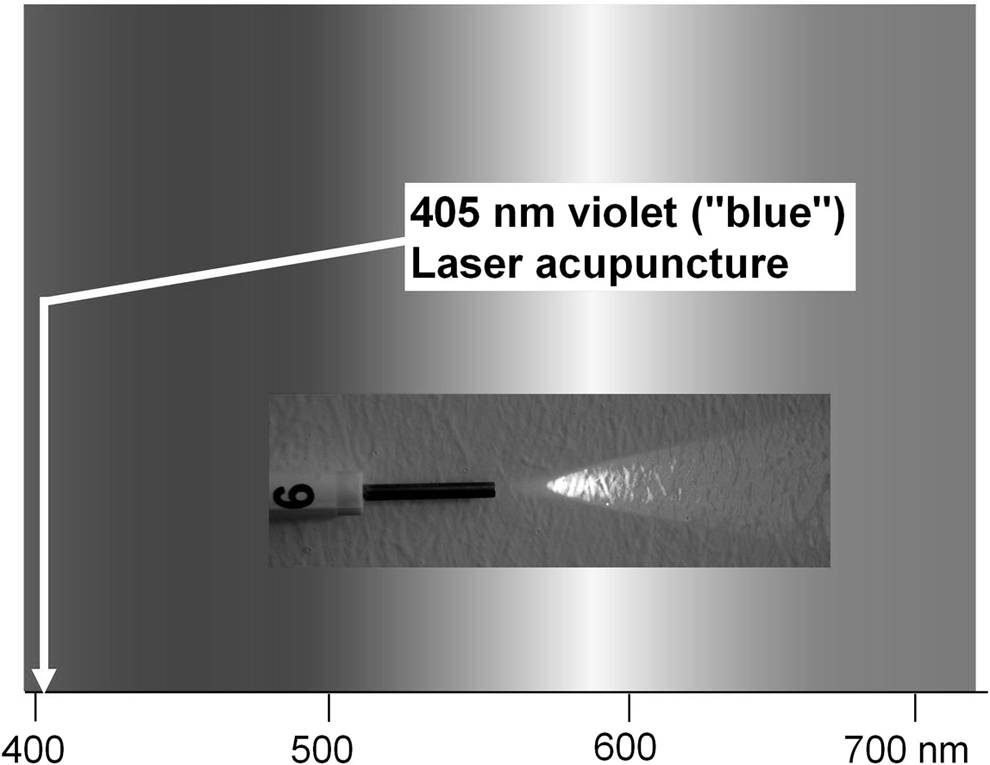
Violet laser–acupuncture needle (modified from ref. 20).
For Chinese acupuncturists and patients, De Qi solicitation is an important prerequisite for a successful needle treatment on the body. De Qi is not immediately perceived by patients or healthy volunteers with a red or infrared laser, but this perception does occur with a violet laser.21,22 Thirteen adult Chinese volunteers reported an immediate sensation evoked by application of a violet laser, similar to the De Qi sensation evoked by a metal needle. “The effect is comparatively not as strong as an ant bite, but [is] longer-lasting,” said a healthy Chinese female volunteer. When the acupuncture point, PC 6, was violet-laser stimulated, there was a significant decrease in this volunteer's heart rate associated with a pleasant, stress-reducing experience. 21 In a controlled study design with the violet laser “turned off,” there was no perception of a De Qi–like sensation. 21 Further violet-laser investigations, determining whether or not a De Qi-like perception is also experienced by Europeans, are in progress. Thermal evaluations of the violet laser also need to be pursued (see Fig. 4). Violet-laser stimulations of specific acupuncture points may be useful for addressing cardiovascular disease and should be researched appropriately in the future.
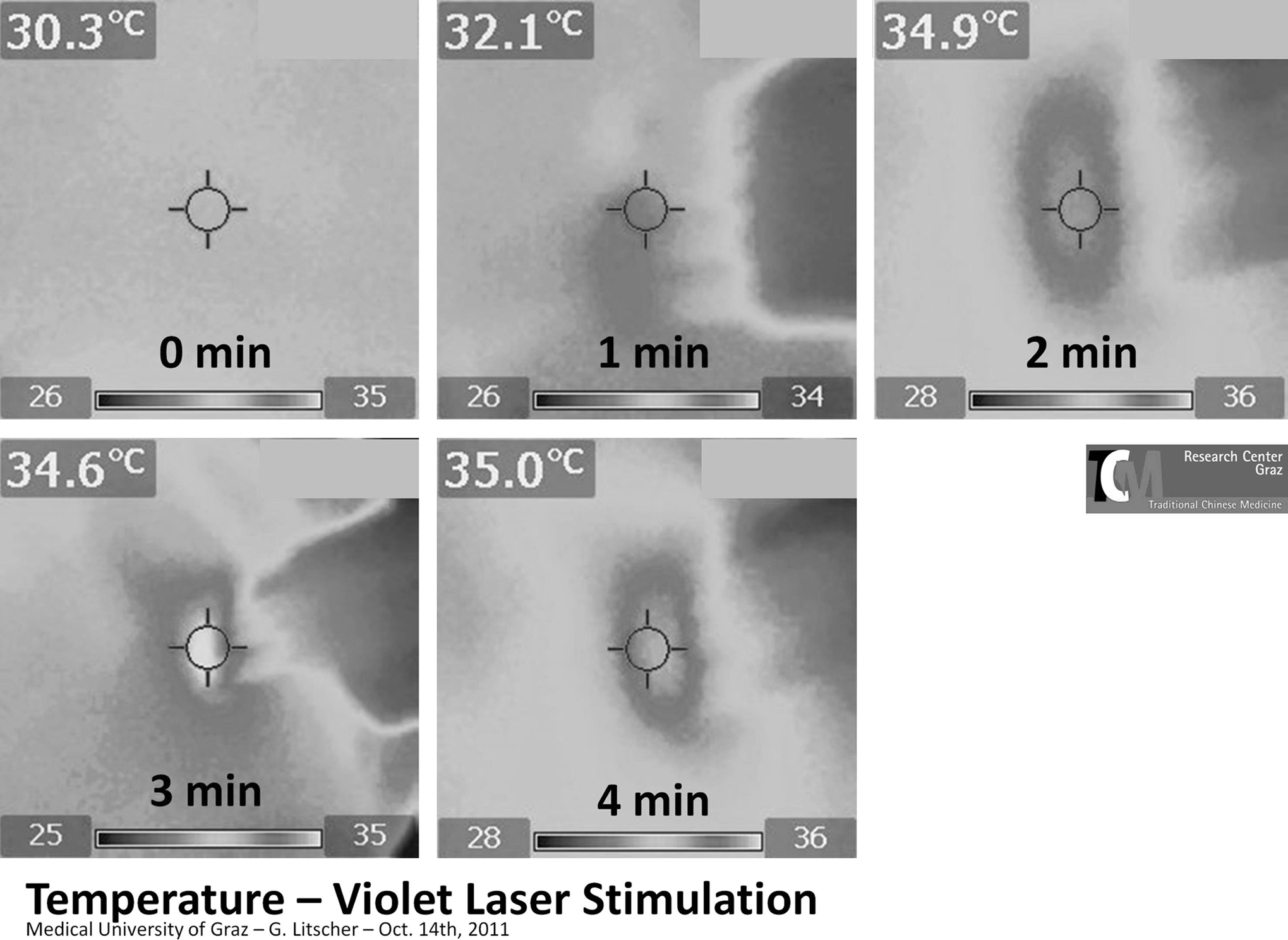
Violet-laser stimulation and temperature effects. Note the increase in temperature is ∼ 4.7°C within 4 minutes. FLIR is camera manufacturer's name. Figure used with permission, courtesy of Dr. Litscher.
Another piece of equipment for laser stimulation (5×30 W, pulse 200 ns) is shown in Figure 5. In this case, light with a wavelength of 904 nm is used.

Laser stimulation system for laser therapy (Reimers & Janssen, Germany) at the Stronach Research Unit for Complementary and Integrative Laser Medicine at the Medical University of Graz.
Discussion
Telecommunication technology includes the assisted transmission of signals and biological data over a distance. In this context, telemedicine, like telesurgery and also teleanesthesiology, have become more interesting. However, teleacupuncture has not yet been performed by other research groups.
For HRV analysis the University used the so-called “Fire of Life” analysis technique, which has been described in previous studies.17,18 The example discussed in this short review article is the first teleacupuncture measurement between Asia and Europe. Teleacupuncture could probably be useful under special circumstances, for example, for cooperation between experts from different continents as demonstrated in this Sino–European collaboration.
The scope of HRV is not yet completely clear, but it is known that there intraindividual and interindividual variances and that HRV depends on age. 23 It becomes less random with the aging process and the appearance of age-related diseases. Apart from age, circadian variations (sleep–wake-cycle), physical condition, and mental and physical exertion are important influencing factors. HRV can also be affected by diverse conditions, such as age-related diseases such as diabetic neuropathy, renal failure, essential hypertension, cardiac disorders, coronary artery disease, or intracranial lesions. In all cases, different medications have to be taken into account.
HRV can be used as a reliable indicator of the state of health. However, it could be demonstrated that, in special syndromes, such as stress, one can counteract this process using different preventive methods such as acupuncture. This has been shown in recent investigations concerning patients with burnout syndrome as performed in a common teleacupuncture study between China and Austria. 24
Conclusions
Acupuncture has been used for medical treatment for thousands of years. A large number of empirical data are available, but the technical quantification of effects was not possible up to now. Using EA, needle, or laser stimulation and modern biomedical techniques, it was possible, for the first time to quantify changes in biological activities caused by acupuncture. This contribution focuses on the latest innovative aspects that underline the further enhancement and development of acupuncture. Special emphasis is given to new methodological and technical investigations, for example, results obtained from acupuncture innovations (e.g., teleacupuncture) and integrative laser medicine. This is the basis for future Sino-European transcontinental basic and clinical high-tech acupuncture studies.25,26
Footnotes
Disclosure Statement
No competing financial interests exist.