




Abstract
Abstract
Background:
Only very few pharmacologic agents can target chronic fatigue, and the success of treatment depends on the successful treatment of the primary chronic condition that has produced the fatigue. In chronic fatigue syndrome (CFS), which is not associated with any chronic medical condition, the only treatment that holds some promise is cognitive behavioral therapy, which produces variable results. Acupuncture is unique position because it can effectively target Qi Deficiency, which is the root cause of chronic fatigue and CFS.
Objective:
The aim of this research was to assess the effect of acupuncture on all forms of chronic fatigue, including CFS and associated pathologies.
Methods:
Thirty cases were studied from the medical records of the current author from 2011 to 2013. These cases represented a wide cross-section of various chronic disorders in which fatigue was a prominent symptom or in which CFS was diagnosed. The primary endpoint was immediate effect on fatigue after the first treatment, the secondary endpoint was level of fatigue after the fourth treatment, and the final endpoint was level of fatigue after sixteen treatments. The first four treatments solely addressed fatigue; treatments 5–16 targeted both fatigue and Chinese Disharmony Patterns.
Results:
There was a 28% improvement in the average fatigue score immediately after the first treatment. After four treatments, the average improvement was 58%, and, after sixteen treatments, the average improvement was 90%. The residual average fatigue score was 6%, while the individual fatigue scores for many patients came down to 0%.
Conclusions:
Acupuncture is a most effective modality of treatment for chronic fatigue and CFS, especially in terminally ill patients, for whom acupuncture is useful, because, it is usually effective without side-effects.
Introduction
F
Chronic fatigue syndrome (CFS) is characterized by debilitating fatigue that lasts for >6 months (3 months in children and adolescents), is not significantly relieved by rest, is not related to exertion, and is not caused by other medical conditions. There is usually muscle and joint pain and headache that were not experienced before. The United States statistics for CFS show an overall prevalence of 235 per 100,000 persons and that CFS is more common in women (373 per 100,000). 5 This article focuses on acupuncture treatment of fatigue and CFS. In Chinese medicine, fatigue is usually a Deficiency of Qi but can occasionally be caused by an Excess condition. Qi may not be Deficient, but Stagnant, and hence, there is an impaired flow of Qi that is occurring, a Qi Deficiency distal to the block, and an Excess of Qi proximal to the block producing distension.
Causes of Fatigue
Causes of fatigue include:
• Weak constitution, determined by the parents' constitution in general (their health at the time of conception and factors associated with pregnancy and early development) • Hormonal and life changes at puberty, pregnancy, and menopause • Overwork (physical and mental) • Physical overexertion, such as engaging in excessive sports. • Various illnesses, in fact, any chronic illness, especially diabetes, hypothyroidism, adrenal insufficiency, and malignancies • Excessive sexual activity (this causes depletion of Kidney essence) • Childbirth • Medication • Recreational drugs • Malnutrition • Lack of sleep.
Chinese medicine also delineates the following pathologic roots of disease. Typically, such roots include, but are not limited to:
• Deficiency of any Yin or Yang organ (mostly of Yin organs) • Excess conditions, such as Stagnation to the flow of Qi in various organs, producing Deficiency distal to the block and Excess proximal to the block, usually manifesting as an Excess condition.
A classic example would be Liver Qi stagnation causing Liver Yang to rise, and associated fatigue.
Chinese Medicine Diagnosis of Chronic Fatigue
Diagnosis requires:
• Distinguishing between Deficiency and Excess (Table 1) • Identifying the organ(s) involved.
This applies to all cases of chronic fatigue, and CFS.
The following fundamental knowledge is essential:
Qi Deficiency is characterized by fatigue, hypoactivity, a low voice, shortness of breath, deficient immune function, low spirits, reluctance to speak, and a pale face. The tongue is pale, and the pulse is weak and empty.
Yang Deficiency has all the above symptoms plus Coldness symptoms, such as cold hands and feet, an increased sensitivity to cold, an aversion to cold, and possibly hypotension. The tongue is moist, because there is no Heat to dry the tongue. The pulse is weak and slow.
Yin Deficiency has all the symptoms of Qi Deficiency, plus symptoms of Heat such as warm palms and soles, a dry mouth, dry eyes, dry nose (Heat dries), and night sweating. The tongue is red, with a thin coat. The pulse is rapid. Yang goes up, producing Heat.
Blood Deficiency produces blurred vision, insomnia, paresthesiae, dizziness, hypotension, a pale face and lips, dry skin, and cold extremities. The tongue is pale, and the pulse is choppy.
Qi Stagnation, in which distension is the cardinal symptom; it is often complained of as bloating. The site of distension varies according to the organ involved. Common abdominal bloating is caused by Qi Stagnation in the Liver. There can be associated pain. The tongue has no specific features, and the pulse is wiry.
To this general picture one adds symptoms specific to the involved organ(s).
Liver. There are several problems involving the Liver. These include:
• Liver Qi Stagnation—This causes hypochondrial distension, irritability, premenstrual tension, irregular menses (caused the influence of the Liver on menstruation); a wiry pulse in all Liver Excesses; and variable tongue signs. • Liver Yang Rising—Because the Yang rises to the head, there is a headache which is usually throbbing; a Wiry pulse; and variable tongue signs. • Liver Fire—Fire is red, so, the patient has a red face; and Fire dries, producing thirst, scanty urine, and dry stools; Fire is hot, producing Heat in the face and bloodshot eyes; and Fire burns, producing a red tongue with redder sides, and a coating that is is toasted to a yellowish-brown color; and the pulse is wiry, as is all Liver Excess patterns. • Liver Wind—Any movement that is normally under voluntary control, if that movement occurs involuntarily, that is a Wind condition; internal wind is a Liver pathology, thus, it produces tremors or sometimes the opposite (paralysis and numbness); and the pulse is wiry. • Liver Blood Deficiency—This produces blurry vision (the Liver opens to the eyes); cramps in muscles (the Liver nourishes the sinews); rigid nails (the Liver nourishes the nails); insomnia (the Ethereal Soul is rooted in the Liver, and this Soul gets unrooted in Liver Blood Deficiency, hence, the result is insomnia); Scanty periods (the Liver regulates menstruation); the tongue is pale and thin; and the pulse is choppy. • Liver Yin Deficiency—Eye and menstrual symptoms predominate, including blurred vision, dry eyes, and floaters in the eyes, diminished night vision, scanty menstruation, amenorrhea, muscle cramps, withered nails, and insomnia; The pulse is empty; the tongue is usually without coating; if there is empty Heat caused by a Yin Deficiency, there will be night sweating, heat in the palms and soles, heavy menses, and thirst; empty Heat is due to the inability of Yin to control the Yang; add in general features of Yin Deficiency.
Spleen. Add to the general picture, digestive symptoms, such as poor appetite and loose stools. The Spleen is responsible for holding organs in their proper places, and, in Spleen Deficiency, there is are prolapses of the Uterus, Stomach, etc. The Spleen holds the stool in the Intestine and Blood in the blood vessels; hence Deficiency causes diarrhea and bleeding. In Spleen Yang Deficiency, there is coldness in the extremities. In Spleen Blood Deficiency one must add add scanty menses. The tongue has transverse cracks on its sides. It is not uncommon to find associated Stomach Deficiency, in which the tongue has a midline crack in the center.
Kidneys. The Kidney has no Excess pattern apart from pyelonephritis. In all Kidney Deficiencies, there is tinnitus, dizziness, and lower backache. In Yin Deficiency, there is heat and night sweating, a floating empty pulse, and a tongue without a coating.
In Yang Deficiency, there is feeling of coldness (especially in the knees), a pale moist tongue, and a deep weak pulse.
Heart. Palpitation is the most important symptom in all Heart patterns. Heart houses the mind and hence mental/emotional symptoms are predominant (e.g., anxiety in Heart Blood Deficiency or agitation in Heart Fire). Heart opens to the tongue and hence in Heart Fire there are tongue ulcers. The pulse is empty in Qi Deficiency and Yin Deficiency, weak and deep in Yang Deficiency, and choppy in Blood Deficiency. Stagnation of Blood in the Heart relates to coronary artery disease. This is the only Heart pattern related to chest pain, all other chest pains are related to Pericardium patterns.
Lungs. In addition to general symptoms, add slight shortness of breath, dry cough, and hoarse voice. Lungs influence defensive Qi, and, hence, there is reduced resistance to infection in Lung Deficiencies. Syndromes related to fatigue are Lung Yin and Qi Deficiency.
Additional factors. There are two additional pathogenic factors to be considered in chronic fatigue; these are Dampness and Phlegm.
Both arise as a result of Spleen Deficiency. The Spleen is responsible for the transportation of body fluids, and, when this is affected as a result of Deficiency, fluids tend to accumulate; this is called internal Dampness. When the fluid thus accumulated condenses, that forms Phlegm. Both produce chronic fatigue; a thick sticky coating on the tongue; slippery pulse; and confusion with heaviness and clouding in the head; but dizziness is a feature of Phlegm.
Phlegm can cause mental confusion producing mental illness (psychosis), but Dampness has no such effect.
In CFS, the distinguishing features are the additional presence of muscular aching, intermittent or continuous fever (flulike symptoms), and glandular enlargement in some cases.
Western Diagnosis of Chronic Fatigue and Correlation with Chinese Medicine
Western Diagnosticians define CFS by the presence of the following symptoms:
(1) New onset of severe fatigue for 6 months or more that is not produced by exertion, is not relieved by rest, and is not caused by other illnesses. (2) Four or more of the following: • Impaired memory or concentration • Postexertional malaise, causing severe fatigue • Unrefreshing sleep • Muscle pain • Arthralgia • New-onset headache • Tender lymphadenopathy • Recurring sore throats.
This is explained in Chinese medicine by the concept of latent Heat. External Heat invades the body without causing immediate symptoms; converts into latent Heat; and emerges later causing fever, muscular aches, and fatigue. The recurrence is explained in terms of residual pathogenic factors that have not been completely eliminated and emerge later when the body's defenses are inadequate.
The greater Yang channels BL+SI control the back of the body, the lesser Yang channels GB+TE control the sides of the body, and the bright Yang channels ST+LI control the front of the body.
External Wind can sometimes get lodged in the energetic niche between Yang Ming (bright Yang) and Tai Yang (greater Yang) channels, and this is called the lesser Yang pattern. This causes the alternating feelings of heat and cold, fullness of the hypochondrium, a bitter taste, blurry vision, and awiry pulse. Bright Yang (Stomach and large Intestine) is the most interior, greater Yang (Small Intestine and Urinary Bladder) is the most exterior, and lesser Yang (Gall Bladder and Triple Energizer) lie in between. When the pathogenic factor bounces between the interior and exterior it produces Heat and Cold respectively. This pattern is seen fairly frequently, and, because of hypochondrial fullness and pain in the lower ribs, these patients are examined for Gall Bladder and Lung problems.
Treatment for Chronic Fatigue
In Western medicine, treatment is directed to the associated medical condition in cases of chronic fatigue. For CFS, cognitive behavioral therapy (CBT) is the treatment of choice. Graded exercise therapy has been found to be beneficial in some cases. Somatic comorbidity, disability claims, and severe pains are associated with poor prognoses.
Chinese medicine lists various syndromes associated with fatigue and this can appear to be complex when attempting treatment. One textbook describes fifteen syndromes with their associated point combinations. 6
The current author follows a simple method. Whatever the cause of fatigue may be—Deficiency or Excess, ultimately, there should be a Qi Deficiency, either relative or absolute, to produce fatigue. Thus, it is necessary to stimulate the Qi first. Apart from the pre-Heaven Qi (original Qi), which is related to pre-Heaven essence and is formed from the parents and present in their neonate at the time of birth, all the other forms of Qi are formed from the food human beings consume and is made by the combined actions of the Stomach and Spleen. Thus, the acupuncturist stimulates SP 6 and ST 36 (the most important points), and also KI 3, to stimulate the Kidney, which supports the Stomach and Spleen. Also stimulated are BL 20, BL 21, and BL 23 (back Shu points of the Spleen, Stomach and Kidney, respectively); CV 12 (the front Mu point of the Stomach), which stimulates both the Spleen and Stomach; CV 4 (stimulates the Kidney); and CV 6 (stimulates Qi in general). If the above points are not sufficient, the acupuncturist next reinforces SI 3+BL 62 in that order, and this stimulates the GV channel, which is the master Yang channel of the body, and the addition of GV 4 adds to the effects of the stimulation. The current author also stimulates GV 1 and GV 26 to potentiate the stimulation of the GV channel further. All of these points are reinforced. If there is Excess Yang, as in Liver Yang rising or Liver Fire, GV channel stimulation should be avoided. This will help the majority of patients almost immediately, irrespective of the associated organ disorders. Once this is done, further treatments for the associated Disharmonies are done as shown in Table 2A.
Jing Gong is 0.5 cun lateral to BL 52.
In CFS, it is important to distinguish whether the predominant factor is the pathogenic factor (an Excess pattern) or Deficiency of the body's resistance (a Deficiency pattern). A full strong pulse, which may be wiry or slippery, and the presence of muscular aching indicate an Excess pattern. A weak or very fine pulse would indicate a Deficiency pattern. See Table 2B.
Many of these patients may be quite sensitive to acupuncture and react adversely at the initial treatment. This is especially so in people with headaches; thus, point stimulation should be of low intensity to begin with and then increased gradually. In addition, any intercurrent infection can cause a relapse and should be treated promptly. GV 14 and SP 6 can be reinforced for immune stimulation and LI 11 can be reduced for reducing Heat.
Materials and Methods
Traditional Chinese Medicine Acupuncture was used in this study.
Study Design
Thirty cases were studied from the existing medical records in the current author's two medical clinics in Melbourne, Australia, from 2011 to 2013. This was a noninvasive clinical audit and no approval of an ethics committee was required. Written informed consent was obtained from all patients whose data were used. Subjects ranged in age from 12 to 88. Cases were selected according to two criteria: (1) patients had fatigue as a prominent symptom and (2) the fatigue was present for >6 months.
Three patients had CFS (cases 19, 20, and 29), and other patients had chronic fatigue in association with various chronic disorders:
• Diabetes mellitus (cases 3, 14) • Generalized osteoarthritis (cases 4 and 16) • Hypopituitarism (cases 5 and 10)) • Rheumatoid arthritis (cases 6 and 8) • Depression (cases 7 and 17) • Idiopathic chronic fatigue (cases 1, 9, and 15) • Overwork (case 10) • Cardiac failure (cases 11 and 25) • Pulmonary hypertension (case 12) • Crohn's disease (case 13) • Cirrhosis liver (case 18) • Chronic renal failure (cases 2, 21, 23, and 26) • Sarcoidosis and hypothyroidism (case 22) • Cancer of the breast with many secondaries (case 24) • Cancer of the colon with many secondaries (case 27) • Chronic obstructive pulmonary disease (case 28) • Ulcerative colitis (case 30).
All of the patients had received 16 treatments, with treatments given twice weekly, the except in cases 19 and 20 (these 2 patients received only 12 treatments). The first four treatments were symptomatic treatments for fatigue only; treatments from 5 to 16 included points to address fatigue and any associated chronic disorder(s). These points were selected not on the basis of Western diagnoses; the points were selected on the basis of Chinese diagnoses as shown in Tables 2A and 2B; based on symptoms and signs, and pulse and tongue diagnoses.
Study Endpoints
The primary endpoint of this study was the immediate relief after the first treatment. The secondary endpoint was the level of relief after the fourth treatment, and the final endpoint was the level of relief after the sixteenth treatment (at the end of 8 weeks).
Treatment Performance and Assessments
All treatments were performed personally by the author, who is a DM with registration in Australia as a Specialist Medical Practitioner and Acupuncturist.
Assessment of fatigue was done on a scale of 0–10, with 10 being the level of fatigue at which the patient would feel tired and exhausted and mostly bedridden. “I feel tired” was 5. “I tire easily” was 1. “I feel fit” was 0.
Equipment Used
All points were stimulated using Pointer Excel II. This is a hand-held point locator and stimulator that has two separate control dials for point detection and stimulation, with the following specifications:
• Single-output channel • Frequency of 1–16 Hz, adjustable+20% • Current outputs for blue zone on dial (0–2 mA) and for black zone (2–45 mA)+20% on 500-ohm loading • Pulse width of 260 μ seconds • Biphasic square-wave pulse shape • Continuous pulse mode • Uses one 9 volt battery • Polarity-reversal switch for reduction and tonification; a grounding circuit is created by holding the metal plate on the unit or with the hand-held grounding pole.
The method used by the current author is to first determine the anatomical location of the point. This is confirmed further by the pointer detection. To do this, one adjusts the point-location dial to maximum (10) and searches, using the spring-action probe to ensure that the pressure exerted is minimal and uniform. A flashing light and a sound indicate point location. This is confirmed further by pressing the stimulator button at a low-intensity level (one adjusts the dial to between 2 and 4), and there is usually a definite tingling sensation felt by the patient when point location occurs. The point is then stimulated for 30 seconds, with the polarity switch at the − or + position for reduction or reinforcement, and the stimulation dial is adjusted to the level of patient's comfort. The dial is usually set between the levels of the patient's tingling sensation and feeling of discomfort.
This is low-frequency equipment (1–16 Hz). The author usually uses 10 Hz; that should be sufficient to provide heat, recovery, enhanced circulation (important for Ah Shi points), and acupoint stimulation. Lower frequencies are used if there is patient discomfort.
The author prefers this equipment for various reasons:
• Accurate point location, using a combination of anatomical location, instrument-assisted point location, and subjective sensation of tingling felt by the patient • Less time-consuming than performing initial needle-point stimulation and then connecting to electroacupuncture equipment • Availability of polarity reversal switch, which provides a more definitive mode of stimulation and eliminates the need for needle manipulation • Most chronic diseases need maintenance treatment after the initial 6–8 weeks of biweekly acupuncture
The author usually treats patients on a monthly basis afterward for ∼2 years, and, if breakthrough symptoms occur, one or two additional treatments are given. It is very easy to train a patient to self-administer the treatment using this device during those breakthrough episodes.
The equipment is designed for body and ear acupuncture and is distributed by Lhasa Oms Inc., Weymouth, MA. Any acupuncturist using this equipment should refer to the safety precautions and warnings issued by this manufacturer prior to using the device.
Results
The primary, secondary, and final endpoints are shown in Table 3 and in the accompanying graphs in Figures 1 and 2. There was a 28% improvement in the average fatigue score immediately after the first treatment. After four treatments, the improvement was 58%, and after sixteen treatments, the improvement was 90%. The residual average fatigue score was 6%, while the individual fatigue scores for many patients came down to 0.
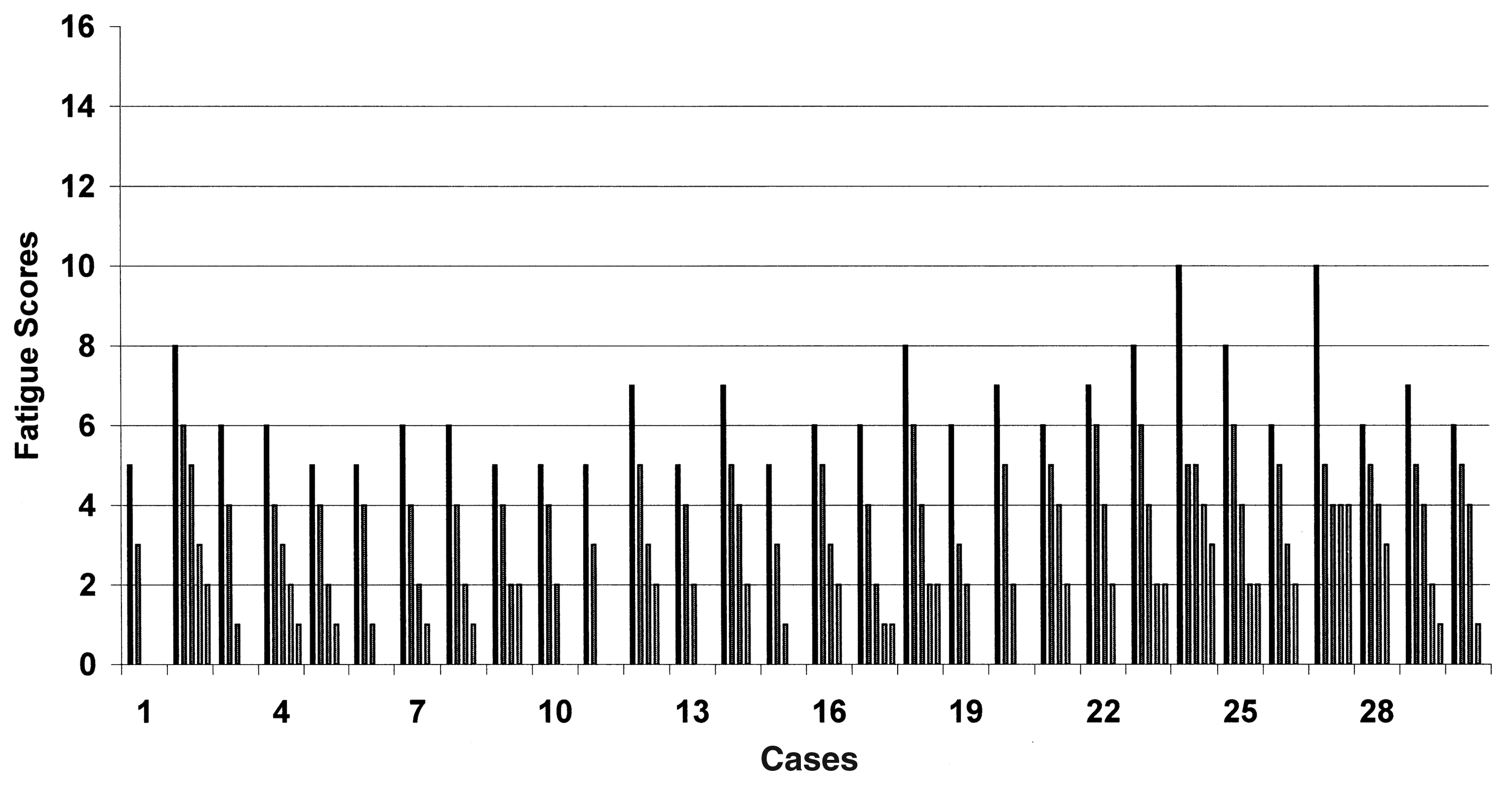
Individual fatigue scores at each visit.
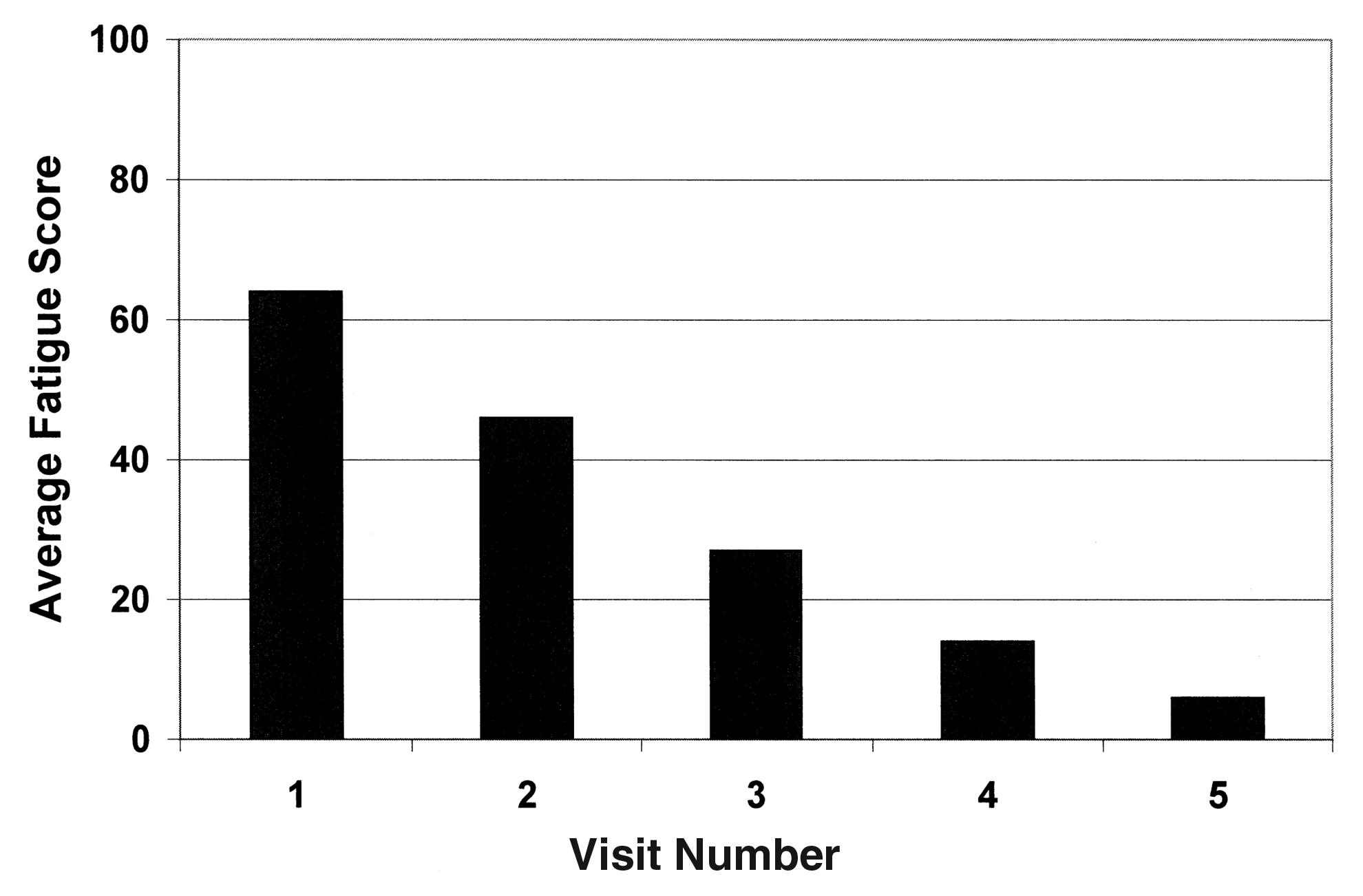
Average fatigue scores at each visit.
Treatments 1–4 used points only for fatigue; treatments 5–16 used points for fatigue and associated pathology and Disharmonies.
It is noteworthy that, in almost all cases, there was definite improvement immediately after the first treatment. This was most apparent in cases 24 and 27. Both patients had malignancies with many secondaries and extreme tiredness. The immediate response was dramatic (10→5). Cases 19 and 20 were CFS patients, one for 7 years and the other for 2 years. These 2 patients responded well and discontinued the treatment after 12 sessions. The ultimate response was determined by the associated conditions; 9 patients had some fatigue left after 16 treatments. Cases 2, 23, and 26 had endstage renal failure; however case 26 had a total response despite having this condition. In cases 24 and 27, both patients had malignancies and extensive secondaries and thus died, but the current author was able to give them an improved quality of life without use of drugs—not even analgesics. Both of these were seen in thee last stages of their disease. Their fatigue levels were reduced 10–4 and 10–3, respectively, but further improvements were not possible because of the extreme Qi and Yin Deficiency in these patients.
Use of points SP 6, ST 36, KI 3, BL 23, BL 18, LR 3, KI 6, CV 6, and LI 11 resulted in maximum possible stimulation of Qi and Yin. Stimulation of CV 4 was avoided as that would have resulted in exhaustion of the patients' existing last reserves of Qi. The three cases of CFS (cases 19, 20, and 29) responded well, because they all had the Excess type of CFS in which their Qi was not very Deficient, thus the pathogenic factor in these patients was more powerful than their defensive Qi. Thus stimulation of Qi was able to fight and dispel the pathogenic factor, resulting in improvement. As of this writing, Case 29 will need some more treatment; she had had CFS for 18 years.
Discussion
The response to acupuncture seen in cases of chronic fatigue is often one of the most dramatic experiences in acupuncture practice. The reinforcing stimulation of SP 6, ST 36, and KI 3, gives the tired patient an almost instant energy lift. This happens only when there is Qi Deficiency; this treatment will not increase energy in a normal person. This is not surprising because, whatever may be the cause of chronic fatigue, ultimately, it is related to a Deficiency of Qi. Yin Deficiency and Yang Deficiency are both variations of Qi Deficiency. Even Blood Deficiency is, in Chinese Medicine, caused by a Deficiency of Qi; without Qi, which is the Life Force, Blood is an inert substance. Qi is its source. After birth, Qi is produced from the food human beings eat through the combined actions of the Stomach and Spleen. In the Five-Element cycle, these are earth organs related to late summer. After the Fire in summer, the energy goes back to the earth for regeneration. This is most relevant at the end of summer, but this also occurs at the end of each season. Thus, every season depends on the earth for replenishment of energy. That means every organ is dependent on the Stomach and Spleen as sources of energy (Qi). After stimulating these three points, all other points are stimulated according to the Disharmony patterns as described in the treatment section and in Tables 2A and 2B. It is of paramount importance to note that, unless the underlying Disharmony is corrected, any beneficial result will be temporary. After the initial sixteen treatments, maintenance treatments along the same lines should be given on a monthly basis for 1–2 years, depending on the severity and chronicity of the particular case. Many patients may require treatments in between monthly visits.
Case 30 in this series has ulcerative colitis with arthritis that shifts from joint to joint. According to a Chinese medicine diagnosis, swelling of the joints is Dampness. When there are signs of inflammation, that is Heat. Thus swelling with pain is Damp Heat. Ulcerative colitis with mucus, pus, and bleeding is also Damp Heat. Hence, the diagnosis in this case is Damp Heat with manifestations in the intestines and joints. The arthritis shifts from joint to joint because of Wind. The pathology behind Dampness is Spleen Deficiency, because, in Spleen Deficiency, the transportation of fluids is hampered, and this collects in tissues, producing Dampness. Dampness can easily combine with Heat to produce Damp Heat. Thus, in addition to treating arthritis and ulcerative colitis, treatment is also directed to the Spleen. When one corrects the Spleen Deficiency, one also corrects the Kidney Deficiency, which is often behind the Spleen pathology. Thus, the points used in this case were:
• ST 25 and BL 25 (front Mu point and back Shu points of the Large Intestine) • SP 9 and SP 6 to resolve Dampness • LI 11 to resolve Heat • ST 37 to lower the He Se point of the Large Intestine • TE 5 and TE 6 to expel Wind • KI 3 to stimulate the Kidney • GB 34 and BL 11 (which are influential points for sinews and bones respectively) • Ah Shi points for involved joints.
All the above points were reduced as this is an Excess condition; KI 3 was reinforced to support the Spleen. SP 6 was reinforced to nourish the Spleen.
Muscle Meridian points were reinforced to stimulate the channels that cover the involved joints and soft tissues. 7
These points were used in addition to the points for fatigue. This collection of points balances the Yin and Yang, above and below, front and back, distal and local, and left and right (by using unilateral points in different sessions). For example, in this case TE 5 and GB 34 were stimulated unilaterally on opposite sides. These two channels form the lesser Yang axis, and their unilateral stimulation on opposite sides produces a very balanced dynamic effect. Such a balanced selection of points often goes to the root of the problem, treating the whole patient and leading to a lasting cure, and this is the goal when treating all chronic conditions. Using the most effective points—such as TE 6 for constipation, the “Hyperhidrosis Point” (PC 8) for sweaty hands, etc.—will often produce disappointing results, unless the accompanying Disharmony is treated with a balanced set of points.
Most medical acupuncturists use Western medicine diagnoses and acupuncture treatments. While a Western diagnosis is important, a Chinese medicine diagnosis is also essential to guide the treatment. For example, in case 30, the Western medicine diagnosis is ulcerative colitis, and the treatment with anti-inflammatories or immune suppressants will not address this patient's fatigue unless the Spleen Deficiency and associated Disharmonies are corrected. That is the reason why the Chinese diagnostic approaches were detailed in this article. The author has been careful to keep this diagnostic approach simple and easily understandable for a beginner in acupuncture. The tables were also kept simple by showing only the minimum signs and symptoms required to make a diagnosis.
Maintenance of improvement is a usual problem. This can be done with acupuncture alone. Additional use of Chinese herbal medicines or homoeopathic medicines (which work through the vital force, the Qi in Chinese medicine) are advantageous because they could reduce the number and duration of acupuncture treatments. When treating chronic disorders, acupuncture often needs support. The great Chinese physician Sun Su Mo (560
Conclusions
Acupuncture is a most effective modality of treatment for almost all cases of chronic fatigue. This is equally applicable to cases of chronic disorders, in which fatigue is a secondary symptom, and CFS, which is a primary disorder. This is best achieved by making a Chinese medicine diagnosis and correcting the Disharmony pattern.
Chronic disorders need long-term treatment and concomitant use of complementary remedies as described above. This approach, has in the experience of the current author, reduced the number and frequency of acupuncture treatments required for patients with chronic fatigue. However, this needs confirmation by further studies.
Footnotes
Acknowledgments
The author extends thanks to the secretaries Alice Scott and Helga Breier, both for their secretarial assistance in the production of this article, and Alice Scott for her help in the production of the graphs.
Disclosure Statement
No competing financial interests exist.