




Abstract
Abstract
Background:
Although the therapeutic encounter is imbued with ritual, conventional medicine tends to minimize ritual's significance, while acupuncture practitioners often try to cultivate it.
Methods:
This article explores the 12 Celestial points as an example of ritual in acupuncture, and suggests ways that modern practitioners might deconstruct and transcend such protocols. Illustrative case histories are provided.
Conclusions:
Grounded in both scientific and energetic paradigms, modern practitioners have an opportunity to deconstruct the therapeutic ritual openly to engender real empowerment as part of treatment process.
Introduction
“A ritual is a religious or solemn ceremony consisting of a series of actions performed according to a prescribed order” 1
T
Interestingly, while conventional medicine strives to diminish the influence of ritual, in an acupuncture clinic, a good performance is something to which practitioners aspire. In this regard, the Fire Element's “virtue” (li), has been interpreted to mean, ceremony, ritual, or propriety. 4
In an acupuncture context, it is possible to awaken patients to the dynamics of therapeutic ritual and, in the process, empower patients to experience a more authentic sense of self. Furthermore, physician–acupuncturists could be at the forefront of such a shift. Being familiar with both conventional and energetic perspectives, medical acupuncturists are in the unique position of being able to transcend power dynamics altogether. 5
Perhaps the first place to look for ritual in acupuncture is in some of the ancient acupuncture protocols. The 12 Celestial points are a good way to start, because acupuncturists have been using them for hundreds of years. Indeed, the points are reputed to be so powerful that some authorities have suggested they are all any acupuncturist needs to know. 6
Worldviews
The values–meme theory of social development suggests that worldviews are constantly evolving. For example, Beck and Cowan have described at least eight discrete stages, which, for visual impact, these researchers divide into various color memes.
7
In this article, the current author considers three of the memes:
(1) Prescientific (mythic/magic) (2) Scientific (rational) (3) Post-modern (transrational or transpersonal).
The current worldview, at least in most Western countries, is predominantly scientific rationalism.
Understanding the Challenges
Ritual and Collective Consciousness
Many acupuncture protocols were developed in prescientific times, and have a magical/mythical quality to them. In acupuncture, examples might include the 12 Celestial points, the 7 Dragons, the Husband–Wife imbalance, and the 4-Needle technique, to name a few. Although the purpose of these protocols is to help patients harmonize various imbalances, the protocols all run the risk of supporting the magical/mythical worldview, especially if the points are used with little rational explanation. In that worldview, power to access the transpersonal dimension lies in the hands of the priest/shaman, who holds the authority to facilitate communion with Spirit.
In contrast, Traditional Chinese Medicine (TCM), anatomical acupuncture, and conventional medicine have all developed in the scientific era. Although science has exposed many of the fallacies inherent in the magical/mythical perspective (such as unquestioned beliefs in rain gods, spirits, and curses), science has introduced its own set of a-priori assumptions (such as reductionism and objectivity). Here physicians take the place of the priests/shamans as the repositories of esoteric knowledge together with the power to mediate healing. Unfortunately, much of that power projection is misplaced and, as a result, is not conducive to healing.
Power projection is an energetic imbalance that can be difficult to address in the conventional milieu. First, in the usual therapeutic context, many patients want to be told what to do—and sometimes even expect it as their entitlement of being medically insured. Second, the worldviews of practitioners and patients can be significant hurdles. Because prescientific and scientific medical systems are both rooted in presumed power differentials, the transition to self-empowerment often involves a fundamental restructuring of the traditional therapeutic relationship itself.
The Existential Split and the Golden Gate
The issue that generally underlies the tendency to project power is the existential split, or in Chinese Medicine (CM) terms, the original differentiation of Yin and Yang. In previous articles, the current author has discussed this split and explored how it gives rise to alienation, existential anxiety, and a sense of disempowerment. 8 To summarize, the split arises in consciousness when the personal “I” emerges out of the Tao to give rise to a separate sense of self.
There is of course nothing wrong with differentiation per se—it is, after all, the basis of reflexive self-awareness. Rather, difficulties tend to occur when patients personalize their experiences exclusively and forget the essential unity of the Tao that underlies the sense of a personal self. This forgetting marks a pathologic separation of Yin and Yang, and, in turn, gives rise to the assumption that something is wrong. After the separation, life becomes a problem to be fixed instead of something to be experienced and accepted. Feeling cut off from a source of authentic power in the Tao, many patients today feel chronically anxious and lost in a vast and uncaring universe.
Perhaps the highest goal of acupuncture is to harmonize this fundamental split. The path to this harmonized state is represented in the 5-Phase model by the Golden Gate analogy (Fig. 1). The Gate is located metaphorically in the Metal phase, where, symbolically, a letting-go and ego transcendence is required to return to the Tao. 4
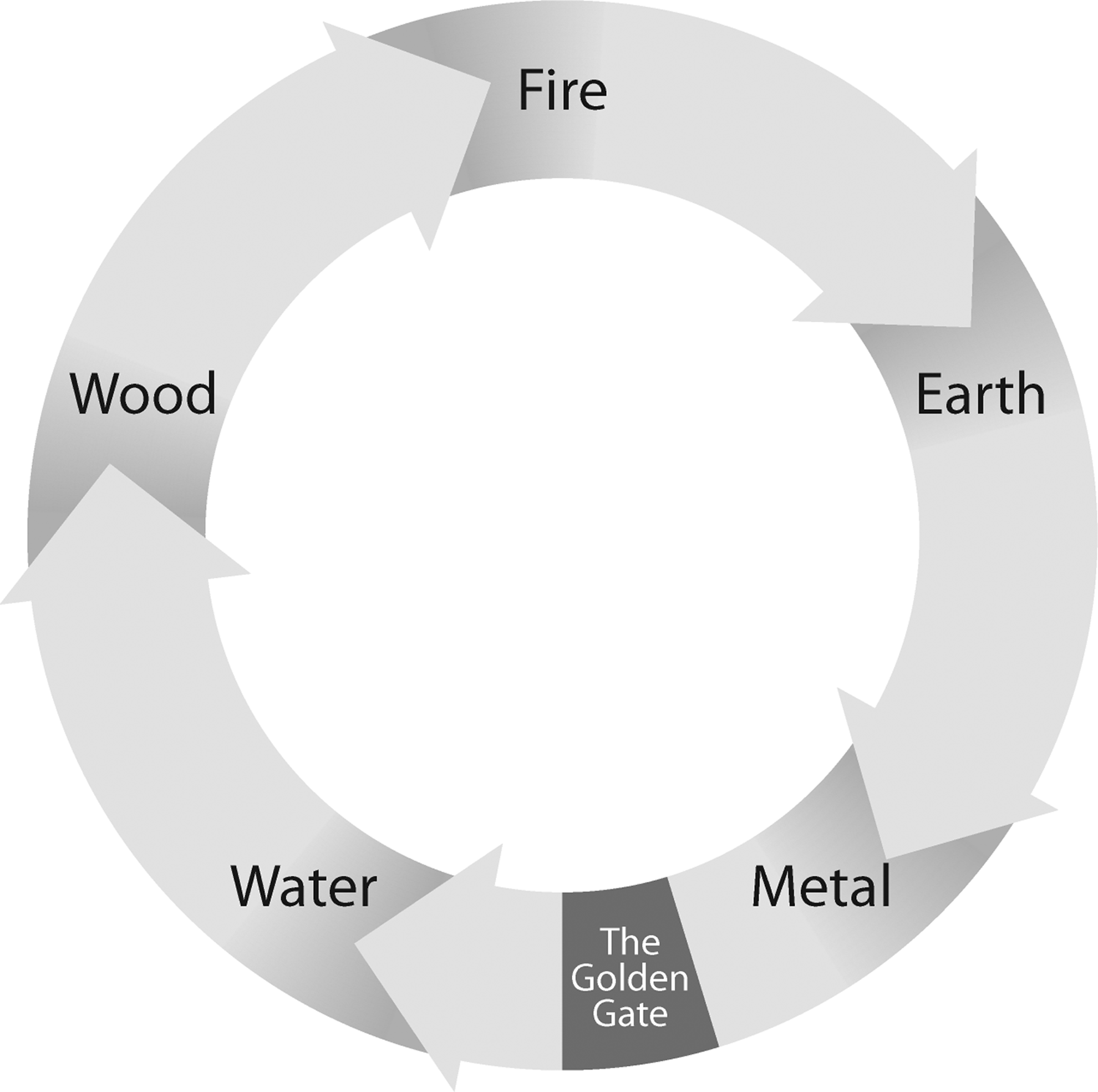
Location of the Golden Gate between the Metal and Water Phases.
Golden Gate passage is notoriously difficult, because it involves ego surrender— something the ego is quite adept at coming up with strategies to prevent. Consequently, on the assumption that the ego is probably always going to be obstructionist, practitioners have historically used ritual to coax people across the Gate.
However, there may be a more creative way to proceed. The ego has a legitimate desire to keep the mind–body safe. We can respect that function by giving the ego sufficient information about the process of crossing the Gate. With such knowledge, the ego can become willing to stand aside and act as a cooperative witness to the transformational process.
Principles of Ritual: Authority, Belief, and Power
Traditionally, healing rituals involve an authority figure. The authority may use context, procedures, laboratory tests, needles, mantras, physical contortions, or even outright trickery to facilitate an effect, but whatever the props are, a patient's belief in the authority is generally necessary for success. To a doubter, it may be unclear whether the authority is real or sham, but to a believer, such a question is irrelevant.
Physicians usually acquire their authority by passing examinations. 9 But passing examinations and/or being able to perform a few procedures, although clearly helpful, is not necessarily crucial—in some cases, only a patient's belief that the particular authority is genuine is needed. For example, there have been many cases of impostor-physicians who have carried on undetected for years, apparently doing a reasonable job, until their pretenses were uncovered. 10
Medical authority gives rise to Aesculapian power (from the Greek God Aesculapius). In CM, the concept of Ling, although superficially similar, refers to an authentic spiritual potency that might well be absent in someone who has societally sanctioned Aesculapian power. 11 The difference is not just semantic, because medical power can sometimes be anything but authentic. Built on the shifting sands of anxiety and fear of disease, this conventional medical power can convince patients to undergo all kinds of indignities that they would perhaps decline if they relied on their own common sense.
Sometimes, authority is completely bogus, yet still powerful. Beginners can occasionally perform extraordinary feats while resting in the illusion of infantile omnipotence. All that is required is for everyone to believe in that authority. One remarkable case involved Albert Mason, MBBS, a resident-in-training who cured a patient with congenital ichthyosis by using hypnosis, all the while thinking he was treating warts. 12 There is also an interesting, perhaps apocryphal story about David Livingstone interviewing a rain doctor in Botswana. When Livingstone accused the rain doctor of being a cheat, the rain doctor replied, “Well, then there is a pair of us. If it rains, I take the credit, and if your patient gets better, you take the credit. In neither case do we lose faith in our professions. You see, what we believe is always more important than what actually happens.” 13
Personal beliefs can generate powerful effects, for both good (placebo) or bad (nocebo). On the good side, a strong belief can generate healing of otherwise untreatable illnesses. 14 For example, the current author recalls a case of a 74-year-old man with a pathologic hip fracture caused by metastatic prostate cancer, who postoperatively announced he was healed. Never mind that the hip was not pinnable, because the femoral head had been completely replaced by metastatic tissue. The patient was convinced. While his belief seemed preposterous from a conventional standpoint, he subsequently went into remission and was cancer-free for another 5 years. On the nocebo side, belief can actually bring about death even though nothing, from a conventional perspective, is wrong. 15 For example, the voodoo hex of “pointing the bone” can have devastating effects, regardless of whatever the individual in the particular culture might outwardly profess to believe. 16
Such phenomena suggest that personal beliefs may be more deeply rooted than the ego. In addition, if so, that fact might explain the common observation that, occasionally, skeptics might get great results from acupuncture, while other so-called believers get nothing. In such cases the true belief might be something other than that which their ego pretends to have.
Notwithstanding such stories, oftentimes, at the end of the day belief is arbitrarily given, authority is an empty mirage, and rituals are exercises in duplicity. The whole structure is a self-sustaining circular loop that collapses when it is examined critically.
The Dark Side of Ritual
One difficulty with medical rituals is that, despite a practitioner's best intentions, they can easily morph into supporting the prevailing medical consensus. For example, some researchers have argued that physicians should spend more time with patients, although that time is spent doing relatively useless things. 17 While such an approach certainly constitutes ritual, time-consuming listening in a conventional setting can easily foster codependency, which, in the long run, simply bolsters conventional therapeutic power dynamics.
Rituals that foster codependency imprison patients rather than empower them—a point that is easy to forget, no matter what kind of medicine one practices. The bottom line is this: It is not good to use acupuncture to regress patients to a prescientific mythical/magical worldview. Nor is there any particular advantage to using acupuncture as a substitute for drugs in the context of a scientific rationalism. Neither approach deals with projected power.
Deconstructing the Acupuncture Ritual
Before building a new paradigm, it is first necessary to deconstruct the old one. In that regard there are six relevant concepts, with respect to acupuncture, as discussed in the sections below.
Intention and Context
One way to start involves disabusing patients of any naïve beliefs concerning authority figures and acupuncture mystique. This can be accomplished by bringing to their awareness the two factors of intention and context. Intention refers to the directional vector of patients' relationships to their symptoms—that is, is whether the patients' goals are to eradicate or to embrace. The latter is the evident preference but must be facilitated through context. Context refers to the environment in which the acupuncture is practiced. Ideally, this environment should be one in which all blocks to the free movement of Qi have been removed. These concepts have been discussed in more detail elsewhere. 18
Field merging
Field merging diminishes the role of projected power by creating a transpersonal dyad (Fig. 2). Merging arises from rapport—not from point protocols—and is best accomplished by dropping the professional mask and being oneself. Although this may seem to contradict training and protocol, it is precisely training and protocol that gives rise to the power dynamics and ritual that one wants to deconstruct.
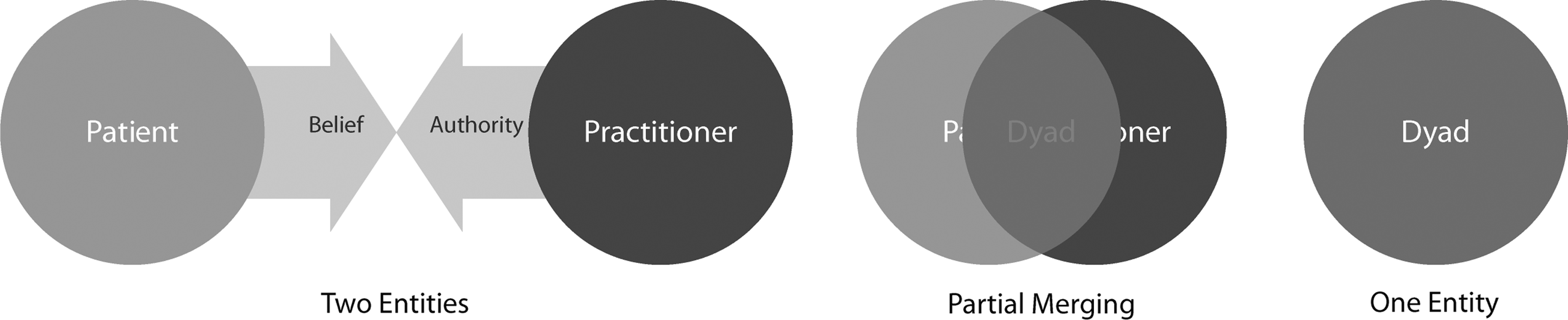
Practitioner–patient field merging creating a transparent dyad.
Pre–Trans Confusion
The pre–trans confusion, or fallacy, refers to an inappropriate equating of prerational and transrational states. 19 Given that both are nonrational, they can superficially appear to be the same. This is quite pertinent to subtle acupuncture techniques, in which magical/mythical hyperbole can be disguised quite easily as esoteric profundity. Patients often need to cultivate some pre–trans discernment in order to distinguish the two as part of their goal of power retrieval.
This is not to discount a natural hierarchy that exists for practitioner and patient, but only the unwarranted power discrepancy. A large part of power retrieval involves appreciating fully the limits of what practitioners can and cannot do. In that regard, patients should be alerted that, when something happens, it is their own Qi that is doing the work and that the practitioner has little to do with it. Once the “blinkers are off,” a transpersonal field-merging can occur out of which, paradoxically, a natural and authentic hierarchy can arise and in which real interpersonal differences are appreciated.
Dismantling Pseudodiagnosis
Much of what passes for diagnosis is really an approximation designed to obfuscate. For example, many apparent diagnoses are actually syndromes (i.e., collections of related symptoms that have no coherent mechanistic explanation) and, therefore, mean little beyond a statement of the obvious in medical jargon. Similarly, TCM patterns are also syndromes, and they, too, can morph into pseudodiagnoses, particularly if patients think that they mean something in a conventional sense. Syndromes masquerading as diagnoses give patients the erroneous impression that someone in authority knows what is going on, which, in turn, supports disempowerment and its associated misunderstanding of authentic hierarchy.
Reframing Symptoms
Reframing symptoms helps a patient see that an illness is part of their wholeness, and therefore, is something to be embraced. Such reframing is heavily intertwined with intent, and comes about naturally as people move toward their symptoms. Reframing ends the conflict patients have with their diseases, and frees up vast amounts of energy previously invested in internal psychic wars.
Reframing Acupuncture Protocols
Reframing point protocols is perhaps most relevant to psychoemotional acupuncture. Anatomical acupuncture generally makes rational sense; TCM needs a little explaining to understand patterns; N-N+1 treatments involve conceptualizing meridians as if they were rivers with water flowing through them; while resonating trigrams involve nonlinear and ripple effects. Most patients can grasp these perspectives fairly easily.
Golden Gate traversal, however, is a different matter. 18 As an example, the current author considers the Celestial or the Heavenly Star points, a protocol that has been used for the purposes of ritual for hundreds of years (Table 1). Here, patients need to understand the Gate concept, the nature of the shift being contemplated, and the rationale behind the choice of points. Finally, patients need be apprised and disabused of the pre–trans fallacy embedded in the traditional point names.
L, left; R, right.
The 12 Celestial Points
The Celestial, or Heavenly Star points were first described as a series of 11 points (later a 12th (LR 3) was added). They are generally attributed to Ma Danyang, who lived during the Jin dynasty. 6 In their original usage the points were picured in a specific order, and the whole process was imbued with a magical/mythical slant that persists to this day. (Tables 1 and 2)
Exploring the Meaning
To deconstruct such a protocol, a practitioner need first understand the intention built into the point sequence. Of course, on a superficial TCM level, the points might be conceived as clearing Heat in the Yang Ming, expelling Cold in the Tai Yang, and/or reducing Stagnation and moving the Qi. The points might also be understood in terms of various resonating trigrams, particularly the Yang Ming. The points could even be related to anatomical acupuncture with regard to releasing myofascial tension. However, the basis of the ritual clearly lies in deciphering the esoteric point meanings. No doubt, there are many valid ways to do this, so here, the current author offers a personal slant on the subject. In doing so, he does not make claims that his interpretation has any ultimate validity. The sequence of points is as follows:
(1) (2) (3) (4) (5)
Taken as a whole from a 5-Phase standpoint, the Heavenly Star sequence might be interpreted to mirror symbolically the alchemical shift that lies at the core of acupuncture philosophy—a shift that represents Golden Gate traversal and a reconnection of Yin and Yang (Fig. 3).
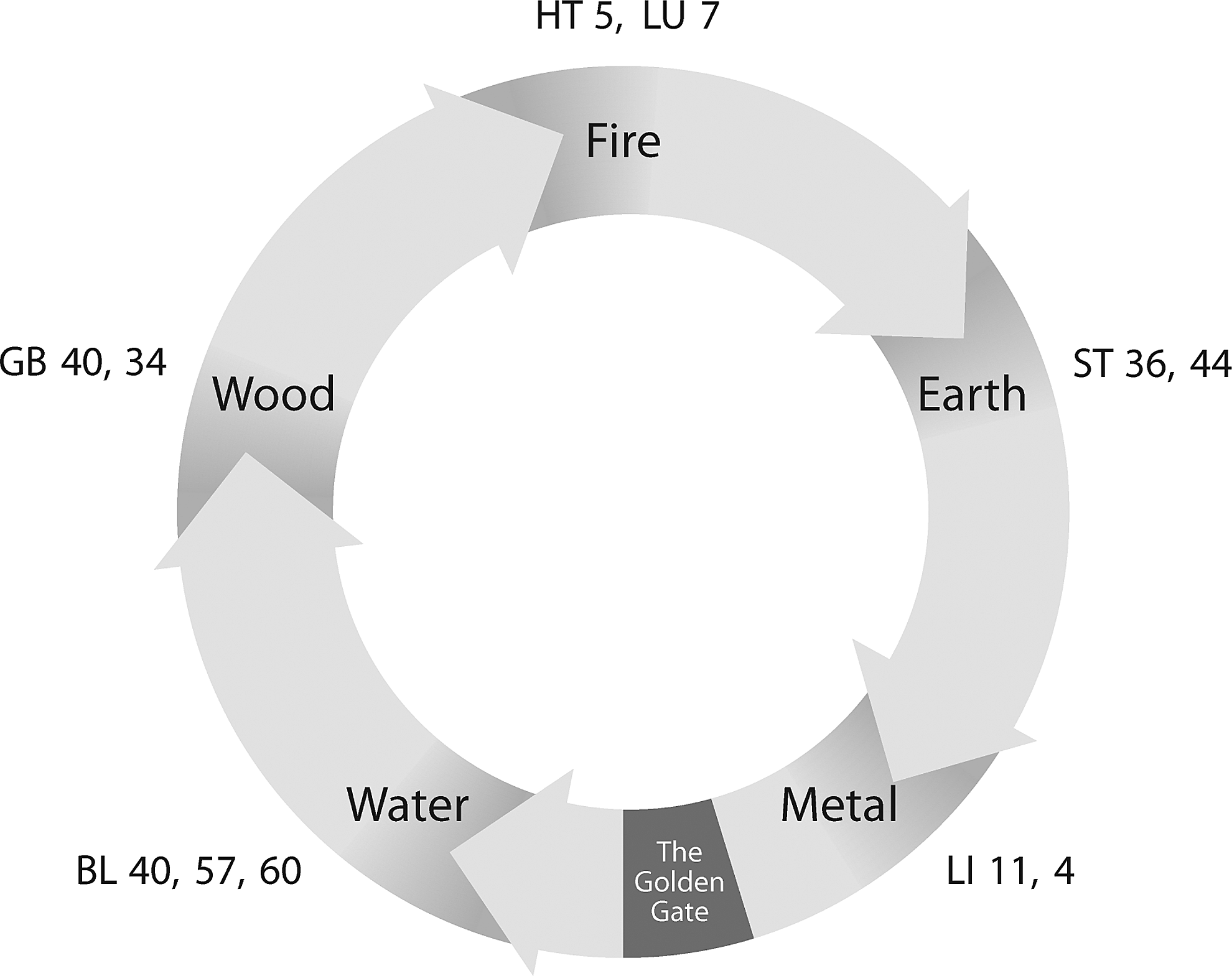
Intention, 5-Elements, and the Golden Gate.
However, a scientific practitioner might recognize this sequence as magical/mythical ritual par excellence. The point is that, although Gate transition is a laudable goal, picuring the Celestial points without a cogent rational explanation can inadvertently support regressing patients to a prescientific meme, thereby missing the opportunity to really empower them. In this day and age, are we really expected to believe the literal interpretation of point names? For example, does anyone seriously believe that GB 30 (Huantiao) actually calms the jumping mind? Or that Hegu (Adjoining Valley) actually propels patients back to the Tao?
Probably not. However, that is not to deny the common observation that such points can have profound effects. They can. Indeed, patients will sometimes describe having an experience during acupuncture that eerily reflects the point's name. Yet, it is a moot point whether such experiences are point specific or merely coincidental. Perhaps they could be viewed better as synchronistic.
In this regard, there are two common biases to which practitioners are prone. The first, sometimes called the confirmation bias, refers to the tendency to remember successful results when a particular point is used, while discounting the numerous times that the same point was chosen and did nothing. The second, known as the narrative fallacy, refers to the tendency, when a particular point has an interesting effect, to impute retrospectively an explanation based on some esoteric CM theory, when, in fact, the effect was spontaneous and did not require an explanation. 20
That said, there is no need to reject point imagery entirely, but practitioners should avoid the trap of attributing mythical power to them. A better approach might be to engage the imagery in a somewhat fluid manner—ideally as a practical reminder of the fundamental intent to traverse the Gate and enter the void. If that notion can be transmitted experientially to the patient, the point names and needling sequence can assume a more balanced import.
Perhaps the biggest challenge therefore, may be to give the patient a good dose of disillusionment before needling ever begins. Having demolished the role of ritual and the pretense of pseudodiagnosis, and having established a good rapport, it becomes time to introduce the transrational view through experience. For that, patients need only to tune into their instincts, feelings, and emotions, and relate them creatively to their symptoms. Deep down, patients usually know why they are ill, but that truth often lies buried under a mountain of intense emotions and painful memories.
Case Histories
Case 1
A 41-year-old woman, with a Fire/Metal Constitutional Type (CT), came to the current author's clinic complaining of widespread pain, migraine headaches, and chronic Lyme disease. Although she had explored several approaches philosophically rooted in self-responsibility, including yoga and meditation, she seemed genuinely disempowered and confused.
The principle of intent was explained and we had available a context from which she could move about and/or make sounds as required. At each session, the roles of the points was explained in advance from both an energetic and rational perspective. Acupuncture treatments began with the 7 Dragons to release old unwanted accumulations 21 and was followed with a couple of N-N+1 treatments directed at her constitutional type. 22 It was apparent she had blocks in the second through fifth chakras, involving sexuality, power, Heart centering, and expression. During the fourth session, when some of the Heavenly star points were utilized (ST 36, LR 3, LI 4, and HT 5), she reexperienced an abuse situation occurring when she was about age 5, involving a stepfather. Session 5 completed the Heavenly Star sequence with the addition of CV 17 and PC 6. At the end of the session, she was pain-free, a state that remained stable at her 1-year follow-up.
She explained her Gate passage as a process of reinhabiting the body, together with the realization she had been dissociated for many years in an effort to avoid her unwanted feelings. By facing and embracing an experience against which her ego had fought for most of her life, she freed up the energy which had kept her tense and in pain. The relief she felt was so dramatic that there seemed little risk of her returning to her old ways.
Case 2
A 54-year-old Wood CT sustained a left-jaw injury falling off a bicycle; the injury required surgical repair and fixation. She eventually developed unremitting pain in the area. Initial treatments involved Shao Yang opening points TE 5 and GB 41 and a few local points around her jaw, while the concept of Golden Gate transition was explored. After a few sessions, she expressed a desire to do deeper work. With that rational preparation—and in the context of Heavenly Star points LI 4, ST 36, and LR 3—during session 5 she plunged into the void, reregressing through the accident, complete with sounds and movements reflecting the accident's mechanism. The process was repeated periodically over several months until the emotional charge on the accident was greatly reduced.
Although initially highly dependent, this patient gradually extricated herself. She began meditating and read extensively to understand the philosophy of illness, while mastering the art of releasing old traumas on her own. Over a period of 2 years, she retrieved most of her personal power, but there remains a tendency to manifest jaw pain when life stresses accumulate in her life. At such times, she will come in for a tune-up.
Case 3
A 60-year-old man with prostate cancer, who had opted for a watch-and-wait approach, thought his Kundalini energy might be blocked and came to explore acupuncture. The Golden Gate concept was introduced and put into the context of the Chakra system. In this system, there are said to be three knots, or Granthis, representing Brahma, Vishnu, and Shiva (Rudra), located in the first, fourth, and sixth chakras, respectively, which have to be negotiated on the way to enlightenment. All three can be regarded as aspects of the Gate. The knot of Brahma, located in the first chakra, can sometimes be opened by spontaneous pelvic movement, which is generally blocked by social conditioning. Acupuncture was initiated with SP 4 and PC 6 to open the Chong Mo, while pelvic rocking was encouraged. Treatments were given weekly for 1 month then monthly thereafter. The patient was also given Chinese herbs in a formula that has induced apoptosis in breast- and prostate-cancer cells. 23 With this approach, over a period of 1 year his prostate-specific antigen level came down from 12 to 5.
Discussion
It may seem disingenuous to suggest that the Celestial Points are just an arbitrary mix of points designed to maintain a prescientific practitioner mystique. Certainly, the ancients were not naïve and grounded their observations in the best available evidence of their time. However, physicians are quite familiar with the potential for deceit when it comes to maintaining a mystique in a scientific context. For example, there are many situations in a conventional milieu in which a specific remedy is probably not necessary; yet, a prescription is written anyway (for example, using antibiotics to treat viral infections).
However, recognition of the potential for deception does not make a case for total rejection of the means. In the above example, just because it is possible to write an unnecessary prescription does not mean prescriptions should never be written. In similar fashion, rather than dismissing the point imagery completely, perhaps there is another way to view the issue—one that allows the modern practitioner to honor ancient protocols without putting too much weight on them. As one practitioner put it, both premature dismissal and uncritical acceptance put a practitioner in the position of knowing, when the key to success in acupuncture is in the not- knowing of the Tao (Lonny Jarrett, personal communication September 22, 2012).
Another issue is the objection that, if the presence of an existential split is indeed erroneous, why do patients not just see it as such, and save a lot of time, money, and energy? After all, if there is no split, then there can be no problem, and so the question regarding the most appropriate treatment becomes meaningless. Unfortunately, this objection misses the point that the split is so embedded in the collective consciousness, that it is virtually impossible for the average person—mired in the fear and anxiety of symptoms—to see through the illusion of separateness.
A third issue is that, while it is one thing to engender an experience beyond mind through acupuncture, it is quite another thing for patients to avoid reverting to their prior mental states with their inherent limitations. One way to approach this conundrum is to recognize that Gate transition is rarely a one-time phenomenon. Moreover, given that sudden transformations can induce significant mental confusion, a slower progression engendered by repeated experience of Gate transition in the treatment room, is often the more suitable approach. The bottom line is that acquiring an integrated awareness is usually, and quite properly, a gradual process.
Conclusions
Modern acupuncturists are well-placed to heal a split that is largely inaccessible to both conventional medicine and TCM. Grounded in both scientific and energetic paradigms, modern practitioners have an opportunity to deconstruct the therapeutic ritual openly to engender real empowerment as part of treatment process.
The issue of whether or not points actually have the magical/mythical qualities associated with their point names may be unanswerable. Nor does such a question need to be answered. By allowing points to have their imagery, while simultaneously embracing modern field theories, practitioners can transcend the contradiction of worldviews. In so doing they can embody an integrated postmodern perspective, while remaining grounded firmly in the not-knowing of the Tao.
The three case histories above illustrate different types of patient: (1) one who takes the concept of empowerment and flies with it; (2) a second individual who takes time and repetition to achieve a lasting result; and (3) a third person who has an empowered stance right from the start. In all three cases, the interactive and transformational use of ritual acupuncture protocols was very much illustrative of where acupuncture can go if the protocols are transcended.
Although this article might appear to argue that acupuncture and/or medicine is unnecessary, in reality, the need for an effective guide has never been greater, and those practitioners who work with transformational ideas can find themselves in great demand. Indeed, the satisfaction of helping people move beyond the need for treatment is so rewarding, that it can transform the experience of practicing medicine from drudgery to joy. When work becomes play, a practitioner's own Mind–Heart split is transcended, and the inner joy radiating from that integration is bound to influence patients in positive ways.
