




Abstract
Abstract
Background:
Although the 5-point acudetox National Acupuncture Detoxification Association (NADA) protocol was developed to treat addictions, it has always been assumed that the healing capacities of this method go far beyond that application.
Objective:
The purpose of this research was to evaluate if the 5-point acudetox ear acupuncture protocol has an immediate stress (prolactin; PRL)–reducing effect and, if so, if the effect is more significant than social support and informal supportive conversation.
Materials and Methods:
A randomized, double-blinded, controlled trial was conducted at the Széchenyi Health Center in Budapest, Hungary. Forty-four patients were included in the study: 22 in an experimental group and 22 in a control group. Volunteer students and workers ages 25–60 were included. Ear acupuncture was performed on 5 points: Shen Men; Sympathetic; Kidney; Liver; and Lung. Each blood sample was taken between 2
Results:
As a result of the 5-point acupuncture treatment, both prolactin levels and skin conductivity decreased in the experimental group, while there was no significant decrease in the control group.
Conclusions:
Acupuncture is a potentially useful complementary therapeutic strategy to Western medicine for stress-level management. Using the 5-point acudetox NADA protocol, can reduce stress level (PRL, skin conductance response) significantly. Further studies with better designs are needed.
Introduction
P
The stress response is defined as an organism's total response to environmental demands or pressures, and is responsible for many human diseases (e.g., anxiety, panic, migraine, indigestion, or sexual disorders; psychosomatic diseases such as stomach and duodenal ulcers, hypertension, heart attacks, diabetes, allergies, asthma, hair loss, menstrual disorders, infertility, and impotence, or a tumor, etc.). 8
Acupuncture is one of the oldest and most important therapeutic techniques of Traditional Chinese Medicine (TCM). 9 Acupuncture was first accepted for treatment of pain and used worldwide as a complementary therapy. Several recent research projects have confirmed the clinical effectiveness of acupuncture.10,11 Acupuncture's clinical effectiveness for addressing 28 conditions was considered as verified by a 2003 study by the World Health Organization, and new research is published every day. 12
Ear acupuncture was developed by Paul Nogier, MD, in 1956. He then published his ear acupuncture system. 13 In 1973 Wen and Cheung were the first to publish an article on the use of ear acupuncture for the treatment of patients who were addicted to opiates. 14 Ear acupuncture treatment is widely used for treating and/or alleviating the symptoms of several conditions, including neurologic problems, such as depression, 15 epilepsy, 16 sleeping disorders, 17 and other conditions (e.g., paralysis). 18 Studies on the effects of 3-point ear acupuncture for treating severe regressive alcoholism had significant results. 19 In 1985, Michael Smith, MD, (Lincoln Hospital, Bronx, NY) developed the National Acupuncture Detoxification Association (NADA protocol). 14 This protocol was used to alleviate withdrawal symptoms and to stop craving for the drug. The standard NADA protocol points are: Shen Men, Sympathetic, Kidney, Liver, and Lung.
Skin Conductivity and Stress
The effects of psychologic factors on electrodermal phenomena were first observed by Marie Gabriel Romain Vigouroux, MD, in 1879. Electrodermal reaction is the parameter that is widely studied in physiologic and psychophysiologic laboratories, and it can also be used well in stress research.
Use of skin-conductance changes during mental stress testing as an index of autonomic arousal in cardiovascular research. As a result of stress, skin conductivity increases; patients with post-traumatic stress disorder (PTSD) actually relive their past traumas, resulting in significantly elevated skin conductivity. 20
Skin Conductivity Response (SCR), Acupuncture and Screening Devices
Acupuncture points are distinct areas of the skin with special characteristics. These properties include increased conductance,21–23 reduced impedance and resistance, increased capacitance,24–27 and elevated electrical potential,23,28–30 compared to nonacupuncture points. Measurement and monitoring the skin resistance of acupuncture points date back to the 1950s. Nakatani (1956), 31 Niboyet (1958), 32 and, later Voll, (1975) 33 independently suggested that the skin has unique electric features at acupuncture points.
The Ryodoraku theory was developed by Nakatani, 31 and the method has since been used in many research projects for monitoring results. In 2003, the results of treating patients with hypertension by Wang et al. showed that, following the stimulation of the Zusanli (ST 36) acupuncture point, Ryodaraku values decreased along with blood pressure and pulse rate. 34 Sancier examined the effects of Qigong, and Ryodoraku, and the results reflected the changes in the equilibrium state. 35 Weng et al. used Ryodoraku in 2005 for evaluating the results of treatments for “tennis elbow” and upper-back pain.36,37
Operation of the MeriDiM® (Natural-Med Ltd.) device used in the present study is based on Ryodoraku principles. Skin conductivity was measured at the starting or endpoints of the 12 principal meridian pairs (24 meridians altogether); conductivity between acupuncture points and a neutral electrode was measured by 12 V measuring voltage, assigning a value between 1 and 200 to the acupuncture points. This value is proportional to the conductivity between the acupuncture point and the neutral electrode; the current is measured in μA.
The present study was designed to evaluate if the 5-point (NADA) ear acupuncture protocol has an immediate stress (PRL)–reducing effect and whether this stress-reducing effect is more significant than social support and informal supportive conversation.
Materials and Methods
Ethics Statement
The authors started to perform the research having obtained “Trial permission: [of the] 201/2013 Ethic[s] Committee Budapest.” The work described in this article was carried out in accordance with the Code of Ethics of the World Medical Association (Declaration of Helsinki) for experiments involving humans. Subjects provided written informed consent before participation in the study.
Participants
Forty-four patients were included in the study: 22 were in an experimental group and 22 were in a control group. The experimental group and the control group were formed by volunteer students and workers ages 25–60. Patients with menstruation disorders, gynecologic problems, or who were taking contraceptives were not excluded, given that the changes in the PRL level of each person was recorded in the study. The gender and age and distributions of the experimental group were 9 females (40%, 40.8±11.4 years) and 13 males (60%, 43.6±8.7 years). The gender and age distributions of the control group were 15 females (68%, 46.4±10.4 years) and 7 males (32%, 44.4±10.8 years).
The control group was randomly divided into two subgroups: one subgroup was exposed to informal, supportive conversation; and another group was exposed to a movie with scary/shocking content. Previous studies have shown that, as a result of quality social support and informal supportive conversation, stress levels decrease and level of satisfaction with life increases. Conversely, intense negative feelings may be evoked in an audience by films and news with shocking, scary, or horrifying content, with a difference between the shock value of fictional and nonfictional programs. 38
Subdividing of the control group was used to differentiate between the decrease in stress/prolactin levels caused acupuncture and the decrease in those levels caused by a pleasant environment, achieved without treatment. This subdivision confirmed further that 1 hour spent in a pleasant environment might also decrease PRL levels (during pleasant activities such as sex, eating, and conversation, dopamine is produced, which decreases PRL levels), while stress-inducing circumstances have a reverse effect and may increase prolactin levels. 38
Control subgroup 1 consisted of 11 persons, ages 46.7±10.2 years; there were 10 females and 1 male. Control subgroup 2 consisted of 11 persons, ages 44.9±10.9 years: there were 5 females and 6 males.
Participants were advised that they were taking part in research examining the ear acupuncture detoxification process (Fig. 1).
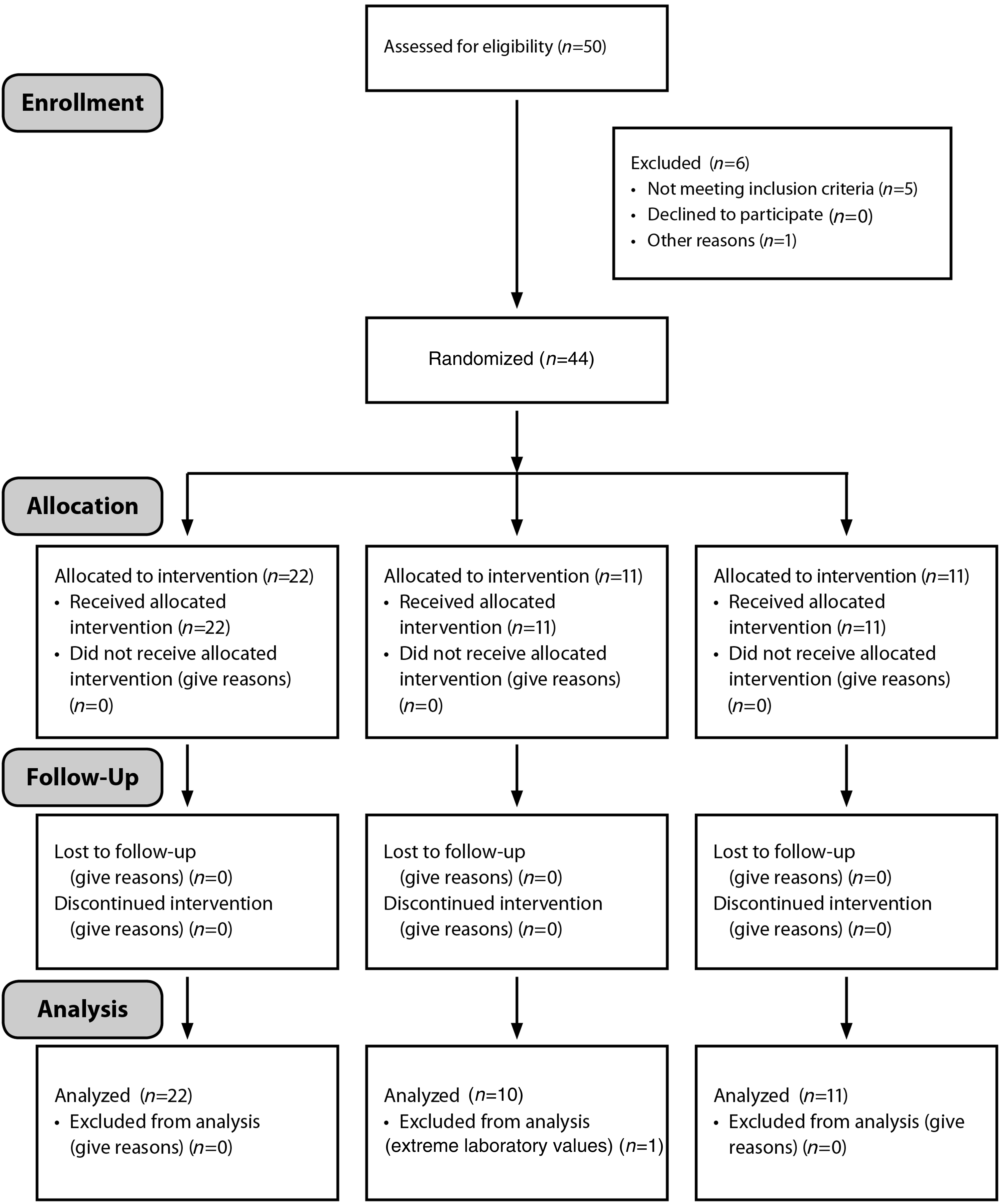
CONsolidated Standards Of Reporting Trials (CONSORT) Statement 2010 flow diagram.
Exclusion Criteria
Pregnant women and patients with endocrinologic disorders were excluded from the study.
Research Procedure
SCR screenings and blood tests (PRL level) were conducted on members of the experimental group, both before and after the 5-point ear acupuncture treatment. Between the two blood tests and SCR screenings, members of the experimental group spent 1 hour in informal conversation with 5 needles in each ear. Members of the control group did not receive 5-point ear acupuncture treatment. The 1-hour between the two blood tests and SCR screenings was spent differently by the two control subgroups. Participants were assigned to the control subgroups randomly. Control subgroup 1 members spent 1 hour between blood tests and SCR screenings engaged in informal conversation, similar to the experimental group. Control group 2 members spent 1 hour between blood tests and SCR screenings watching a shocking film, which increased these subjects' stress levels (Extreme Healing, a 50-minute documentary; Fig. 2). 39
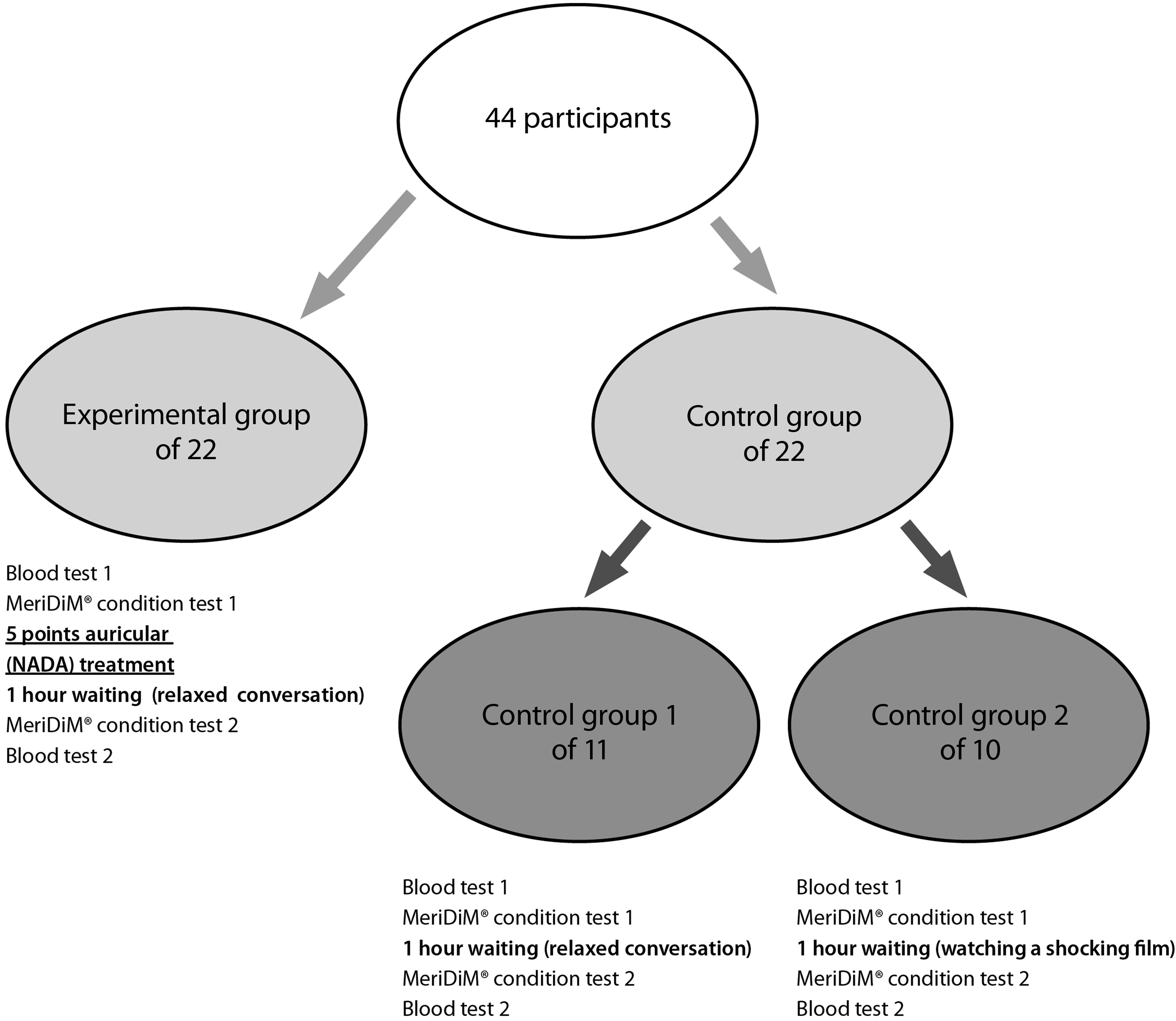
Depiction of the groups. MeriDiM® (Natural-Med Ltd.). NADA, National Acupuncture Detoxification Association.
Blood testing and measurement of PRL levels
The same person took each blood sample between 2
MeriDiM screening
Screenings (skin conductivity tests) were conducted using a MeriDiM device. The starting and endpoints of the 12 principal meridian pairs of the body were measured during the MeriDiM screening, which produced 24 results for each patient. The person conducting the screening (along with all of the study participants) believed that the detoxification process was examined. All MeriDiM screenings were conducted by the same person.
5-point NADA ear acupuncture treatment
Each patient received a 5-point NADA ear acupuncture treatment, conducted by the same person. The localization of the acupuncture points was assisted by the 191 point Széchenyi ear map. 40 The names of the 5 points according to the Széchenyi 191 point ear map are: point 1 (Shen Men 1); point 2 (Sympathetic point 21); point 3 (Kidney point 167); point 4 (Liver point 148); point 5 (Lung point 108).
The points described are compliant with the points of the NADA protocol in the United States. As there is no standard ear acupuncture nomenclature. 40 the 191-point Széchenyi map helped locate the identical localization of the 5 points by the acupuncture specialist. In different maps of the 5 NADA points, the localization of the points may vary greatly (Fig. 3A–C).
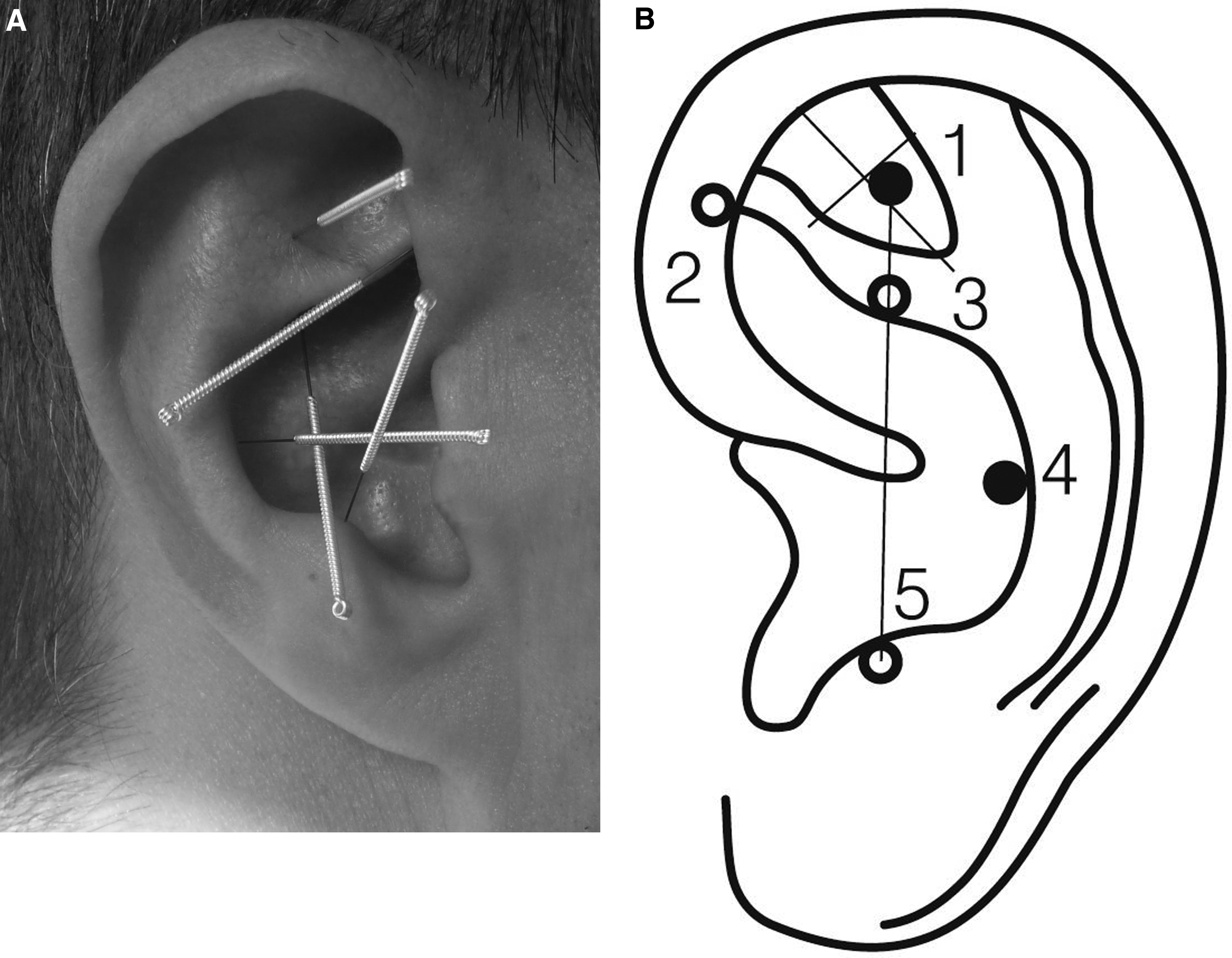
Auricular National Acupuncture Detoxification Association (NADA) image with the 5 points+drawing+auricular map.
Statistics
Data were analyzed by a t-test and a Wilcoxon test (using SPSS 15.0 software). The level of significance for the analyzed values was P<0.05.
Results
In the experimental group there was a certifiable, significant decrease of PRL and μA levels after the 5-point auricular acupuncture, compared to the conditions before treatment (P=0.026; P=0.0008, respectively). The PRL level decreased from 214.20 mIU/L to 191.41 mIU/L. MeriDiM averages decreased from 40.29 μA to 32.27 μA, compared to the conditions before treatment (P=0.0008; Table 1). The μA averages consisted of 24 individual measurement results of 22 persons, which means that the mathematical average of 528 before-treatment measurement results were compared to the mathematical average of 528 after-treatment measurement results. In the experimental (acupuncture-treated) group, the measurements before treatment consisted of 24 points/person×22 persons=528 results; then, after the treatment the 528 measurements were repeated.
Natural-Med Ltd.
P<0.05 is statistically significant.
In the control group (control 1 and control 2 subgroups together), in which the participants did not receive a 5-point auricular acupuncture treatment, there was no significant change in PRL level between the two measurement times (P=0.35; Table 2.). In the control group, the PRL level was 190.31 mIU/L at the first measurement and, then, after 1 hour, the PRL level was 183.95 mIU/L. There was no certifiable significant change in the MeriDiM averages either (P=0.35).
Natural-Med Ltd.
P<0.05 statistically significant.
In the subgroups within the control group there, was also no significant change with respect to PRL levels between the two measurements: (control subgroup 1: P=0.18; control subgroup 2: P=0.72; Table 3.). MeriDiM averages were as follows: In control subgroup 1, there were 11/persons×24=264 measurements without treatment before spending 1 hour waiting (friendly talks) and after 1 hour 246 measurements again. In control subgroup 2, there were 10/persons×24=240 measurements. For the condition of watching a shocking film, there was no significant and demonstrable change between the two measurement times (control subgroup 1: P=0.09; control subgroup 2: P=0.8).
Natural-Med Ltd.
One subjects's results were eliminated because she had hypothyroidism.
P<0.05 statistically significant.
In control subgroup 1, the PRL level was 189.37 mIU/L at the first measurement; then, after 1 hour, the PRL level was 168.04 mIU/L. In control subgroup 2, the PRL level was 191.33 mIU/L at the first measurement, and then, after 1 hour, the PRL level was 201.44 mIU/L.
The MeriDiM averages were as follows: In control subgroup 1 the average was 52.39 μA at the first measurement, and, after 1 hour, the average was 41.72 μA. In control subgroup 2, the average was 41.72 μA at the first measurement, and, after 1 hour, the average was 42.87 μA. This would suggest that there was a remarkable tendency in control subgroup 2—as a consequence of stress (induced by watching a shocking film)—for PRL levels to have increased just as the MeriDiM averages did at the same time, compared to the starting values.
Although there was a significant decrease in the experimental group in both PRL (P=0.026) and μA levels (P=0.000779), while examining the changes between all groups, the present authors found (using a difference test and assuming normal distribution) that there was a decreasing tendency in the experimental versus the control groups as follows: experimental versus control subgroup 2; control subgroup 1 versus control subgroup 2; experimental versus control (subgroups 1 and 2); and experimental versus control subgroup 1; meanwhile there was no significant differences among the groups (Table 4.).
Natural-Med Ltd.
One subjects's results were eliminated because she had hypothyroidism.
PRL, prolactin.
P<0.05 is statistically significant.
The present authors excluded the PRL and the meridian values of 1 person from control group 2, because the PRL level of this woman decreased (reference: 40–530) from 649.57 mIU/L to 236.80 mIU/L after watching the stressful film. Further laboratory tests revealed that she had hypothyroidism—her thyroid-stimulating hormone value was more than twice of the top of the reference value at 8.93 (reference: 0.4–4.00), her T4=11.94 pmol/L (reference: 10.3–24.45), and her T3=5.85 pmol/L (reference: 2.76–6.45), all of which might have been the cause of her starting high PRL level.
Discussion
The aim of the present study was to provide objective confirmation of the immediate stress-reducing effect of the NADA 5-point ear acupuncture protocol—an effect that has been well-known from subjective reports—in compliance with the requirements of both Western and Eastern medicine.
According to subjective reports by patients in the authors' clinic (“world peace has come,” “I'm relaxed,” “I could fall asleep,” “I feel I don't have any problems,” and “my head is clear”) and observations made by other professionals, the most frequent experience in clinical practice is that, after treatment, patients become calmer, less afraid, less hostile, more receptive, less aggressive, and more sociable.
In the experimental group, PRL levels and skin conductivity significantly decreased 1 hour after the needles were inserted, compared to the levels measured before needle insertions.
Although the 5-point NADA protocol was developed for the treatment of patients who have addictions, the therapeutic features of the 5-points suggest that this method has greater potential.
In 2011, Smith et al. confirmed that the treatment using the NADA 5-point protocol significantly decreases the following seven psychologic symptoms: craving; depression; anxiety; anger; body pain and headache; concentration; and weakness. 40
There is an ongoing project using the NADA 5-point protocol—the “Military Stress Recovery (Veterans) Project, USA”—which aims to eliminate the symptoms of PTSD. For example, the protocol has been used to treat Iraq and Afghanistan veterans diagnosed with PTSD. Likewise, this treatment is also used in crisis interventions after individual and/or mass disasters. 42
The aim of the presnt authors was to take their clinical experience and the available research results further and confirm their hypothesis objectively by using two methods: (1) PRL levels, which represents the Western mentality; and (2) the SCR measurement, which was desirable to use with a TCM approach. (SCR is used by both Western and Eastern medicine). The study results confirmed unambiguously that, as a result of the 5-point acupuncture treatment, both PRL levels and skin conductivity decreased in the experimental group, while there was no significant decrease in the control group.
An interesting outcome of the present research is that the two subgroups of the control group had different results, PRL and SCR decreased in control subgroup 1, while, in control subgroup 2, PRL and SCR increased; these findings are in line with the results of studies confirming the stress reducing effect of social, supportive conversation.
The present authors have confirmed that, by treating and measuring according to point system of Eastern medicine, in combination with the laboratory results of Western medicine, it is possible to decrease serum PRL level immediately. Consequently, even the harmful effects of prolonged stress, such as restlessness, nervousness, and insomnia, may be prevented. This approach is important for disease prevention and health promotion. When there are no visible symptoms or conditions yet in a patient, alterations that might subsequently manifest in psychosomatic illnesses are detectable by instrumental measurements. Although, laboratory results might be negative, anxiety, panic, migraine, digestive, and sexual disturbances may develop. Psychosomatic illnesses often follow. The adaptation of the immune system is weakened by stress, which may lead to gastric ulcers, duodenal ulcers, hypertension, heart attacks, diabetes, allergy, asthma, hair loss, menstruation disturbances, infertility, impotence, and tumors.
These results imply that, if a conversational and supportive therapeutic atmosphere is created for patients with a combination of the 5-point acupuncture treatment, their stress levels can be reduced.
The current study has some limitations. The authors performed treatment on healthy subjects and determined the effects the NADA 5-point acupuncture had on PRL levels and SCR in this given situation only. Further research is needed to determine how effective and applicable this treatment is for different conditions.
Because to the low number of samples, there were statistical and other interpretation limitations to the research results; however, these results are encouraging and promising for future research. Although some uncertainty may arise regarding the choice of PRL as a hormone indicating stress levels—as its use in research is not as widely accepted as that of adrenaline or cortisol—PRL measurement is a method that, if expanded, may pave the way for researchers/specialists to study other fields (e.g., conditions caused by high PRL levels) as well.
Conclusions
In the present study, the measurements of the Western strategies, and those of TCM are comparable. The integration of the two strategies is significant. When utilizing the 5-point ear acupuncture NADA protocol in a supportive social environment, stress levels (as measured by PRL and SCR) can be reduced immediately.
Footnotes
Acknowledgments
The authors extend grateful thanks to Gábor Ringwald, MD, MSc, and Karoly Heberger, PhD (Cand Sci.) D.Sc T.Prof., for the statistics.
Disclosure Statement
The authors have no conflicts of interest to declare.