




Abstract
Abstract
Objective:
Neonatal abstinence syndrome (NAS) has risen drastically over the past decade. Infants with NAS experience extreme discomfort and developmental delays when going into withdrawal. Management includes multiple supportive and nonpharmacologic therapies as first-line treatments in an effort to reduce or prevent the need for medication management. Acupuncture has demonstrated efficacy in adults experiencing withdrawal from addictions, as well as for treating many other conditions in pediatric patients who have similar symptoms to withdrawal. The purpose of this review is to evaluate the safety and efficacy of acupuncture for neonates in withdrawal.
Materials and Methods:
This review was guided by the Arksey and O'Malley methodological framework, and analysis was performed based on a social ecological model. The PRISMA [Preferred Reporting Items for Systematic Reviews and Meta-Analyses] statement was used to organize selected publications, and a flow chart was created to display the search process. PubMed, EMBASE, Cumulative Index to Nursing and Allied Health Literature, and the Cochrane Databases were searched for relevant publications.
Results
: Acupuncture appears to be safe and effective for reducing withdrawal symptoms in infants, and, thus, should be considered as an additional nonpharmacologic treatment option for NAS.
Introduction
Neonatal abstinence syndrome (NAS) is a condition in which infants go through withdrawal secondary to prenatal substance exposure. This condition causes many uncomfortable and painful symptoms that result from central nervous system hyperirritability and autonomic nervous system dysfunction, including tremors, hypertonicity, agitation, disrupted sleep, feeding difficulty, vomiting, diarrhea, temperature instability, tachypnea, and impaired weight gain.1–3 Over the past 15 years, the incidence of NAS has risen by 300%, now affecting 6 infants per 1000 live births in the United States.4–6 This trend has increased NAS-specific health care treatment costs specifically related to NAS by an estimated range of $190 million to $720 million. 3
The current standard of care for NAS emphasizes nonpharmacologic interventions that modify the infant's environment to support neurodevelopmental and physiologic stability.1,3 These treatments include a combination of therapies, such as breastfeeding, rooming-in, positioning, swaddling, clustering care around feedings, rocking beds, and sound-makers as tolerated. 3 However, these methods often fail to relieve the infant's symptoms. Pharmacologic treatments, such as morphine or methadone tapers, are administered in the neonatal intensive care setting, which are, in turn, associated with longer hospital stays, interruption of maternal bonding, and increased risk for negative developmental effects.1,7 Therefore, effective nonpharmacologic treatments are the preferred first line of therapy for infants with NAS and warrant further investigation.
Acupuncture has demonstrated effectiveness for treating addiction and pain in both adult and pediatric populations.8–15 Given this success, acupuncture may serve as an additional nonpharmacologic treatment for NAS, preventing or reducing the need further for pharmacologic management. Current evidence on neonatal acupuncture for treating NAS is limited; therefore, a scoping review was performed to investigate and summarize findings related to the efficacy and safety of acupuncture in the neonatal population to support further research on this treatment for NAS. This review was guided by the following question: “What is known from existing research about acupuncture in the neonatal population?”
Theoretical Framework
The social ecological model was used to guide this review to ensure a thorough assessment and description of the behavioral and environmental influences that affect NAS in order to support inclusion of effective, early health-promoting interventions such as acupuncture.16,17 Combined strategies targeting both the individual and the social environment are the most successful for attaining comprehensive health promotion. This framework accounts for the multisystem interactions contributing to behavioral outcomes and displays how incorporation of acupuncture may be integrated in the standard of care for NAS. 18 Figure 1 presents these relationships on the five levels proposed by McLeroy and colleagues, which includes intrapersonal, interpersonal, institutional, community, and public policy. 16
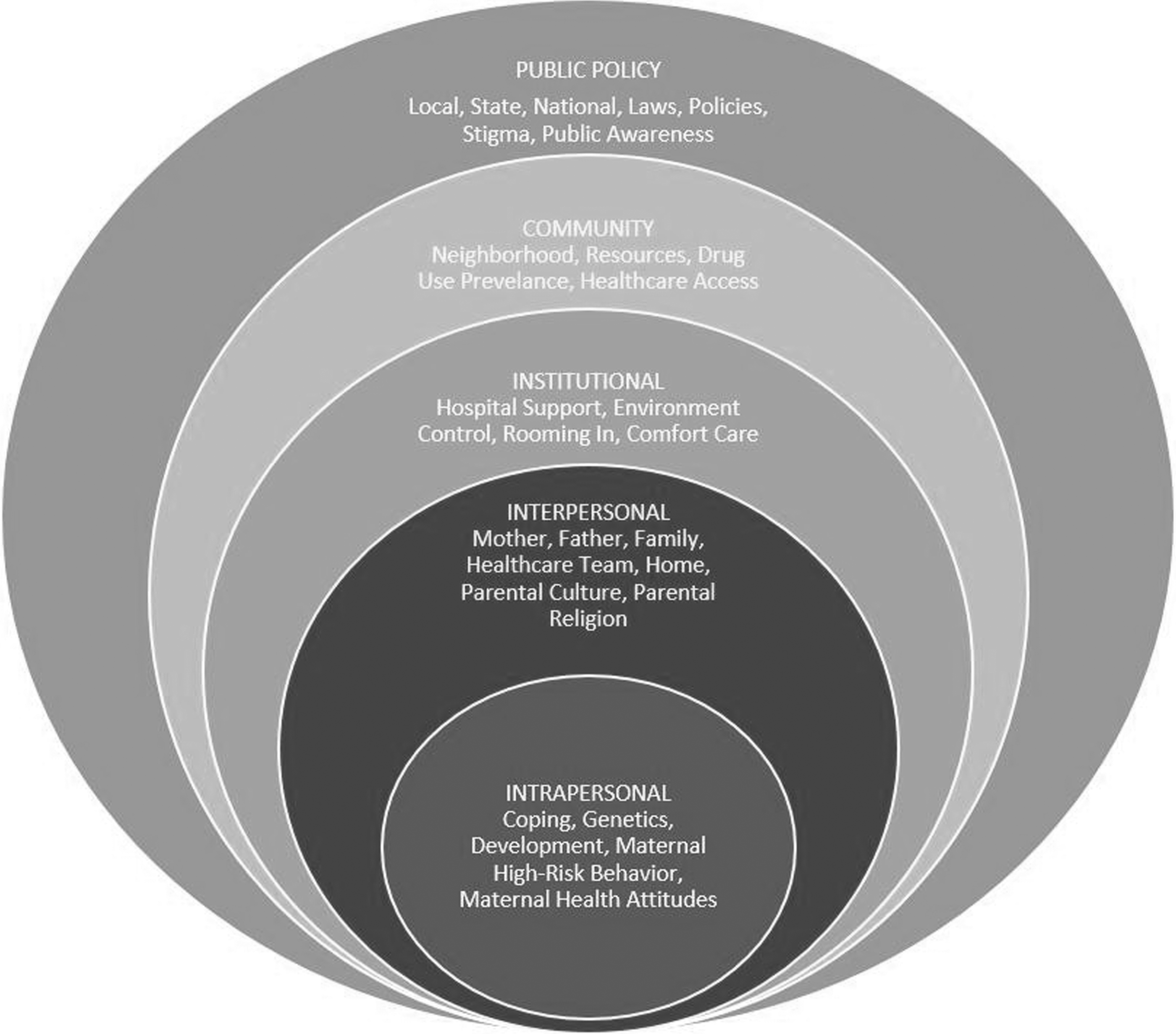
Social ecological model for neonatal abstinence syndrome management.
Intrapersonal factors include coping mechanisms, genetics, developmental history, maternal high-risk behavior, and maternal attitudes about health. 18 A mother's high-risk behavior and health attitude affects her decision directly to consume opioids and continue usage throughout her pregnancy. This decision affects the developing infant directly, as the mother provides all nourishment, potentially exposing her fetus to harmful substances. The amount and type of substance consumption also influences the complexity of the withdrawal an infant might experience. For example, if a mother chooses to smoke cigarettes, consume alcohol, and take benzodiazepines in addition to opioids, the infant will experience a higher level of withdrawal. 19 The infant's ability to handle withdrawal, is the combined result of genetics and developmental history. These collectively affect the infant's severity of opioid withdrawal in complex, interconnected ways.
Pharmacologic interventions might be administered to relieve severity symptoms associated with withdrawal and ideally improve the infant's comfort. However, these medications are associated with longer hospital stays, and there are no universal evidence-based pharmacologic treatment strategies. 20 At this level, acupuncture may serve as an additional, first-line nonpharmacologic therapy to relieve symptoms of withdrawal by promoting parasympathetic activity and reducing the need for medication.2,21
The interpersonal level of the social ecological model comprises the social network of the baby. 16 These individuals would include family members, friends, and the health care team that come into contact with the baby. Parental culture and religious affiliation also influence the infant's lifestyle and may serve to provide support and supplies. On the institutional level, the infant's care is centered around the mother–infant dyad, with a focus on maternal bonding and comfort care.1,16 Controlling the infant's environment by limiting stimulation is a priority when treating NAS. This includes soft music or sound machines, clustered care around feeding to reduce stimulation, and gentle touch. The healthcare team and medical center institutionally focus on this holistic care to maximize nonpharmacologic interventions fully that may be continued in the home after discharge from the hospital. Use of acupuncture could be included in this model of care and potentially serve as an additional therapy.
In the social ecological model community level, the baby's neighborhood, community resources, prevalence of drug abuse, and access to healthcare—in an interconnected fashion—all influence the mother's decisions whether to continue her high-risk behavior and/or utilize designated resources. 17 Finally, public policy at the local, state, and national level affect the availability of assets and the direction of effective programs to treat substance dependence and prevent NAS. 16 Social stigma associated with substance misuse, especially among mothers, is even more isolating and might prevent a mother from seeking appropriate medical care. 22 Public awareness could bridge the healthcare gap by increasing social acceptance of this condition and by encouraging more mothers to obtain care.
Materials and Methods
The Arksey and O'Malley methodological framework 23 guided this scoping review with enhancements directed by Colquhoun et al. 24 and Levac. 25 The five-stage approach included identifying the research question, identifying relevant studies, selecting applicable studies, charting the data, and summarizing the results. 23 A search strategy was developed and devised after consultation with a reference librarian in August 2018. The PRISMA [Preferred Reporting Items for Systematic Reviews and Meta-Analyses] statement was used to organize selected publications, and a flow chart was created to display the search process (Fig. 2). PubMed, EMBASE, Cumulative Index to Nursing and Allied Health Literature, and Cochrane Databases were searched for relevant publications.
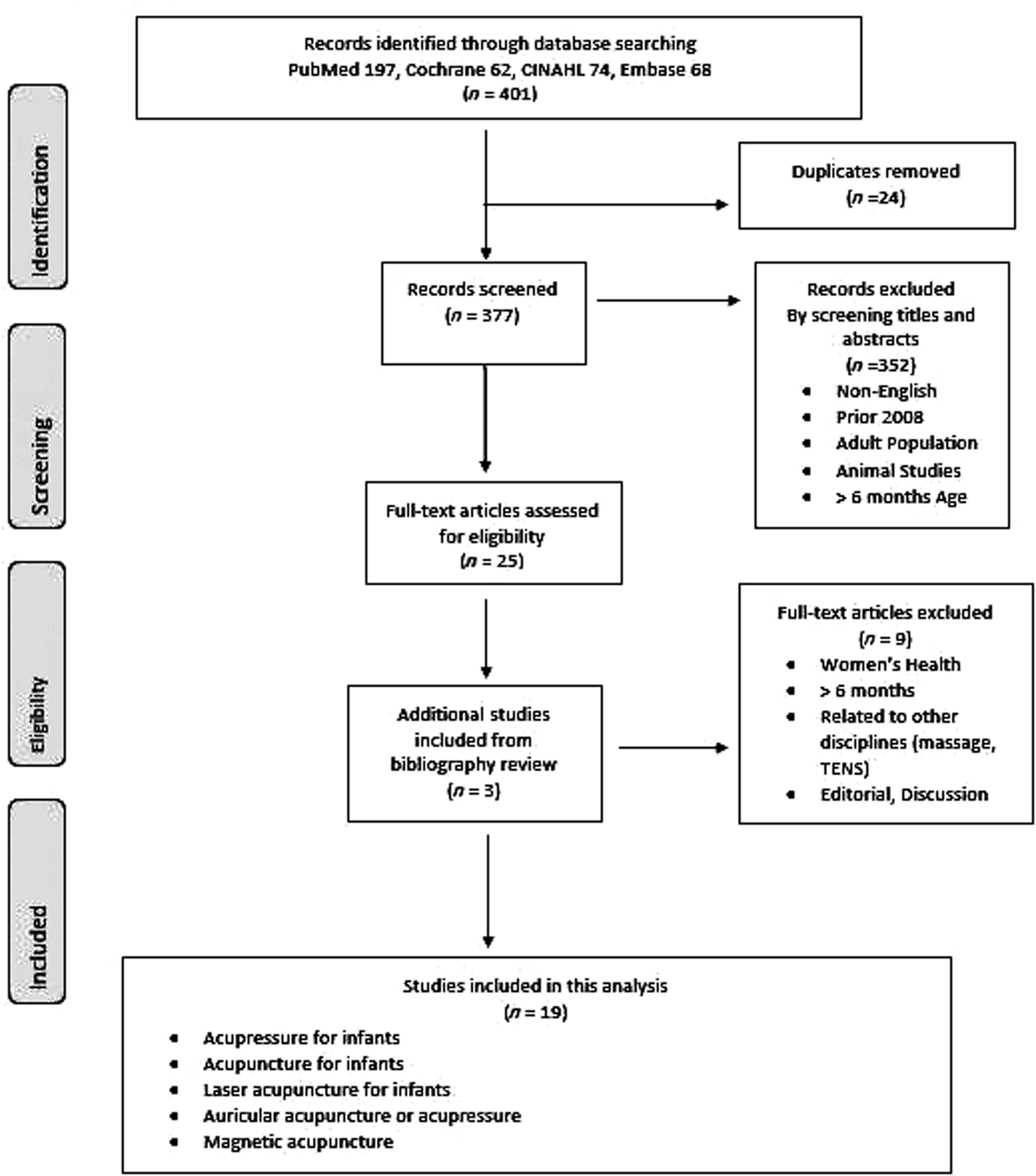
The PRISMA (Preferred Reporting Items for Systematic Reviews and Meta-Analyses) flow diagram. CINAHL, Cumulative Index to Nursing and Allied Health Literature; TENS, transcutaneous electrical nerve stimulation.
Inclusion and exclusion criteria were developed and used to filter studies that pertained to the infant population; that were published in English over the past 10 years; and that included randomized, controlled, and pilot studies published in scholarly peer-reviewed journals. The reference lists of the retrieved documents were reviewed to seek additional primary sources and relevant publications. An initial search included all nonpharmacologic interventions for neonatal populations and yielded more than 2000 results. Therefore, the search methods were refined. A combination of the following search terms was used for each database: neonatal acupuncture, infant acupuncture, infant acupressure, neonatal abstinence syndrome, opioid withdrawal, and non-pharmacologic treatments.
The refined search initially led to the identification of 401 publications. After checking for duplicates, the total was reduced to 377 studies, which were each evaluated based upon the inclusion/exclusion criteria. After abstract reviews, 352 publications were excluded because they were not published in English within the last 10 years, did not pertain to the neonatal population, or were animal studies. The remaining 25 full-text studies were reviewed, and an additional 3 studies were included after review of the references. Of those 28 publications, 9 were excluded because they were related to other disciplines such as women's health or were editorials and/or were discussion articles. Finally, 19 studies were included in the study sample for analysis.
A data-charting matrix was developed to organize extracted data, as recommended by Arksey and O'Malley (Appendix 1). 23 Recorded information was categorized into the following groups: author; date; purpose; sample; setting; design; methods; primary outcome variable(s); aim; use of theory; intervention; results; and recommended research. The social ecological model was utilized to describe findings (stage 4) and to synthesize results (stage 5) from the publications, with a focus on the five influential levels of health outlined by McLeroy and colleagues.16,23
Results
Nineteen studies were retained for this review and charted analytically (Appendix 1). Of these, 12 were randomized controlled trials (RCTs) performed in inpatient (n = 6) or outpatient settings. The trials were conducted in multiple countries, including China (n = 1), Austria (n = 1), the United States (n = 1), Taiwan (n = 1), Norway (n = 2), Turkey (n = 3), and Sweden (n = 3). Five trials were pilot studies conducted on inpatients in Wales (n = 1), the United States (n = 2), and Austria (n = 2). One was a case study of an inpatient in Austria. The remaining study did not report a formalized clinical trial structure and provided acupressure in addition to the standard of care in an inpatient setting in Iraq. 26
Five of the included studies evaluated the use of acupuncture to relieve symptoms of withdrawal caused by intrauterine exposure to substances and 5 studies utilized acupuncture to reduce symptoms of colic. Four trials assessed the effect of acupuncture or acupressure on neonatal pain; and the remaining 5 trials focused on improving weight gain (n = 1), Apgar scores (n = 1), neurologic development in cerebral palsy (n = 1), and the safety of laser acupuncture (n = 2). Overall, the results of these studies supported the use of acupuncture for treating multiple conditions in the infants.2,12,21,26–41
The 12 RCTs had varying sample sizes ranging from 7 to 147 participants.2,12,21,27,29,30,33–36,39,40 Of these randomized studies, half were prospective.2,12,21,27,35,40 The primary aim of other studies varied but often included the safety (n = 5) and feasibility (n = 4) of utilizing acupuncture as a treatment modality.26,28,32,37,39,41 Researchers in the studies also assessed the effect of acupuncture on withdrawal symptoms (n = 5), colic (n = 5), or pain (n = 4), neural development (n = 1), Apgar scores (n = 1), and weight gain (n = 1).2,12,21,26–31,33–36,38–41
Primary outcome variables assessed in the studies included duration of crying (n = 7), analgesic use (n = 6), symptoms of withdrawal (n = 5), vital signs (n = 5), pain scores (n = 4), presence of colicky crying (n = 4), pain scores (n = 4), hospital lengths of stay (n = 3), feedings (n = 3), durations of procedures (n = 2), Apgar scores (n = 2), thermographic skin measures (n = 2), behavioral states during the procedures (n = 1), weight (n = 1), stooling patterns (n = 1), gross motor function (n = 1), mental development (n = 1), psychomotor development (n = 1), cranial imaging (n = 1), and electroencephalogram (n = 1). Any adverse events were evaluated and/or reported in most of the studies (n = 16).
Several types of acupuncture were used in these studies. Needle acupuncture (n = 8) was most commonly used, followed by laser acupuncture (n = 5), acupressure (n = 4), magnetic acupuncture (n = 1), and a combination of needle and acupressure techniques (n = 1). The majority of the studies utilized full-body acupuncture sites (n = 13), 4 studies utilized a combination of auricular and body points (n = 4), and the remaining 2 studies applied auricular therapy alone.
Social Ecological Model
None of the studies discussed use of theory in their designs or analyses. A level of influence was included in all of the studies (Fig. 1). Intrapersonal factors were present in all 16 of the studies. The safety of acupuncture was also addressed on the intrapersonal level in all of the studies (n = 16). The majority of the studies concurrently included intrapersonal, interpersonal, and institutional influences (n = 9).
Intrapersonal Influences
The intrapersonal level of the social ecological model is the most basic aspect of the individual and includes developmental history. 16 When considering the use of acupuncture as a potential adjunct treatment, safety and any potential negative effects must be considered. The majority of the studies (n = 14) incorporated intrapersonal characteristics by discussing targeted interventions focused on comfort care and coping for the treatment of pain, colic, or withdrawal.2,12,21,27,28,30,31,33–35,38–41 All of the studies outlined the safety of acupuncture in the neonatal population.2,12,21,26–41 The aim of 5 of these studies was to evaluate the safety of acupuncture in the neonatal population.26,28,32,37,41 No adverse events were reported in any study, and all of the studies supported further research on acupuncture due to proven safety. Several of the studies reported specific therapeutic benefits of acupuncture, such as better sleep (n = 1), improved weight gain and feeding (n = 2), reduced pain or need for rescue medications (n = 3), and less crying (n = 3).21,28–31,33–35,38
Interpersonal Influences
For neonates with NAS, family members, friends, and healthcare providers are the only social contacts, thus encompassing the social relationship as outlined by McLeroy, et al. 16 Most of the interventions outlined the standard of care for hospitalized infants and fostered the mother–infant dyad. Swaddling, rooming-in, kangaroo care, parental involvement with care, breastfeeding, and holding were continued as part of the standard of care.2,12,21,26,28,29,31–36,38,41 Four of the studies utilized acupressure, which could feasibly be included in the standard of care as an additional adjunct and would not disrupt maternal bonding, as acupressure could be applied to the ear with continued nonpharmacologic interventions.2,12,26,29
Institutional Influences
In treating sick infants, 10 of the studies outlined the need for environmental controls, which have become the standard of care. 3 Medical centers providing care to this population have created supportive rooms that are private, as opposed to the historical community nursery setting, thus allowing for more direct support of the infant's individual needs. This supports the use of incubators, sound-makers, reduced stimuli, and clustering of care to allow for longer resting intervals.2,12,21,26,28–32,36,41 Such modifications to the baby's environment support neurodevelopmental and physiologic stability.3,42
Five of the studies concluded that the use of acupuncture is a feasible intervention in the neonatal population as part of the standard of care.2,21,28,30,41 Of these 5 studies, 3 assessed the use of acupuncture to treat NAS.2,21,41 Three of the studies added that acupuncture was well-accepted by parents, providers, and staff members implementing care.21,31,41 Golianu and colleagues surveyed the nurses and providers caring for the infants who were weaning off of medications and reported a consensus among these caregivers that acupuncture was helpful in reducing medications. 31 Schwartz, et al. reported a 96% successful recruitment and maternal support of their study utilizing acupressure to relieve symptoms of NAS. 2
Discussion
The most prominent finding from this scoping review is that use of acupuncture is safe for infants.2,12,21,26–41 The social ecological model demonstrated that acupuncture may be incorporated into the standard of care for NAS as acupuncture may be administered to the infant's ear and/or be part of clustered care in order not to disrupt swaddling, kangaroo care, or breastfeeding. Further practicality was supported by reports of acupuncture acceptance among families as well as institutions. All reported benefits in these studies targeted specific symptoms of opioid withdrawal, including feeding difficulties, disrupted sleep, pain, and agitation. These findings supported the use of acupuncture as a potential intervention to treat NAS.2,12,21,26–31,33–41 All of the investigators recommended additional research to evaluate the efficacy of acupuncture further, and collectively agreed that acupuncture is safe, feasible, and may be implemented in the neonatal population. These results support further research to evaluate the use of acupuncture for the treatment of NAS.
Gaps in the Literature
The use of acupuncture in the neonatal population has been studied and deemed to be safe; however, the researchers involved in these existing studies recommended further analyses of efficacy (n = 13). With respect to acupuncture for treating NAS, few studies resulted in implementation, and only justification for feasibility and safety had been achieved (n = 5). Multiple methods and sites are also discussed in the literature with no indication regarding which technique would be optimal as a treatment intervention. The overall consensus from these studies is that the researchers recommended higher sample sizes, as well as prospective, RCTs with blinding to evaluate the efficacy of a standardized protocol using acupuncture for treating infant medical conditions.
Limitations
This scoping review provided a large overview of acupuncture in the infant population. The search was limited to English-language publications within the last 10 years. Inclusion of non–English-language databases might have provided further studies for analysis. Therefore, some relevant studies might have been excluded. A second reviewer was not included in the search process despite recommendations by Arksey and O'Malley. 24
Conclusions
Acupuncture may be a noninvasive, acceptable, and feasible intervention for the neonatal population. Given the safety of acupuncture and positive outcomes in treating adult and pediatric populations, further research should be conducted examining the efficacy of acupuncture for treating NAS. Exploratory results of pilot studies with neonatal populations indicate that acupuncture could reduce opioid-withdrawal symptoms, reduce length of hospital stays, and, subsequently, reduce healthcare costs associated with treating NAS. Many opportunities exist to study the use of acupuncture for multiple medical conditions in neonatal medicine. Higher-quality RCTs should be performed to assess the safe use of acupuncture as an effective intervention. Additionally, comparisons of acupuncture techniques, sites, timing, and applications should be made to assess the greatest effects and feasibility.
Footnotes
Acknowledgments
The authors thank Camille Ivey the Health Sciences Informationist, Vanderbilt University's Annette and Irwin Eskind Family Biomedical Library and Learning Center.
Author Disclosure Statement
No competing financial interests exists.