




Abstract
Background:
Laser acupuncture is a relatively young modality in the field of acupuncture, used successfully for the treatment of various conditions since the early 1970s. It has, despite its ∼50 years of existence, already a comprehensive history behind it. This review deals with facts of this history and summarizes the most-important milestones.
Materials and Methods:
Scientific articles from the PubMed, Google Scholar, and China National Knowledge Infrastructure databases served as research documents. In addition, the research on laser acupuncture history included material published in scientific books.
Results:
A total of 38 listed articles were identified, 7 of which were considered relevant. In addition to a generally recognized definition of laser acupuncture, the beginnings of laser acupuncture and the first clinical applications worldwide, this review also shows the most-important milestones in the development of this discipline. The latter are, of course, the development of laser acupuncture systems, the first clinical studies, the implementation of multichannel laser acupuncture devices with laser-needle technology, and, ultimately, the combination of laser acupuncture with methods from research on photobiomodulation.
Conclusions:
Although considerable progress has been made in evaluating this innovative method of laser acupuncture, further research is needed in the coming years and decades.
Introduction
The effect of light has been known in medicine for thousands of years. The father of alleged “modern” Western medicine, Hippocrates (Fig. 1), already used heliotherapy on the Greek island of Kos to treat patients. 1 In addition, scientific treatments with different sources of light were available in Western medicine since approximately the middle of the last century.

Hippocrates of Kos (born ∼ 460
Linked to Traditional Chinese Medicine (TCM), the famous doctor, Sun Simiao, 2 from the Shanxi province in China, is accredited with describing the value and importance of light “therapy,” established in the Tang Dynasty to strengthen the Qi (Fig. 2).
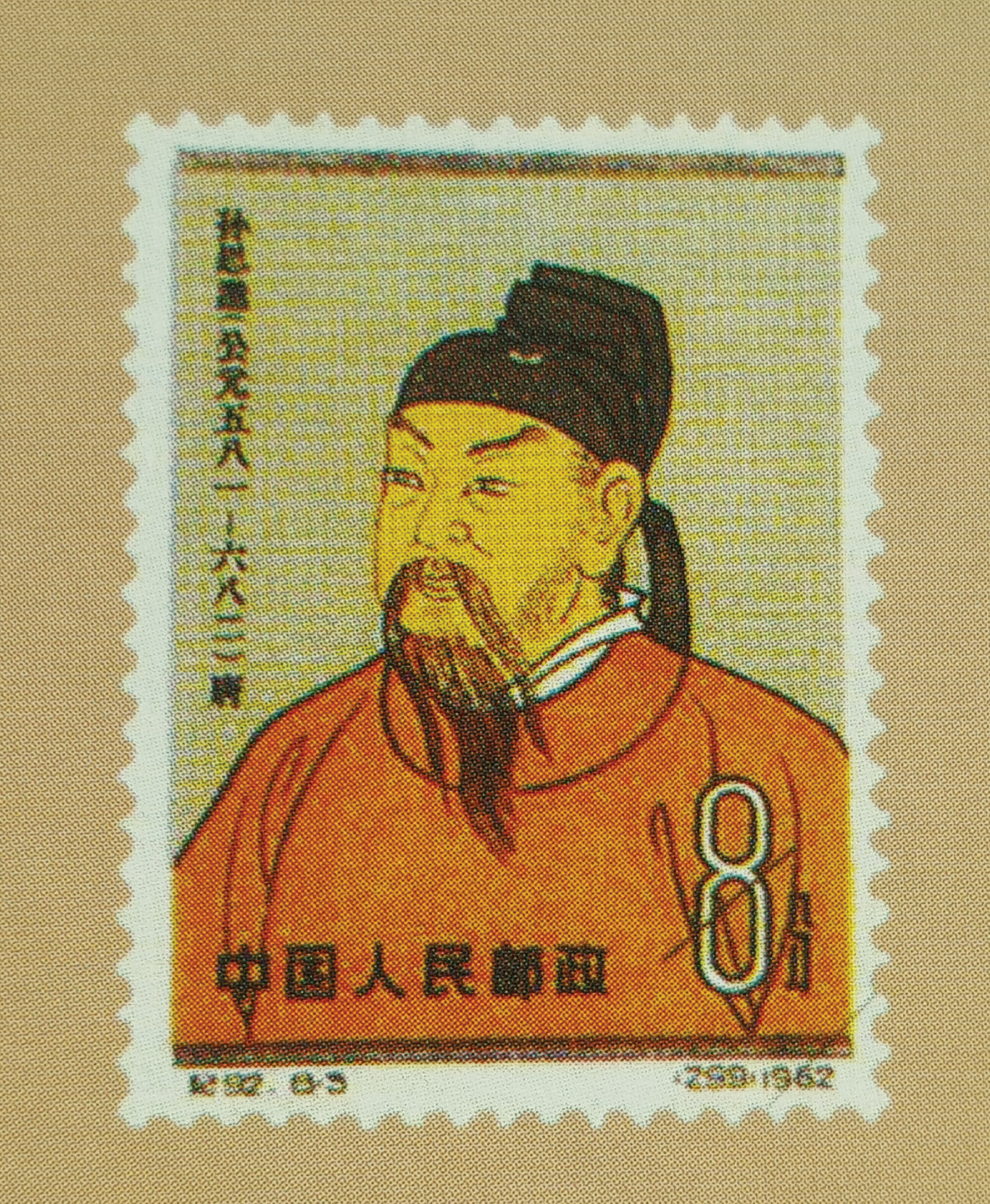
Sun Simiao (581
The world's first laser was developed ∼60 years ago. At that time, nobody thought that the term
Figure 3 shows the oldest still existing laser in Austria. The instrument was developed by Aussenegg at the Institute of Physics, University of Graz, Austria, in 1964, and is now in the Museum at the University of Graz. A ruby stick was used as the light-reinforcing material. 4

Laser from 1964 from the University of Graz, Austria. © G. Litscher. Color images are available online.
Currently, the scientific literature on laser acupuncture is quite extensive; however, the mechanisms and effects have not been proven in every detail. The PubMed scientific database (as of March 31, 2020) contains more than 1000 referenced laser-acupuncture publications. Recent studies with biomedical equipment that compared the effects of laser and needle acupuncture have contributed to a better understanding and demonstrated that laser light can be used successfully, efficiently, and safely in acupuncture treatments. However, since the early days of laser acupuncture, there are still many unanswered questions regarding the different parameters and effects of this innovative method.
This article summarizes a comprehensive review of historical knowledge dealing with laser acupuncture. The reader will be able to appreciate the evolution and progress that lasers have made in the field of acupuncture. This progress is continuing today with better therapy options for patients.
Materials and Methods
Search Strategy
The PubMed, Google Scholar, and China National Knowledge Infrastructure (CNKI) databases were searched until the end of March 2020. The Boolean operators and keywords used in the search were laser acupuncture, history AND laser acupuncture history AND laser moxibustion, and laser acupuncture definition OR laser acupuncture in ancient times. The strategy and keywords were adapted according to the respective database. In addition, historical and relevant scientific books on the topic were analyzed.
Results of Database Searches
The search request in the databases resulted in 38 articles, which were analyzed by the current author (Table 1). The focus of the analysis was on the interpretation of original and review articles. After removing duplications (n = 6), articles with no laser acupuncture history at all (n = 20), non-English-language articles (n = 1), and incomplete articles (n = 4), only 31 articles were left for further review (Fig. 4).
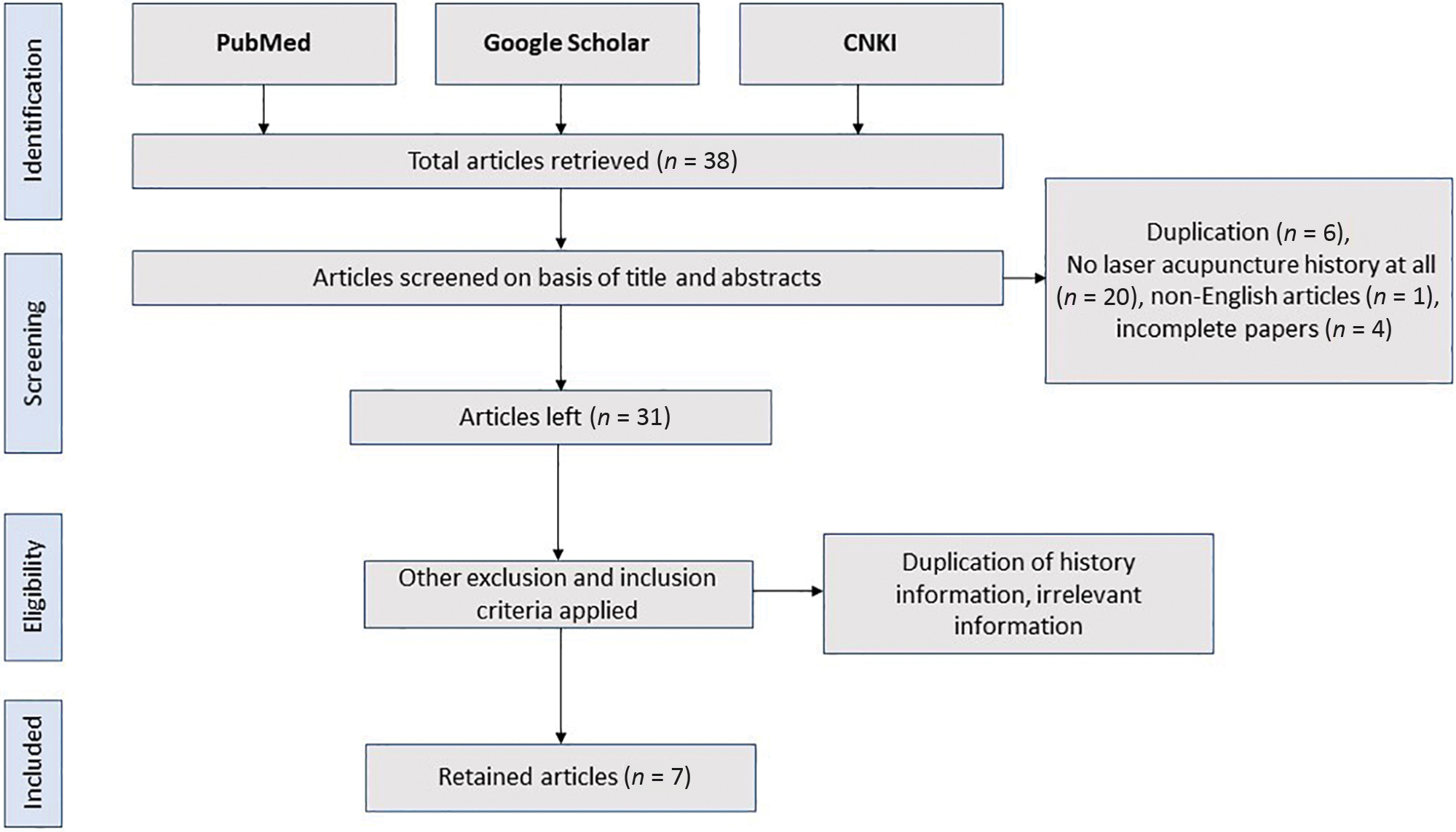
Selection of articles for this review. Color images are available online.
Results from the Different Databases (March 24, 2020)
CNKI, China National Knowledge Infrastructure.
Definition and History of Laser Acupuncture
Definition of Laser Acupuncture
The term laser acupuncture was used for the first time in the magazine Omni in the year 1978 in the introduction of laser equipment manufactured by the German company Messerschmitt–Bölkow–Blohm.5,6
Laser acupuncture studies listed in the Science Citation Index (SCI) and PubMed databases are steadily increasing. Altogether, in PubMed, there were 1015 publications on this topic as of March 25, 2020. However, 1.5 years ago, there was no commonly accepted definition of the term laser acupuncture.
On October 5, 2018, the following general definition of laser acupuncture was discussed during a consensus session (the current author served as Chairman of that session) at the 12th International
Early Sources of Laser Acupuncture in the Western World
As stated in the Introduction, the first laser was produced in 1960. Laser acupuncture has been used clinically since the 1970s (Fig. 5). It was the Hungarian professor Mester who was the first to report on significant improvements in animal wound healing.8–16
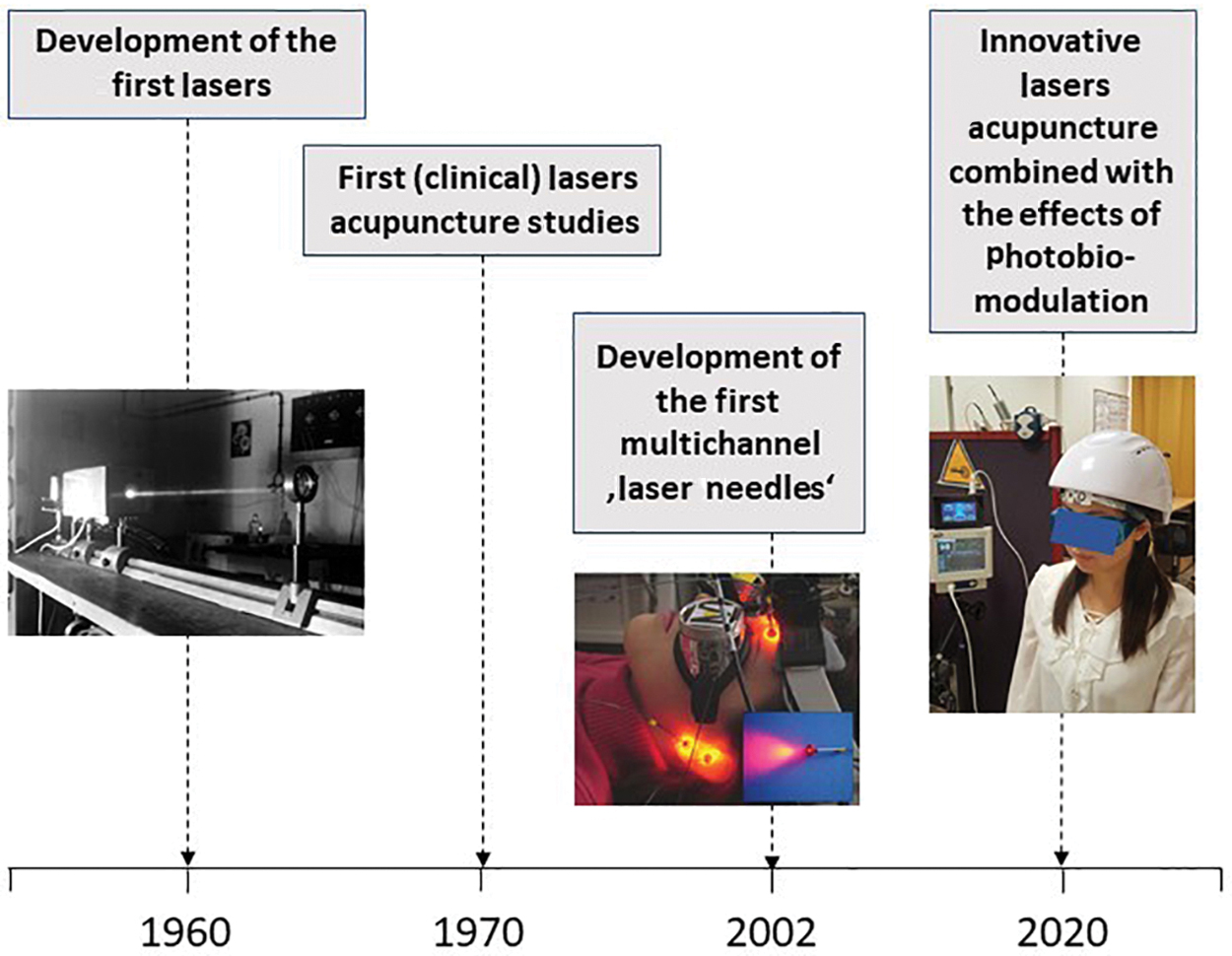
Milestones in laser acupuncture within the last decades. Color images are available online.
Plog, a Canadian, delineated the usefulness of laser acupuncture in the West. He had been testing lasers instead of acupuncture needles.4,6,17 Plog began his experiments with laser stimulation of acupuncture points in 1973. 17 In a book chapter entitled “Biophysical Application of the Laser Beam,” 17 he described some laser acupuncture procedures in detail. Plog also detailed 17 indications of laser acupuncture for lumbar pain, insomnia, headache, cervical pain, etc.6,17 This work resulted in the production of the first commercial laser acupuncture system. 18 Unfortunately, the majority of the studies performed with this system were neither randomized nor controlled.19,20 Nevertheless, it was also used for pain relief.21,22
There were many claims that laser acupuncture was first developed in China and the former Union of Soviet Socialist Republics (USSR).23–25 Yet, Plog is undisputed in the literature and scientific community as the first practitioner of laser acupuncture.6,18,26
Early Laser Acupuncture in Asia
It is largely unknown in the West that one of the medical pioneers of laser acupuncture originated from China. In 1997, the oral surgeon Zhou used laser acupuncture in China as a kind of controlled anesthesia for dental treatments.4,27,28 Zhou developed techniques that involved irradiation of different acupuncture points. 28 For tooth extraction in the lower jaw, a single acupuncture point (Hegu, LI 4) was irradiated for 5 minutes with helium–neon (HeNe) laser equipment, which focused a laser beam of 2.8–6 milliwatts (mW) at the acupuncture point. 28 Zhou also worked with CO2 lasers (in a range from 0 to100 mW), which he considered to be more effective than the other equipment at that time. He performed more than 10,000 tooth extractions with this laser acupuncture anesthesia.
A review of the Chinese literature and information from previous reviews on the history of laser acupuncture, 6 revealed an indication that a CO2 laser was used for acupuncture in 197629 before Zhou. 28 In addition, according to other scientific work, laser acupuncture was possibly first performed in Korea in 198030,31 and in Japan in 1983.6,32
Early Laser Acupuncture in Russia
In 1964, immediately after the development of lasers, 33 the study of laser therapy began in Russia (formerly the USSR). During 1965–1972, hundreds of studies were published on the topic. 33 For more than 50 years, no less than ∼1000 books were printed (monographs, collections, and methodological and clinical materials). 33 Also in 1975, Shchur et al. introduced laser acupuncture in the USSR and reported on a compilation of hypertension treatments.6,33,34
In 1970, Jang et al., all laser specialists from Korea, reported in their review article 6 that Utemuratova and Sokolova treated 118 hypertensive patients with a HeNe laser by irradiation of special acupuncture points. 35 Jang et al. then reported a large number of treatment successes of the Russian researchers, but also stated that these reports were primarily very brief reports and that most were in Russian. It was noted that the acupuncture points were not described, but were usually incorporated with so-called reflexology zones. From 1981 to the present, high-level basic research on laser therapy was performed in Moscow by Karu.33,36 Indeed, there are numerous advanced Russian publications on lasers and several published clinical guidelines. Unfortunately, most of these documents are in the Russian language and are not readily available.6,33
Past and Current Laser Acupuncture Research
In the next 30 years between 1973 and 2003, after the first clinical research publications by Plog, 17 more than 500 scientific articles (per PubMed) were published worldwide. The focus was on the development of different laser devices, animal experiments, case reports, fundamental research, and clinical studies. Most of these investigations were done with single-channel, handheld, laser stimulation devices. The years 2001 and 2002 were certainly considered milestones in the brief history of laser acupuncture. It can be seen in Figure 5, that the first multichannel laser acupuncture devices were developed. The basic idea of the laser needles comes from Traditional Chinese Medicine (TCM). Acupuncture requires multiple points for a treatment. As such, this was achieved in 2002 with multichannel laser systems. These laser instruments were developed at the University of Paderborn, Germany by Schikora, and the first clinical examinations were carried out in Lauenförde, Germany, by Weber. The first experimental studies and publications in this field of research started in 2002 in Graz, Austria.4,22 Numerous scientific articles on laser acupuncture and its effects have been published by the current author and his team37–44 and some of them are referenced in this article.
Although the practice of laser acupuncture in China still seems to be in its infancy, China occupies the first place for published research in the international scientific ranking in the English language. A total of 274 scientific articles on laser acupuncture from China were published. Fifty-nine articles were published with the participation of the Traditional Chinese Medicine Research Center of Graz and written by the current author and colleagues. In fact, Austria plays an important role in laser acupuncture research. 44 Nevertheless, it has to be repeated that hundreds of papers were published in the Russian language (Fig. 6).

Ranking of countries according to the number of published scientific articles (the majority in the English language) on laser acupuncture (March 27, 2020). USA, United States of America. Color images are available online.
Figure 5 illustrates that modern laser acupuncture has increasingly become a methodology combining innovative approaches such as PBM. The spectrum ranges from invasive laser acupuncture, in which optical fibers are inserted into the skin via needles, or intravenous laser blood irradiation, to transcranial laser stimulation, in which special helmet structures are used. PBM is the term used to describe the mechanistic/scientific basis for photonic specialty, and photobiomodulation therapy (PBMT) is the term for its therapeutic application. Thanks to the efforts of Arany, PBMT was added to the National Library of Medicine database as an entry term to the existing record of laser therapy. Thus, PBM and PBMT are accurate and specific terms for this effective and important therapeutic application of light.45–54
Discussion
Although laser acupuncture has a relatively young history, compared to other evidence-based complementary medicine methods, the beginning of using light as a therapeutic method originates far in the past. Therefore, it seemed appropriate today, ∼50 years after the first use of the laser in acupuncture, to summarize historical facts concerning the development of laser acupuncture in this narrative review.
Currently, laser acupuncture research is worldwide. Laser physicists, biomedical scientists, and doctors and scientists from other fields of research have performed basic research that comprises neuromodulation, neurophysiology, neurochemistry, cell biology, and vascularization—all of which confirms the bioregulatory effects attributed to lasers. 55
Laser pioneers received numerous prestigious awards for their research. For example, Townes (USA), and Basov and Prokhorov (both USSR) were awarded the Nobel Prize in 1964 dealing with visible light in the field of electromagnetic radiation.
Initially, in the medical field, there was a very critical lapse on laser treatment. It was only at the beginning of the 1980s that laser therapy—and, thus, laser acupuncture—were introduced very slowly into the various therapeutic areas. In the early 1990s, Pöntinen and Pothmann, 199356; Elias, 199657; Bahn and Kübelböck, 199758; and Bringmann, 201555 demonstrated that laser acupuncture might be an alternative to needle acupuncture.
The basics of laser acupuncture are well-described in the scientific literature.4,27,37,39,43,59,60 In addition, it has also been shown that laser acupuncture and needle acupuncture in healthy participants produces different brain activities.7,61 Laser acupuncture activates the precuneus relevant to mood in the posterior default-mode network, while needle acupuncture activates the parietal cortical region associated with the primary motor cortex.7,61 However, further investigations are warranted to evaluate the clinical relevance of these effects.
Today, innovative state-of-the-art methodologies guide future research strategies in the field of acupuncture in general and in laser acupuncture in particular. This includes nanotechnology or robotics, just to name two new branches of research.62,63
Conclusions
The relatively new methodology of laser acupuncture has already produced a comprehensive history. It took almost 50 years to appreciate the value of laser acupuncture. Findings from basic medical research together with clinical research helped to explain the effects of laser acupuncture on a biomedical and clinical basis acceptable to the Western medical establishment. Recently, laser acupuncture can be combined with conventional medicine to take advantage of what PBM can offer. By studying both Eastern and Western medicine, laser acupuncture can be used as an effective evidence-based complementary medicine method.
Footnotes
Acknowledgments
The author would like to thank the Editor-in-Chief of Medical Acupuncture, Richard C. Niemtzow, MD, PhD, MPH, for all recommendations for the article and the valuable help during the reviewing procedure.
Author Disclosure Statement
No financial conflicts of interest exist.
Funding Information
Funding was received from the TCM Research Center Graz, Medical University of Graz, Austria (telework).