




Abstract
Background:
Breast cancer is the most widespread cancer type, with more than half of the afflicted women suffering from sleep disorders and fatigue, as common complications of the treatment. This study aimed to evaluate the effects of acupressure and aerobic exercises on such women's sleep disorders.
Materials and Methods:
This study was carried out on 99 women affected by breast cancer. Participants were divided to acupressure, exercise, and control groups. The acupressure group received the treatment 3 days a week for 8 weeks. The exercise group participated in aerobic exercises 3 times a week for 8 weeks. The control group received routine care in the oncology clinic. Sleep quality was assessed by Pittsburg sleep quality index.
Result:
The overall score of sleep quality scale in the acupressure and exercise groups was significantly less than that in the control group at weeks 4 (Medical Doctor: 2.7 with 95% confidence interval [CI]: 1.67 to 1.12) and 8 (MD: 0.07 with 95% CI: −1.21 to 1.03) of intervention. However, there was no significant difference between the acupressure and exercise groups.
Conclusion:
The results of this study indicated that both acupressure and exercise methods can be effective and safe methods in reducing sleep disorders of breast cancer survivors and neither is superior to the other.
INTRODUCTION
Breast cancer is considered as one of the major causes of death across the globe.1,2 Nowadays, most of the women with breast cancer either recover or keep on living with the disease and its complications thanks to advanced treatments and early diagnoses. 3 Sleep disorders are among prevalent complications cancer patients have to cope with, and seem to result from pain or common treatments for cancer, such as chemotherapy and selective estrogen receptor modulators (SERMs).4–6 The prevalence of insomnia among breast cancer survivors has been reported to be 30%–60%, 7 which often lingers on for years, reducing the quality of life. Besides, the lack of appropriate treatment for insomnia can make it chronic. 8
There are a variety of medications, for example, Benzodiazepines for treating insomnia. However, studies suggest that there are several associated side-effects and drug dependence, which make them unsuited for these patients. 9 Furthermore, the long-term effectiveness of pharmacologic treatments remains unclear. 10 Physical exercise is regarded as one of the safe, effective, and measurable methods, which enhances general health and lowers the risk of chronic diseases associated with one's lifestyle. 11
There is an abundance of systematic reviews and studies in this regard. Some of the systematic reviews reported the improvements in the sleep quality of the cancer patients, whereas the findings of a meta-analysis suggested that exercise interventions may have little effect on objective and subjective sleep quality of cancer patients.12,13
One of the complementary treatments in this regard is acupressure, which is known as a noninvasive easy technique and one of the selective treatments for sleep disorders. Acupressure is actually noninvasive form of acupuncture in which finger pressure on particular points is used rather than inserting needles into those points. In other words, acupressure is defined as exerting pressure on certain points of the body for treatment purposes. The Chinese medicine texts conceive of the world and human body as an energy system, which cannot exist independently of each other. 14
The meta-analysis of Waits et al. revealed that acupressure could improve the perceived sleep quality assessed by Pittsburg sleep quality index (PSQI) by 13%–19%. 15
Given the prevalence of breast cancer and the associated sleep disorders among the afflicted, alongside the effectiveness of exercise interventions and acupressure in ameliorating this complication as well as the lack of research comparing the effects of these 2 methods, this study aimed to compare the effects of physical exercise against acupressure on the sleep disorders breast cancer survivors who are on medication.
MATERIALS AND METHODS
This randomized controlled clinical trial was conducted on 99 women with breast cancer referring to oncology clinics of 2 centers affiliated with Tabriz University of Medical Sciences. The study was registered in clinical trials registration office (IRCT20150424021917N8). The inclusion criteria checklist was filled out for every individual and eligible women were invited to an introduction meeting. The participants completed the informed written consent forms after providing the adequate explanations about the objectives and method of the study. The participants were followed up through telephone.
The inclusion criteria were women aged 18–45 years, being at stage 2 or 3 ductal or lobular carcinoma without metastasis, obtaining score 5 or higher in the PSQI questionnaire, having no limb movement disorder, and having finished the last chemotherapy or radiotherapy period 8 weeks before. The exclusion criteria included women with BMI over 30 kg/m2, receiving any medication for insomnia, doing any physical exercise regularly or professionally, suffering from cardiovascular diseases, having any sort of limitation for physical activity or inability for aerobic exercise, and having acupuncture within the previous 2 weeks.
Data Collection Tools
The demographic questionnaire was used, including the variables of age, marital status, disease stage, and family income level.
The PSQI is a self-rated questionnaire, assessing sleep quality on 7 subscales of subjective sleep quality, sleep latency, sleep duration, habitual sleep efficiency, sleep disturbances, sleep sufficiency, and use of sleep medications. The scores allotted to each subscale ranged from 0 to 3, with the total score of 21. The reliability of the questionnaire in Iran was reported at Cronbach's alpha of 0.88. 16 Informed written consent forms were obtained from all the participants. The demographic questionnaire and PSQI were filled out for each participant before the intervention. PSQI was completed again at the 4th and 8th weeks. The questionnaire of satisfaction with the received intervention was filled out for each participant at the end of the intervention.
Sample Size
This study is derived from a wider research comparing the effects of exercise and acupressure on reducing hot flash and sleep disorders among women with breast cancer. 17
The sample size was calculated according to the study of Bourd et al, 18 based on the hot flash variable using G-power software. Considering m1 = 6.7, m2 = 8.7, standard deviation (SD)1 = 4.3, and SD2 = 3.7, β = 0.2, and α = 0.05, sample size was determined 33 for each group.
Random Allocation and Allocation Concealment
The eligible women were allocated randomly in exercise, acupressure, and control groups with a ratio of 1:1:1 by blocked randomization using Random Allocation Software with a block size of 6 and 9. For allocation concealment, the type of intervention was written on a piece of paper and placed in opaque envelops numbered consecutively. Each envelope was given to a participant orderly. The envelopes were opened by a noninvolved person in the sampling process in the order in which the participants entered the study.
Intervention
The acupressure points of HE7, HE GU, and SP6 were selected for this study. Participants were asked to perform self-acupressure 3 times per day and stimulate each point in a circular motion for 10 minutes during 8 weeks. All participants were trained to do acupressure under the supervision of the acupuncturist (M.S.N.) and the training session was in the office of acupuncturist. The participants were instructed to apply enough pressure without feeling pain. A member of research team (S.K.) called women for following acupressure every Friday.
An aerobic exercise training program was considered for the exercise group at a gym 3 times a week for 60 minutes during 8 weeks under the supervision of a sports coach and the researcher. The exercise program was aerobic with low to moderate intensity. The exercise intensity was determined based on the participant's ability. Exercise program included warming up and cooling down for 10 minutes and performing kinetic movements and treadmill workout between them. The control group received only routine care in the oncology clinic, including general training to change the lifestyle and the factors affecting cancer recurrence. Participants completed the PSQI at 4th and 8th weeks.
The collected data were analyzed using SPSS24 software. Analysis of variance (ANOVA) and chi square tests were used to compare the sociodemographic characteristics among the 3 groups. Shapiro Wilk test was applied to assess the normal distribution of PSQI score. In the case of normal distribution, ANOVA test was used to analyze the score among the 3 groups before the intervention. The general linear model with PSQI score adjustment was utilized before the intervention to compare the PSQI score among the study groups at the 4th and 8th weeks. The repeated measure test was used for the intragroup comparisons. In addition, all the analyses were performed using the intention to treat method.
RESULT
The research was conducted in 2 educational treatment centers in Tabriz. Sampling process lasted nearly 1 year (since January 2018 to January 2019). Although about 280 people could meet the inclusion criteria, 99 individuals were finally included in the study (the rest were reluctant to participate), who were assigned to the acupressure (n = 33), exercise (n = 33), and control (n = 33) groups (Fig. 1). The mean (SD) age of the participants was 38.4 (5.4). All participants were using SERMs' analogues in the time of study. Furthermore, 40 participants had experienced radiotherapy and 99 (100%) had at least 8 sessions chemotherapy. In general, there was no significant difference between the groups in terms of the sociodemographic characteristics (Table 1).
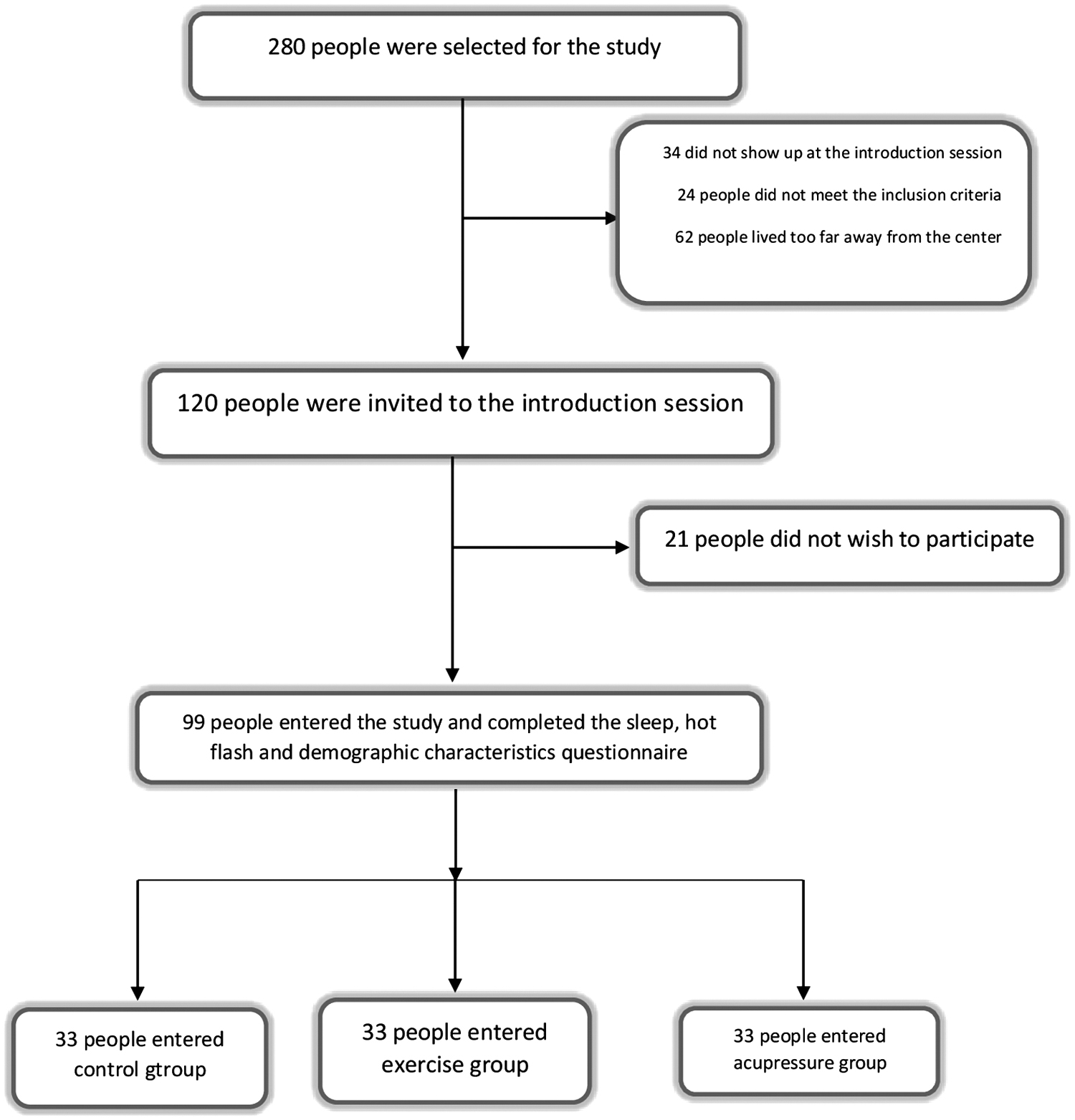
Study flowchart.
Sociodemographic Characteristics of Participants
BMI, body mass index.
The results of first part of study indicated that both acupressure and exercise can decrease frequency and severity of hot flash episodes. However, there was no difference between 2 methods. 17
Data analysis revealed that there was no significant difference between 3 groups with respect to PSQI at the beginning of intervention. The PSQI total score was significantly lower in the exercise and acupressure groups compared with the control group at the 4th and 8th weeks of intervention. However, a significant difference was not observed between the exercise and control groups (Table 2). In the intragroup comparisons, there was a significant decline in PSQI score in both exercise and acupressure groups at the 4th and 8th weeks although there was no corresponding decline in the control group.
Comparison Pittsburg Sleep Quality Index Score Between 3 Groups
One-way ANOVA, Tukey ad hoc test.
General linear model.
Repeated measure ANOVA.
ANOVA, analysis of variance; CI, confidence interval; SD, standard deviation.
DISCUSSION
This clinical trial was carried out on 99 breast cancer survivors, who had finished their chemotherapy and radiotherapy periods. In this study, 1 group received acupressure on 3 points of their body, the next group received an aerobic exercise program, and the third group received only the routine care. The hypothesis was that both aerobic exercise and acupressure methods would be effective in improving the sleep quality, with little difference between the 2 methods.
The results revealed that both acupressure and exercise were acceptable methods with few side-effects, which had significant effects on reducing the sleep disorders of women with cancer. A comparison of the acupressure and exercise groups indicated that there was no significant difference between the 2 methods in reducing the scores of sleep disorders after the 4th and 8th weeks of the treatment. However, considering the mean differences, it seems that exercise was just a little more effective than acupressure in reducing sleep disorder scores at the end of the 4th and 8th weeks.
There is a lot of research on the effects of exercise on sleep, most of which pointed to its positive effects. There are certain studies underlining the positive effects of aerobic exercise on improving sleep quality among teenagers, young, and elderly.19–21 In this study, exercise was found capable of improving all 7 PSQI subdomains. Although the exact mechanism of exercise effect on sleep is unknown, it might be safe to say that a probable mechanism was related to the enhancement of energy intake, endorphins, and body temperature.
In contrast, mediocre exercise can reduce pro-inflammatory cytokins and increase anti-inflammatory cytokins, and consequently improve the sleep quality. 22
Furthermore, the results of the studies investigated the effects of acupressure on improving sleep disorders indicated the positive effects of acupressure.23–26 The exact mechanism of the acupressure effectiveness on sleep quality is not quite known although it could be assumed that the increase in neurotransmitters such as serotonin might improve the sleep quality. 27
Based on the results of this study, exercise and acupressure performed for 8 weeks were effective on improving the sleep quality in the subscales of subjective sleep quality, sleep latency, sleep duration, and actually improved the aforementioned subscales. In addition, 6 patients needed the treatment with exercise number needed to treat to reach a score of PSQI 5, 5 treated with acupressure, and 4 treated with Paroxetine. 28
Given the results of this research, acupressure and exercise are nonhormonal, noninvasive, painless, and safe methods to improve women's sleep quality and sleep disorders of breast survivors. We came across just a few side events in the intervention groups. Ankle sprains were the only complication observed for 2 participants in the exercise group and no complication was observed for the acupressure group.
Strengths and Weaknesses
There were strengths and weaknesses in our research. One of the strengths concerns the method, which involved randomization and allocation concealment. Good adherence to the intervention protocol was perhaps another strong point of this study. However, the lack of the assessment of sleep disorders with an objective criteria was regarded as one of the weaknesses of this study. Although PSQI sensitivity is pretty high (98.7%), 29 the objective criterion, such as polysomnography should be used for accurate and precise interpretation of the results.
CONCLUSION
Breast cancer survivors usually experience drop in sleep quality and suffer from sleep disorders as a result of cumulative effects of the medication taken. The results of this research revealed that exercise and acupressure are 2 effective methods with negligible complications in reducing sleep disorders among women with breast cancer. Neither method was found to be more effective than the other. Considering the prevalence of sleep disorders among women with breast cancer and the limitations in pharmacologic treatments, exercise, and acupressure might be good substitutes to be employed for reducing sleep disorders among these women.
Footnotes
ACKNOWLEDGMENTS
We hereby express our sincere gratitude to all the participants and the oncology clinic of Ghazi treatment and educational center. Authors are all from Tabriz University of Medical Sciences (Tabriz, Iran), where medical education, treatment and research in medical are the primary functions.
AUTHOR DISCLOSURE STATEMENT
No competing financial interests exist.
FUNDING INFORMATION
The article has been extracted from an M.Sc. dissertation, and Tabriz University of Medical Sciences has funded the study.