




Abstract
Background:
Low-back pain, with or without sciatica, is the most-frequently encountered pain in clinical practice. There are many ways to alleviate this pain, but most modalities are time- or cost-consuming.
Cases:
This report describes how pestle-needle therapy was used to treat low-back pain and sciatica in 3 patients.
Results:
The 3 patients had much relief of their low-back pain and sciatica after their first sessions of pestle-needle therapy.
Conclusions:
Pestle-needle therapy is safe, simple, and effective for treating low-back pain and sciatica, and can be considered as a first-line treatment for low-back pain and sciatica.
INTRODUCTION
Low-back pain is the type of pain most often encountered in clinical practice.1,2 About 80% of adults have low-back pain at some point in their lives. This pain is the most-common cause of job-related disability and is a leading contributor to missed workdays and visits to physicians. 1 The National Center for Complementary and Integrative Health (NCCIH) has identified a variety of complementary practices—including acupuncture, electromyography biofeedback, low-level laser therapy, mindfulness-based stress reduction, progressive muscle relaxation, spinal manipulation, T'ai Chi, and yoga—that may be helpful for relieving chronic low-back pain. 1 Low-back pain is frequently associated with sciatica, as ∼90% cases of sciatica are caused by herniated discs with nerve-root compression. 2 Clinical guidelines in 2019 in Denmark, the United States, and the United Kingdom highlighted the role of conservative treatments for sciatica. 3 Most of the currently practiced conservative treatment modalities take at least several weeks to be felt. Thus, this article explains the methodology of Chu Zhen and shares 3 cases from the current authors' experiences in treating low-back pain alone and low-back pain with sciatica using pestle-needle acupressure, which was able to induce prompt relief.
Methodology
Pestle-needle, or Chu Zhen in Chinese literature, is a Traditional Chinese Medicine (TCM) therapeutic modality that originated from the Taoist master in Wudang Mountain. The therapy is traceable to at least more than 500 years ago.4,5 Pestle-needle therapy is a noninvasive acupuncture method using a unique set of meridians and points, specialized tools, and specific methods of manipulation. Until modern times, this therapy was a secret method, passed down through a lineage to its modern inheritor, Li Zhong Yu, a professor of acupuncture at the Chengdu University of Traditional Chinese Medicine.4,5 The current authors have practiced Chu Zhen for more than 10 years to treat various conditions, especially those related to pain, including low-back pain and sciatica, with mostly satisfactory results.
The tool used in pestle-needle therapy for low back-pain and sciatica is the Jin Gang Chu, a small stick, ∼12 cm long, with one end rounded as its base, and another end pointed as its tip, as depicted in Figure 1. The rounded end is for massaging and for stroking manipulation, while the pointed tip is for pressing the Chu Zhen's points (the Bazhen points as described below). 4
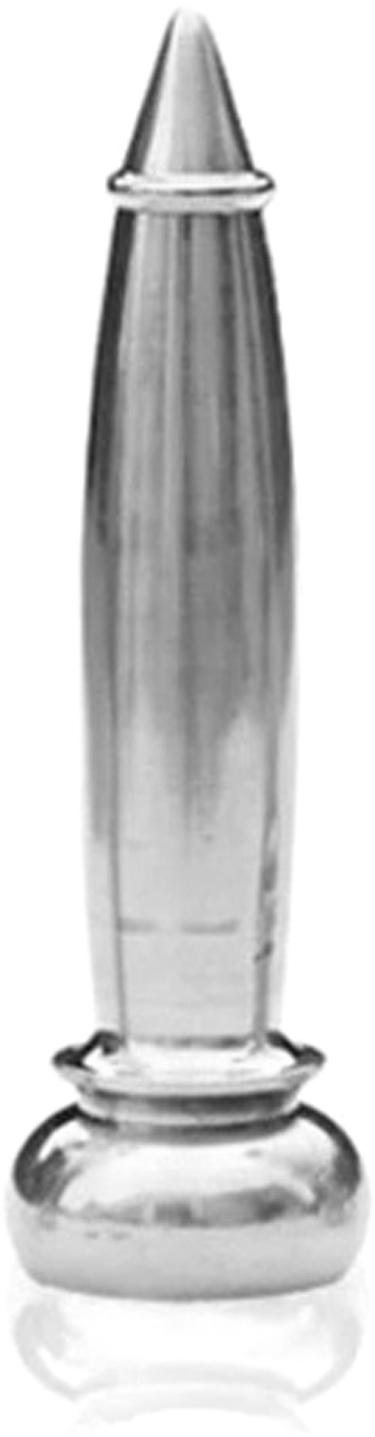
The pestle needle (Jin Gang Chu) used to treat low-back pain and sciatica.
The meridians and points of pestle-needle therapy are much more simple than in fine-needle acupuncture. Chu Zhen uses only 2 sets of meridians, the Hechelues, along the governing (GV) and conception (CV) vessels. The Hechelues on the back for treating low-back pain and/or sciatica consist of 7 lines (i.e., 1 line along the GV in the midline of the spine; 3 other lines bilaterally on each side of the GV, respectively, 0.5″, 1.5″, and 3″ lateral to the GV; all those 7 lines running from the level of Dazhui [GV 14] at the base of the neck up to Changqiang [GV 1] at the coccyx). The Chu Zhen therapy points are the Bazhen points. Each set of Bazhen points has 25 points with 1 central point and 24 satellite points surrounding the central point. The 24 satellite points are located in 8 directions on 3 concentric circles encircling each central point.4,5 The Bazhen points used to treat low-back pain and sciatica are shown in Figure 2.
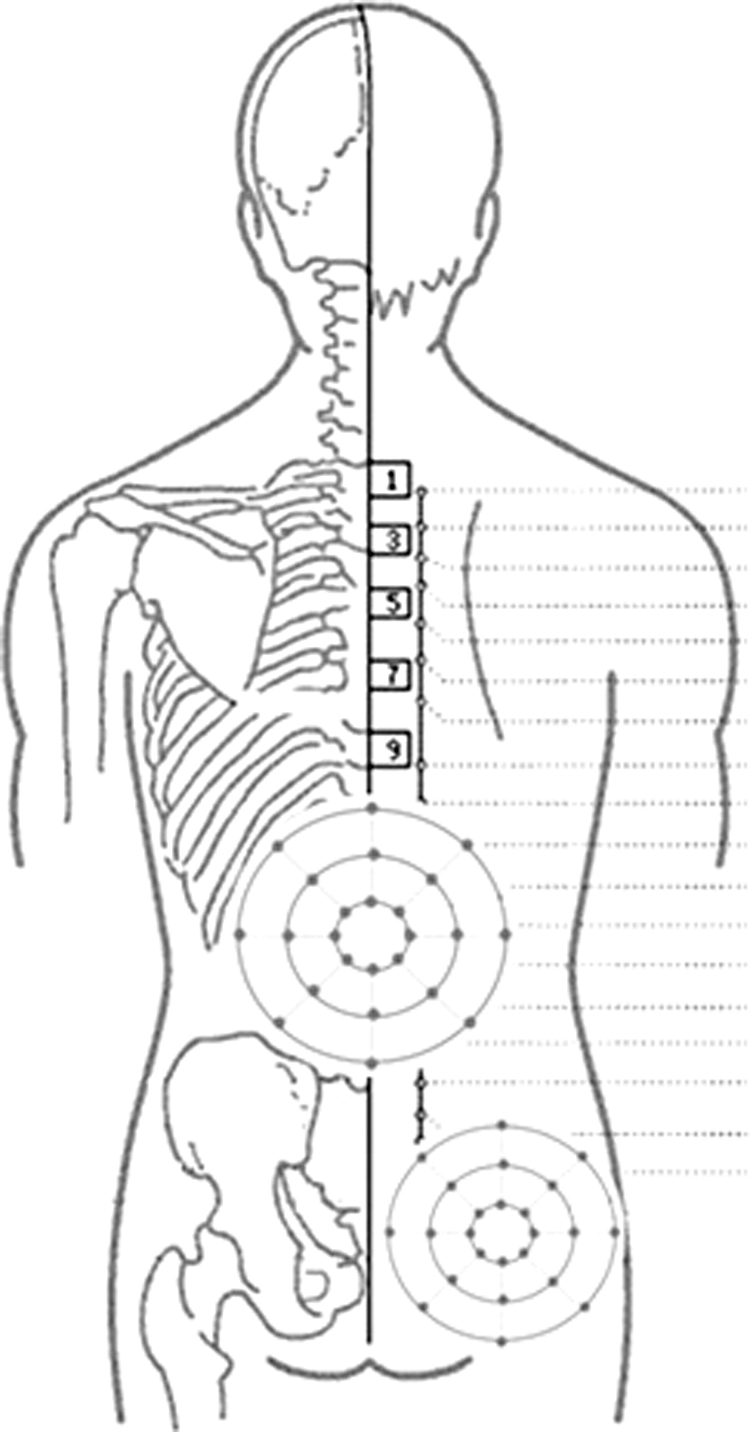
The Bazhen points on the lumbar and gluteal areas used for treating low-back pain and sciatica.
The standard procedure of pestle-needle therapy for low-back pain and sciatica is as follows:
The patient is given an explanation about pestle-needle treatment. Informed consent for treatment is then obtained. The patient lays in a prone position, with both arms at the side of the body, and is relaxed with the lumbar and/or gluteal area(s) exposed. The lumbar and/or gluteal area(s) are examined by pressing the acupoints in the area(s) to locate Ashi point(s). These Ashi points could induce the patient's painful symptom of low-back pain and/or sciatica. This examination is repeated after treatment to assess the therapy's results. Pestle-needling begins with mild manipulation (i.e., a rotating manipulation upon the Mingmen–Bazhen and/or the gluteal Bazhen area[s]). Rotating manipulation involves exerting a massaging pressure in a circular clockwise motion upon the affected area. It takes ∼2–3 minutes. Then stroking up and down repetitively along Hechelues of the lumbar and/or gluteal area(s) of the affected side(s), from the level of GV 9 to GV 1, takes another 2–3 minutes. Both the rotation motion and the stroking manipulations are performed with the rounded end of the Jin Gang Chu. Then the 25 points of either the Mingmen–Bazhen or the gluteal Bazhen are stimulated with the pointed end or tip of the Jin Gang Chu. On each point, the pointed tip is pressed and released (keeping the tip in contact with the skin) 7–10 times. All 25 points are stimulated in turn from the central point outward to the points in the 3 concentric circles in the 8 directions. For patients with sciatica, pestle-needling manipulation is performed on the affected gluteal area, with the central point located 1″ medial to GB 30 (Huantiao), and the 24 satellite points surrounding it spread evenly all over the gluteal area, as shown in Fig. 2. This manipulation takes ∼3–5 minutes. After stimulating the Bazhen points, the lumbar and/or gluteal area(s) are massaged again with the rounded tip of the Jin Gang Chu, with an up-and-down stroking motion. Finally a rotation motion ends the procedure. The up-and-down stroking motion and the rotation motion in is the same as described in step 4. Step 3 is repeated to assess if the Ashi point(s) have diminished or disappeared.
The entire procedure usually takes ∼20 minutes. To facilitate manipulation, massaging oil may be used as an adjuvant lubricant.
Contraindications include any inflammatory or other lesions in the Mingmen–Bazhen and/or gluteal area(s) that might be hurt by the pestle-needle manipulations.
After pestle-needle therapy, patients usually feel relief from low-back pain and/or sciatica immediately when they rise from the prone position. No serious adverse reactions occur, and only a few patients experience a feeling of tenderness at the site of manipulation. This resolves in 1–2 days.
THREE CASES:
TREATMENTS AND RESULTS
Case 1
Dr. E, a 59-year-old female, with a body mass index (BMI) of 31, had an acute exacerbation of low-back pain due to herniation of a vertebral disc at L-4–L-5. Her pain with visual analogue scale (VAS) of 9. She was told about the treatment, and consented to it. Pestle needling was performed according to the standard procedure on the Mingmen–Bazhen area, with this patient in a prone position. After ∼20 minutes of treatment, she felt relieved, and had a VAS score of 3. The pestle needling, was repeated 2 days later, and her husband was instructed to imitate the manipulation using his bare hands to give her care maintenance. At her follow up 1 month later, no recurrence of her low-back pain was reported or noted.
Case 2
Mrs. B, a 48 year-old housewife, had chronic low-back pain and sciatica of her right leg, with a VAS score of 7–8. Her straight leg-raise test result was positive. After having the treatment explained and giving her consent, she was placed in a prone position. Pestle needling was performed according to the standard procedure first on the Mingmen–Bazhen in the lumbar area. Her low-back pain was relieved immediately, but she still had sciatica. Pestle needling was performed on her right gluteal area, with an Ashi point at 1″ medial to GB 30 (Huantiao) as the central point. Massaging with rotation and an up-and-down stroking motion was performed to relax her thick gluteal muscles for ∼5 minutes. Then, the Ashi point and the satellite points in 8 directions around it were pressed according to standard procedure of pestle needling. After this treatment, the patient had immediate relief with a VAS score of 1–2. No recurrence was reported or noted at a 2-week follow-up.
Case 3
Mr. F, a 70-year-old senior pastor, had chronic low-back pain with VAS score of 6, in addition to coronary heart disease and a prolapsed heart valve. He was still able to perform his job as a clergyman. Pestle-needle therapy was explained, and he gave his consent for the treatment. He then lay down in a prone position. An examination revealed that he had Ashi points at the right transverse processes of the third, forth, and fifth lumbar vertebrae. Pestle-needling was performed, according to the standard procedure, on the Mingmen–Bazhen. After treatment he felt relief and had a VAS score of 3. Then, every 1–2 weeks, he was treated with pestle needling for maintenance care. Despite his heart problems, he did not report any adverse effects and none were observed.
DISCUSSION
Low-back pain is divided into 3 categories according to its time span. Most episodes of low-back pain last only a short period of time; this is acute low-back pain. Acute low-back pain is often defined as pain that lasts for up to 4 weeks. In most cases, acute low-back pain goes away without causing any lasting problems. Low-back pain that lasts between 4 and 12 weeks is subacute low-back pain. If the pain lasts for 12 weeks or longer, it is considered to be chronic low-back pain. 1 The majority of patients seen by the current authors are chronic sufferers, who present due to acute exacerbations caused by faulty exercise or posture.
Pestle needling or Chu Zhen acupressure is a health-maintaining and -sustaining method that originated hundreds of years ago from the Taoist master in Wudang Mountain, China.4,5 Since ∼50 years ago, the therapy has been studied and disseminated worldwide. It has proven to promote blood flow6,7 and relieve various kinds of pain,8–10 including intractable pain after surgery for lumbar-disc herniation. 11
Regarding a mechanism of action, from the TCM perspective, pestle-needle manipulation stimulates, facilitates, and regulates the smooth flow of energy and Blood, overcoming blockages due to Cold, Phlegm, or Qi Stagnation. In principle, this mechanism of action is similar to acupuncture except it is noninvasive in nature.4,5 Hence, lately it has been termed pestle acupuncture. 12 Facilitating and regulating the flow of Blood and other body fluids6,7,12 this therapy relieves pain by reducing compression caused by edematous tissue due to Stagnation of Blood and lymph flow at the affected site. The therapy also works by removing inflammatory substances accumulated at the affected site. Pestle-needle therapy has been shown to improve lumbar-muscle tone, 11 so this therapy may make the lumbar spine more stable to guard against any recurrences of low-back pain and sciatica.
In case 2, there was combined low-back pain and sciatica. This lumbar radicular symptom is painful and disabling, resulting in worse pain, disability, and quality of life, and also results in increased use of health resources, compared with low-back pain alone. 13 The causes are multifactorial. There is increasing evidence that radicular pain may involve almost all types of pain, including ischemic, inflammatory, mechanical, and neuropathic pain. 13 In TCM theory, the lower back and legs are traversed by the Kidney and Bladder meridians so, these areas, in fact, belong to 1 entity (i.e., the Kidney–Bladder meridian system). 14 In addition, pain is caused by blockages in the flow of either energy or Blood in the meridian(s), which may be due to Cold, Wind, Dampness, overstrain, injury, or organ exhaustion. Hence, pestle needling is performed to remove the blockage and normalize the flow of energy and Blood to relieve the pain.4,14
When treating sciatica, the rotating motion on the gluteal Bazhen points area and the up-and-down stroking massage manipulation along the Hechelues of the affected area with the rounded end of Jin Gang Chu takes more time, due to the thick muscular layers of the buttocks. The pressing stimulation with the pointed tip of Jin Gang Chu also requires deeper pressure until the patient feels Qi (i.e., a feeling of localized or radiating soreness). The pressure is then maintained for ∼1 minute before being released at the Ashi point(s). In the current authors' clinical experience, most patients experience prompt relief of their low-back pain and/or sciatica after 1 treatment; some patients may require repeat treatment(s) at 1–2-week intervals. No untoward reactions have occurred as a result of this treatment to date in the current authors' practice.
The NCCIH has been collaborating with other agencies to fund 11 large-scale studies on implementation of nondrug approaches for pain management in the military and veterans' health care systems. Several of these studies focus specifically on low-back pain. 1 Meanwhile, the American College of Physicians issued a clinical practice guideline for treating low-back pain in 2017. The guideline recommended using nondrug treatments as first-line therapies for chronic low-back pain. This guideline also recommends nondrug approaches for treating acute low-back pain, with or without drug therapy. 1 Considering the safe, noninvasive, simple, and economical approach and prompt effectiveness of pestle-needle therapy, it is recommended as a first-line treatment for low-back pain with or without sciatica.
CONCLUSIONS
Pestle-needle therapy is noninvasive, safe, and effective for producing prompt relief of low-back pain with or without sciatica.
Footnotes
ACKNOWLEDGMENTS
The authors are thankful to Hasan Mihardja for his overview of and advice on the draft of this article.
AUTHORs' CONTRIBUTIONS
Dr. Japaries wrote this article and Dr. Nando reviewed it.
AUTHOR DISCLOSURE STATEMENT
No financial conflicts of interest exist.