




Abstract

Head of the life-sized bronze acupuncture model preserved in the Tokyo National Museum today. (Credit: The Tokyo National Museum with permission.)

INTRODUCTION
Eighty years ago, the Japanese navy launched an unprovoked attack on Pearl Harbor, Hawaii, USA, on December 7, 1941, that forced the United States into direct conflict with the Empire of Japan. This was the beginning of the Pacific Theater of World War II, which did not end until the Japanese surrendered on August 15, 1945. This historical essay describes certain not-well-known aspects related to the acupuncture communities and Pacific Theater of that war.
1941—FATE OF ACUPUNCTURE MODELS MADE OF METAL IN JAPAN
Almost all antique acupuncture models preserved today in Japanese museums nationwide were made of wood and/or paper, although this was not because the Japanese did not produce acupuncture models made of metal in olden times. In contrast, hundreds of bronze acupuncture models (∼3' tall) were produced in 1941 or before. 1 This type of model was a miniature copy of the life-sized bronze acupuncture model with 365 acupoint-holes, shown at the beginning of this article, that is preserved in the Tokyo National Museum today. Due to amplified military supply demands and imported metals being cut off by American forces, the Japanese faced a crisis of a shortage of raw metal materials in 1942. Without other solutions, the government issued a “metal recycling order” that was supported by the typically patriotic Japanese population.
For unknown reasons, only the life-sized bronze model survived this recycling order. A prewar myth has long been circulating that the bronze model was used in old-time physicians' comprehensive examinations of students, in which the 365 acupoint-holes were sealed with wax and the model was filled with water or mercury. If the examinee inserted the needles properly into the acupoints, water or mercury would escape; if this was not done properly, the needling would reach a hard end and the student would fail the examination. 2
Completely waxing the life-size model would be a difficult task, however, because there are gaps between 11 interlocking parts that form the model (Fig. 1). In addition, the weight of water or mercury put an inside–out pressure on the wax; thus, thin wax was unlikely to be a choice. A thick wax covering, however, might have made the model an impractical human simulator. Although air-seal waxing could be done flawlessly, it is not difficult to imagine that it was somewhat chaotic in the moment— an examinee would insert needles into the model and the water or mercury would keep ejecting, leading to burdensome after-examination work to stop the leaking. The model being filled with a large volume of mercury was highly unfeasible, because mercury is 13 times heavier than water and evaporates slowly at room temperature. In addition, even short-term exposure to mercury vapors could have led to skin rashes, eye irritations, and other negative effects. Recollection of spilled mercury would also have been technically challenging in the old days. 3
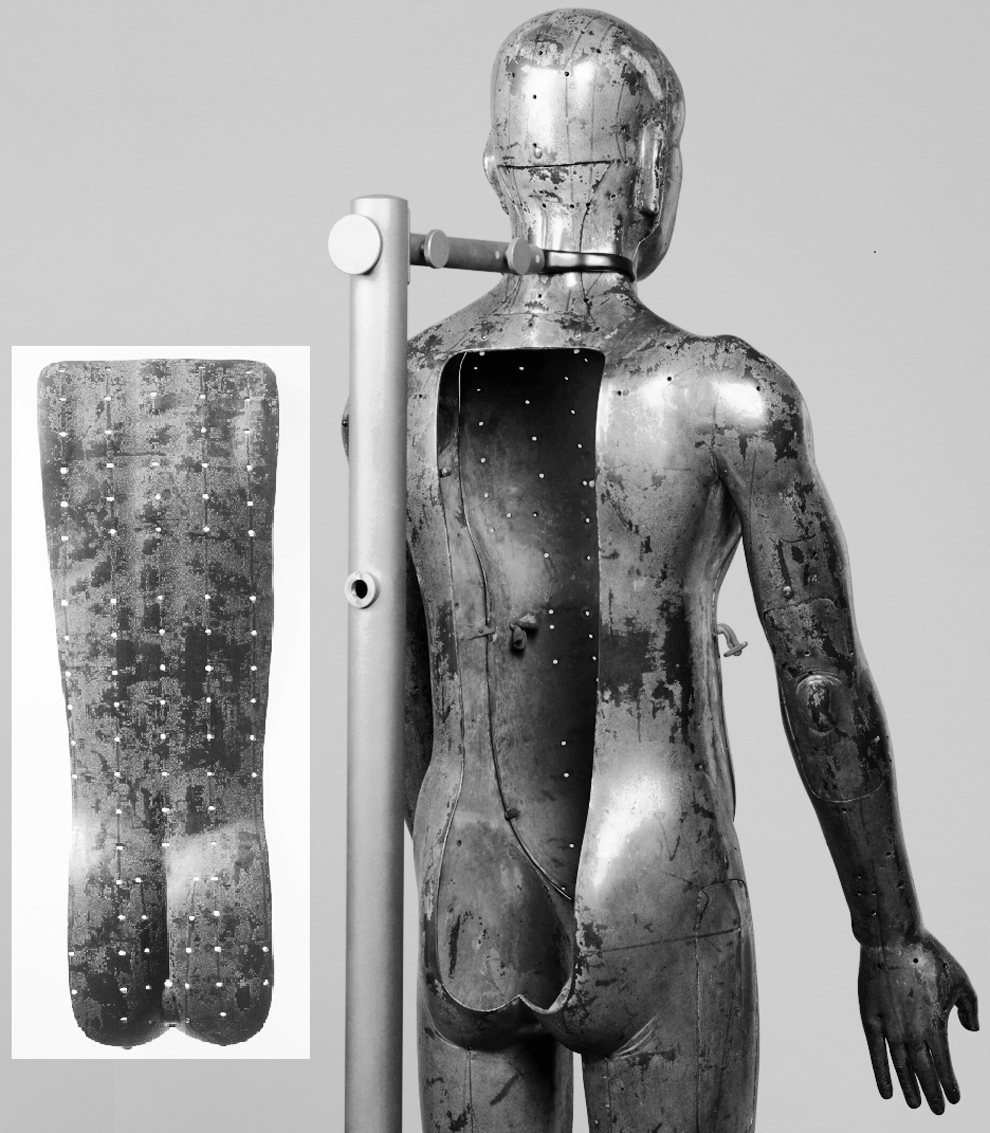
The interior space of the life-sized bronze acupuncture model can be seen after the backplate is removed. (Credit: The Tokyo National Museum with permission.)
The life-sized model has a removable torso plate and back plate that facilitate a view of the interior space (Fig. 1), and, therefore, it is rather reasonable to presume that the model was designed to explain the placement of acupoints and corresponding internal organs underneath if wooden anatomical organs were placed inside. If this was the case, educational purposes for diagnostic palpation and acupuncture safety could have been be achieved using the model as a 3-dimensional, hands-on learning tool.
1945—END OF THE PACIFIC WAR
Although acupuncture has been a traditional medicine in Japan for more than 1500 years, it was almost outlawed after the Pacific war. After being defeated in 1945, Japan was occupied by American-led Allied forces. Their general headquarters were formed in Tokyo under the command of General Douglas MacArthur (1880–1964
1950—ACUPUNCTURE MODERNIZED
In 1951, a Japanese physician—Yoshio Nakatani, MD, PhD (1923–1978
The Ryodoraku measurement can be used to differentiate the sites of acupoints from other skin areas (Fig. 2), but these sites do not always coincide with the classic acupoint locations. This means that the placements of acupoints could be individualized and can vary during diseases processes. 6 Ryodoraku treatment is performed by inserting an acupuncture needle to targeted acupoints and applying a direct current (adjustable 6–21 V, 10–200 μA) for 20 seconds or less. The short duration of this invasive electrical stimulation is based on it being sufficiently long enough to suppress a patient's pain and essentially short enough to minimize tissue electrolysis as a potential adverse effect. In short, Ryodoraku measurements and treatments are suitable to be used in a busy clinic or by clinicians who pay little attention to classic acupuncture and Oriental medical philosophy such as Yin–Yang and the Five Elements. 7
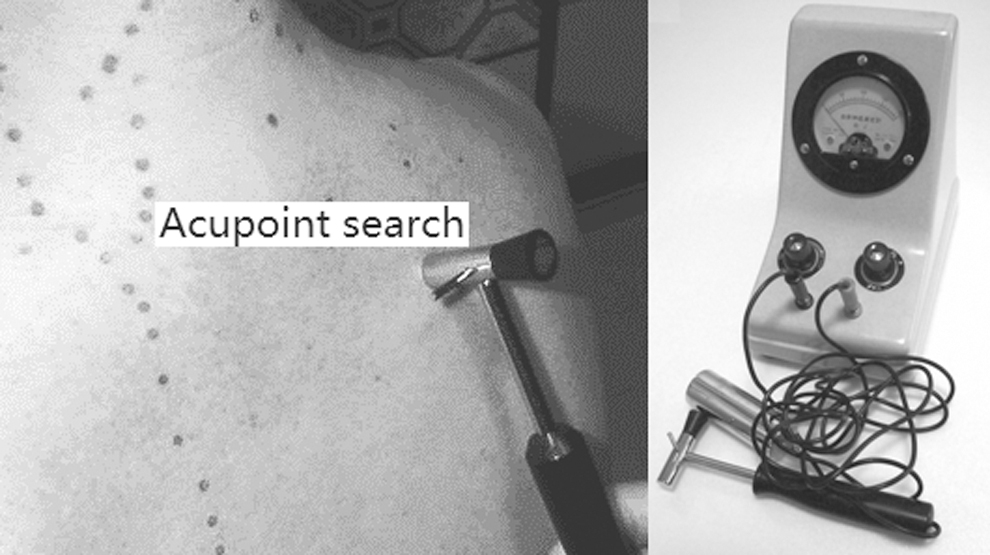
Ryodoraku measurement differentiates the sites of acupoints (dark spots) from adjacent skin areas.
1960s—EXPORT OF JAPANESE ACUPUNCTURE
After Ryodoraku acupuncture became a milestone of modernized acupuncture and was widely accepted by the Japanese medical community, in which 80% of physicians who practiced acupuncture used the Ryodoraku approach to treat various illnesses,
7
Dr. Takatani and his colleagues traveled abroad and exported Ryodoraku acupuncture to foreign countries in the 1960s. American physician James L. Rowland, OD, PhD (1917–2002

A handheld stimulating probe in which a noninvasive point electrode and a ring ground electrode form a bipolar circuit.
2021—ACUPUNCTURE MODAL AND RYODORAKU ACUPUNCTURE
Although there is no direct clinical relevance of the present article, knowing the past allows readers to appreciate the historical development of acupuncture and diversity of acupuncture styles. Recently, sales of life-sized and desktop acupuncture models have declined. Students are more keen to learn from acupuncture textbooks with colored anatomical graphs, relevant computer software, or smartphone apps.
Nearly 70 years has passed since Ryodoraku was devised in Japan—its core concept regarding the individualized and varying placements of acupoints during disease processes has become well-known to acupuncturists worldwide. Currently, standalone and computerized Ryodoraku devices are still being built and upgraded. Researchers also note that acupoint-searching using the parameter of skin resistance can help identify myofascial trigger points, 10 ; these points can be treated by means of an acupuncture needle with/without electricity, as well as modern modalities, such as laser and focused ultrasound. 11
Footnotes
AUTHOR DISCLOSURE STATEMENT
No financial conflicts of interest exist.
FUNDING INFORMATION
No financial support was received for this article.