




Abstract
Objective:
Pneumothorax is the most common serious complication of acupuncture and can be fatal. The aim of this research was to review publicly available documents from the California Acupuncture Board on pneumothorax after acupuncture.
Materials and Methods:
Searches for accusations involving pneumothorax filed against licensees were conducted on September 21, 2021, and on July 3, 2022.
Results:
Nine cases of pneumothorax were found for a timeperiod over 12 years. There was no evidence in any of the cases that precautions were taken to avoid pneumothorax. Two practitioners voluntarily surrendered their licenses, 6 were required to complete a court-ordered remediation program, and 1 received a public reprimand from the Board. The mean cost to the practitioners for investigation and enforcement was $7,868.35. None of the 9 patients were immediately referred to a physician by the practitioner as required by law.
Conclusions:
Patients are vulnerable to pneumothorax when acupuncture points between the shoulder blades are needled, as the distance from the skin to pleural surface is only 10–20 mm in this area. GB-21 should also be used with care, as this acupoint is close to the pleural apex. Using shorter needles, grasping the skin to retract the soft tissue away from the chest wall, and inserting needles at an oblique angle are techniques to minimize this possibility. If a patient has chest pain or shortness of breath during or after acupuncture, emergency services should be called to have the patient evaluated without delay.
INTRODUCTION
Acupuncture has been increasingly accepted in Western countries. For example, there was a fivefold increase in acupuncture for addressing female infertility in Great Britain during a 14-year interval. 1
In general, acupuncture is considered safe when performed by a well-trained practitioner using sterile needles.2,3 However, complications can occur, as acupuncture involves inserting thin needles through the skin into the underlying soft tissues.
Pneumothorax, or collapsed lung, is the most-frequent serious complication of acupuncture. 4,5 This happens when air leaks into the space between the lung and chest wall. 6 Pneumothorax is usually unilateral, but sometimes it is bilateral, which naturally puts a patient at increased risk.
California has about one-third of all the licensed acupuncturists in the United States. There are roughly 37,886 licensed acupuncturists throughout the country. 7 Pneumothorax is the most-common reason for malpractice settlements, according to the California Acupuncture Board. 8
The current author was asked to review several medicolegal cases of pneumothorax after acupuncture during <1 year. This prompted a review of publicly available information on other cases that might offer ways for practitioners to avoid this complication in the future.
MATERIALS AND METHODS
The CA.gov Department of Consumer Affairs Acupuncture Board website provides information regarding administrative disciplinary actions for immediate access and convenience for interested persons. 9 Searches for accusations filed against licensees involving pneumothorax were performed on September 21, 2021 and on July 3, 2022.
Unfortunately, neither the California allopathic nor osteopathic physician-licensing board websites provides similar applications for users to find this information.
RESULTS
These searches resulted in a total of 9 accusations against licensed acupuncturists from 2008 through 2020 (Table 1). There was no indication in the records of these cases that the patients were made aware of the possibility of pneumothorax caused by acupuncture prior to treatment.
California Acupuncture Board Enforcement Actions Involving Pneumothorax After Acupuncture
Acupuncture points were listed in the documents available for review in only 3 cases. There was nothing in any of the 9 cases indicating that the practitioner recorded the depth or angle of needle insertion. The most-common symptoms the patients had were chest pain with difficulty breathing, which had started during or shortly after treatment.
In none of these 9 cases was the patient immediately recognized as having a complication and referred to a physician. However, all of these individuals were ultimately evaluated and cared for at a hospital.
After the Board's accusations were filed, 2 practitioners voluntarily surrendered their licenses, 6 were required to go through court-ordered remediation plans with probation for 4 years, and 1 practitioner received only a public reprimand.
The California Acupuncture Board requires practitioners to reimburse the costs of investigation and enforcement if the practitioners' licenses are not surrendered. The mean cost to the practitioners was $7,868.35, with a range from $2,937.50 to $17,000.00 (Table 1). This amount is outside of attorney's fees to defend against the Board's enforcement action, legal costs for a malpractice lawsuit, and the cost to comply with the court-ordered multiyear remediation program.
DISCUSSION
According to the medical literature, many patients who have developed postacupuncture pneumothorax had needles placed in the upper back, most notably between the shoulder blades (Fig. 1).
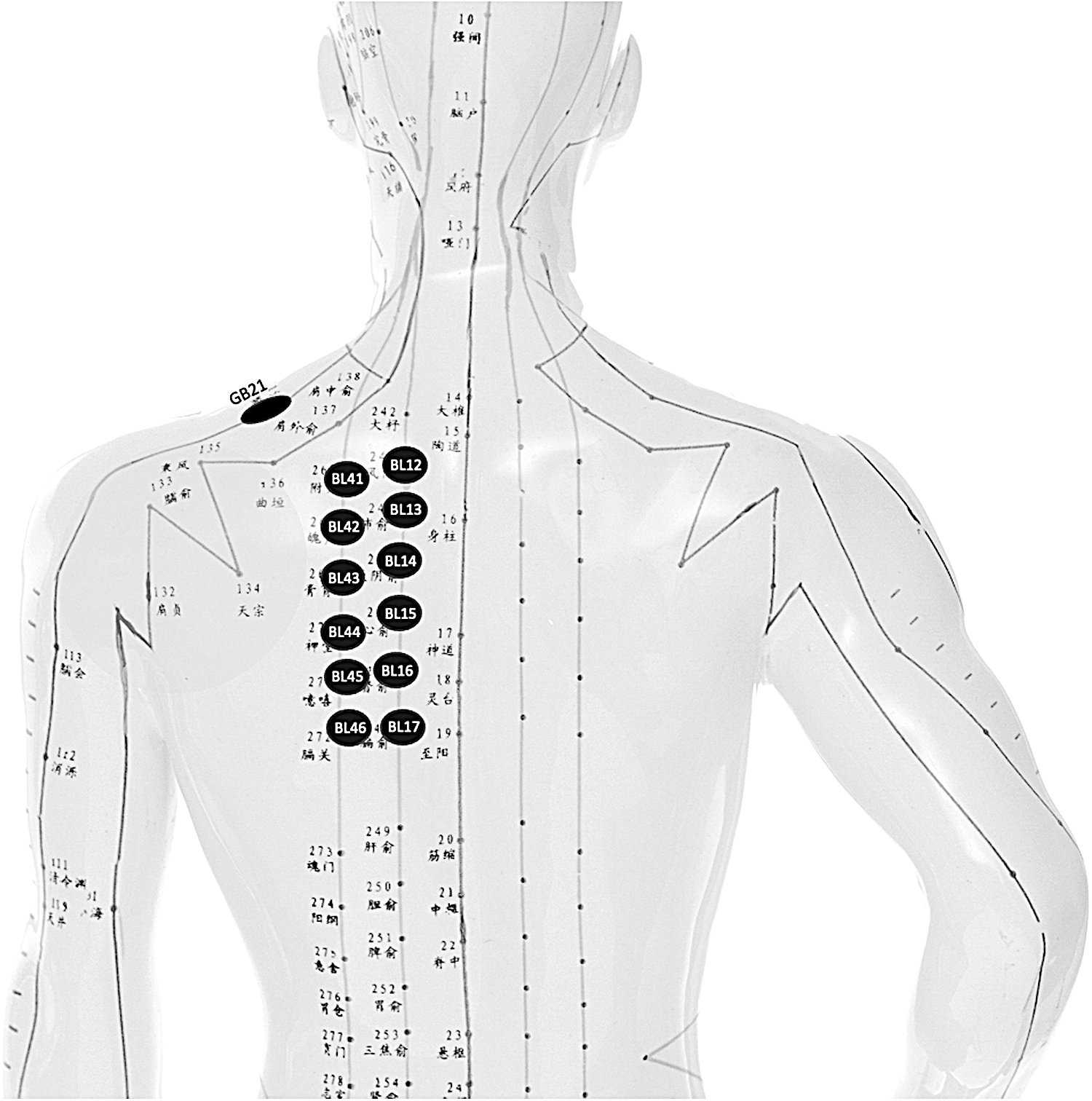
Acupuncture points BL-12- to BL-17 and BL-41 to BL-46 are between the scapulae and over the pleural surfaces. GB-21 is superior to the pleural apex.
A large study of several hundred thousand patients who had more than 5 million acupuncture treatments found that prior lung diseases correlated highly with pneumothorax. 10 These conditions included chronic bronchitis, asthma, and lung cancer. Patients who have hyperinflation from chronic obstructive pulmonary disease were also at increased risk of pneumothorax according to that study.
Techniques to minimize the risk of pneumothorax include: (1) using needles with short shafts; (2) grasping the skin gently between the thumb and index finger to raise the soft tissue away from the chest wall; and (3) inserting the needles obliquely.3,16
Small pneumothoraces may be managed conservatively, as long as patients have, at most, mild symptoms and are oxygenating normally. More often than not, however, larger or symptomatic pneumothoraces require chest-tube placements with constant wall suction, oxygen-saturation monitoring with possible supplementation, and hospitalization for several days.
The diagnosis of iatrogenic pneumothorax, such as after acupuncture, is often delayed 17 even if symptoms occur during treatment. Furthermore, some patients will not manifest symptoms until after leaving the office, so it is important to advise patients of this possibility and to instruct them to call emergency services immediately if this should happen. 16 In this series of 9 patients, none were referred immediately to a physician as required by California law. 18
Untreated pneumothoraces can be deadly. There have been at least 86 reported deaths from acupuncture complications; the majority of these were due to pneumothoraces. 19 A search for medical literature about possible long-term complications of patients who suffer iatrogenic pneumothorax did not yield any results.
CONCLUSIONS
Pneumothorax is the most common serious complication of acupuncture. All practitioners need to be aware of this possibility and should obtain informed consent from patients before beginning treatments. After reviewing several medicolegal cases of pneumothorax, these are the recommendations for practitioners:
* Consider whether a patient has a history of lung disease or is very thin, as both of these factors increase the risk of pneumothorax. * To reduce the risk of pneumothorax, when performing acupuncture between the shoulder blades or at GB-21, use shorter needles, lift the soft tissue away from the chest wall gently, and insert the needles obliquely. * If a patient has chest pain or shortness of breath, call emergency services so the patient can be evaluated without delay.
Footnotes
AUTHOR DISCLOSURE STATEMENT
No financial conflicts of interest exist.
FUNDING INFORMATION
This research was funded by the author.