




Abstract

Based on randomized clinical trials, acupuncture therapy has shown clinical efficacy for chronic musculoskeletal pain conditions and has gradually gained insurance coverage in North America.1,2 However, human studies did not reveal many physiologic mechanisms explaining the unknown aspects of acupuncture. Thus, laboratory-based or preclinical studies were performed in animal models to obtain the biologic evidence for acupuncture therapy before using it reliably on final targets—humans. Small animals, such as Sprague–Dawley or Wistar rats—with the mature rats weighing ∼250–400 g, the size of an adult human hand—were commonly used in preclinical acupuncture research.
Preferably, animal studies should apply acupoints that are anatomically equivalent to their locations in humans. 3 Mapping the precise location of needles at specific acupoints and the repeatability of doing so, including insertion placement/depth/angle, can affect experimental efficacy. The acupoint ST-40 is a good example that shows the limits of preclinical studies. This acupoint was commonly used in preclinical research in endocrinology or hepatology for measurable acupuncture outcomes. 4 For human subjects, it is quite easy to locate ST-40 if a subject performs ankle dorsiflexion actively that makes the lateral border of the tibialis anterior muscle observable or palpable. The needle is then inserted within the muscle on the anterolateral aspect of the lower leg (Fig 1A and B). 5
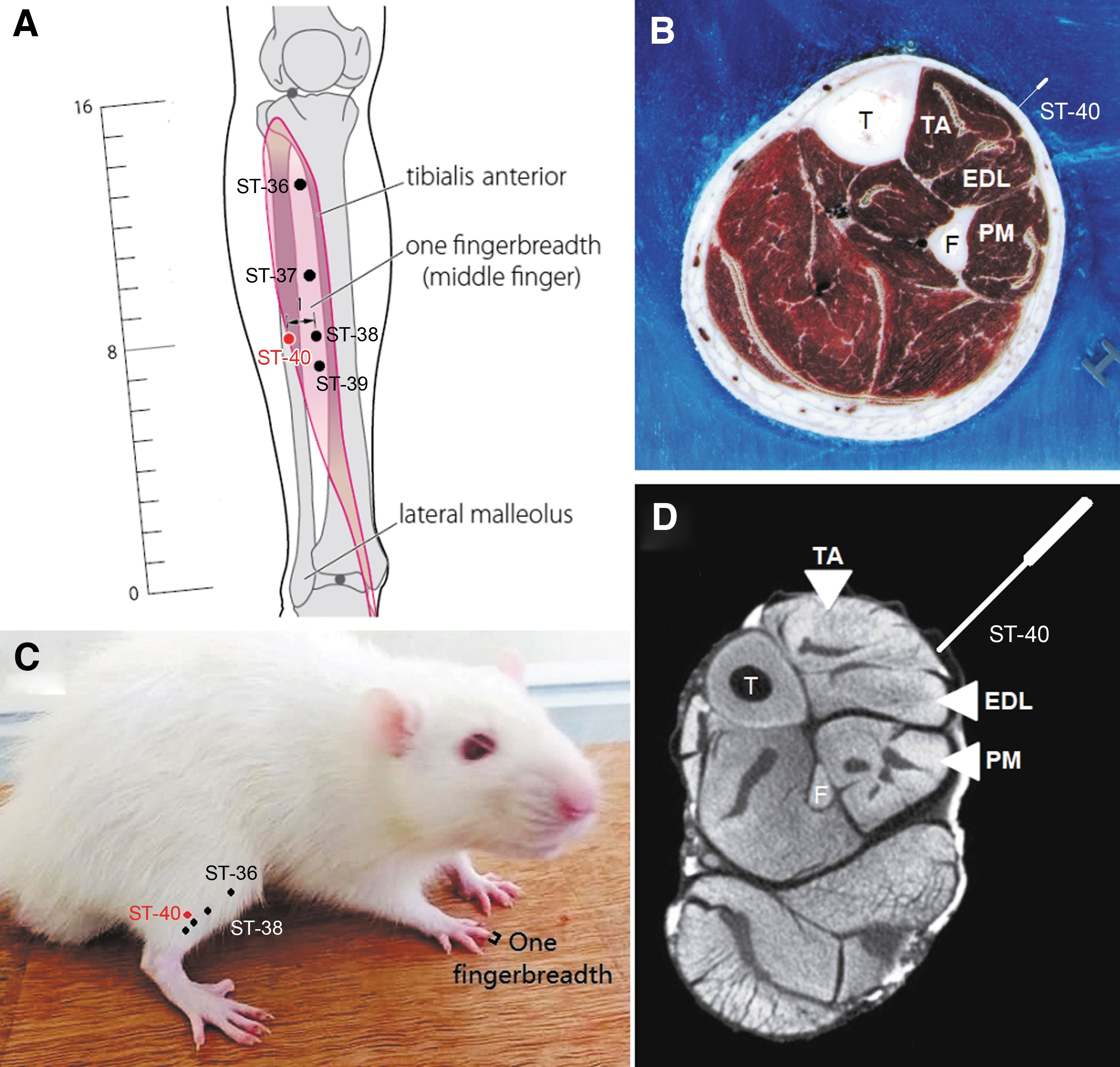
(A) World Health Organization standardized ST-40 placement in anterior view.
For animal studies, because acupuncture is repeated several times, locating the same acupoint every time is technically challenging when using the rats due to indistinguishable surface landmarks and researchers' palpations being ineffective on this small animal's leg muscles. Figure 1C illustrates a laboratory rat's surface placements of ST-40 and adjacent acupoints. Figure 1D outlines the transverse anatomical structures corresponding to the location of ST-40 and reveals a considerable margin of unintentional error in which the needle might be inserted into the extensor digitorum longus or peroneal muscles rather than the original, the target tibialis anterior. In other words, potentially imperfect needle placements lead to inconsistent and unpredictable neurologic stimuli; not to mention that a 0.20-mm acupuncture needle in the leg of a rat weighing only 400 g may be the equivalent of shoving a 5-mm nail into the leg of a human.
Acupuncturists may tend to believe experiments with animal models are predictive of acupuncture efficacy in human health care. We must not ignore animal–human species differences, and the external validity of preclinical experiments in which research findings derived from animals being applied reliably to humans may be questionable. 6 While we should interpret the preclinical findings with caution, we also should focus on human-relevant research methodology and technology that can show the advantages of acupuncture ultimately benefiting patients.