




Abstract
Objectives:
In sports, recovery after exercise is a very important process for athletes. Several studies have shown that the rate of an athletes recovery can be increased by several modalities, one of which is acupuncture. This study was conducted to learn how press-tack needle acupuncture reduces blood lactic-acid levels after sports students exercise.
Materials and Methods:
This was a randomized controlled trial. Twenty-four sports students were divided into 2 groups: (1) an acupuncture group (n = 12) and (2) a control group (n = 12). In each acupuncture group member press-tack needles were attached on PC-6 Neiguan and ST-36 Zusanli 30 minutes before doing high-intensity exercise. Measurement of lactic-acid levels was performed at 5 minutes and at 30 minutes after exercise.
Results:
The mean levels of lactic acid at 5 minutes after exercise in the acupuncture group were higher (p = 0.028), compared to the control group. The mean levels of lactic acid at 30 minutes after exercise in the acupuncture group was lower (p = 0.572) than in the control group. The mean reduction of lactic acid levels in the acupuncture group from 5 minutes after exercise to 30 minutes after exercise was statistically higher (p = 0.007) than in the control group.
Conclusions:
Press-tack needle acupuncture affects reduction of lactic-acid levels after high-intensity physical exercise. Further studies are needed to investigate the more-detailed biochemical mechanisms.
This trial was registered at ClinicalTrials.gov (ID: NCT04892784).
INTRODUCTION
Physical exercise is an activity engaged in to maintain health. In the world of professional sports, physical exercise is the main method of athletic development, because the higher the level of health and fitness of the athlete, the higher the ability to work physically to attain higher achievements. Various kinds of physiologic responses can occur after physical exercise, such as cardiovascular adaptation, initiation of an immune response, and fatigue and muscle pain due to exercise. 1
Many countries have tried to develop competitive advantages in sports by using various methods to increase the maximum performance of athletes with the hope of winning competitions. Developing effective methods to help athletes recover quickly from muscle fatigue after competing, and helping athletes achieve the best physiologic status is important, especially when athletes participate in international competitions. 2
Recovery after competing is a very important process for athletes. Athletes may compete more than once per day in a competition. Therefore, the ability to recover quickly is very important for athletes. Professional athletes often engage in high-intensity training, which increases lactic-acid in muscles. The accumulation of lactic acid in muscles is often associated with muscle fatigue. 3 The clearance rate of accumulated lactic acid is indicated by a decrease in the level of lactate in the blood, which is used as a criterion to assess the quality of an athlete's recovery rate. 4 Several studies have shown that the level of lactic-acid clearance associated with the athlete's recovery rate can be increased by several modalities, such as acupuncture, massage, active recovery, hyperbaric oxygen therapy, compression stockings, and stretching.
Acupuncture is a nonpharmacologic therapeutic modality that is performed by inserting fine needles in acupuncture points. 5 Punctures on acupuncture points can activate nerve fibers and peripheral afferent receptors, produce sensory interactions at various levels of the central nervous system, and release various transmitters and modulators, thereby producing anti-inflammatory, neuroendocrine, and neuroimmune signals. 6 Press-tack needle is a kind of acupuncture wherein a needle is attached on the skin and can be left in the skin for several days, making it much easier to use than conventional acupuncture. The purpose of this study was to determine how the immediate effect of press-tack needle acupuncture in reducing lactic-acid levels after physical exercise in sports students.
MATERIALS AND METHODS
This was a randomized controlled trial. This research was conducted at the Universitas Negeri Jakarta, Jakarta, DKI Jakarta, Indonesia, from September to December 2020. This research was approved by the Medical Research Ethics Committee of the Faculty of Medicine, Universitas Indonesia, Central Jakarta, DKI Jakarta, Indonesia (Ethical Approval No: KET/1471.UN2.F1/ETIK/ PPM.00.02/2020) and was also registered at ClinicalTrials.gov (ID: NCT04892784).
Participants
Twenty-four sports students in the same sport (futsal, a FIFA * -recognized form of indoor football), and who agreed to participate as subjects of this study, were randomized into 2 groups: (1) an acupuncture group (n = 12) and (2) a control group (n = 12), by using a computer-based random table. Inclusion criteria in this study were as follows: willingness to complete an informed-consent form; ages between 18 and 25; male; normal body mass index (BMI) value of 18.5–22.9 kg/m2; no history of injuries or history of surgeries on the lower extremities in the prior 3 months; and good health. Exclusion criteria were absence or refusal to be examined and not cooperative.
Procedure
Acupuncture was performed at bilateral PC-6 Neiguan and ST-36 Zusanli 30 points using a 0.20 x 1.2mm press-tack needle (SEIRIN,® New Pyonex, SEIRIN Corp., Shizuoka, Japan). The press-tack needle was attached to the acupuncture point 30 minutes before the physical exercise and left in place until the blood lactic-acid measurements were completed. Measurement of lactic acid using a lactic-acid meter (Accutrend® lactate meter, Roche, Mannheim, Germany) was performed at 5 minutes after and at 30 minutes after high-intensity physical exercise. In addition, heart rate (HR) measurements were also carried out 3 times: before (HR at rest), right after, and 30 minutes after high-intensity physical exercise. The HR before was taken while the athlete was at rest and it was confirmed that the subject had not carried out moderate-to-severe intensity physical activity 2 hours prior.
The high-intensity physical exercise carried out in this study was anaerobic physical exercise in the form of running on a 35-meter straight track at full speed for 6 rounds.
Data Analysis
Data analysis was performed using SPSS, version 25. Bivariate analysis was conducted to detect the mean difference between variables. The normality test used was the Saphiro–Wilk test, which shows distribution of the data. To analyze the effect of press-tack needle acupuncture for reducing lactic-acid levels in both groups, an independent t-test was used if the data were normally distributed, or the Mann–Whitney-U test was used if the data were not normally distributed. The significance of the test results was determined based on a p-value <0.05.
RESULTS
This research was conducted on 24 futsal sports students who agreed to participate as subjects in the study, by signing prior informed consents, and who were randomized into 2 groups: (1) treatment (acupuncture) group and (2) control group. Of the total research subjects, none of them were dropped or excluded, so all 24 subjects completed the study.
Table 1 shows the characteristics of the research subjects, based on several variables, namely age, weight, height, BMI, and HR at rest. Data descriptions, presented in tabular form, contains the means and standard deviations (SDs) for each group.
Basic Characteristics of Research Subjects
Mann–Whitney-U test.
Independent t-test.
yrs, years; BMI, body mass index, HR, heart rate.
Table 1 shows that the variables age, weight, height, BMI, and HR of research subjects did not appear to be significantly different (p-value >0.05), which indicates that, before the treatment, the 2 groups were equal.
Description of Mean Lactic-Acid Levels
Data on lactic-acid levels was assessed twice—at 5 minutes after and at 30 minutes after each subject did high-intensity physical exercise. Table 2 presents an overview of these data (means and SDs) on lactic-acid levels in both groups.
Mean Lactic-Acid Levels in the 2 Groups
Independent t-test.
Mann-Whitney-U test.
min, minutes.
Table 2, shows that the lactic-acid levels at 5 minutes after exercise in the treatment group was significantly higher than those in the control group (p-value 0.028; independent t-test analysis). However, at 30 minutes after, the treatment group's mean lactic-acid levels were lower than those the control group (p-value 0.572; independent t-test analysis). From the value of the reduction in lactic-acid levels from 5 minutes after to 30 minutes after, the reduction in lactic-acid levels in the treatment group was significantly greater than that in the control group (p-value 0.007; Mann–Whitney-U test analysis).
In Table 3, the mean-lactic acid levels from 5 minutes after to 30 minutes after in both groups, respectively, were significantly decreased, using a paired t-test analysis.
Mean Reductions in Lactic-Acid Levels from 5 Minutes After to 30 Minutes After
Paired t-test.
min, minutes.
Description of Mean HR
HR data were assessed 3 times: before exercise, right after exercise (0 minutes), and 30 minutes after exercise. Normality testing with the Saphiro–Wilk test showed that the data were normally distributed (p > 0.05). Table 3 shows an overview of these data (means and SDs) of HRs in both groups.
In Table 4, the HR before or HR at rest was not significantly different between the 2 groups (p-value 0.626). The HRs at 0 minutes or right after high-intensity physical exercise were not significantly different between the 2 groups (p-value 0.924). However, at 30 minutes after, the treatment group's HRs were lower than those the control group (p-value 0.007).
Mean Heart Rates in Both Groups
Independent t-test; between the 2 groups.
HR, heart rate; min, minutes.
Adverse Effects
In this study, there was no significant adverse effects when the press-tack needle acupuncture was performed. There were no hematomas or infections at the puncture sites. The adverse effect found was that 2 subjects felt a little pain or discomfort when the press tack needle was inserted, but that pain disappeared within a few seconds and the subjects felt no need for analgesics.
DISCUSSION
This study examined the immediate effect of press-tack needle acupuncture for assisting recovery in athletes, as assessed by lactic-acid levels and HRs after physical exercise. The physical exercise carried out in this study was high-intensity physical exercise, with the intention that the metabolism that occurred was anaerobic metabolism, so that lactic-acid buildup occurred. Physical exercise was in the form of running on a 35-meter straight track at full speed for 6 round trips. It was intended that each subject would use energy with anaerobic metabolic sources so that there would an increase in the levels of lactic-acid in his blood. The kind of exercise that requires high-intensity in a relatively short time, the predominant energy system is anaerobic exercise. Lactate is a byproduct of glucose uptake by muscle cells. The higher the glucose input into cells, the higher the production of lactate will be; and it is known that lactate is a waste product of anaerobic exercise. It has been stated that short-term high-intensity physical exercise can produce blood lactate levels up to 25 mmol/L, and this is the factor that plays the largest role in causing fatigue.3,7
The acupuncture points selected for this study were PC-6 Neiguan (Fig. 1) and ST-36 Zusanli (Fig. 2), 8 according to acupuncture points used in a study conducted by Tandya et al. (in 2018), 9 who studied the effect of manual acupuncture for reducing lactic-acid levels after physical exercise by performing 12 sessions of manual acupuncture at both points. That study had indicated that the decrease in postworkout lactic-acid levels was greater in the acupuncture group than in the control group. The current study was performed to learn what would occur if manual acupuncture was changed to use of press-tack needles.
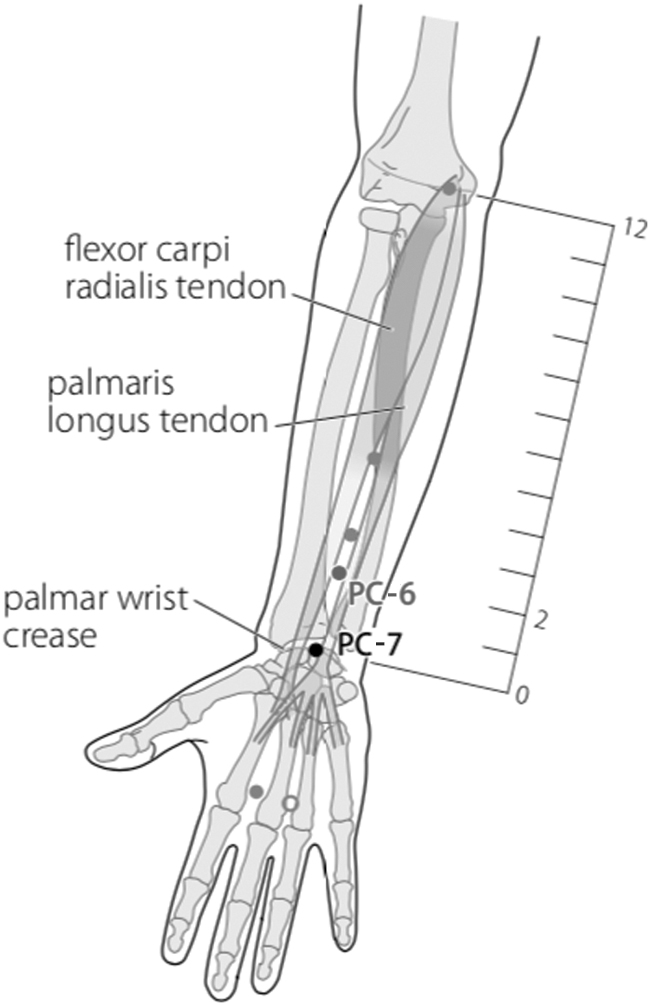
PC-6 Neiguan. 8 Source: World Health Organization (WHO). WHO Standard Acupuncture Point Locations in the Western Pacific Region. Manila: WHO; 2008.
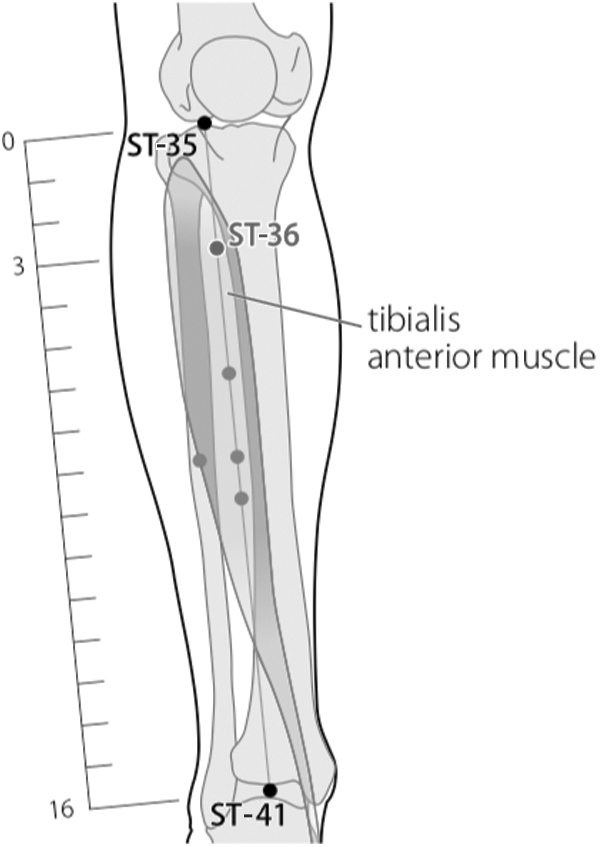
ST-36 Zusanli. 8 Source: World Health Organization (WHO). WHO Standard Acupuncture Point Locations in the Western Pacific Region. Manila: WHO; 2008.
An analysis of the difference in the mean reduction in lactic-acid levels from 5 minutes after to 30 minutes after showed that the reductions in lactic-acid levels in the acupuncture group were significantly greater than those in the control group (p-value = 0.007). This suggests that the press-tack needle affects reduction of lactic-acid levels after physical exercise, which means that acupuncture may help speed recovery after high-intensity physical exercise. Based on the evidence that acupuncture at PC-6 Neiguan and ST-36 Zusanli points can increase blood flow, this can cause a faster recovery. 9
According to review by Gladden, it was stated that stimulation of the ST-36 Zusanli point can increase blood flow by modulating nitric-oxide (NO) production. 10
In addition, a study by Wadsworth concluded that PC-6 Neiguan, concluded that PC-6 Neiguan and ST-36 Zusanli can stimulate NO release, resulting in increased blood flow. 11 NO has several functions, including regulating blood vessels and blood flow. 9 Acupuncture can also restore the body's homeostatic function and improve the body's physiologic balance. 12
Research by Lin et al. concluded that electroacupuncture on PC-6 Neiguan and ST-36 Zusanli after exercise can increase the clearance rate of sarcolactic acid. In addition, acupuncture at PC-6 Neiguan and ST-36 Zusanli can reduce resting HR and carbon-dioxide production.2,12,13
This current study's results are in line with research conducted by Lin et al. (in 2009). 2 In that study, 30 professional basketball athletes were randomized into 3 groups: (1) an acupuncture group; (2) a placebo group; and (3) a control group (n = 10 athletes in each group). Manual acupuncture on PC-6 Neiguan and ST-36 Zusanli was performed 15 minutes before the subjects exercised with on a bicycle ergometer. Lactic acid levels in that study measured at 5 minutes did not show a significant difference between the 3 groups (p-value >0.05), meanwhile lactic-acid levels at 30 minutes and 60 minutes after exercise were lower in the acupuncture group than in the other 2 groups (p-value <0.05).
One of the studies by Lin et al. (in 2011) conducted a study on 24 professional basketball athletes who were divided into 2 groups: an acupuncture group and a control group. This study used ear points, namely Shen Men, Heart, Lung, Liver, Sanjiao, Adrenal Cortex, and Endocrine points, which were used in the treatment given 30 minutes before exercise with an ergometer bicycle and continued until the training was complete. The subjects' lactic acid levels measured at 30 minutes after exercise were lower in the acupuncture group than in the control group (p-value <0.05).
The limitation of the current study is that the measurements of body composition analysis— such as total body water, body fat mass, and muscle-fat analysis—were not carried out. However, BMI was used as an inclusion criteria, whereas, theoretically, it is known that lactic-acid level is correlated with muscle mass. In addition, the number of subjects was relatively small in this study.
CONCLUSIONS
Based on the results of this study, press-tack needle acupuncture at bilateral PC-6 Neiguan and ST-36 Zusanli affects reduction of lactic-acid levels after high-intensity physical exercise. Further studies are needed to investigate the more-detailed biochemical mechanisms on how lactic-acid levels decrease. In addition, further research can be performed by minimizing confounding variables that might affect the results, such as kinds of sport and kinds of competition levels followed by sports students.
Footnotes
ACKNOWLEDGMENTS
The authors would like to thank the Faculty of Sports Science, of the Universitas Negeri Jakarta, Jakarta, DKI Jakarta, Indonesia, for providing funds for this research. Thank you also to the Somatokinetic Laboratory FIO UNJ, the sports-club students, and all of the individuals who helped this research. This trial was registered at  (ID: NCT04892784).
AUTHORs' CONTRIBUTIONS
Dr. Djaali led the study's conceptualization and writing the article's original draft, and had a supporting role in scientific feasibility testing, which was led by Dr. Mighra. Dr. Mighra supported the study's conceptualization and writing the article's original draft. Dr. Nurdin led the statistical analysis of the data and Dr. Setiakarnawijaya led the study's methodology. All authors participated equally in writing, reviewing, and editing this article.
AUTHOR DISCLOSURE STATEMENT
No financial conflicts of interest exist.
FUNDING INFORMATION
As mentioned in the Acknowledgments, the Faculty of Sports Science, at the Universitas Negeri Jakarta, funded this research.