




Abstract
Objective:
Stroke is a leading cause of death and disability worldwide. To find ways to reduce behavioral disabilities, researchers study animal models. By targeting ST-36 (Zusanli) and SP-9 (Yinlingquan), this study investigated the effects of traditional acupuncture and electroacupuncture (EA) on motor behavior in gerbils following global cerebral ischemia.
Materials and Methods:
Thirty-six male gerbils were randomly assigned to 6 groups (n = 6 in each): control (C); sham-surgical (S); ischemia (I); acupuncture (Ac); EA (Ea); and sham-EA (SEa). The animals were habituated in an activity cage (AC) 72 hours before surgery. After induction of global ischemia, the Ac, Ea, and SEa groups received bilateral stimulation at ST-36 and SP-9. In the Ea group, an alternating electrical current was used. The animals were tested in the AC 4 days after surgery, and the results were analyzed by Kruskal-Wallis, followed by Dunn's posthoc test.
Results:
Statistical analysis revealed increased distance traveled and sensors triggered by the I, Ea, and SEa groups, compared to the C, Ac, and S groups. The animals' movement tracks had a similar pattern between the I and Ea groups, with increased exploration along the walls of the AC. Meanwhile, the Ac, S, and SEa groups explored the AC similarly to the C group.
Conclusions:
These findings suggest that acupuncture may normalize motor behavior in gerbils with ischemia and could be a promising treatment for stroke-induced motor deficits.
INTRODUCTION
Stroke is a cerebrovascular disorder that affects ∼15 million people yearly and is one of the leading causes of death and disability in adults. 1 There are 2 types of stroke: hemorrhagic stroke, which occurs after a blood vessel ruptures and is less-common, representing ∼27% of cases, and ischemic stroke, which accounts for ∼73% of all stroke cases. 2 Ischemic stroke occurs when there is a sudden development of a neurologic deficit caused by permanent or transient reduction of blood flow to the brain.2,3
Cerebrovascular diseases such as ischemic stroke involve lesions in several regions that result in the loss of essential brain activities in areas responsible for functions such as memory and motor coordination. 4 Using animal models allows researchers to advance understanding of stroke disabilities and to test the effects of drugs and rehabilitation techniques that can be accessed through behavioral examination.5–7
Due to its simplicity, one of the most commonly used animal models for cerebral ischemia is the 2-vessel occlusion model in Mongolian gerbils (common carotid-artery occlusion). This species of animal lacks the circle of Willis and has a vulnerability between the anterior and posterior cerebral circulation, which means that interruption of blood flow through the carotids can cause injuries in regions such as the CA1 of the hippocampus and the striatum.3,8 In addition to the morphologic damage, the main sequelae caused by global ischemia are dysfunctions in exploratory and motor behavior, which can be investigated through behavioral studies.3,9
Behavioral studies are critical for assessing locomotor activity and are among the most-valuable tools for characterizing the impact of global ischemia and potential therapies in animal models. One of the primary methods used for this purpose is the activity cage (AC), similar to the open-field test. 10 The AC is a widely used behavioral test for evaluating motor activity and anxiety by recording the movements and behaviors of animals within an arena.
In the AC test, prior habituation to the testing environment tends to decrease exploratory behavior in subsequent sessions. During habituation, animals explore the environment more extensively as they become familiar with it. However, with repeated exposures, their exploratory behavior gradually decreases as they habituate to their surroundings. 11
In animal models, such as gerbils, ischemia-induced damage to the hippocampus has been observed to result in increased exploratory behavior during the AC test. The hippocampus is crucial for spatial learning, memory, and exploratory behavior. Consequently, ischemic injury can lead to heightened exploratory activity when the hippocampus is affected. 12
Furthermore, control animals, who do not experience ischemic injury, in these studies typically exhibit reduced locomotion in the AC test. This decrease in locomotion can be attributed to the absence of a motivating factor for exploration in the familiar environment. Given that the control animals have no underlying ischemic damage, they may display lower levels of exploration as there is no need to engage with the environment actively.11,13
Acupuncture and electroacupuncture (EA) are tools commonly used in Traditional Chinese Medicine and are frequently recommended as therapies for stroke due to their potential benefits for reducing motor symptoms. 14 These poststroke treatments commonly use acupoints, such as ST-36 (Zusanli), LI-11 (Quchi),14,15 and GV-20 (Baihui), 16 to modify motor and behavioral symptoms resulting from global cerebral ischemia.
There still needs to be more consensus in the scientific literature regarding the benefits and adverse effects of acupuncture and EA after brain ischemia. Although most studies show significant benefits, such as improved motor function and neurologic functions such as learning and memory, the underlying associated mechanisms still need to be elucidated fully.14,15,17
To understand the effects of acupuncture and EA in 2-vessel models of global ischemia, this study investigated the effects of traditional acupuncture and EA on ST-36 and SP-9 (Yinlingquan) through the behavioral patterns of ischemic gerbils.
The hypothesis was that acupuncture and EA treatments would standardize exploratory behavior and motor activity in the gerbils, compared to ischemic gerbils who did not receive acupuncture or EA.
MATERIALS AND METHODS
Ethical Approval
The procedures for handling animals and their care conformed to the guidelines that comply with the Committee on Ethics in Animal Experimentation of the University of São Paulo and the Brazilian College of Animal Ethics in Research (registered protocol no.: 109/2018). Furthermore, to reduce animal suffering and minimize the number of animals used, the current authors adopted the recommendations for experimental design reported in the ARRIVE guidelines (replacement, refinement, and reduction) for animals used in research. 18
Experimental Animals
Thirty-six male gerbils (Meriones unguiculatus; Rodentia; Gerbillinae), weighing between 65 g and 80 g and ages ∼70 days, were housed in polypropylene cages in a colony room of the Laboratory of Neuropsychobiology and Motor Behavior of the Medicine School of the University of São Paulo, Ribeirão Preto, São Paulo, Brazil, at 23°C ± 1°C and on a 12-day cycle (lights on at 7:00
Groups
The animals were randomly divided into 6 groups (each: n = 6) to ensure equal distribution: a control group (C) who did not receive any intervention; a sham-surgical (S) group who did not receive any intervention; an ischemic (I) group who did not receive any intervention; an ischemic group who received traditional manual acupuncture (Ac); an ischemic group who received EA (Ea); and an ischemic group who received sham EA (SEa).
Experimental Protocol
The animals were habituated to the AC 72 hours before surgery was performed to produce brain ischemia. In the AC, animals were allowed 5 minutes of free exploration. The second exploration was allowed on the fourth postsurgical day when the animals were evaluated for 15 minutes. Habituation reduces hyper-exploration of gerbils in new and unknown environments. Hippocampus function in retaining spatial information can also be analyzed during habituation. 11
Induction of Cerebral Ischemia
Each gerbil was intraperitoneally anesthetized with 60 mg/kg of Zoletiltm (Virbac, São Paulo, Brazil). After observing a reflex loss, in the I, Ac, Ea, and SEa groups, the animals' bilateral common carotid arteries were isolated and occluded using a silk suture line (3-0 Prolene®; Shalon) for 5 minutes. The surgical field was irrigated with sterile sodium chloride during this procedure to prevent tissue dehydration. A visual check was performed to ensure proper occlusion of the carotid arteries and subsequent cutoff of blood flow to the brain. Only animals who showed bilateral ptosis—a sign of ischemia—were used in the study. The sham-surgical animals underwent the same surgical procedures without occluding the common carotid arteries.
Acupuncture and EA Treatment
After the surgical procedure with the animals under anesthesia, ST-36 and SP-9 (Yinlingquan) were punctured bilaterally on the hind limbs of the gerbils in the Ac, Ea, and SEa groups, using a disposable sterile stainless-steel acupuncture needle (0.18 × 8 mm, Dongbang Medical, Seoul, Republic of Korea).
In the Acupuncture (Ac) group, needles were inserted without a tube, using a snapping technique without rotating the needles. The needles were left in the acupoints for 20 minutes. In the EA (Ea) group, an alternating electrical current was applied using an electrostimulator device (WQ-IOD1, Haidian District Donghuan Electronic Instrument Factory, Beijing, China), powered by an 8-Volt battery, with a frequency of 20 Hz (f1: 20 Hz; f2: 20 Hz), for 20 minutes. Alligator-clip electrodes were used with the active pole (negative) placed in ST-36 and the passive pole (positive) in SP-9.
The sham-EA (SEa) group underwent the same protocol without electrical stimulation.
Note that, in a gerbil, ST-36 is located 5 mm beneath the capitulum fibulae and lateral posterior to the knee joint on the contralateral side. In contrast, SP-9 is located in the lower depression of the tibial plateau.
Behavioral Evaluation in the AC
The EP 149 model of the AC (Insight Ltda, São Paulo, Brazil) is a square arena of 46 cm (length) × 46 cm (width) × 34 cm (height) that is elevated 50 cm above the ground. The apparatus is powered by 127/220 Volts and a 1A power-supply voltage. It has 4 parallel horizontal infrared beams with 16 sensors that send electrical impulses to a microcomputer via a USB [universal serial bus] connection. These impulses are processed by software to interpret recorded behaviors. The AC monitors animal movements in 3 axes: width; height; and depth. This enables the software to identify locomotion and crossing behaviors. Locomotion refers to the distance traveled in cm within the AC, while crossings refer to the number of infrared beams triggered within the AC. In addition, the infrared beams enabled tracking of the animals' trajectories during the experiment, making it possible to visualize their displacement patterns in lines on the AC. 19
Before the surgical procedure, each animal was individually placed in the center of the AC and tested for 5 minutes on the 3 days leading up to the surgery. On the fourth day following the surgery, the gerbils were again placed individually in the center of the arena, and a 15-minute test session was recorded. After each test session, the AC was thoroughly cleaned to ensure proper hygiene. 7
After the experiment, the data collected were converted into spreadsheet data in both .txt and Excel® formats. Following ethical guidelines, the animals were euthanized at the study's conclusion, using an anesthetic overdose of Zoletil (180 mg/kg).
Statistical Analysis
The behavioral data on locomotion and crossings (sensors triggered) were analyzed using nonparametric Kruskal-Wallis, followed by Dunn's posthoc test. GraphPad Prism 6.0 software was used for all statistical analyses, and a P-value <0.05 was considered statistically significant.
RESULTS
The statistical analysis of the behavioral responses from the AC test showed that the I group traveled a more-significant distance, compared to the C, Ac, and S groups, which was a clear indication of a hippocampal lesion in the I group (Fig 1A). Furthermore, regarding the number of crossings, the I, Ea, and SEa groups had higher numbers of sensors triggered than the C, Ac, and S groups (Fig 1B).
The animals' trajectory tracks revealed similar patterns between the I and Ea groups, with greater exploration of the walls of the AC. The C, Ac, S, and SEa groups showed distinct movement patterns throughout the AC (Fig. 2).
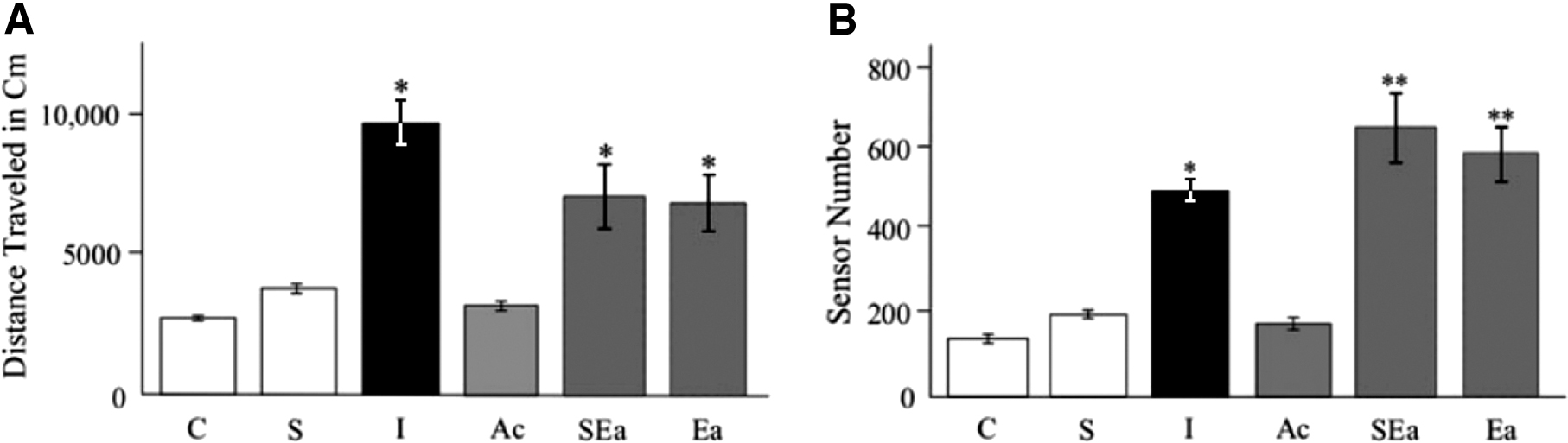
Behavioral responses on the activity monitor:
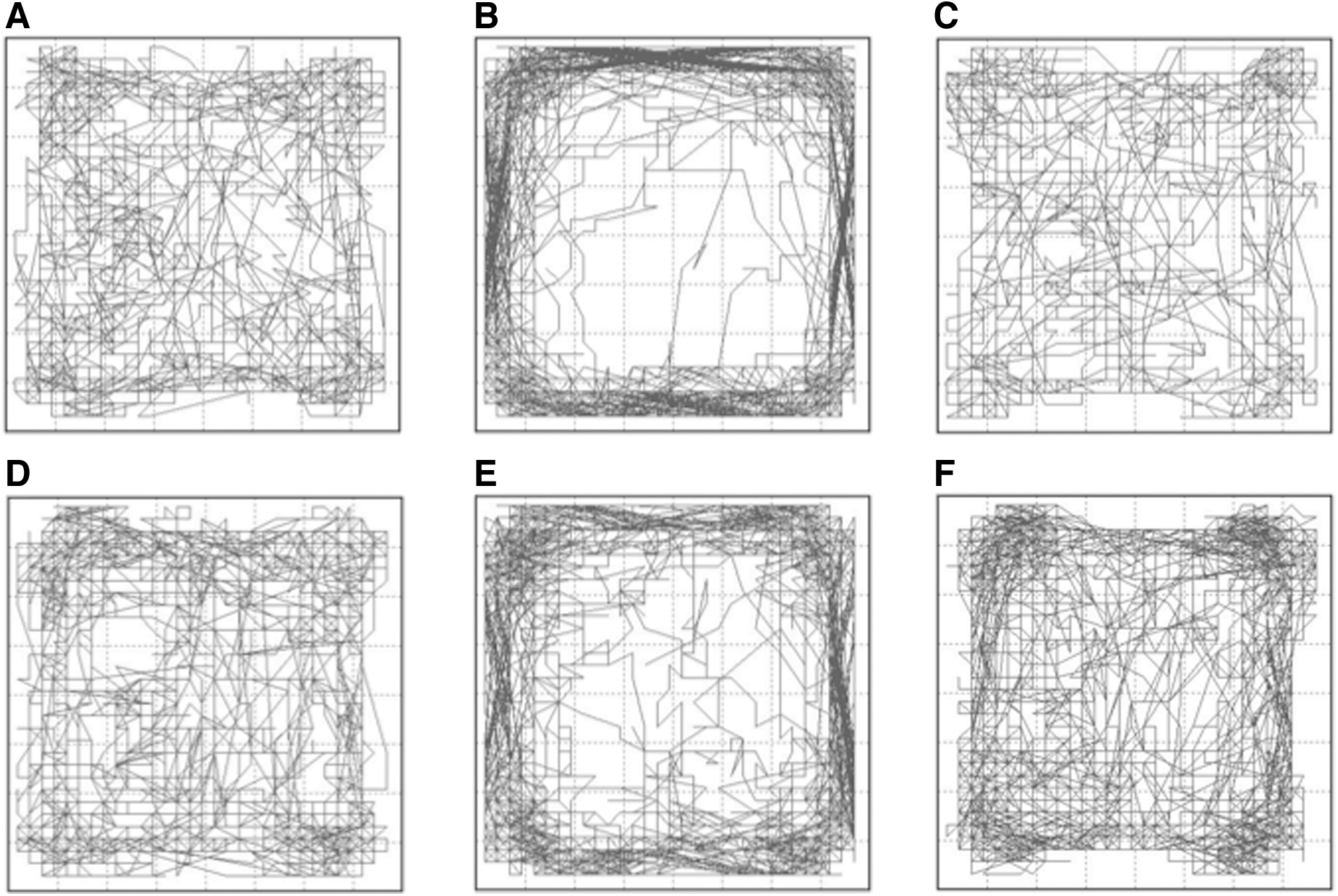
Patterns of animal explorations. Solid black lines represent the animals' trajectories during their stay in the activity cage. The dashed black lines represent the virtual quadrants drawn by the infrared beams. Groups are:
Data Access
The data supporting this study's findings are available from the corresponding author upon reasonable request.
DISCUSSION
This study compared and investigated potential differences in the effects of EA and traditional acupuncture at ST-36 and SP-9 on ischemic gerbils' behavioral and motor patterns. It was predicted that acupuncture and EA would produce standardized effects, resulting in less behavioral and motor activity variability than the ischemic gerbils.
This study investigated the behavioral impairments induced by cerebral ischemia. The behavioral changes observed in ischemic animals were used to validate the efficacy of the surgical procedure. Other studies also utilized this experimental model of ischemic injury to test drugs that can interfere with the pathologic events triggered by ischemia.
To achieve this study's goal, a carotid artery occlusion model was used in gerbils. Gerbils are particularly susceptible to cerebral ischemia due to the lack of a circle of Willis. This global ischemia model produces selective damage in the CA1 regions of the hippocampus, striatum, and M1 regions of the motor cortex, all of which are involved in processes related to memory and learning.6,7,9,11
The injury to the CA1 region of the hippocampus played a critical role in the observed behavioral responses of the ischemic gerbils in the AC. This was also the reason for the previous habituation in the behavioral test. Specifically, the analyzed behaviors were related to the animals' curiosity to explore what seemed to them to be a new environment.11,17
On the day of the test, after habituation in the AC, the control group showed a standard exploration of the familiar environment upon reexposure to the test, as evidenced by the distance traveled and the photocells triggered, compared to the ischemic group. However, the ischemic animals showed greater exploration behaviors because those animals had no memory of the habituation session.10,20,21
Using this specific method of inducing cerebral ischemia in gerbils, it has been possible to study the effects of behavioral rehabilitation techniques, such as physical exercise and magnetic fields.6,19 Other studies using different models of brain injury have shown that acupuncture and EA can promote neuron growth, increase brain-derived neurotrophic factor expression, and reduce neuronal apoptosis.14,22,23
Contrary to this study's initial hypothesis, acupuncture had a positive effect on the behavior of ischemic animals, whereas EA did not. This could have been due to the early onset and high intensity of the stimulus used in the EA group, which may have led to the lack of results observed.
Electrical stimulation can increase excitatory signaling and metabolism in brain tissue, exacerbating the underlying pathologic processes already occurring in the penumbral zone. The penumbral zone is an area surrounding the ischemic region, where blood flow is compromised, and viable neurons are at risk. Indeed, this possibility has been reported for early initiation of treadmill training and excessive use of injured limbs.6,24–26 Notably, the group experiencing ischemia and sham electrical stimulation had similar behavioral patterns. One plausible reason for this could be that the electrode caused mechanical stimulation through tissue traction, activating the mechanism due to its weight on the needle.
The absence of results in the EA group may be attributed to the electrostimulation parameters used in this study. In a review study, Huang et al. highlighted various electrostimulation parameters utilized in research on brain ischemia. Stimulation may occur prior to, and following, ischemia at different intervals. The electrical pulses can be either continuous or sparse–dense, with frequencies ranging from 2 Hz to 50 Hz and the total stimulation time being between 20 and 30 minutes. 27
One study utilizing gerbils and immediate EA after brain ischemia showed results contradicting the current ‘study's findings. In this research, a frequency of 20 Hz for 20 minutes was applied; conversely, Pang et al.'s study utilized a frequency of 7 Hz for 30 minutes. 28 The higher frequency utilized in the current study could explain the absence of results in the EA group. Supporting this concept, Zhou et al. also reported a lack of positive effects when maintaining the stimulation for 45 minutes while noting positive effects within groups subjected to 5, 15, and 30 minutes of stimulation. 29 This evidence reinforced the importance of establishing optimal stimulation parameters to mitigate the impacts of brain ischemia.
The current study showed that traditional acupuncture, which involves needle insertion without stimulation, had a similar effect on the behavior of animals both with and without ischemia. In addition, another study showed that acupuncture applied to GV-26 for 60 seconds every 12 hours for 72 hours reduced overactivity of large-conductance calcium ion–activated potassium channels in CA1 neurons of the hippocampus after cerebral ischemia–reperfusion. 30
Traditional acupuncture produced positive results, while EA and sham acupuncture did not, possibly due to the intensity and duration of stimulation provided after ischemia. This research showed that 20 minutes of EA or intense mechanical stimulation had harmful effects. Yao et al. conducted study that yielded positive results using EA for just 10 minutes twice daily over 72 hours. 31
One potential limitation of the current study was the absence of morphologic data, which could have provided more insights into the quality of the neural substrate underlying the observed behaviors. Nevertheless, this limitation was mitigated by the robust behavioral data acquired using validated behavioral models, supporting the conclusions.
The second potential limitation of this study was the accurate localization of acupoints in gerbils. Due to their small size and proximity, ensuring precise acupoint localization in gerbils can be challenging. There was the possibility of inaccuracies in pinpointing the exact locations of the acupoints, and this raises questions about potential cross-stimulation of neighboring acupoints near SP-9 and ST-36. In the context of EA, the proximity of these points in small animals such as gerbils poses challenges and may lead to unintended effects. Additional research is required to examine the neural mechanisms and various time frames and frequencies of electrostimulation to understand better the consequences of acupuncture and EA following cerebral ischemia.
Extrapolating animal study results directly to humans can be challenging. While animal models can provide valuable insights into biologic processes and potential therapeutic interventions, there are biologic and physiologic differences between animals and humans. Animal studies can provide preliminary evidence and inform further investigation, but careful interpretation and cautious extrapolation to human populations are necessary.
CONCLUSIONS
According to this study, traditional acupuncture with needle insertion and stimulation can help maintain the behavior of ischemic animals similar to that of non-ischemic control animals. Furthermore, it is noteworthy that the EA treatment with the parameters used in this study and the sham-EA produced no significant effects. The researchers believe that the amount and intensity of stimulation immediately after ischemia may have been the reason for this outcome.
Footnotes
ACKNOWLEDGMENTS
The authors would like to thank the São Paulo Research Foundation (FAPESP) for the financial support of the research throught the undergraduate research scholarship program.
AUTHORs' CONTRIBUTIONS
Dr. de Araujo conceptualized this project and acquired funding for it. Dr. Bertolino conducted the formal analysis. Drs. Zhang, Gallon Pitta, and de Mello Rosa were responsible for the methodology and investigation as well as writing the article's original draft. All of the authors critically revised, read, and approved the final version of this article.
AUTHOR DISCLOSURE STATEMENT
No financial conflicts of interest exist.
FUNDING INFORMATION
The São Paulo Research Foundation (FAPESP) supported this research throught a scholarship grant to Dr. Zhang (grant 2019/06286-0) and Dr. Pitta (grant 2019/07817-9).